Key Points
- Permanent Traffic Ban: Camden Council officially confirmed on Tuesday, October 27, 2026, that Camden High Street will permanently ban motor vehicles following an 18-month trial period.
- Exemptions: Emergency service vehicles, council refuse vehicles, essential maintenance access, and northbound cyclists remain exempt from the restrictions.
- Pedestrian Scope: The motor-traffic-free zone covers the section from the junction with Parkway and Kentish Town Road (Britannia Junction) up to the junction with Jamestown Road and Hawley Crescent.
- Safety & Air Quality Improvements: Data gathered by Camden Council showed zero traffic collisions within the pedestrian zone during the trial (down from 6 collisions and 8 casualties in the previous year), alongside a 14.4 per cent reduction in nitrogen dioxide ($NO_2$) levels.
- Crime Reduction: Metropolitan Police data revealed noticeable drops in anti-social behaviour, pickpocketing, and other criminal offences without evidence of crime shifting to surrounding side streets.
- Public Consultation Results: A formal public consultation showed that 57 per cent of overall respondents supported the permanent change, with 51 per cent of local residents approving. However, 40.9 per cent of respondents expressed opposition due to concerns over traffic displacement and public bus journey delays.
- Infrastructure Upgrades: Permanent retractable bollard systems will replace temporary barriers starting in early 2027, supported by a £1 million investment in local street care and Community Safety Officer patrols.
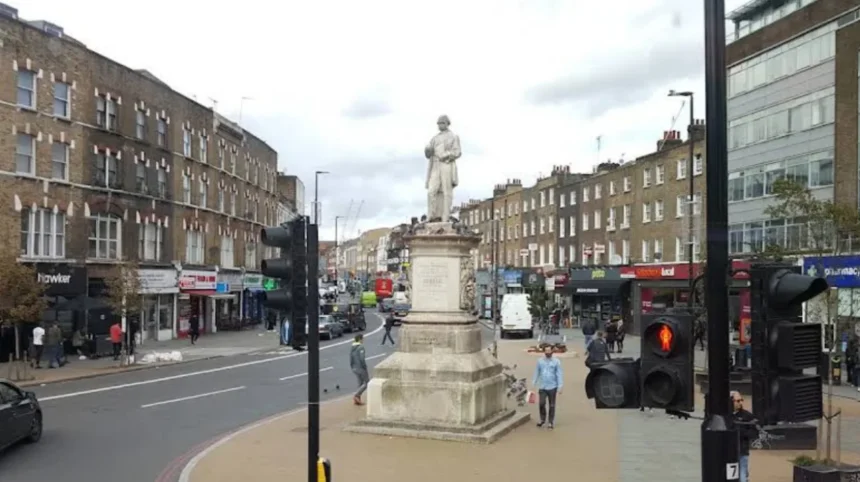
Camden (North London News) October 30, 2026 — Camden High Street, one of London’s most famous and heavily foot-trafficked shopping thoroughfares, has officially banned motor vehicles on a permanent basis following the conclusion of an 18-month trial. Banning general traffic along the central strip between Britannia Junction and Hawley Crescent, Camden Council confirmed that the measures will take effect immediately before the existing Experimental Traffic Order expires on November 1. The decision follows a similar city-wide push towards active travel, coming just days after the pedestrianisation of Oxford Street in central London.
- Key Points
- What specific statistical evidence convinced Camden Council to make the scheme permanent?
- How did local residents and local business owners respond to the public consultation?
- What are the long-term physical and infrastructural changes planned for Camden High Street?
- What is the background of this particular development?
- Prediction: How will this permanent development affect local stakeholders?
As reported by Josef Steen of the Local Democracy Reporting Service (LDRS) for The Evening Standard, Councillor James Slater, executive member for planning—who is scheduled to assume the role of Camden Council Leader in November—stated that the trial had successfully tackled street overcrowding and improved air quality. Slater described Camden Town as “an internationally recognised destination that draws people in from across London, the rest of the UK and the world,” emphasizing that the removal of vehicles successfully prevented pedestrians from “overspilling” into dangerous live lanes of traffic.
What specific statistical evidence convinced Camden Council to make the scheme permanent?
According to official council documents and research detailed by Katie Forge of Secret London, data collected over the course of the 18-month experimental scheme demonstrated measurable gains in both environmental quality and public safety.
As reported by Ground News and local municipal health records, atmospheric nitrogen dioxide ($NO_2$) levels along the primary high street stretch plummeted by 14.4 per cent during the trial run. Furthermore, Camden Council records confirmed there were zero vehicle-related traffic collisions recorded inside the pedestrianised section during the trial, compared to six collisions resulting in eight casualties during the preceding 12-month period before the trial was introduced.
Police figures cited by the local authority also highlighted a drop in street crime. Incidents of pickpocketing, anti-social behaviour, and opportunistic theft fell significantly within the motor-free area, with monitoring data confirming that crime had not merely displaced into nearby residential side streets.
How did local residents and local business owners respond to the public consultation?
As highlighted by Natalie Wilson of The Independent, public consensus surrounding the pedestrian zone showed a clear split between local visitors and residents.
In the official public consultation results released by Camden Council, 57 per cent of total respondents supported making the trial permanent. When isolating local residents living in the immediate vicinity, approval stood at 51 per cent. Overall, 52.9 per cent of respondents stated they liked or strongly liked the alterations, while 6.2 per cent held a neutral stance.
However, opposition to the permanent scheme remained notable. As noted by Josef Steen of the LDRS, 40.9 per cent of overall consultation respondents expressed disapproval. Approximately 43 per cent of local residents and nearby business operators who opposed the measure voiced strong disapproval, citing elevated noise levels, longer journey times for private vehicles, and driver impatience leading to speeding along surrounding diversion routes.
What are the long-term physical and infrastructural changes planned for Camden High Street?
As detailed by news reports from MyLondon, Camden Council estimates the administrative cost of converting the experimental order into a permanent traffic order at approximately £10,000.
To replace the temporary water-filled plastic barriers and temporary signage used throughout the experimental period, permanent mechanical bollard systems—similar to those implemented along Strand Aldwych in central London—will be installed starting in early 2027.
Additionally, the council confirmed an investment package including a £1 million allocation dedicated to funding Community Safety Officer patrols and routine street washing. Bus services towards Chalk Farm will continue using permanent diversions via Kentish Town Road and Hawley Crescent, supported by dedicated bus lane trial improvements along Kentish Town Road to preserve public transit reliability.
What is the background of this particular development?
Camden High Street, which welcomes roughly 250,000 visitors every week, has historically suffered from acute sidewalk congestion, particularly during weekend market hours when crowds routinely overflowed onto active roadways.
The decision to test pedestrianisation was initially launched by Camden Council in May 2025 as part of its broader active travel, climate action, and borough-wide transport strategy. The initial 18-month trial sought to rebalance road space away from private motor vehicles to lower local carbon emissions, support local trade, and prevent pedestrian injuries along the tight corridor connecting Camden Town Underground Station to the Camden Lock market area.
Following positive preliminary trial data in late 2025 and early 2026, Camden Council opened a formal borough consultation during the summer of 2026 to gauge opinion on both the permanent closure of the initial stretch and the potential future expansion of the traffic-free zone further north towards Chalk Farm Road. The decision to establish a permanent pedestrian zone arrives as part of a wider trend across Greater London, where municipal authorities are increasingly restricting private motor vehicles along core commercial high streets to meet regional air quality standards.
Prediction: How will this permanent development affect local stakeholders?
Impact on Retailers, Market Traders, and Hospitality Businesses
For local retailers, food vendors, and hospitality venues situated directly within the pedestrianised zone, the permanent removal of traffic is anticipated to maintain steady footfall and expand outdoor commercial space. Council expenditure data during the 18-month trial showed that consumer spending inside the car-free zone remained stable during both day and evening periods. The transition to permanent infrastructure will allow businesses to apply for permanent outdoor seating licenses and street-spillout permits, encouraging longer visitor dwell times. However, businesses reliant on quick vehicular deliveries or specialized servicing will need to permanently adapt to designated off-street loading windows and side-street loading bays.
Impact on Local Residents and Commuters
For local residents living along Camden High Street, the reduction in motor traffic delivers permanently cleaner air and lower night-time traffic noise. Conversely, residents situated on secondary residential roads—such as Hawley Road and Castlehaven Road—may experience continued pressure from displaced vehicular traffic and re-routed commercial transport. Public transport commuters relying on local bus routes will continue navigating altered stops and diverted routes along Kentish Town Road. Meanwhile, pedestrians and cyclists will gain safer, continuous north-south links through one of London’s most heavily congested cultural districts.