Clerkenwell, in central north London, is closely associated with London’s printing industry because it developed into an important centre for commercial printing, engraving, publishing, book production and political publishing during the nineteenth century. Its proximity to Fleet Street, Farringdon, Holborn and the City of London connected local printers with newspaper publishers, booksellers, businesses and commercial customers.
- What Made Clerkenwell an Important Centre for London’s Printing Industry?
- How Did Clerkenwell’s Location Support Printing Businesses?
- Why Did Printing Become an Established Local Trade?
- When Did Clerkenwell Become Associated With Printing and Publishing?
- What Happened to Printing Businesses During the Victorian Period?
- How Extensive Was Printing Activity in Clerkenwell?
- What Types of Printing Businesses Operated in Clerkenwell?
- Commercial Printers and Publishers
- Engraving and Lithography Workshops
- Book and Periodical Production
- Pamphlet and Political Printing
- How Did Clerkenwell Green Become Connected With Radical Publishing?
- What Was the Twentieth Century Press?
- What Was the Connection Between Clerkenwell and Lenin?
- Why Is Marx House Important to Printing History?
- How Did Printing Technology Transform Clerkenwell’s Businesses?
- How Did Letterpress Printing Work?
- How Did Lithography Improve Printing?
- What Was the Role of Typesetters and Printing Workers?
- How Did Mechanisation Change the Industry?
- Why Was Printing Education Important in Clerkenwell?
- What Was the Guild and Technical School?
- How Did Printing Education Develop?
- What Skills Did Printing Schools Teach?
- What Role Did Clerkenwell Play in London’s Commercial Development?
- How Did Printing Support London’s Business Community?
- How Did Printing Connect With Publishing and Distribution?
- What Was the Connection Between Clerkenwell and Fleet Street?
- How Did the Printing Industry Affect Clerkenwell’s Workers and Local Communities?
- Why Did Clerkenwell’s Traditional Printing Industry Decline?
- How Did the Newspaper Industry Change During the 1980s?
- What Was the 1986 Wapping Dispute?
- How Did Digital Publishing Change Clerkenwell?
- What Can Visitors Explore Today to Discover Clerkenwell’s Printing Heritage?
- Can Visitors Visit the Marx Memorial Library?
- What Is There to See Around Clerkenwell Green?
- Is St Bride Foundation Worth Visiting?
- Can Visitors Explore London’s Historic Newspaper District?
- How Does Clerkenwell’s Printing Heritage Influence the Area Today?
The district’s printing heritage reflects London’s wider industrial and commercial development. Printing businesses supplied books, newspapers, religious publications, maps, advertisements, pamphlets and specialist printed materials. Small workshops operated alongside larger production premises, creating a network of skilled workers and supporting businesses.
Clerkenwell also became associated with radical publishing and working-class political movements. Printing premises around Clerkenwell Green and Farringdon Road produced publications that circulated political ideas, organised communities and supported social campaigns.
Today, historic buildings, surviving institutional collections and the area’s cultural organisations preserve this connection. Visitors exploring Clerkenwell encounter a district where printing, publishing, design, education and London’s commercial history developed together.
What Made Clerkenwell an Important Centre for London’s Printing Industry?
Clerkenwell became an important printing centre because of its central location, established skilled trades, affordable industrial premises and proximity to London’s publishing markets. These conditions attracted printers, engravers, publishers and book-related businesses, creating a concentrated network of commercial printing activity.
Clerkenwell’s industrial development was closely connected to its geographical position. Located immediately north of the historic City of London, the district offered convenient access to commercial customers, transport routes, warehouses and established business districts.
The neighbourhood also benefited from its proximity to Fleet Street, which became London’s principal newspaper and printing centre. While Fleet Street developed a strong identity around national newspapers and journalism, Clerkenwell supported a wider range of printing activities.
These included commercial printing, book production, engraving, lithography, pamphlet printing and the production of printed materials for religious and political organisations.
How Did Clerkenwell’s Location Support Printing Businesses?
Clerkenwell occupied a strategic position between several important commercial districts.
- Fleet Street: The historic centre of London’s newspaper publishing industry.
- Farringdon: An established commercial and industrial area with convenient transport connections.
- Holborn: A centre for legal services, offices, bookselling and professional businesses.
- The City of London: London’s financial and commercial centre, generating demand for printed documents, business stationery and publications.
This geographical relationship allowed printing businesses to serve customers across central London.
Printers also benefited from nearby suppliers and skilled tradespeople. Bookbinders, engravers, typesetters, paper merchants and publishers contributed to the wider production network.
Why Did Printing Become an Established Local Trade?
Printing required specialist equipment, trained workers and reliable access to customers. Clerkenwell offered an environment where these requirements could be met.
The district already had a history of manufacturing and skilled craftsmanship. Its workshops and commercial premises supported businesses that needed space for machinery, materials and manual production.
During the nineteenth century, expanding literacy, commercial advertising, religious organisations and political movements increased demand for printed materials.
Clerkenwell’s printing businesses responded to this demand by producing publications for different markets rather than concentrating exclusively on national newspapers.
When Did Clerkenwell Become Associated With Printing and Publishing?
Clerkenwell’s printing trade expanded significantly during the nineteenth century, although London’s printing history began much earlier. By the Victorian period, local workshops around St John’s Square, St John’s Lane and Clerkenwell Green had developed into an established network of printing and engraving businesses.
The history of printing in London stretches back to the introduction of movable-type printing in England during the fifteenth century.
In 1476, William Caxton established England’s first printing press using movable type at Westminster. His work helped establish commercial printing as an important part of English literary and commercial life.
Following Caxton’s death, his apprentice Wynkyn de Worde developed the business and moved his printing operation to the churchyard of St Bride’s Church in 1500.
This move strengthened the relationship between Fleet Street and the printing trade. It also established a long-standing connection between printing, publishing and the professional communities of central London.
Clerkenwell developed its own distinct printing identity later, particularly during the expansion of Victorian manufacturing and commercial publishing.
What Happened to Printing Businesses During the Victorian Period?
The nineteenth century transformed London’s printing industry.
Population growth, expanding education, increased literacy and the development of mass newspapers created demand for printed materials.
Clerkenwell’s printing businesses produced a diverse range of products, including:
- Books and booklets, including commercial and educational publications.
- Periodicals and newspapers, including religious and political publications.
- Maps and engravings, including illustrated geographical and artistic materials.
- Pamphlets and leaflets, including campaign literature and public information.
- Commercial stationery, including business forms, labels and advertisements.
The district’s printing businesses were not all large newspaper operations. Many specialised in smaller commercial commissions and specialist production.
Historical research published through the Survey of London documents how printing trades expanded beyond their earlier concentration around St John’s Square and St John’s Lane before 1850.
The industry subsequently spread towards Clerkenwell Green, where printing-related premises became increasingly prominent.
How Extensive Was Printing Activity in Clerkenwell?
Historical research provides a useful indication of the industry’s concentration.
By 1939, printing trades occupied approximately one-third of premises around Clerkenwell Green. By 1946, the proportion had increased to approximately half.
These figures demonstrate the importance of printing to the area’s commercial identity during the first half of the twentieth century.
The local trade included specialist engravers, commercial printers and publishers rather than simply the large newspaper operations traditionally associated with Fleet Street.
This distinction explains why Clerkenwell’s printing history deserves separate attention when examining London’s industrial development.
What Types of Printing Businesses Operated in Clerkenwell?
Clerkenwell supported several specialist printing businesses, including commercial printers, book producers, engravers, lithographers and political publishers. These businesses served religious organisations, commercial companies, publishers and campaign groups, making the district an important centre for London’s wider printing economy.
The printing industry in Clerkenwell was diverse. Different businesses specialised in particular stages of production, from preparing illustrations to printing finished publications.
Commercial Printers and Publishers
Commercial printers produced documents for businesses, institutions and private customers.
Their work included invoices, letterheads, advertising materials, product labels, catalogues and business stationery.
London’s growing commercial economy created regular demand for these services. Businesses needed printed materials to communicate with customers, maintain records and advertise products.
Clerkenwell’s position near the City of London made it a convenient location for commercial printing operations.
Engraving and Lithography Workshops
Engraving and lithography were important specialist trades.
Engraving involves cutting designs or text into a hard surface, such as metal or wood, to create a printable image. Lithography is a printing process based on the principle that oil and water repel each other.
These techniques allowed printers to produce detailed illustrations, maps, decorative images and commercial artwork.
The presence of specialist engravers helped establish Clerkenwell as more than a location for ordinary text printing.
Book and Periodical Production
Book and periodical production connected printers with London’s expanding reading public.
Periodicals included regularly published magazines, journals and newspapers. Religious publications, educational materials and political journals also formed part of the local printing economy.
Printers worked with publishers, editors, writers and distributors to prepare material for circulation.
Pamphlet and Political Printing
Political printing was another important part of Clerkenwell’s identity.
Printers produced campaign literature, political journals, socialist publications and trade union documents.
These publications helped political organisations communicate with supporters and circulate arguments about workers’ rights, economic conditions and social reform.
The area’s connection with radical publishing became particularly visible around Clerkenwell Green.
How Did Clerkenwell Green Become Connected With Radical Publishing?
Clerkenwell Green became associated with radical publishing because political organisations established printing operations and meeting spaces nearby. During the late nineteenth and early twentieth centuries, socialist publications, campaign literature and international political journals circulated from local premises.
Clerkenwell Green is a historic public space surrounded by buildings with connections to London’s political, religious and industrial history.
Its importance to printing developed partly through the area’s established network of workshops and publishers.
Political organisations recognised the value of having direct access to printing facilities. They could produce newspapers, distribute information and communicate with supporters without relying entirely on commercial publishers.
What Was the Twentieth Century Press?
The Twentieth Century Press was a publishing and printing business established in Clerkenwell during the 1890s.
In 1893, the Social Democratic Federation (SDF), a British socialist political organisation, established the press at 37a Clerkenwell Green.
The business printed Justice, the SDF’s weekly newspaper, alongside other socialist and progressive publications.
William Morris, the British designer, writer and socialist, helped guarantee the enterprise’s early rent.
The press expanded into neighbouring premises as its activities developed. Its location made Clerkenwell Green an important address in the history of socialist publishing.
What Was the Connection Between Clerkenwell and Lenin?
Clerkenwell also has a documented connection with Vladimir Lenin, the Russian revolutionary and political writer.
Between April 1902 and May 1903, Lenin worked in a shared upstairs office at Marx House, then associated with the Twentieth Century Press.
He edited Iskra, a Russian-language revolutionary newspaper. The publication was printed at the building before copies were transported and distributed clandestinely in Russia.
According to the Society for the Study of Labour History, 17 issues of Iskra were printed there during 1902–1903.
This connection demonstrates how Clerkenwell’s printing facilities served international political networks as well as local commercial customers.
Why Is Marx House Important to Printing History?
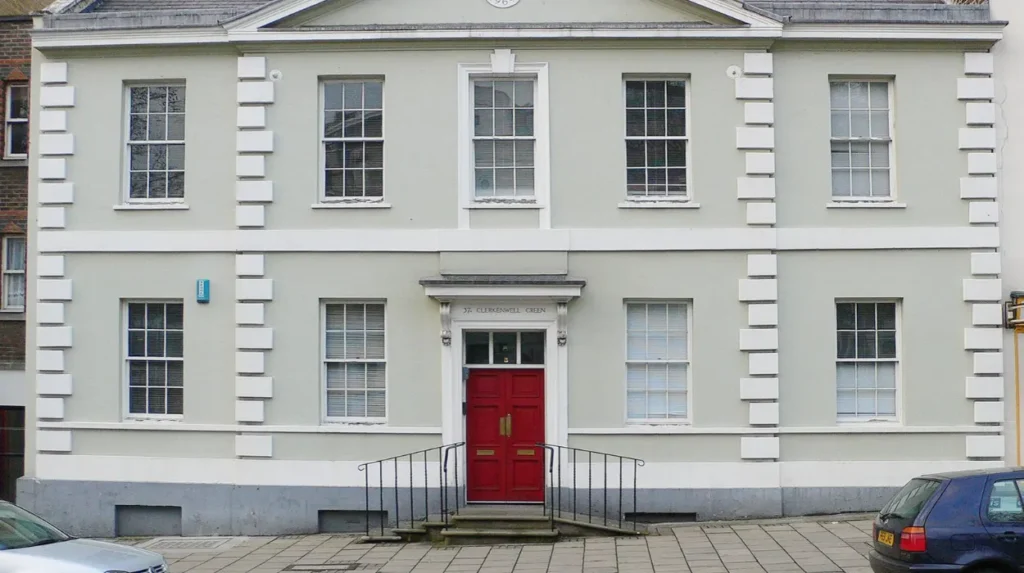
Marx House at 37a Clerkenwell Green is an important surviving location associated with radical publishing and working-class history.
The building dates from 1738 and originally served as a school for Welsh children in London.
Its later use by the Twentieth Century Press connected the property with socialist publishing. It subsequently became the home of the Marx Memorial Library and Workers’ School, established in 1933.
The Marx Memorial Library preserves documents relating to political movements, workers’ organisations and the history of printing.
For visitors interested in London’s industrial and political heritage, Marx House provides a direct connection with the people and organisations that used printing to circulate ideas.
How Did Printing Technology Transform Clerkenwell’s Businesses?
Printing technology transformed Clerkenwell by increasing production capacity, improving image reproduction and changing the skills required from workers. Letterpress printing, lithography, engraving and later mechanical and electronic systems allowed businesses to serve expanding commercial and publishing markets.
Printing was not a single process. It involved different technologies that developed over several centuries.
The changes affected production costs, working conditions, the speed of manufacturing and the range of materials printers could produce.
How Did Letterpress Printing Work?
Letterpress printing was one of the most important traditional printing methods.
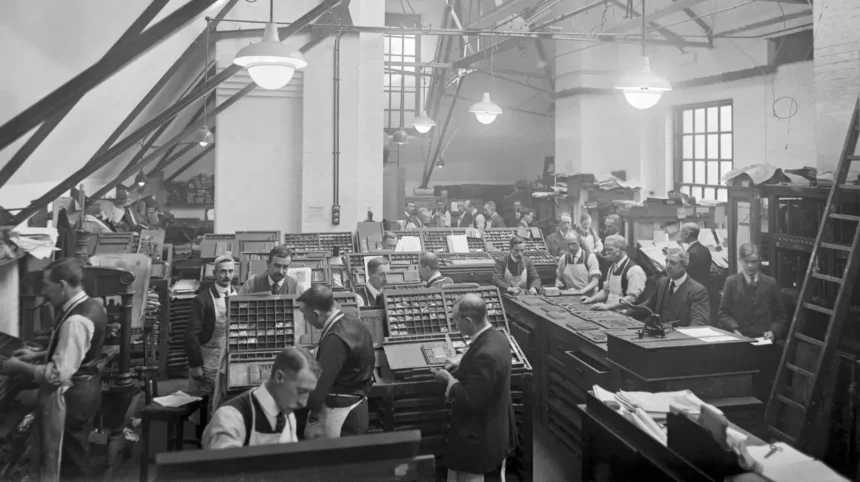
It uses raised surfaces carrying ink to transfer text and images onto paper. Printers arranged individual metal or wooden letters into lines and pages, secured them in a frame and applied ink before pressing paper against the type.
The process required specialist knowledge of typography, composition and machine operation.
Letterpress remained important for newspapers, books, commercial stationery and other printed products.
How Did Lithography Improve Printing?
Lithography introduced a different method of reproducing images and text.
Invented by Alois Senefelder in the late eighteenth century, the process made it easier to reproduce detailed illustrations and artwork.
Lithographic printing became valuable for producing posters, maps, illustrations and commercial advertising.
Clerkenwell’s specialist engraving and lithography businesses benefited from growing demand for visually detailed printed materials.
What Was the Role of Typesetters and Printing Workers?
Printing depended on a skilled workforce.
Typesetters arranged individual characters into readable lines and pages. Compositors prepared text for printing, while press operators managed the machinery.
Other workers handled paper, ink, illustrations, binding and finishing.
These occupations required technical training and experience. Errors in typesetting, ink application or paper alignment affected the quality of the finished publication.
The concentration of specialist workers helped establish printing as an important skilled industry in Clerkenwell.
How Did Mechanisation Change the Industry?
Industrial printing machinery increased the speed and volume of production.
Mechanical presses reduced the time required to produce large quantities of printed material. Improved typesetting systems also helped newspapers and publishers prepare lengthy publications more efficiently.
The development of Linotype machines introduced another major change.
The Linotype machine, developed by Ottmar Mergenthaler in the nineteenth century, allowed operators to cast complete lines of type mechanically rather than arranging every individual character by hand.
This technology became particularly important in newspaper production.
By the twentieth century, printing businesses increasingly adopted more automated systems, changing the relationship between traditional craft skills and industrial production.
Why Was Printing Education Important in Clerkenwell?
Printing education became important because technological changes required trained engravers, lithographers, compositors and machine operators. Local educational institutions provided practical instruction, improved professional standards and helped printing workers adapt to increasingly specialised production methods.
The printing industry depended on more than machinery and commercial premises. It needed workers who understood the technical processes involved in producing accurate and consistent printed materials.
During the nineteenth century, professional organisations recognised the importance of formal technical education.
Clerkenwell became part of this educational development through institutions established to support printing-related occupations.
What Was the Guild and Technical School?
The Guild and Technical School was established on 2 October 1893 by the National Society of Lithographic Artists, Designers and Writers, Copperplate and Wood Engravers.
It initially operated at 35 Clerkenwell Road.
Its purpose was to improve the technical skills of engravers and lithographers through specialist instruction.
The school addressed concerns about declining wages, inconsistent printing quality and the need for improved professional training.
In 1895, it moved to larger premises at 6 Bolt Court and became known as Bolt Court Technical School.
The institution later came under the London County Council and developed into the London County Council School of Photo-Engraving and Lithography.
How Did Printing Education Develop?
The Bolt Court school and St Bride Foundation Printing School became important predecessors of the modern London College of Communication.
The St Bride Foundation Printing School opened in November 1894.
The institution offered technical education alongside reading rooms, lectures and community facilities.
The University of the Arts London archive records that the St Bride school and Bolt Court institution merged in 1949 to form the London School of Printing and Graphic Arts.
This educational history demonstrates that Clerkenwell’s printing industry supported the development of professional training, not just commercial production.
What Skills Did Printing Schools Teach?
Printing schools developed practical skills relevant to different stages of production.
These included:
- Typography and typesetting, involving the arrangement of letters and text.
- Photoengraving and lithography, involving the reproduction of images and designs.
- Printing machinery operation, involving the preparation and maintenance of presses.
- Graphic production, involving the preparation of visual material for publication.
These subjects established foundations for later developments in graphic design, publishing technology and visual communication.
What Role Did Clerkenwell Play in London’s Commercial Development?
Clerkenwell’s printing industry supported London’s commercial development by supplying businesses, publishers, institutions and political organisations with essential printed materials. Its workshops connected manufacturing with advertising, distribution, education and professional services, strengthening the relationship between printing and London’s growing economy.
Printing was an essential part of London’s commercial infrastructure before digital communication.
Businesses relied on printed documents to advertise products, communicate with customers, record transactions and distribute information.
Clerkenwell’s printers served these requirements through specialist production services.
How Did Printing Support London’s Business Community?
Commercial printing helped businesses operate more efficiently.
Banks, merchants, manufacturers, professional offices and retailers needed printed materials for everyday operations.
Examples included invoices, account books, product catalogues, price lists and advertising posters.
Printing companies supplied these materials in different quantities and formats according to customer requirements.
The district’s location near the City of London gave printers access to a large commercial market.
How Did Printing Connect With Publishing and Distribution?
Publishing involved several stages beyond printing.
Authors and editors prepared content, publishers organised production, printers reproduced the material, and distributors delivered finished publications to readers.
Clerkenwell’s printing businesses operated within this wider commercial system.
Their proximity to Fleet Street, Holborn and Farringdon made it easier to work with publishing organisations and other businesses across central London.
The development of transport infrastructure also supported the movement of printed materials.
Railway connections and improved roads helped businesses transport newspapers, books and commercial documents beyond central London.
What Was the Connection Between Clerkenwell and Fleet Street?
Clerkenwell and Fleet Street formed closely connected parts of London’s printing and publishing landscape, but their historical roles were not identical.
Fleet Street became particularly famous for national newspaper production, journalism and major publishing organisations.
Clerkenwell developed a broader manufacturing identity based on commercial printing, engraving, specialist production and smaller publishing operations.
The distinction is important because the history of London’s printing industry extends beyond the newspaper offices traditionally associated with Fleet Street.
The Survey of London identifies a concentration of printing trades around Clerkenwell Green and the surrounding streets, while historical research also records specialist printing premises near Farringdon and Shoe Lane.
How Did the Printing Industry Affect Clerkenwell’s Workers and Local Communities?
Printing shaped Clerkenwell’s working population through skilled employment, technical education and trade organisation. Printers, compositors, engravers, bookbinders and machine operators formed part of an industrial community whose working conditions and professional interests influenced London’s wider labour movement.
The printing industry created employment for people with different levels of technical expertise.
Some workers operated machinery, while others prepared text, designed illustrations or completed the finishing stages of production.
This division of labour created specialised occupations and established professional relationships between different trades.
Why Were Printing Trade Unions Important?
Printing workers organised themselves to protect wages, working conditions and professional standards.
Trade unions represented workers in disputes over pay, working hours, employment practices and technological changes.
The printing industry had a particularly strong tradition of organised labour because many production processes depended on specialised skills.
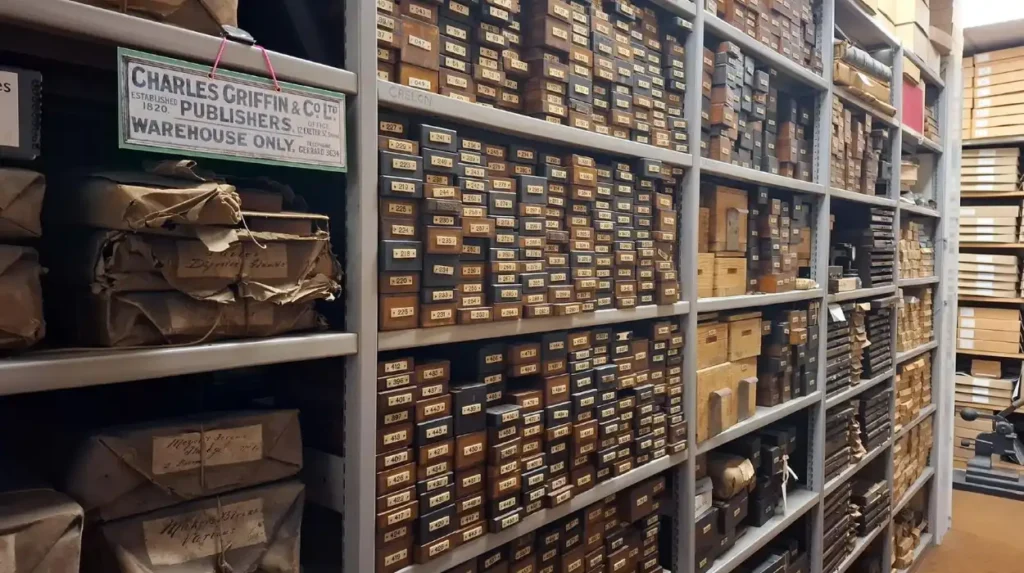
The Printworkers’ Collection at the Marx Memorial Library preserves documents that record this history.
Its holdings include:
- Trade union journals, documenting discussions about wages and working conditions.
- Handwritten minute books, recording meetings and organisational decisions.
- Photographs, documenting industrial disputes and workers’ lives.
- Trade union banners, representing the identity of organised printing workers.
- Agreements and rule books, recording employment arrangements and professional standards.
The collection also includes records relating to women workers and their contribution to the printing and publishing industries.
How Did Printing Technology Affect Employment?
Technological development changed the number and type of skills required in printing.
Mechanical typesetting reduced reliance on some traditional manual processes. Automated machinery also increased production capacity and changed factory organisation.
Later, digital typesetting and computer-based design transformed the industry further.
These developments created new technical occupations while reducing demand for some traditional printing roles.
The history of Clerkenwell therefore reflects wider changes in industrial employment, professional education and workplace organisation.
Why Did Clerkenwell’s Traditional Printing Industry Decline?
Clerkenwell’s traditional printing industry declined as production technologies changed, operating costs increased and publishing businesses adopted modern production systems. The movement of newspaper operations away from Fleet Street and the expansion of digital publishing also reduced demand for traditional printing premises.
Printing remained important throughout the twentieth century, but the industry gradually changed.
Traditional printing businesses faced pressure to modernise equipment and improve production efficiency.
New technologies transformed the economics of producing newspapers, books and commercial publications.
How Did the Newspaper Industry Change During the 1980s?
The 1980s marked a major turning point for London’s newspaper industry.
National newspaper production had traditionally relied on large printing operations, specialist machinery and established printing workforces.
Many newspapers used hot-metal typesetting systems, including Linotype machinery.
However, computer-based production offered faster workflows and reduced dependence on traditional mechanical typesetting.
The conflict between newspaper employers and printing unions became particularly significant during this period.
What Was the 1986 Wapping Dispute?
The Wapping dispute was a major industrial conflict involving Rupert Murdoch’s News International and newspaper printing workers.
On 24 January 1986, approximately 6,000 newspaper workers went on strike following a breakdown in negotiations.
News International had prepared a new production facility in Wapping, east London, using modern printing technology.
The company transferred newspaper production there, bypassing the traditional Fleet Street production system.
This event accelerated the decline of Fleet Street as the centre of national newspaper printing.
By 1989, national newspapers had largely moved away from their traditional Fleet Street operations.
Although this transformation primarily affected Fleet Street, it also reflected the wider technological changes that affected nearby printing districts, including Clerkenwell.
How Did Digital Publishing Change Clerkenwell?
Digital publishing changed the way written information was created, reproduced and distributed.
Traditional printed newspapers faced competition from online news websites, digital subscriptions and electronic publications.
Businesses increasingly used digital documents instead of printed stationery and commercial forms.
Graphic designers and publishers also adopted computer-based production systems.
These developments reduced demand for some traditional printing processes while creating new opportunities in digital design, communications and creative production.
Clerkenwell’s commercial identity gradually shifted towards professional services, architecture, design and creative businesses.
Explore More Area Guide
Regent’s Canal Islington History: Construction, Trade and Heritage
How Islington Grew from Rural Village to Urban Borough
What Can Visitors Explore Today to Discover Clerkenwell’s Printing Heritage?
Visitors can explore Clerkenwell’s printing heritage through historic buildings, political archives, educational collections and nearby printing landmarks. Marx House, Clerkenwell Green, the surrounding industrial streets and St Bride Foundation provide important connections with London’s historic printing and publishing communities.
Clerkenwell remains a useful destination for visitors interested in London’s industrial and cultural history.
Its printing heritage is visible through surviving buildings, preserved collections and organisations that continue to document traditional printing techniques.
Can Visitors Visit the Marx Memorial Library?
Marx Memorial Library
The library preserves historical material relating to workers’ movements, socialism, political publishing and printing history. Its building has a direct connection with the Twentieth Century Press and the publication of Justice and Iskra.
Visitors should check opening arrangements and access requirements before travelling. The library’s collections are particularly relevant to researchers studying printing workers, political movements and London’s publishing history.
What Is There to See Around Clerkenwell Green?
Clerkenwell Green
This historic public space provides a starting point for exploring the district’s industrial and political past. The surrounding streets contain buildings connected with workshops, political organisations and commercial development.
Walking around the Green helps visitors understand how printing businesses operated within a wider network of local industries.
Nearby Clerkenwell Close, St John’s Square and Farringdon Road also contribute to the area’s historic character.
Is St Bride Foundation Worth Visiting?
St Bride Foundation
St Bride Foundation is an important institution for understanding London’s printing and design heritage. Its library contains historical type specimens, printing equipment and archival material. The organisation also runs workshops, talks, courses and public tours.
The foundation was established in 1891 and developed educational facilities for people working in the Fleet Street printing trade.
Its collection contains more than 100,000 items, including historic printing material and design resources. Its holdings include more than 10,000 historic type specimens.
Visitors interested in traditional letterpress techniques can explore its learning programme and public workshops.
Can Visitors Explore London’s Historic Newspaper District?
Fleet Street
Fleet Street provides the wider historical context for Clerkenwell’s printing industry. Its connections with early printing, newspaper production and journalism help explain how London’s publishing economy developed.
Visitors can also explore St Bride’s Church, which has a long association with printers and journalists.
The church commemorates Wynkyn de Worde, whose printing business moved to the area in 1500. Its history also documents the development of London’s newspaper industry.
The relationship between Clerkenwell and Fleet Street makes the two areas useful complementary destinations for anyone studying London’s printing heritage.
How Does Clerkenwell’s Printing Heritage Influence the Area Today?
Clerkenwell’s printing heritage continues to influence its cultural identity through historic buildings, specialist collections, creative businesses and educational institutions. Its former industrial character provides context for the district’s modern association with graphic design, architecture, publishing and creative professional services.
The traditional printing industry has largely disappeared from Clerkenwell, but its historical influence remains visible.
Many former industrial buildings have been adapted for offices, studios, cultural organisations and other commercial uses.
The area’s established connection with skilled craftsmanship also contributes to its wider creative identity.
Why Is Clerkenwell Associated With Design and Creative Industries?
Printing helped establish an environment where technical production and visual communication developed together.
Engraving, typography, illustration and publishing required both practical skills and creative expertise.
These activities provided foundations for modern graphic design and visual communication.
Today, Clerkenwell is associated with architecture, interior design, product design and creative businesses.
Its historic workshops and commercial buildings provide an important connection between traditional manufacturing and contemporary professional activity.
What Is the Importance of Preserving Printing Archives?
Historical printing archives preserve evidence of how information was produced and distributed.
They also document the working lives of people who operated presses, prepared publications and organised within trade unions.
The Marx Memorial Library’s Printworkers’ Collection is particularly valuable because it records the experiences of workers rather than concentrating exclusively on famous publishers and newspaper proprietors.
St Bride Foundation preserves another important aspect of this history through its collections of typography, printing equipment and design material.
Together, these institutions help researchers understand the relationship between technology, labour, publishing and commercial development.
Why Does Clerkenwell’s Printing History Still Matter?
Clerkenwell’s printing history demonstrates how a specialist manufacturing industry helped shape a London neighbourhood.
It connects several important aspects of urban development, including commercial growth, industrial employment, technical education, political communication and technological innovation.
The district also illustrates how industries adapt when production methods change.
Traditional printing gave way to digital systems, while former industrial premises acquired new commercial and cultural uses.
For tourists, residents and researchers, Clerkenwell offers an opportunity to understand London’s development beyond its most famous newspaper offices.
Its printing heritage remains an important part of the wider story of how London became a centre for publishing, business communication and creative production.
As you explore Clerkenwell’s modern creative businesses, you are also walking through an important part of London’s industrial past. Discover the full [Insert Anchor Text for Clerkenwell History Article Here] to understand how the district developed from its medieval origins into a major centre of manufacturing and publishing.
Why is Clerkenwell famous for the printing industry?
Clerkenwell became famous for printing because it developed a concentration of commercial printers, engravers, publishers and book producers during the nineteenth century. Its location near Fleet Street and the City of London supported a thriving printing trade.