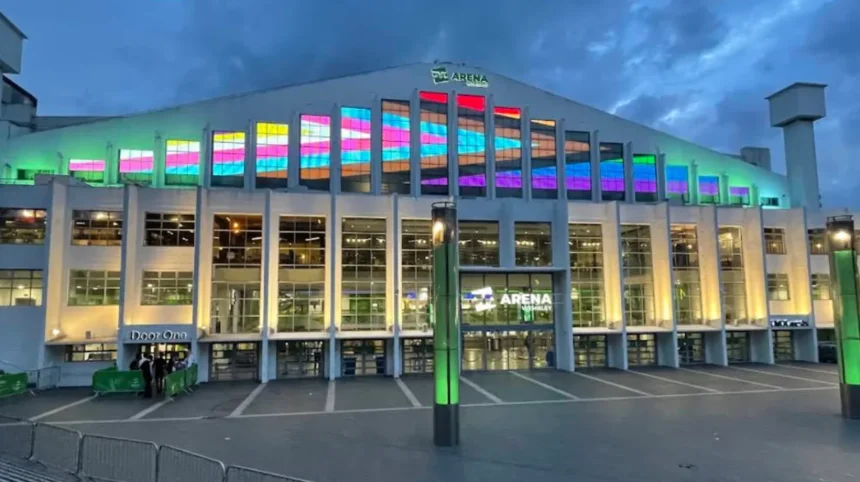
Tourists can visit several prominent historical places in Brent, including the Grade II-listed Wembley Arena, the monumental Gaumont State Cinema, the traditional BAPS Shri Swaminarayan Mandir, and the heritage-rich Gladstone Park. These locations preserve North London’s architectural, cultural, and wartime history.
- What Is the Historical Significance of Wembley Arena?
- Why Is the Gaumont State Cinema a Key Heritage Site?
- How Did the BAPS Shri Swaminarayan Mandir Form Its History?
- What Wartime and Social History Exists within Gladstone Park?
- Where Can Visitors Uncover Brent’s Institutional and Civic History?
- What Distinct Architectural Eras Can Be Found in Brent’s Subways?
- What Historic Cemeteries and Famous Tombs Are Located in the Borough?
- How Have Brent’s Historic Places Impacted Modern Urban Tourism?
What Is the Historical Significance of Wembley Arena?
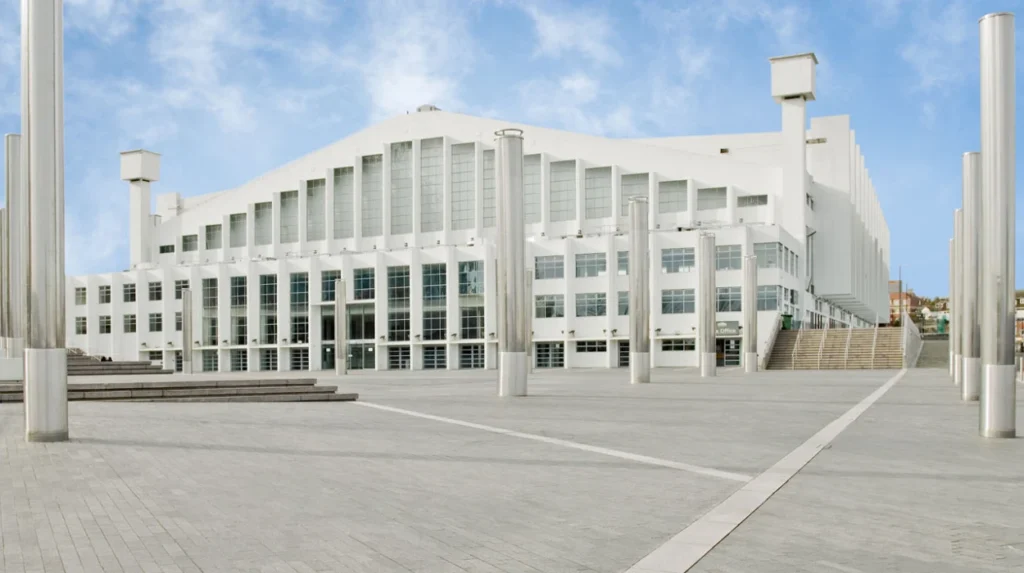
Wembley Arena is a globally recognized landmark of twentieth-century civil engineering and entertainment history, serving as a pioneer in reinforced concrete construction and a primary venue for major international sporting events, including two iterations of the modern Olympic Games.
The structure opened in 1934 under its original designation, the Empire Pool. The structural engineer Sir Owen Williams designed the venue without employing an architect, achieving a significant milestone in modern structural design. Williams constructed a unique layout featuring a reinforced concrete frame with three-hinged arches spanning 73 metres (240 feet). At the time of completion, this installation represented the largest concrete span in the world. This design utilized massive concrete buttresses along the sides and gabled ends with narrow lights to support the roof without the use of internal pillars, ensuring an unobstructed view for all spectators.
The venue initially housed a swimming pool measuring 61 metres (200 feet) long by 18 metres (60 feet) wide, alongside a deck designed for ice skating. The end of the building featured movable elements opening onto outdoor sunbathing terraces and lawns. During winter months, operators boarded over the pool to accommodate ice hockey, ice skating, and indoor sports tournaments. The financial success of these winter activities led to the pool remaining permanently covered after 1945.
Wembley Arena holds a prominent position in international sporting history. It served as the primary indoor aquatics venue for the 1948 Summer Olympics, hosting boxing, diving, swimming, and water polo. Preparing the building for the 1948 games required a massive restoration effort, which included scraping off wartime blackout paint and removing the sand and piping infrastructure used for the ice rink. During this process, engineers discovered a crack in the concrete pool lining caused by an exploding German landmine during the Blitz. The venue returned to the Olympic stage during the London 2012 Summer Olympics, hosting the badminton and rhythmic gymnastics events.
Architectural authorities recognized the technical virtuosity of the building on 9 October 1976, when the British government awarded it Grade II Listed status to protect its structural integrity. The Empire Pool formally changed its name to Wembley Arena on 1 February 1978. Tourists visiting the structure today view a preserved piece of industrial engineering that continues to function as a major performance space. As you explore the modern site, you are crossing land with a deep heritage. Read about the full [Wembley Park and Wembley Stadium urban development history] to understand its origins.
Why Is the Gaumont State Cinema a Key Heritage Site?
The Gaumont State Cinema in Kilburn is a premier heritage site because it represents one of the largest and most luxurious examples of Art Deco cinema architecture in Europe, illustrating the golden age of British mass entertainment.
Built between 1936 and 1937, the Gaumont State Cinema stands as a monumental expression of the Art Deco architectural movement. The renowned theater architect George Coles designed the building for the Circuit Cinema group. Coles drew inspiration from the design trends of contemporary American movie palaces, combining European finishes with large-scale entertainment engineering. The name “State” came from the iconic huge neon sign erected on the exterior tower, which mimicked the profile of the Empire State Building in New York.
The construction of the cinema utilized a monumental steel frame faced with cream-colored ceramic tiles, known as faience. The exterior features a 37-metre (120-foot) tower that remains a dominant feature of the Kilburn skyline. Upon its official opening in 1937, the auditorium accommodated 4,004 seated patrons, making it the largest auditorium in Europe at the time. The interior design featured an opulent Italian Renaissance style, incorporating a massive broadcast organ, a fully equipped theatre stage, and a grand choral foyer illuminated by crystal chandeliers.
The building served as a multi-functional cultural hub throughout the mid-twentieth century. In addition to screening motion pictures, the venue hosted live musical performances by major international artists, including Louis Armstrong, Buddy Holly, and The Beatles. The scale of the building allowed it to survive the decline of traditional cinema attendance by transitioning into a bingo hall operated by Mecca Bingo in the later decades of the twentieth century.
The architectural and historical value of the structure earned it Grade II* listed status, placing it in the top tier of protected historic buildings in the United Kingdom. This designation ensures the preservation of its external faience facade, the decorative proscenium arch, and the internal plasterwork. In the twenty-first century, the building transitioned to a new function as a place of worship for the Ruach City Church, preserving the historical interior while serving the contemporary local community.
How Did the BAPS Shri Swaminarayan Mandir Form Its History?
The BAPS Shri Swaminarayan Mandir, popularly known as the Neasden Temple, established its history as Europe’s first traditional stone Hindu temple, constructed entirely without structural steel using ancient architectural principles and thousands of tonnes of hand-carved stone.
The history of the mandir began with the migration of Hindu communities from East Africa and India to North London during the mid-twentieth century. The Bochasanwasi Shri Akshar Purushottam Swaminarayan Sanstha (BAPS) organization opened its first UK temple in a converted church in Islington in June 1970. As the congregation expanded, the community relocated to a small warehouse in Neasden in 1982. In 1990, the spiritual leader Pramukh Swami Maharaj initiated plans to construct a permanent, purpose-built temple matching traditional scripts.
Construction began in August 1992 on the site of a disused truck warehouse. The building relies entirely on the architectural rules of the Shilpa Shastras, a corpus of ancient Vedic texts governing structural mechanics, religious geometry, and stonecraft. The design prohibits the use of ferrous metals, such as iron and steel, because iron degrades over time and expands when rusted, which can fracture stone joints. To secure the foundation before winter freezes, builders executed the largest concrete pour in British history on 24 November 1992, laying 4,500 tonnes of concrete in 24 hours to create a structural mat 1.8 metres (6 feet) thick.
The materials used in the temple represent an international logistical operation. The exterior features 2,828 tonnes of Bulgarian limestone, selected for its density and weather resistance. The interior comprises 2,000 tonnes of Italian Carrara marble and Indian Ambaji marble. In December 1993, the organization shipped raw blocks of stone to India, where a team of 1,526 traditional stone sculptors across five specialized sites carved the intricate patterns. The sculptors created 26,300 unique carved stone pieces across 55 different ceiling designs.
The finished pieces returned to London by sea container, where engineers assembled them like a massive three-dimensional puzzle. Pramukh Swami Maharaj formally inaugurated the complete mandir complex on 20 August 1995. The structure features 7 pinnacles, 6 domes, and 193 structural pillars. The complex also contains a cultural centre, known as the Havili, which features hand-carved Burmese teak and English oak across its balconies and corridors. The building represents a monument to the religious pluralism and migrant history of modern London.
What Wartime and Social History Exists within Gladstone Park?
Gladstone Park preserves critical elements of British wartime defense systems and local social history, featuring military installations from World War II, a commemorative Holocaust sculpture group, and the architectural remnants of a prominent local estate.
The London Borough of Willesden purchased the land for Gladstone Park in 1899 to establish a permanent public green space for the rapidly expanding urban population. The local authorities named the park after the former British Prime Minister William Ewart Gladstone, who spent frequent periods of recreation at the Dollis Hill House estate located within the grounds. The park opened to the general public in May 1901, providing structural landscaped gardens, tree-lined avenues, and sports fields.
During World War II, the geographical elevation of Gladstone Park made it a strategic location for the air defense network of London. The British military selected the highest point of the park, which stands approximately 65 metres above sea level, to install an anti-aircraft gun battery. This installation protected nearby industrial sectors, such as the Park Royal industrial estate and the railway junctions at Willesden, from Luftwaffe bombing raids. The military also excavated a network of subterranean air-raid shelters across the park grounds to protect local citizens during air raids.
The park contains a prominent artistic monument dedicated to the memory of global conflict. Sited near the former walled gardens stands a memorial sculpture group created by the prominent artist Fred Kormis between 1967 and 1969. The installation consists of five bronze figures representing the psychological progression of individuals experiencing captivity, dedicated specifically to the memory of prisoners of war and victims of concentration camps active between 1914 and 1945.
The park also contains the structural footprint of Dollis Hill House, a classical villa built in 1825 by the Finch family. The house served as a hospital for wounded military officers during World War I and later accommodated public tea rooms. Although fire destroyed the main superstructure in the late twentieth century, the stabilized historic brick walls and formal regency gardens remain accessible to tourists, demonstrating the evolution of the landscape from a private estate to a public sanctuary.
Where Can Visitors Uncover Brent’s Institutional and Civic History?
Visitors can uncover the institutional and civic history of the borough at the Brent Museum and Archives, located inside the Library at Willesden Green, which houses thousands of artifacts detailing local industrial and domestic development.
The institutional preservation of Brent’s history began in 1977 with the opening of the original Grange Museum, located inside a historic nineteenth-century outbuilding on the Neasden roundabout. The local council later relocated the entire historical collection to its current home on the second floor of the Library at Willesden Green to improve public access and preservation conditions. The current museum and archive center maintains an inventory of over 10,000 distinct physical artifacts, oral history recordings, and historic photographs.
The permanent galleries trace the chronological evolution of the local area from its agricultural origins into a major manufacturing and residential center. A major component of the original collection comes from the antiquarian George Titus Barham, who bequeathed his diverse private collection to the local council in 1937. Barham derived his family fortune from Express Dairies, an organization that pioneered the industrial transport of milk via early railway networks from rural farms into urban North London hubs.
The museum displays artifacts showing the domestic life of diverse communities that settled in the region from 1850 onward. Key historical exhibits include:
- Victorian manufacturing tools from local brickworks.
- Wartime civil defense uniforms worn by local volunteers during the Blitz.
- Original architectural blueprints for the 1924 British Empire Exhibition.
- Early industrial consumer goods manufactured at the nearby Park Royal estate.
The adjacent archive section contains comprehensive copies of local newspapers dating continuously back to 1870, alongside historical maps showing the micro-level transformation of areas like Kilburn, Wembley, Harlesden, and Willesden. This research facility allows tourists and historians to access official parish registers, old electoral logs, and early municipal records, providing an authoritative resource for understanding the civic development of North London.
What Distinct Architectural Eras Can Be Found in Brent’s Subways?
Brent’s subterranean and surface transport hubs display two distinct twentieth-century architectural movements, featuring the Edwardian classicism of Leslie Green at Kilburn Park and the brick modernism of Charles Holden at Sudbury Town.
The expansion of the London Underground network in the early decades of the twentieth century triggered the rapid suburban growth of Northwest London. The stations built during this expansion period served as architectural experiments, defining corporate design systems for public transit infrastructure. Kilburn Park Underground Station, constructed between 1914 and 1915 on the Bakerloo line extension, represents a highly preserved example of Edwardian transit architecture designed by Leslie Green.
Green developed a strict standardized corporate identity for the London Electric Railway using specific structural elements. The exterior of Kilburn Park features a facade constructed from deep red, glazed ceramic tiles known as faience, which resisted the heavy soot and pollution of early twentieth-century London air. The station design includes large semi-circular windows on the first floor and a wide, decorated cornice. The interior booking hall retains its original green and cream wall tiling patterns, designed to guide passengers toward the newly invented escalator systems that replaced traditional station lifts.
A completely different architectural philosophy exists at Sudbury Town Underground Station on the Piccadilly line, located on the western boundary of the borough. Designed by the visionary architect Charles Holden and opened in 1931, Sudbury Town represents a major shift toward European modernism. Holden moved away from historic ornamentation, creating a clean geometric structure consisting of a tall, rectangular brick-and-glass box supporting a flat concrete roof.
The Sudbury Town design allows large amounts of natural light to flood the interior concourse through tall vertical window panels. The structure uses bare, unadorned materials such as red brick, exposed concrete, and bronze window frames. This station served as the official prototype for Holden’s celebrated designs across the entire Piccadilly line extension, influencing public transport architecture across the globe. Both stations hold statutory Grade II listing status, preserving these contrasting visions of industrial transit design.
What Historic Cemeteries and Famous Tombs Are Located in the Borough?
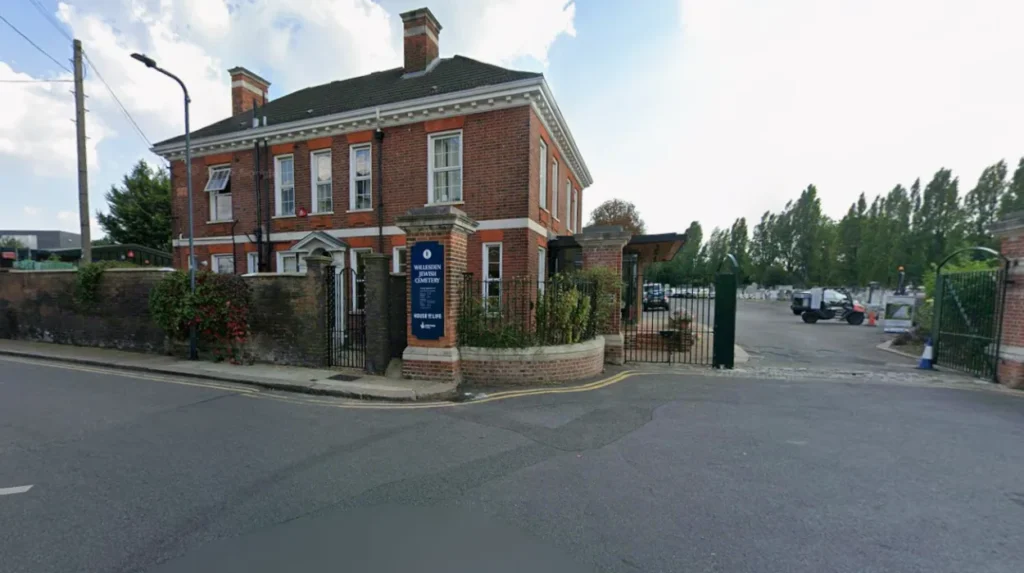
The borough houses the Willesden Jewish Cemetery, an internationally significant Victorian burial ground that contains the protected tombs of foundational figures in British science, politics, and art.
Established in 1873 by the United Synagogue organization, the Willesden Jewish Cemetery covers 21 acres of land in Willesden. The prominent architect Nathan Solomon Joseph designed the original layout, incorporating formal tree-lined walkways, a Gothic Revival prayer hall, and separate burial sections. The cemetery served as the premier burial site for the Anglo-Jewish community during the late nineteenth and early twentieth centuries, reflecting the demographic shifts and social integration of Jewish families into British society.
The cemetery contains several tombs designated as listed monuments due to their exceptional architectural craft and historical significance. A primary location of historical pilgrimage is the tomb of Rosalind Franklin, the visionary biophysicist whose work proved essential to unlocking the structural secrets of DNA molecules. Franklin’s simple granite headstone, dated 1958, attracts scientists and tourists from around the world.
The site also features opulent Victorian burial enclosures belonging to the Rothschild banking dynasty. These structural enclosures include the tombs of Baron Mayer Amschel de Rothschild and his daughter Hannah Primrose, the Countess of Rosebery, who became one of the wealthiest women in Victorian Britain. The enclosures feature intricate stone carving, classical pillars, and wrought-iron railings designed by leading architects of the nineteenth century.
The Commonwealth War Graves Commission maintains 124 official military graves within the cemetery grounds, marking the resting places of service personnel who died during the First and Second World War. The British heritage authorities awarded the entire cemetery Grade II registered park status, recognizing its landscape design and institutional importance. The site operates an active visitors’ centre that provides educational walking routes detailing the biographical histories of the individuals interred within the grounds.
How Have Brent’s Historic Places Impacted Modern Urban Tourism?
The preservation of Brent’s historic places has transformed the borough from a standard residential suburb into a resilient cultural tourism destination, balancing high-capacity commercial entertainment with heritage preservation.
The survival of these diverse heritage buildings directly shapes the economic and cultural profile of North London. Iconic venues like Wembley Arena demonstrate how historic engineering can adapt to twenty-first-century entertainment requirements. By maintaining its Grade II listed structure while upgrading internal sound and staging systems, the arena generates regular tourism revenue without destroying its unique architectural character. This commercial success funds the broader preservation of surrounding historic public spaces.
The presence of architectural monuments like the BAPS Shri Swaminarayan Mandir expands the demographic reach of London tourism. The temple attracts approximately 500,000 visitors annually, including international cultural tourists, architectural students, and religious pilgrims. This foot traffic supports independent local hospitality businesses, transport services, and cultural institutions outside the traditional tourism zones of central London.
The conservation of open green spaces like Gladstone Park provides essential environmental and health benefits while protecting historical infrastructure. By preserving wartime gun emplacements and historic estate walls within a modern public park, local authorities ensure that historical education remains integrated into daily community recreation. This approach prevents the loss of local history amidst intense modern real estate development.
The network of historic subway stations, museums, and cemeteries ensures that Brent maintains a distinct cultural identity within the landscape of Greater London. These sites provide clear physical reference points showing how diverse communities, industrial engineering innovations, and critical wartime events shaped the modern metropolis. The ongoing protection of these structures guarantees that future generations of travelers can explore the complete social history of North London.
What Is the Historical Significance of Wembley Arena?
Wembley Arena is historically significant as a pioneering reinforced concrete venue and an important entertainment and sporting landmark. Opened in 1934 as the Empire Pool, it introduced one of the largest concrete spans in the world and later hosted events during both the 1948 and 2012 Olympic Games. Its Grade II listed status protects its engineering and architectural value.