Edgware is known for its historic role as a north London settlement on the Edgware Road, its long-standing market-town identity, Station Road shopping area, Northern Line terminus, diverse community, and access to open spaces such as Edgwarebury Open Space. Its character combines historic streets, suburban development, transport connections and modern town-centre activity.
- What is Edgware best known for?
- Why is Edgware Road important to the area’s history?
- How did Edgware change from a village into a suburban town?
- What is Edgware Station known for?
- What is Edgware known for shopping and local businesses?
- What is Edgware known for its multicultural community?
- What historic places are associated with Edgware?
- What is Edgwarebury Open Space known for?
- How is Edgware connected to Burnt Oak?
- What makes Edgware important as a transport hub?
- Is Edgware known for its town-centre regeneration?
- What can visitors do in Edgware?
- Why is Edgware significant in North London’s identity?
- What is Edgware likely to be known for in the future?
- What should you remember about what Edgware is known for?
Edgware sits in the northern part of London Borough of Barnet, close to the Greater London boundary with Hertfordshire and adjacent to areas including Burnt Oak, Mill Hill, Stanmore and Queensbury. Its location has shaped its identity for centuries because roads, railways, trams and the Underground repeatedly connected the settlement with London and surrounding towns.
Today, Edgware functions as a substantial suburban town centre. Barnet Council describes it as one of the borough’s busiest transport hubs, with more than 43,930 square metres of retail space and a mixture of independent shops, restaurants, cafés, bars and local services.
What is Edgware best known for?
Edgware is best known for its historic Edgware Road, Station Road shopping centre, Northern Line Underground station, market-town heritage, diverse local community and surrounding open spaces. Its identity developed from a medieval settlement into a major suburban centre during twentieth-century transport-led expansion.
Edgware has several defining characteristics rather than one single attraction. Its historical importance comes from its position on the route between London and St Albans. Its modern importance comes from the expansion of public transport and housing during the twentieth century.
Barnet Council records that the settlement’s name derives from “Ecgi’s weir fishing pool”. The original settlement was probably located closer to the bridge over Edgware Brook on the Edgware Road. Pilgrims travelling between London and St Albans used Edgware as a resting point.
By the time of Elizabeth I, a substantial village had developed along the road from Edgware Bridge towards what is now Station Road. The settlement had about 120 residents at that period. By the seventeenth century, Edgware had developed into a small market town.
Its modern town-centre identity therefore sits on top of a much older settlement pattern.
Why is Edgware Road important to the area’s history?
Edgware Road is important because it connected Edgware with London and northern settlements for centuries, supporting pilgrimage, coaching, trade and commuting. Its strategic road position helped establish Edgware as a stopping point before railways, trams and the Underground transformed its suburban role.
The Edgware Road was an important northbound route during the growth of London. Its significance increased as London’s population expanded and travel between the capital and settlements farther north became more frequent.
The road was not always easy to use. Barnet Council records that its condition deteriorated significantly during periods of heavy use. A turnpike system operated on the Edgware-Kilburn section between 1711 and 1872. Turnpikes charged travellers fees that helped fund road maintenance.
Coaching strengthened Edgware’s role. By the end of the coaching era, nine coaches passed through the settlement each day on journeys between London and destinations farther north. Travellers generated demand for accommodation, food, services and commercial activity.
The road also explains why Edgware developed differently from an isolated rural village. Transport shaped the local economy before modern suburbanisation began.
The historical road remains relevant today because Station Road and the surrounding town centre continue to operate as a commercial and transport focus.
As you explore the modern site, you are crossing land with a deep heritage. Read about the full to understand its origins.
How did Edgware change from a village into a suburban town?
Edgware changed through successive transport and housing developments. The nineteenth-century railway produced limited immediate growth, while the 1904 tram service and especially the Northern Line extension completed in 1924 accelerated housebuilding, shopping development and suburban expansion around Station Road.
The nineteenth century demonstrates that transport infrastructure does not automatically create rapid urban growth. The Edgware, Highgate and London Railway opened a single-track service to Finsbury Park in 1867, but population growth remained limited.
Barnet Council records a population decline from 755 in 1851 to 665 in 1871. The railway therefore did not immediately produce the transformation later associated with Edgware.
Trams arrived in 1904. Their effect was also relatively limited at first. Significant suburban development accelerated after the First World War.
The decisive change came with the Underground. The Northern Line extension from Golders Green reached Edgware in August 1924. The station became a major catalyst for residential and commercial development.
Much of the built environment around Station Road dates from the period after the Underground station opened. Shopping parades carry dates including 1923, 1925 and 1928, demonstrating the speed of commercial expansion during the interwar period.
This transport-led growth established the basic pattern recognisable today: a central shopping corridor surrounded by residential neighbourhoods and linked to wider London by public transport.
What is Edgware Station known for?
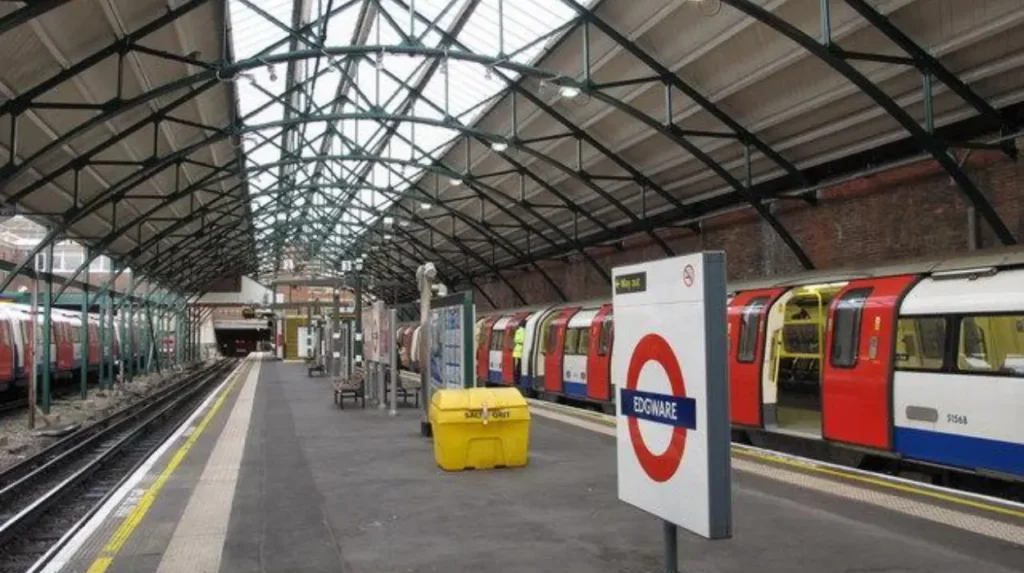
Edgware Station is known as the northern terminus of the Northern Line’s Edgware branch and as a major transport interchange serving the surrounding communities. The station opened in August 1924 and helped drive Edgware’s transformation into a twentieth-century suburban centre.
Edgware Underground Station stands on Station Road and forms a central part of the town centre. Transport for London identifies it as a Northern Line station with lifts, Wi-Fi, ticket halls and other passenger facilities.
The present station opened in August 1924. It was designed by architect Stanley Heaps and has three platforms. Step-free access was installed in 2009.
The station’s importance extends beyond commuting. It influences where shops, services and bus connections concentrate. The Underground station sits alongside Edgware Bus Station and the Broadwalk Shopping Centre, creating a combined transport and commercial hub.
For visitors, the station provides a straightforward starting point for exploring Station Road, local shops and nearby residential areas.
For residents, its Northern Line connection provides access towards central London through stations on the Edgware branch.
What is Edgware known for shopping and local businesses?
Edgware is known for its substantial Station Road shopping area, independent businesses, restaurants, cafés, bars and everyday services. Barnet Council records more than 43,930 square metres of retail space, making the town centre an important commercial destination in north London.
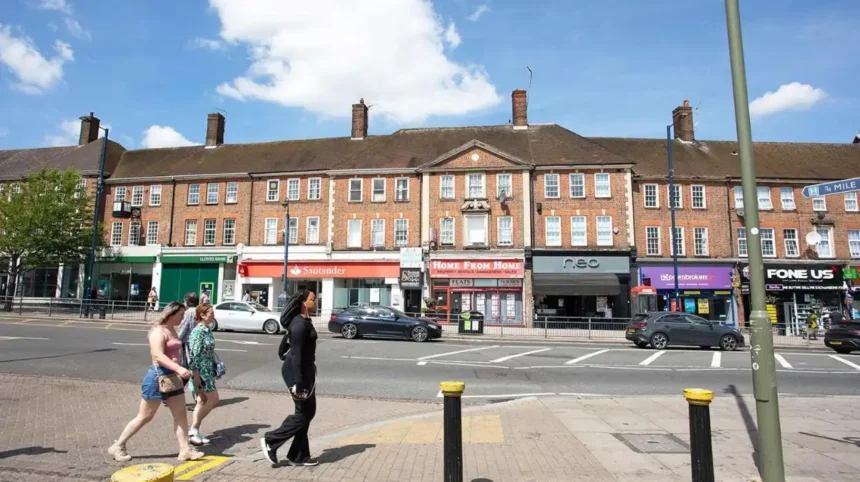
Station Road is the principal commercial thoroughfare. It contains traditional shopping parades, local services and food businesses alongside larger retail premises.
Barnet Council describes Edgware as a town centre with many independent shops and a broad range of restaurants, cafés, bars and local services. Its retail space exceeds 43,930 square metres.
The Broadwalk Shopping Centre is another important part of the commercial structure. The covered shopping centre dates from the 1990s and includes a large Sainsbury’s food retailer. It sits beside the Underground and bus stations.
Edgware therefore serves different shopping purposes. Station Road supports traditional high-street activity, while Broadwalk provides covered retail space and larger-format shopping.
The combination creates a town centre that serves residents as well as visitors from surrounding neighbourhoods.
What is Edgware known for its multicultural community?
Edgware is known for a diverse population and a commercial environment shaped by different communities, cuisines, businesses and religious institutions. This diversity is visible across its food businesses, independent shops, local services and community facilities concentrated around the town centre.
Edgware’s contemporary identity is strongly connected with its diverse population. The town centre contains businesses serving different cultural communities, particularly through food, retail and specialist services.
This diversity is not limited to individual businesses. It contributes to the wider character of Station Road and neighbouring streets, where different commercial traditions operate within the same town centre.
Restaurants and cafés form an important part of this identity. They complement shops and everyday services, making the centre useful for both daytime visits and evening activity.
Edgware Library also forms part of the town centre’s community infrastructure. Barnet Council identifies the library alongside shops, restaurants, cafés, bars and transport facilities as elements contributing to the area’s distinctive character.
For visitors, this means Edgware provides an opportunity to experience a working suburban London centre rather than a district dominated by major tourist attractions.
What historic places are associated with Edgware?
Historic Edgware includes St Margaret’s Church, Edgwarebury Farm, the former Cannons estate and surviving elements of older settlement patterns. These sites connect modern Edgware with medieval, early-modern and eighteenth-century history recorded in local archives.
St Margaret’s Church is one of the most important historic landmarks associated with the old settlement. A church has existed in Edgware since the thirteenth century, while the surviving tower of the medieval building dates from the fourteenth century.
The present church has undergone substantial rebuilding. Major works took place in 1763–64, 1845 and 1928.
Edgwarebury Farm provides another connection with the area’s rural past. Barnet Council states that part of the farm building dates from the seventeenth century and that the site probably has medieval origins. The manor was held by All Souls College, Oxford, from 1442.
Cannons provides an important eighteenth-century connection. The estate was associated with James Brydges, Duke of Chandos, whose house developed into an elaborate palace. Composer George Frideric Handel lived at Cannons between 1717 and 1718. The palace was demolished in 1747 after the contents were sold.
These locations show that Edgware’s history extends well beyond twentieth-century suburban development.
What is Edgwarebury Open Space known for?
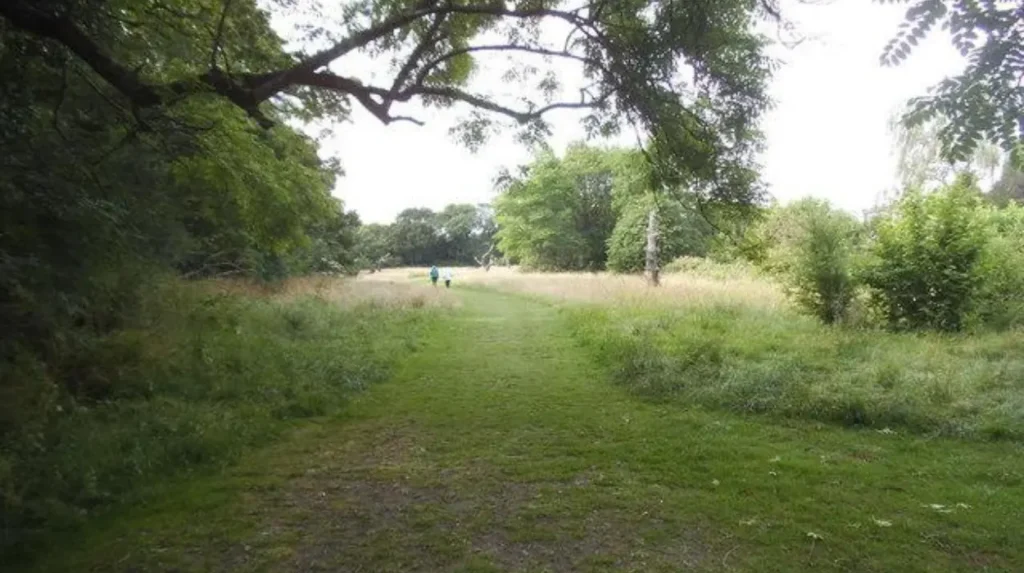
Edgwarebury Open Space is known for its large green setting, recreational use and connection with Edgware’s historic rural landscape. The open space began with a 29.5-acre land purchase in 1930 and opened as a recreation ground in 1932.
Edgwarebury Open Space provides an important contrast with the dense commercial environment around Station Road.
Hendon Rural District Council and Middlesex County Council purchased 29.5 acres in July 1930. The land was converted into a recreation ground and opened in 1932 after £7,000 was spent on the park.
The site forms part of the wider green landscape north of the town centre. The Edgware Roughs, a nearby area of Metropolitan Open Space, add further countryside character.
The area also contains historical infrastructure remains associated with a proposed railway between Edgware and Bushy. Brick remains survive from the unfinished scheme.
For leisure visitors, the open space provides a setting for walking and outdoor recreation. For local residents, it contributes to access to green space within a highly urbanised part of Greater London.
How is Edgware connected to Burnt Oak?
Edgware is closely connected to Burnt Oak through shared transport, housing and commercial history. Burnt Oak developed from rural land into a suburban district during the twentieth century, with its Underground station opening in 1924 and the Watling Estate accelerating population growth.
Burnt Oak lies immediately south of Edgware and forms part of the wider urban area associated with the Edgware Road corridor.
Its transformation followed a similar transport-led pattern. A tram service began in 1905, while Burnt Oak Underground Station opened on 27 October 1924. The station was rebuilt in 1928.
The Watling Estate produced large-scale residential development. By 1931, the Burnt Oak ward, including the Watling Estate, had a population of 21,545.
Burnt Oak also developed a strong retail identity. Watling Avenue shops were constructed in 1930, while a market developed from costermonger stalls established during the early 1930s.
These developments helped create the continuous urban environment experienced today between Edgware and Burnt Oak.
What makes Edgware important as a transport hub?
Edgware functions as a major north London transport hub because its Underground station and bus station connect the town with central London and surrounding districts. Current TfL services include routes serving destinations such as Watford, Borehamwood, Cockfosters and Brent Cross.
Transport is one of Edgware’s clearest modern defining characteristics.
Barnet Council describes the town centre as one of its busiest transport hubs, with capacity for around 170 buses and a Northern Line connection towards central London.
TfL currently lists numerous bus services operating around Edgware Bus Station. These include routes 107, 142, 288, 292, 384, 606 and 642, with destinations including Watford Junction, Borehamwood and Cockfosters.
Other services around the wider Edgware interchange include routes such as 32, 204, 251, 303 and N32.
This network gives Edgware a wider catchment than its immediate residential streets. People use the centre for shopping, services, work journeys and connections to other north London districts.
For domestic business travellers, this connectivity also makes Edgware practical for short periods between appointments elsewhere in north London.
Is Edgware known for its town-centre regeneration?
Edgware is known for an active regeneration programme focused on housing, retail, public spaces, transport infrastructure and environmental improvements. Barnet’s planning framework aims to retain the town centre’s commercial role while improving connections, public realm and long-term investment.
Regeneration is becoming an important part of Edgware’s current identity.
Barnet Council’s Edgware Growth Area framework identifies Station Road as the principal shopping thoroughfare and aims to support retail, commercial, leisure and cultural uses.
The regeneration framework covers the area around the Broadwalk Shopping Centre, Underground station and bus station. Proposed improvements include better public space, improved bus interchange, junction changes and pedestrian and cycling connections.
The town centre also has a Business Improvement District, known as Edgware – Your High Street. Barnet Council states that the BID was launched in 2023 and is associated with more than £800,000 of new investment over five years from 2023 to 2028.
Regeneration therefore forms part of Edgware’s future as well as its present identity.
What can visitors do in Edgware?
Visitors can explore Station Road, historic St Margaret’s Church, local cafés and restaurants, independent shops, Edgwarebury Open Space and nearby neighbourhoods. Edgware also works as a transport base for exploring wider north London and destinations beyond the immediate town centre.
Edgware is not primarily defined by a single major tourist attraction. Its visitor appeal comes from combining local history, everyday London life, shopping, food and access to green space.
A practical visit can begin at Edgware Underground Station and continue along Station Road. The commercial centre provides opportunities for shopping, eating and observing the architecture of the interwar suburban expansion.
Historic interests can include St Margaret’s Church and the older parts of the settlement. Edgwarebury provides a different environment, with open space and connections to the area’s rural history.
The town also provides access to surrounding districts. Burnt Oak, Mill Hill, Stanmore and other parts of north London are reachable through the local transport network.
For leisure travellers, Edgware therefore works best as a local character destination rather than a conventional central London sightseeing district.
Why is Edgware significant in North London’s identity?
Edgware is significant because it combines an ancient road settlement, market-town traditions, twentieth-century suburban expansion, modern transport infrastructure, commercial activity and green space. These layers give Edgware a distinct identity within Barnet and the wider North London urban landscape.
Edgware demonstrates how North London developed through several overlapping phases.
The earliest phase centred on the road network and Edgware Brook. The medieval and early-modern settlement developed around travel, trade and agriculture. The market-town phase introduced regular commerce and fairs.
The nineteenth century introduced railway infrastructure without immediately creating rapid population growth. The twentieth century then brought trams, the Underground and large-scale housing development.
By 1930, Barnet Council records that Edgware had become a bustling shopping centre surrounded by expanding suburban streets.
The current town centre retains this layered structure. Station Road remains commercially important, the Northern Line remains central to movement, and green spaces preserve elements of the area’s rural geography.
This combination explains why Edgware is recognised as both a historic settlement and a modern suburban centre.
Explore More Area Guide
What Is Hendon Known For? History, RAF Museum & Landmarks
Camden Market London: Shops, Food and Opening Times Camden 2026
What is Edgware likely to be known for in the future?
Edgware’s future identity is closely linked to town-centre regeneration, new housing, improved transport infrastructure, public-realm investment, greener spaces and continued commercial activity. Planning documents position Edgware as a major centre serving a wide surrounding catchment.
The future of Edgware is being shaped through formal planning frameworks rather than a single redevelopment project.
Barnet Council’s Edgware Growth Area planning documents focus on maintaining the town centre’s commercial function while improving its environmental quality and connections. The framework includes retail, leisure, cultural, residential and community uses.
The Broadwalk and station area represents a major development opportunity because it combines shopping, Underground infrastructure, bus facilities and public space.
The town’s historical character also remains relevant to future planning. Barnet’s sustainability framework states that renewal should draw on local character and heritage where appropriate while addressing environmental resilience, biodiversity and pollution.
Edgware’s long-term identity will therefore continue to combine established high-street functions with transport, housing, public space and environmental improvements.
What should you remember about what Edgware is known for?
Edgware is known for its historic road and market-town origins, Northern Line terminus, Station Road shopping centre, diverse community, historic buildings, Edgwarebury Open Space and strong transport connections. Its character comes from centuries of change rather than one defining landmark.
The most important facts can be summarised through Edgware’s development.
Its original identity came from the road between London and St Albans. Its market-town character developed through trade, coaching and fairs. Its historic landscape includes St Margaret’s Church, Edgwarebury Farm and the former Cannons estate.
Its modern identity developed rapidly after the Underground reached Edgware in 1924. Station Road became the centre of suburban commercial life, while residential development expanded around the station.
Today, Edgware remains a major Barnet town centre with extensive retail space, restaurants, cafés, local services and transport infrastructure.
Its green spaces add another dimension, while regeneration plans are reshaping the town centre for future housing, commerce, leisure and public use.
For tourists, Edgware offers local history and everyday north London character. For residents, it provides a substantial service and transport centre. For business travellers, its connections make it useful as a northern London base.
Edgware is therefore best understood as a historic settlement that became a major suburban centre while retaining links to its older landscape and transport history.
What is Edgware famous for?
Edgware is known for its historic Edgware Road, Station Road shopping area, Northern Line Underground station, diverse community, historic buildings and nearby green spaces such as Edgwarebury Open Space.