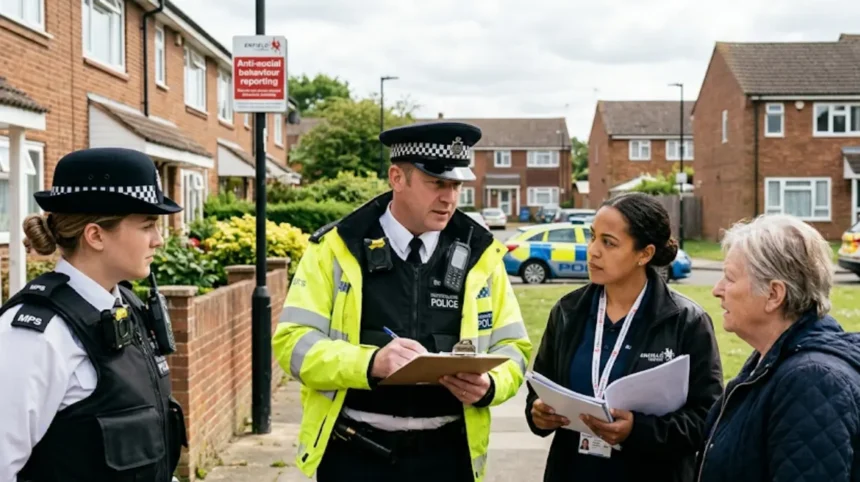
Anti-social behaviour reports in Enfield trigger a structured response from the council, police, and housing providers, but effectiveness varies by case type, reporting channel, and whether thresholds for enforcement are met. In the year ending December 2024, Enfield recorded 7,766 anti-social behaviour (ASB) offences, a 9% decrease from 8,560 in the previous year, indicating that reporting and intervention mechanisms are contributing to a measurable reduction. However, many reports still end “under investigation” or with no suspect identified, so effectiveness depends on residents using the right channels, reporting consistently, and escalating via the Antisocial Behaviour Case Review (Community Trigger) where appropriate.
- What is anti-social behaviour and how is it defined in Enfield?
- How do residents report anti-social behaviour in Enfield?
- What happens after an anti-social behaviour report is made in Enfield?
- How effective are council-led anti-social behaviour reports in Enfield?
- How effective are police reports of anti-social behaviour in Enfield?
- How effective are anti-social behaviour reports for housing tenants in Enfield?
- What is the overall trend in anti-social behaviour in Enfield and does it suggest effectiveness?
- When are anti-social behaviour reports most effective in Enfield?
- How can residents improve the effectiveness of their anti-social behaviour reports in Enfield?
- What are the limitations of anti-social behaviour reports in Enfield?
What is anti-social behaviour and how is it defined in Enfield?
Anti-social behaviour in Enfield is any action that causes or is likely to cause alarm, distress, nuisance, or annoyance to individuals or the community, and includes noise, harassment, intimidation, littering, drug use, and vandalism reported to the council, police, or housing providers.
The legal definition stems from the Anti-social Behaviour, Crime and Policing Act 2014, which sets out that ASB involves behaviour that causes or is likely to cause harassment, alarm, or distress to one or more persons not of the same household as the perpetrator. In Enfield, this definition is applied across council housing, private rentals, and neighbourhoods, covering a wide range of 13+ types, including:
- Persistent loud noise and music
- Verbal harassment and intimidation
- Abusive or threatening behaviour
- Excessive rubbish or littering
- Drug-related activity and paraphernalia
- Abandoned vehicles
- Vandalism and graffiti
- Aggressive pets
- Hate-related incidents
- Rowdy behaviour in public spaces.
Enfield Council’s Housing Anti-Social Behaviour Policy 2023–2028 frames ASB as a major cause of distress, anxiety, and fear for personal safety, and commits to structured responses through its Anti-Social Behaviour team, supported by the police and registered housing providers. This policy sets expectations for how reports should be handled, recorded, and escalated, forming the backbone of the borough’s ASB reporting system.
How do residents report anti-social behaviour in Enfield?
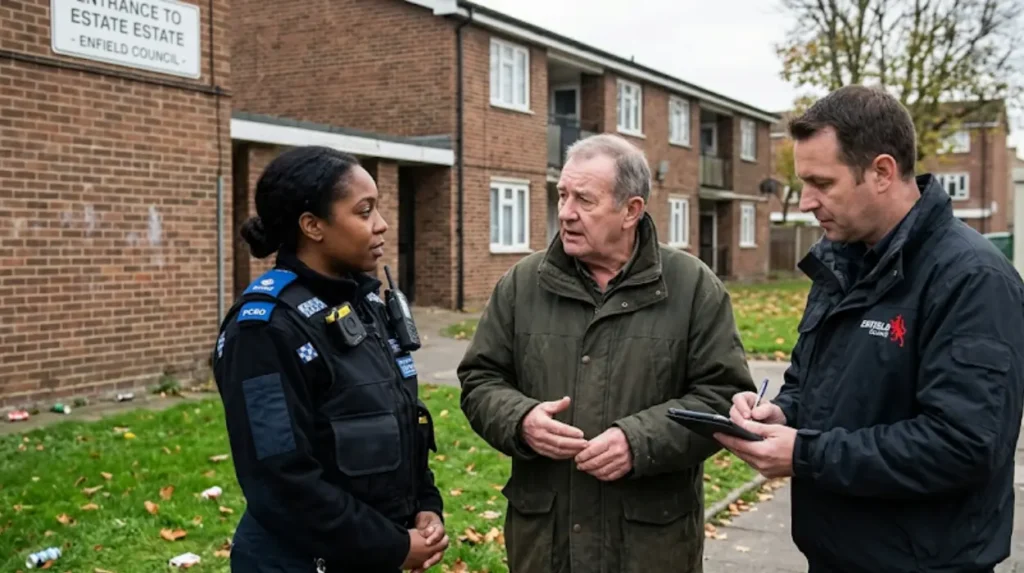
Residents in Enfield report ASB via three main routes: the council’s Anti-Social Behaviour team (email asbu@enfield.gov.uk or phone 020 8379 4612), the police (101 for non-emergency, 999 for immediate risk, or online reporting), and registered housing providers or landlords for tenants.
The council’s Anti-Social Behaviour team operates as the central point for neighbourhood and housing-related ASB that does not constitute an immediate crime. When contacting them, callers must leave their name, address, telephone number, and brief reason for the call on voicemail if no immediate answer is available. Emails must clearly state the nature of the behaviour, location, dates, and any previous reports.
For criminal or potentially criminal behaviour, the police are the primary route. Non-emergency reports can be made by calling 101 or submitting an online report via the Metropolitan Police website. In cases where someone is at immediate risk or a crime is being committed, residents must call 999. Anonymous reports can also be made to CrimeStoppers on 0800 555 111, which is useful when residents fear retaliation but still want to provide information.
For council and housing association tenants, the first step is to report ASB to their housing provider, as these organisations have specific ASB policies and case management systems. Private renters must contact their landlord or managing agent, who then decide whether to escalate to the council or police. This layered approach ensures that housing-related ASB is handled by those with direct contractual responsibility, while wider community issues are routed to the council and police.
What happens after an anti-social behaviour report is made in Enfield?
After an ASB report is made, Enfield Council, the police, or housing providers record the incident, assess risk, and may issue warnings, mediate, or initiate enforcement; complex or persistent cases can be escalated through an Antisocial Behaviour Case Review.
When the council receives a report, the Anti-Social Behaviour team logs it on their case management system and assigns it for investigation. Depending on the nature and severity, actions may include:
- contacting the complainant and the alleged perpetrator
- issuing formal warnings
- arranging mediation between parties
- gathering evidence (e.g., noise logs, witness statements, CCTV)
- referring to the police if criminal behaviour is suspected
- initiating enforcement under housing tenancy agreements or civil orders.
The police treat ASB reports as potential offences under the 2014 Act and local priorities. For many ASB incidents, outcomes recorded by the Metropolitan Police in areas such as Enfield Lock include:
- “Under investigation” (around 43% of cases in April 2025)
- “Investigation complete; no suspect identified” (around 20.5%)
- “Unable to prosecute suspect” or other outcomes (remaining cases).
These outcome patterns show that while reports are processed, a significant proportion do not result in identified suspects or prosecutions, limiting the perceived effectiveness for some residents.
If a resident has reported the same ASB three times in the last six months to the council, police, or a registered housing provider, and considers that no action has been taken, they can request an Antisocial Behaviour Case Review (previously known as the Community Trigger). This review brings agencies together to take a joined-up, problem-solving approach. Upon request, the council provides an initial response within three working days, then confirms whether the threshold is met and how the review will proceed. This mechanism is designed to improve effectiveness in persistent or complex cases where standard reporting has not led to resolution.
How effective are council-led anti-social behaviour reports in Enfield?
Council-led ASB reports in Enfield are moderately effective: they trigger recording, risk assessment, and targeted interventions, but effectiveness is limited by resource constraints, evidence requirements, and the fact that many cases do not meet thresholds for strong enforcement.
Enfield’s Housing Anti-Social Behaviour Policy 2023–2028 emphasises that the council will support victims of ASB, review cases when requested, and work with partners to address behaviour through a range of interventions. The council’s ASB team manages cases from council housing tenants and, where appropriate, wider community issues referred by residents or housing providers.
Data from the council’s case management system shows that between May 2021 and April 2022, there were 126 reported ASB cases from Enfield council housing tenants, translating to around 12 cases per 1,000 council homes, compared with 55 cases per 1,000 homes across London. This relatively lower rate among council tenants suggests that council-led reporting and management may be more effective within its own housing stock, where the council has direct tenancy enforcement powers.
However, enforcement options such as tenancy termination, injunctions, or closure orders require strong evidence and often depend on the behaviour meeting specific legal thresholds. Many reports involve noise, nuisance, or low-level harassment that, while distressing, may not always lead to formal sanctions. The existence of the Antisocial Behaviour Case Review indicates that some cases are perceived as unresolved or inadequately addressed, prompting escalation to multi-agency review.
Overall, council-led reports are effective at:
- capturing incidents systematically
- providing structured support and mediation
- initiating enforcement where thresholds are met
but less effective at:
- quickly resolving low-level but persistent nuisance
- dealing with cases where evidence is weak or perpetrators are unidentified
- ensuring consistent outcomes across all types of ASB.
How effective are police reports of anti-social behaviour in Enfield?
Police reports of ASB in Enfield are effective at capturing incidents and responding to criminal elements, but many reports end without a suspect identified or prosecuted, limiting their perceived effectiveness for non-violent, persistent nuisance.
In the year ending December 2024, Enfield recorded 7,766 ASB offences, a 9% reduction from 8,560 in the previous year. This downward trend suggests that police reporting, combined with council and community interventions, is contributing to reduced ASB levels. At the local level, such as in Town ward, anti-social behaviour was one of the top reported crimes, with 41 incidents recorded in May 2025, alongside violence, theft, and other offences.
The Metropolitan Police publishes monthly crime data showing fluctuations in ASB reports across months, with totals ranging from about 147 to 188 incidents per month in the year ending May 2025. These figures indicate that ASB remains a consistent and significant category of reported incidents in Enfield.
Outcome data for areas like Enfield Lock shows that, in April 2025:
- 43% of cases were “under investigation”
- 20.5% were closed with “no suspect identified”
- 6.6% were “unable to prosecute suspect”
- smaller proportions awaited court outcomes or had other outcomes.
These patterns reflect the challenges of dealing with ASB:
- behaviour that is intermittent or hard to evidence
- perpetrators who are not easily identified
- incidents that may not reach criminal thresholds required for prosecution.
Police reports are most effective when:
- there is clear evidence (e.g., recordings, CCTV, witness statements)
- behaviour involves harassment, intimidation, or hate-related elements
- incidents are frequent and well-documented over time.
For residents, consistent reporting, detailed records, and escalation via the Community Trigger can improve the likelihood of police and council working together to address persistent ASB.
How effective are anti-social behaviour reports for housing tenants in Enfield?
For housing tenants in Enfield, ASB reports to council or housing associations are relatively effective because these landlords have direct tenancy enforcement powers, but outcomes still depend on evidence quality, behaviour severity, and whether cases escalate to formal enforcement.
Council and housing association tenants in Enfield are required to report ASB to their housing provider first. These providers maintain case management systems and apply ASB policies that may include warnings, mediation, and, where necessary, enforcement under tenancy agreements. The lower rate of ASB cases per 1,000 council homes (around 12) compared with the London average (55) suggests that internal reporting and management within council housing may be more effective than in the wider community.
Effective outcomes for tenants often involve:
- structured investigation by housing officers
- mediation with neighbours
- formal warnings or tenancy conditions
- enforcement actions such as demotion or termination where behaviour is severe and persistent.
However, challenges remain:
- low-level or intermittent nuisance may not meet thresholds for strong enforcement
- evidence gathering can be difficult, especially for noise or behaviour inside neighbours’ homes
- some cases remain unresolved despite repeated reports, leading to complaints and potential ombudsman involvement, as seen in cases where residents question the landlord’s response to ASB reports.
Where tenants feel that no action has been taken despite multiple reports, they can still request an Antisocial Behaviour Case Review, which brings the council, police, and housing providers together to review the case and seek a coordinated solution.
Explore More Help & Resources
Why are parking restrictions changing in Enfield borough?
What are Enfield parking permit rules for residents?
What is the overall trend in anti-social behaviour in Enfield and does it suggest effectiveness?
The overall trend shows a 9% reduction in ASB offences in Enfield between 2023 and 2024, suggesting that reporting and intervention systems are contributing to a measurable decline, though ASB still accounts for around 20% of all crimes in the borough.
In the year ending December 2024, Enfield recorded 7,766 ASB offences compared to 8,560 in the previous year, a 9% decrease. This reduction aligns with broader London initiatives to reduce crime and ASB in town centres and communities, including enhanced police and local authority presence and partnership work.
However, ASB remains a significant proportion of overall crime. For Enfield as a postcode area, ASB made up 20.4% of all crimes reported in the period October 2024 to September 2025, with a total of around 7.3k ASB incidents, decreasing by 3.7% year-over-year. The annual crime rate in Enfield is 22.9 crimes per 1,000 people, which is 140% of the national crime rate as of October 2025, indicating that while ASB is falling, overall crime levels remain elevated compared to national averages.
The downward trend in ASB suggests that:
- reporting systems are capturing incidents
- interventions are having some effect
- multi-agency approaches (council, police, housing) are contributing to reductions.
But the persistence of high ASB volumes and the fact that many cases end without identified suspects or prosecutions indicate that reporting alone is not sufficient; effectiveness depends on how reports are processed, evidence gathered, and whether residents escalate persistent cases.
When are anti-social behaviour reports most effective in Enfield?
Anti-social behaviour reports in Enfield are most effective when they are consistent, detailed, and escalated through the right channels, especially when behaviour is persistent, criminal, or hate-related, and when residents use the Antisocial Behaviour Case Review for unresolved cases.
Reports are more likely to lead to action and enforcement when:
- the same behaviour is reported multiple times over time (meeting the three reports in six months threshold for a Case Review)
- residents provide clear dates, times, locations, and descriptions of incidents
- evidence is available, such as noise logs, recordings, videos, witness statements, or CCTV
- the behaviour involves harassment, intimidation, hate, or criminal activity that police can act on
- tenants report through their housing provider, who can apply tenancy enforcement powers.
Reports are less effective when:
- incidents are isolated, low-level, or hard to evidence
- perpetrators are unidentified or behaviour occurs inside their own home
- residents do not follow up or provide additional information
- cases are not escalated to a Case Review despite repeated reports and perceived lack of action.
The Case Review mechanism is designed specifically to improve effectiveness in these challenging situations by bringing agencies together to review the case and develop a coordinated response. Its existence acknowledges that standard reporting processes can sometimes fail to deliver results, particularly for persistent or complex ASB.
How can residents improve the effectiveness of their anti-social behaviour reports in Enfield?
Residents can improve the effectiveness of ASB reports by documenting incidents thoroughly, reporting through the correct channel, following up consistently, and using the Antisocial Behaviour Case Review when they have reported the same issue three times in six months with no action.
To maximise the impact of reports:
- keep a detailed log of incidents with dates, times, locations, and descriptions
- save any evidence (audio, video, photos, messages) and note witnesses
- report first to the correct body: housing provider for tenants, landlord for private renters, council or police for wider community issues
- use the council’s ASB team (asbu@enfield.gov.uk or 020 8379 4612) for non-criminal but serious nuisance
- use the police (101 or online) when behaviour is criminal or involves harassment, threats, or hate
- follow up on reports and ask for reference numbers
- if three reports in six months have not led to action, request an Antisocial Behaviour Case Review by emailing asbu@enfield.gov.uk and quoting “Antisocial behaviour case review”.
Consistent, evidence-based reporting increases the likelihood that agencies can identify perpetrators, take enforcement action, or implement targeted interventions. The Case Review provides a formal route to challenge perceived inaction and ensure a multi-agency response.

What are the limitations of anti-social behaviour reports in Enfield?
Anti-social behaviour reports in Enfield face limitations including evidence requirements, identification challenges, resource constraints, and legal thresholds for enforcement, which mean not all reported incidents result in prosecution or strong sanctions.
Key limitations include:
- many ASB cases end “under investigation” or with “no suspect identified,” as seen in police outcome data for Enfield areas
- enforcement actions require behaviour to meet specific legal thresholds under the 2014 Act and housing policies
- low-level but persistent nuisance may not justify strong measures such as injunctions or tenancy termination
- resource constraints can limit the speed and depth of investigations
- some residents experience delays or perceive that no action is taken, leading to complaints and escalation to the Case Review or ombudsman processes.
These limitations mean that while the reporting system is structured and functional, effectiveness is not uniform across all cases. Residents dealing with persistent or complex ASB may need to combine repeated reporting, evidence gathering, and escalation via the Case Review to achieve meaningful outcomes.
In summary, anti-social behaviour reports in Enfield are a key part of a multi-agency system that has contributed to a measurable reduction in ASB offences. Their effectiveness depends on how reports are made, the nature of the behaviour, the quality of evidence, and whether residents use escalation routes such as the Antisocial Behaviour Case Review when standard reporting does not lead to action.
Are anti-social behaviour reports effective in Enfield?
Yes, anti-social behaviour reports can be effective in Enfield, particularly when incidents are reported consistently, supported by evidence, and escalated through the correct channels. However, outcomes vary depending on the nature of the behaviour and whether enforcement thresholds are met.