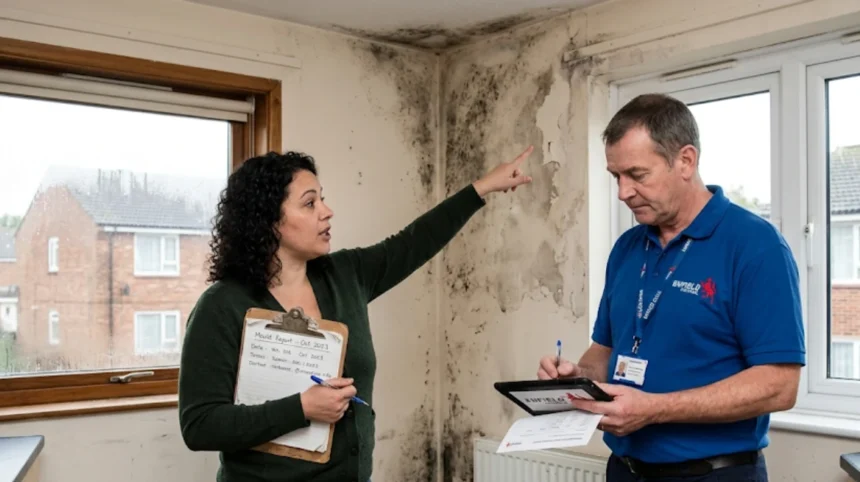
Enfield Council tenants should report damp and mould through the council repairs route as soon as the problem appears, then keep records of the issue, the dates, and all contact with the council. Enfield Council says residents should report the issue through its repairs service, and it has also set up a damp and mould policy and team to manage cases in council homes.
- What counts as damp and mould?
- How do Enfield tenants report it?
- What should a report include?
- What happens after you report it?
- What is Enfield Council’s legal duty?
- How does Awaab’s Law change this?
- What evidence should tenants keep?
- Why does the cause matter?
- How fast should tenants expect action?
- What if the council does not act?
- Why does this matter for North London?
- What is the clearest reporting approach?
What counts as damp and mould?
Damp and mould are moisture problems in a home that create visible staining, peeling surfaces, bad smells, or fungal growth, and they need a landlord response because they can damage the building and affect health. The government treats damp and mould as a housing hazard under the Housing Health and Safety Rating System, also known as HHSRS, which was introduced by the Housing Act 2004.
Damp usually means water entering or building up in the home. Mould is a visible fungus that grows where moisture stays trapped. The two issues often appear together because the same fault causes both.
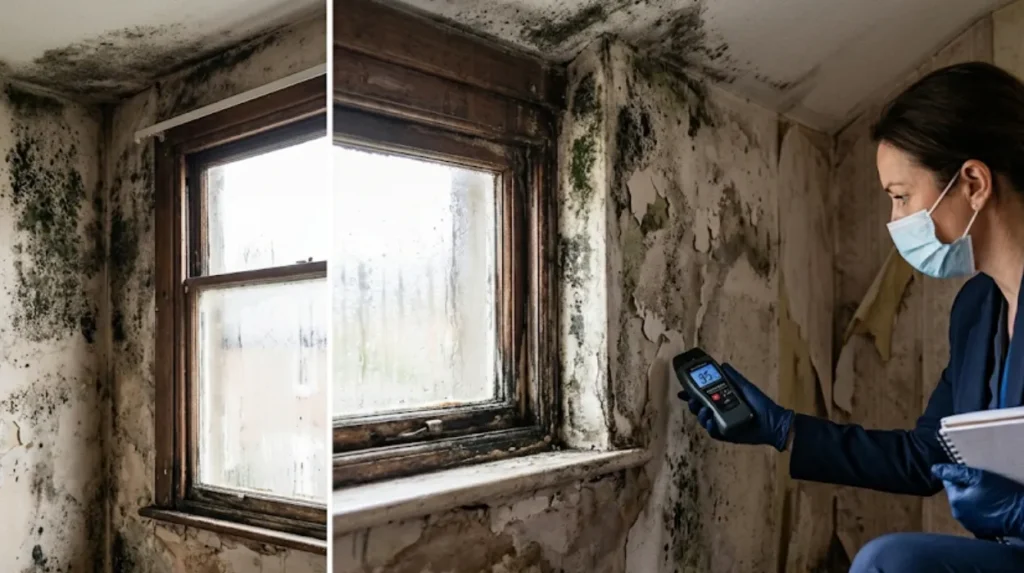
Common signs include:
- Black, green, or white mould on walls, ceilings, around windows, or behind furniture.
- Flaking paint, bubbling plaster, or stained patches.
- Condensation on windows and persistent musty smells.
- Water ingress from leaks, roof faults, gutters, pipes, or damaged seals.
How do Enfield tenants report it?
Enfield Council directs residents to report damp and mould through its repairs reporting route, and the council has publicly said residents should let it know quickly when an issue appears. Enfield Council’s video on treating damp and mould tells residents to “make a report at enfield.gov.uk/repairs,” and says the council wants issues reported quickly so they can be treated and prevented.
The council’s housing report also says the repairs service includes emergency, routine, and planned repairs, with contact managed through an in-house Housing Repair Resolution Centre.
The practical reporting route is:
- Use the council’s repairs reporting channel.
- Describe the exact room, surface, or fitting affected.
- State when the problem started.
- Say whether the mould is spreading, returning, or linked to a leak.
- Mention any health concerns or vulnerabilities in the household.
Written reporting matters because it creates a clear record. That record supports follow-up repairs, complaint handling, and any later legal or housing disrepair action.
What should a report include?
A strong report gives the council enough detail to identify the cause, inspect the property, and arrange the right repair. Enfield Council’s damp and mould policy, described in its March 2025 housing report, uses a dynamic risk assessment and aims both to remove the mould and to investigate the underlying cause so the problem does not return.
That means the report should focus on symptoms and causes, not only the visible mould. A clear report usually includes the date, location, extent of damage, and any water source such as a leak, broken extractor fan, cracked seal, or blocked gutter.
Include:
- Photos of the affected area.
- Video if water is actively entering the home.
- Notes on smell, condensation, or repeated recurrence.
- Messages you have already sent to the council.
- Details of children, older residents, disabled residents, or medical risks in the home.
If the issue affects a bedroom, bathroom, kitchen, or hallway, mention that directly. If the mould appears after rain, after heating use, or after plumbing activity, include that detail too.
What happens after you report it?
Enfield Council says it treats damp and mould as a repair issue, informs residents through the process, and carries out work to clean, repair, and update the resident during the job. In the council’s public video, staff explain that once the issue is reported, the team carries out treatment, clears the area, completes patch repairs, and keeps the resident informed through the process.
The council’s March 2025 housing report also says it created a dedicated damp and mould team within repairs and ERD, and that all Category One jobs were prioritised by a weekly damp and mould taskforce.
In practice, a report should lead to:
- An inspection or assessment.
- Cleaning or treatment of the mould.
- Repair of the underlying defect.
- Follow-up checks if the issue is complex.
- Escalation where the hazard is serious or recurring.
Enfield also says it uses a specialist damp surveying contractor for complex cases, which adds an independent assessment where needed. That matters when the cause is not obvious or when the issue keeps coming back after previous repairs.
What is Enfield Council’s legal duty?
Enfield Council, like every social landlord in England, must provide homes that are safe and deal with housing hazards such as damp and mould under housing law and public health enforcement rules. HHSRS, created under the Housing Act 2004, is the main hazard assessment system used by local authorities to identify risks in homes, including damp and mould growth.
The council report says Enfield completed thousands of HHSRS inspections and uses those inspections to identify hazards during wetter months, when damp issues become easier to detect.
This matters because damp and mould are not only maintenance issues. They are also health and safety issues. If a council home has a hazard serious enough to affect health or safety, the landlord must act.
How does Awaab’s Law change this?
Awaab’s Law makes social landlords respond to dangerous damp and mould within fixed time limits, and those rules came into force on 27 October 2025. GOV.UK says the regulations under Awaab’s Law came into force on 27 October 2025.
Guidance for social landlords states that, when a potential damp and mould hazard is reported, landlords must investigate within 10 working days, give a written summary within 3 working days after the investigation, and make the property safe within 5 working days if there is a significant risk.
The same guidance says emergency hazards require action within 24 hours, and temporary or alternative accommodation is required if the home cannot be made safe in time.ppconline+1
Enfield Council’s March 2025 report shows the council was already preparing for this regime in advance, with process changes, a damp and mould policy, a taskforce, and a dedicated team.
For tenants, the practical effect is clear: reports of damp and mould now trigger a stricter response standard in social housing than before.
What evidence should tenants keep?
Tenants should keep evidence from the first day they notice damp or mould, because proof supports repairs, complaints, and any later disrepair claim. Enfield Council’s own repair report notes that the repairs system has been updated, including an AI diagnostic tool called RepairSense to help track repeated damp and mould repairs.
Evidence helps the council see patterns that are easy to miss in a single visit. It also shows whether the problem was reported promptly and whether the landlord responded in time.
Keep:
- Dated photos.
- Screenshots of emails, texts, or webform submissions.
- A list of phone calls with dates and times.
- Copies of inspection notes or contractor visits.
- Any doctor’s note or health-related correspondence if the issue affects someone in the home.
If the mould returns after a clean or patch repair, keep before-and-after evidence. Repeated recurrence is often a sign of an unresolved building fault, not a cleaning problem.
Explore More Help & Resources
What rights apply when repairs are ignored in Enfield housing?
How to force action on delayed council services in Enfield?
Why does the cause matter?
The cause matters because mould removal without fixing the source only gives a short-term result. Enfield Council’s published approach says its aim is to remove the mould and investigate the underlying cause so it does not come back.
That distinction is important in council homes because moisture enters properties through different pathways. A leak, defective roof, broken extractor fan, poor sealing, cold bridging, or ventilation failure all need different repairs.
Typical causes include:
- Plumbing leaks, such as under sinks or behind baths.
- Roof or rainwater leaks, such as gutters and downpipes.
- Failed seals around windows or external walls.
- Poor ventilation in kitchens and bathrooms.
- Building defects that trap condensation inside cold surfaces.
A council can wipe mould away in one visit. It can only solve the problem by finding the reason it formed. That is why a proper report should mention where the mould appears and when it gets worse.
How fast should tenants expect action?
Damp and mould in social housing now falls under tighter statutory response times, and emergency conditions require the fastest action. Under the current Awaab’s Law guidance for social landlords, landlords must investigate a potential damp and mould hazard within 10 working days, provide written findings within 3 working days, and complete safety works within 5 working days if the case is significant.
Emergency hazards require action within 24 hours.
Enfield Council’s own report shows it was already building staffing and process capacity around this issue, including a dedicated team, weekly case management, and specialist surveying support.
That means tenants should not treat damp and mould as a routine cosmetic issue. It sits inside a formal repair and safety process with expected timeframes and documented follow-up.
What if the council does not act?
If the council does not act, tenants can escalate through complaints, environmental health, and housing disrepair routes, while keeping full records of the original report and follow-up. The council’s own report shows tenant satisfaction with complaints handling remained low, while the service continued to improve repairs, engagement, and safety systems.
That means tenants who do not get a response should move the issue up the chain, not wait indefinitely.
Escalation normally includes:
- Submitting a formal complaint.
- Reporting the hazard again in writing.
- Asking for inspection notes and target dates.
- Contacting environmental health if the home remains unsafe.
- Seeking specialist advice on housing disrepair if the problem continues.
The key point is documentation. An escalation works best when the tenant can show repeated reporting, visible deterioration, and the effect on daily living.
Why does this matter for North London?
Damp and mould affects many older and densely occupied homes across North London, so Enfield residents need a clear, local reporting habit that creates fast action and a paper trail. Enfield Council’s repair report shows the council has been investing in stock condition surveys, planned works, and repairs system changes to improve home standards and respond to hazards.
It also reports that 84.46% of homes met the Decent Homes Standard at the end of March 2024, rising from 64.1% in April 2023, which shows the scale of improvement work already underway.
For residents, the local lesson is simple. Report early, report in writing, and keep records. In council housing, that approach strengthens the repair case and supports the landlord’s duty to investigate hazards before they become more serious.

What is the clearest reporting approach?
The clearest approach is to report quickly, describe the problem precisely, store evidence, and follow up until the cause is fixed. Enfield Council’s public guidance says residents should let the council know about damp and mould issues and use the repairs route.
Its housing report shows the council has formalised a damp and mould policy, a specialist team, and a risk-based response model that treats underlying causes as well as visible mould.
How do I report damp and mould to Enfield Council?
Report damp and mould through Enfield Council’s housing repairs service as soon as you notice the problem. Include details of the affected areas, when the issue started, whether it is spreading or recurring, and any health concerns within your household.