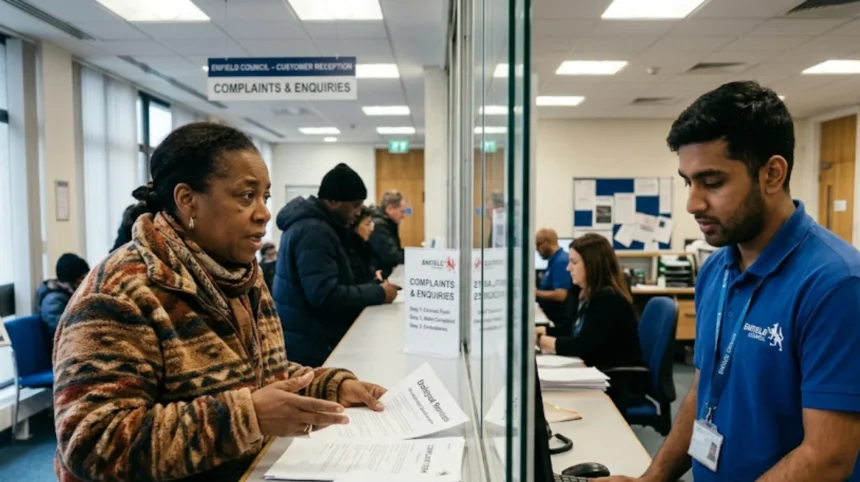
Delayed council services in Enfield are handled through a formal escalation path: contact the service team, make a written complaint, use the council’s complaints process, and then escalate to the Local Government and Social Care Ombudsman if the delay remains unresolved. Enfield Council’s published complaints process states that it aims to resolve first-stage complaints as soon as possible and within 10 working days, and the council gives residents a complaints route by phone, email, letter, and online form.
- What counts as a delayed council service in Enfield?
- How do you start forcing action?
- How do you make a formal complaint?
- What should the complaint say?
- What if the council does not answer?
- When can you go to the Ombudsman?
- What can the Ombudsman do?
- How do you escalate urgent cases?
- What evidence should you keep?
- What timelines matter in Enfield?
- What if the delay is in housing?
- What if the issue is planning or enforcement?
- What outcomes should you request?
- Why does escalation work?
- What is the best sequence to follow?
- What should North London residents remember?
What counts as a delayed council service in Enfield?
A delayed council service is any council function that is not delivered within a reasonable or published timeframe, including housing repairs, planning decisions, bin collections, adult social care responses, or complaint handling. Enfield Council uses a formal complaints system for service failures, and residents can complain when a service is unresolved after contacting the team responsible for it.
A delay becomes more serious when it affects health, safety, housing, or statutory duties. In practice, that includes missed repairs, slow safeguarding responses, long waits for assessments, and repeated failure to answer correspondence. The Local Government and Social Care Ombudsman also records Enfield cases involving delay, which shows that service delay is a recognised complaint ground in local government.

How do you start forcing action?
Start by contacting the service team directly and asking for a clear deadline in writing. Healthwatch Enfield says residents should first contact the team responsible for the service they are unhappy about, and only then move to a formal complaint if the issue stays unresolved.
Keep the message short and specific. State the problem, the date it began, the effect on you, and what action you want. Ask for one named officer or team to reply, because repeated handoffs often create more delay. Save every email, letter, screenshot, reference number, and call log, because evidence becomes important if you escalate later.
How do you make a formal complaint?
Make a formal complaint through Enfield Council’s complaints process if the service team does not resolve the delay. Enfield Council says it has a two-stage complaints process, and the council’s overview says the first stage aims to resolve complaints as soon as possible and within 10 working days.
You can complain by telephone, letter, or email, and Healthwatch Enfield lists Enfield Council’s customer services number as 0208 379 1000. Older published complaint guidance also shows the council accepts complaints by email and post, which confirms that written escalation is an established route. A written complaint should include the service area, the timeline of delay, the harm caused, and the remedy you want, such as a repair date, decision date, apology, or service review.
What should the complaint say?
The complaint should state the facts, the delay, the impact, and the remedy. Use dates and events, not emotion and not general criticism.
Include these points in one clear paragraph each:
- What service is delayed.
- When you first reported it.
- What the council promised.
- What happened instead.
- What you want now.
That structure helps the complaint officer identify the failure quickly and reduces the chance of a vague response. It also creates a cleaner record if the case later reaches an ombudsman.
What if the council does not answer?
If the council does not answer, chase the complaint in writing and ask for a stage update and a revised deadline. Enfield Council’s process is built around a two-stage model, so silence or repeated non-action at stage one is a valid reason to pursue escalation.
Use the phrase “formal complaint escalation” and ask for the complaint reference number. Ask for the complaint to be treated as unresolved if the service delay continues. If the council gives a new target date, record it and follow up on that date. A pattern of missed deadlines strengthens the case that the delay is systemic rather than temporary.
When can you go to the Ombudsman?
You can go to the Local Government and Social Care Ombudsman after the council’s complaints process is finished or if the council fails to deal with the matter properly. The Ombudsman investigates local authority complaint handling, including unreasonable delays and failures in the complaint process.
The Ombudsman’s decision records for Enfield include cases where the council apologised and made payments because of delay, which shows that delay can justify redress when it causes injustice. This route matters when the council has not acted, has taken too long, or has handled the complaint badly. The Ombudsman does not replace the council’s complaint process, but it gives residents a higher-level review when local resolution fails.
What can the Ombudsman do?
The Ombudsman can order a remedy where a council’s delay caused injustice. Remedies can include apologies, service recommitment, financial payments, or a review of procedures, depending on the fault and the harm.
The Ombudsman usually expects residents to use the council complaint process first. That makes your written complaint record essential. If the council ignores deadlines, sends incomplete replies, or repeatedly resets the clock, the Ombudsman file becomes stronger.
How do you escalate urgent cases?
Urgent cases need immediate written escalation to the council, with a clear explanation of risk and a request for same-day or next-day action. This applies where delay affects safety, homelessness risk, care needs, sanitation, disability access, or essential housing repairs.
State the immediate risk in plain language. For example, report loss of heat, damp and mould, blocked access, unsafe electrics, or failure to provide an assessment for a vulnerable adult. Councils treat these matters differently from ordinary service delays because the consequences are more serious. If the delay creates imminent danger, also use any emergency reporting route the council provides alongside the complaint route.
What evidence should you keep?
Keep a complete paper trail from the first report to the final reply. This is the strongest way to force action because it proves delay, repeated chasing, and failure to respond.
Keep:
- Complaint reference numbers.
- Email chains and screenshots.
- Call notes with dates and names.
- Photos or videos of the problem.
- Any letters, appointment slips, or missed-visit notices.
This record helps in three ways. It pressures the council to act, it supports complaint escalation, and it improves the chances of a successful Ombudsman complaint if the issue continues.
What timelines matter in Enfield?
The key published timeline is Enfield Council’s aim to resolve first-stage complaints within 10 working days. That figure appears in the council’s complaints process overview and gives residents a clear benchmark for challenge when the process stalls.
That does not mean every service issue is solved in 10 working days. It means the council has publicly set a complaint-handling expectation for stage one. If the reply comes late, is incomplete, or does not address the delay, you have a concrete basis to escalate. A long gap without a meaningful response also supports an Ombudsman referral when the process has clearly failed.
What if the delay is in housing?
Housing delays need faster escalation because they often affect safety and habitability. Enfield’s complaint routes still apply, but housing problems frequently justify urgent follow-up because the resident can suffer immediate harm from inaction.
If the issue is a repair, report it again and ask for a repair reference. If it is damp, mould, leaks, heating failure, pest control, or an unfit property issue, state the health impact and request urgent action in writing. If the council or its housing arm does not act, the complaint file should show the repeated delay, the dates, and the risk caused by the failure.
What if the issue is planning or enforcement?
Planning and enforcement delays should still be complained about through the council first, then escalated if the complaint is mishandled. Public complaint guidance and Ombudsman material both show that planning-service delay is a recognised local government complaint issue.
Planning cases are often slower because they involve consultation, policy checks, and legal process. That does not remove the resident’s right to complain about unreasonable delay, poor communication, or failure to follow process. If an enforcement matter stays inactive, record each report, each promise, and each missed deadline before escalation.
What outcomes should you request?
Ask for a practical remedy, not just a general apology. The best complaint outcomes are specific and measurable.
Request one or more of these:
- A fixed date for action.
- A named officer to manage the case.
- A written explanation for the delay.
- A service apology.
- A service review.
- Compensation where delay caused loss or distress.
A precise remedy is easier for the council to answer and easier for the Ombudsman to assess. It also makes the complaint less likely to be dismissed as a general expression of dissatisfaction.
Why does escalation work?
Escalation works because councils respond more quickly when a case becomes documented, time-bound, and reviewable. A service team can ignore a casual chase, but a formal complaint creates obligations, deadlines, and internal oversight.
The process also creates escalation pressure outside the council. If the matter reaches the Ombudsman, the council faces formal scrutiny of delay, process failure, and remedy. Published Ombudsman cases involving Enfield show that delay can end in apology and payment, which confirms that residents can obtain redress when the council fails to act properly.
Explore More Help & Resources
How effective are council anti-social behaviour reports?
Who to contact for neighbourhood disturbance complaints?
What is the best sequence to follow?
The best sequence is report, chase, complain, escalate, and refer to the Ombudsman if needed. This sequence reflects Enfield’s published complaints route and the external complaint review route available for unresolved local government issues.
Use this order in every serious delay case:
- Report the issue to the service team.
- Request a deadline in writing.
- Submit a formal complaint.
- Chase missed complaint deadlines.
- Escalate to the Ombudsman when local resolution fails.
That sequence keeps the case organised and makes the resident’s position clear. It also shows that every internal route was used before external review.

What should North London residents remember?
North London residents dealing with Enfield delays should rely on written evidence, fixed deadlines, and the council’s own complaints procedure. The strongest cases are specific, dated, and persistent, because they show the council had repeated chances to act but did not resolve the problem.
Enfield’s complaints system gives residents a formal route, and the Ombudsman gives them a second layer of accountability when the council fails. The key is to move from informal chasing to formal escalation quickly when the delay becomes prolonged, harmful, or ignored. That is the most effective way to force action on delayed council services in Enfield.
What should I do if Enfield Council is delaying a service?
Contact the relevant service team first and request a written update with a clear deadline. If the issue remains unresolved, submit a formal complaint through Enfield Council’s complaints process.