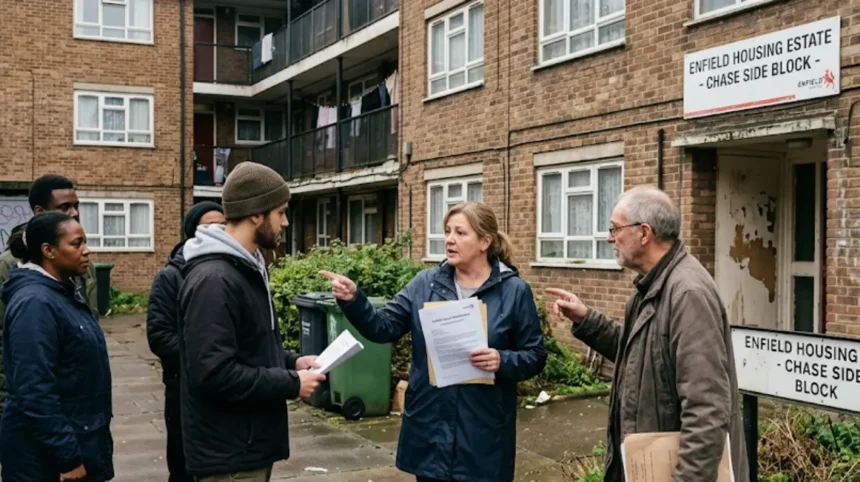
Residents in Enfield, a London borough in North London, have a clear set of legal and practical routes to address poor estate maintenance, including formal complaints to Enfield Council, engagement with freeholder or managing agent obligations, and escalation to the Housing Ombudsman or local MPs when necessary.
- What does “estate maintenance” mean in Enfield?
- Who is responsible for estate maintenance in Enfield?
- How do I report poor estate maintenance in Enfield?
- What steps can residents take if maintenance is not fixed?
- What are the legal rights of residents regarding estate upkeep?
- How have Enfield residents successfully challenged estate neglect?
- What role does Enfield Council play in estate maintenance?
- How can residents work together to improve estate conditions?
- What evidence should residents collect about estate maintenance issues?
- What happens if estate maintenance issues remain unresolved?
- How do estate maintenance standards affect safety and property value?
- What future improvements are expected for estate maintenance in Enfield?
What does “estate maintenance” mean in Enfield?
Estate maintenance refers to the upkeep of communal areas, structures, and services on a housing estate, including pathways, lighting, landscaping, bin areas, play space, and building safety systems, as defined by Enfield Council’s Estate Standards Guidance and standard UK property law.
In Enfield, estates may be council-managed housing, private developments, or mixed tenure schemes. The term “estate” covers both the outdoor communal environment and the shared parts of buildings. Poor maintenance typically includes litter, weeds, broken steps, damaged lighting, and failure to clean communal bin areas. These issues are documented in resident reports and local news, such as in Ponders End’s Electric Quarter estate, where residents have reported neglect and safety hazards since 2021.
Estate maintenance is not just aesthetic; it affects health and safety, access, and property value. Under the Housing Ombudsman’s landlord report for Enfield, the council acknowledges responsibilities for maintaining communal areas and responding to repair complaints. Private estates are governed by the terms of leases, management agreements, and the Landlord and Tenant Act 1987, which impose duties on landlords and managing agents to maintain shared parts.
Who is responsible for estate maintenance in Enfield?
Responsibility depends on tenure: Enfield Council maintains council estates; freeholders and managing agents maintain private estates; and mixed estates split duties between council and private parties, as set out in leases, management contracts, and Enfield’s Estate Standards Guidance.
On council-managed estates, Enfield Council is the landlord and holds responsibility for communal maintenance, including cleaning, repairs, lighting, and landscaping. This is the core duty of the council’s housing services and estates teams. Residents report issues via the council’s “report a problem” system, and the council is expected to respond within published timescales.
On private estates, the freeholder (often a developer or property company) and appointed managing agent are responsible. Leases specify who maintains roofs, communal halls, external walls, gardens, and pathways. In developments like Electric Quarter in Ponders End, the scheme was developed by Enfield Council and housebuilder Lovell, with ongoing maintenance expected to be managed by appointed agents. When agents fail, residents must push the freeholder or use legal channels.
Mixed tenure estates, common in newer regeneration schemes, involve shared responsibilities. Council housing parts fall under Enfield Council; private rented or owned parts fall under private landlords or agents. Residents must identify which entity controls each area. Complaints should be directed to the correct landlord or manager, not assumed to be the council alone.
How do I report poor estate maintenance in Enfield?
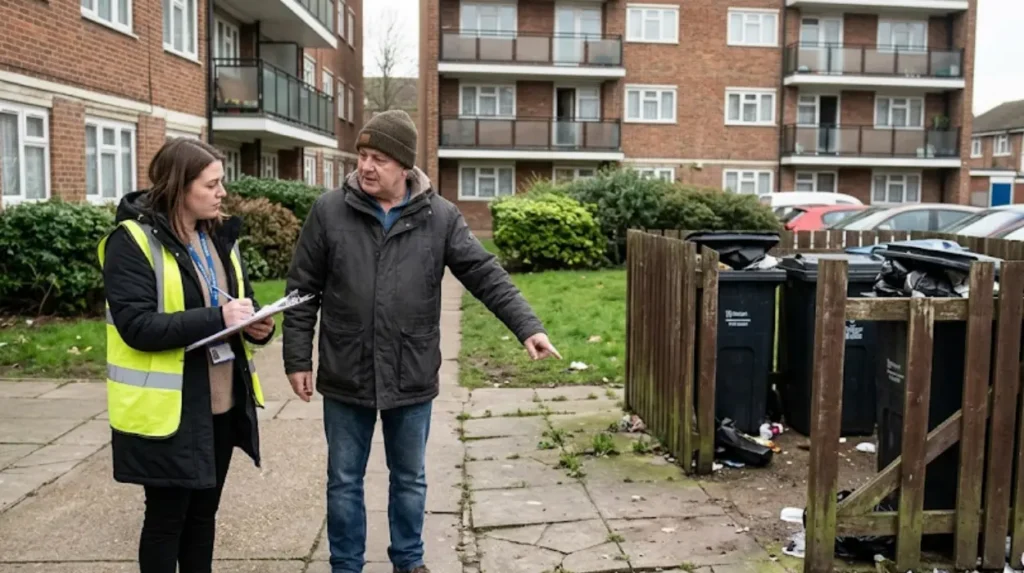
Residents report issues via Enfield Council’s online “report a problem” service, by phone, or in writing, specifying the estate, problem type, location, and evidence such as photos, then request a timeline and written response as required under the council’s complaints procedure.
Enfield Council operates a central reporting system for housing and estate issues. Residents can submit reports online, by phone, or by email. For best results, include the estate name, address, type of problem (e.g., “weeds in communal garden,” “broken step outside medical centre”), exact location, and date. Attach photos where possible. This creates a clear record and supports follow-up.
The council is expected to acknowledge reports and provide an initial response within a defined timeframe, usually within 5 working days for non-emergency issues. Residents should ask for a reference number and a scheduled inspection date. If the issue is not addressed within the agreed time, the resident can escalate to a formal complaint under the council’s complaints procedure.
For private estates, residents contact the managing agent or freeholder directly. Many developments have dedicated email addresses or customer service portals. If the agent does not respond, residents should escalate to the freeholder and, if needed, the Housing Ombudsman.
What steps can residents take if maintenance is not fixed?
Residents escalate by issuing a formal written complaint, requesting a timeline and written response, then contacting Enfield’s Housing Scrutiny Panel, the Housing Ombudsman, or the local MP if the landlord or agent fails to act, as supported by the council’s own scrutiny and ombudsman reports.
When a repair or maintenance issue is not addressed, the first formal step is a written complaint to the landlord or agent. This should include:
- A clear description of the problem
- Dates of previous reports
- Evidence (photos, emails)
- A request for a specific timeline and written response
The landlord or agent must respond under their complaints procedure. If the response is inadequate or the problem persists, the resident can escalate.
For council estates, residents can ask their local councillor to intervene, or request that the issue be considered by Enfield’s Housing Scrutiny Panel, which reviews performance and complaints about housing services. This panel can pressure the council to improve maintenance and address systemic issues.
For private estates, residents can escalate to the Housing Ombudsman if the landlord or managing agent fails to resolve the complaint within the required timeframe. The Ombudsman can order repairs, compensation, or policy changes. This route is supported by the Housing Ombudsman’s inspection of Enfield’s services, which highlights areas needing improvement.
Residents may also contact their local MP, who can press the council or landlord for action, especially in cases of repeated neglect or safety risks.
What are the legal rights of residents regarding estate upkeep?
Residents have rights under the Landlord and Tenant Act 1987, the Housing Act 2004, and lease terms, which require landlords and managing agents to maintain communal areas, respond to repair requests, and follow statutory housing standards, including safety and cleanliness obligations.
Under the Landlord and Tenant Act 1987, landlords must maintain the structure and exterior of buildings and communal areas, including pathways, lighting, and shared facilities. They must also respond to repair requests within a reasonable time. Failure to do so can be challenged through legal action or the Housing Ombudsman.
The Housing Act 2004 introduces the Housing Health and Safety Rating System (HHSRS), which assesses risks such as structural instability, damp, and inadequate lighting. Estates with serious hazards may be subject to enforcement by the council, including improvement notices or prohibition orders.
Leases and management agreements also set out obligations. For example, a lease may require the landlord to maintain communal gardens, clean bin areas, and repair broken steps. If the landlord fails, residents can seek enforcement through the courts or the Ombudsman.
Enfield Council’s Estate Standards Guidance reinforces these duties, setting expectations for cleanliness, safety, and maintenance on council-managed estates. This guidance is a public document that residents can use to benchmark performance and demand action.
How have Enfield residents successfully challenged estate neglect?
Residents in Ponders End’s Electric Quarter and Tower Point in Enfield Town have challenged neglect by documenting issues, engaging local media, contacting councillors, and pressing landlords for action, resulting in increased scrutiny and partial remediation of maintenance problems.
In Electric Quarter, residents reported weeds, litter, broken steps, and neglected landscaping. Local reporting and resident-led documentation led to media coverage and public criticism of the scheme’s maintenance. This raised awareness and pressured the council and developer to address the problems.
At Tower Point in Enfield Town, residents complained about fire safety defects and lack of communication from landlord Comer Property Management. They reported delays in receiving information about defects and inability to sell or remortgage due to lack of EWS1 certificates. Their persistent complaints and media coverage led to ongoing scrutiny of the landlord’s performance.
These cases show that residents can succeed by combining documentation, media engagement, and formal complaints. They also demonstrate the importance of following up with councillors, the Housing Scrutiny Panel, and the Housing Ombudsman when necessary.
What role does Enfield Council play in estate maintenance?
Enfield Council is responsible for maintaining council-managed estates, sets standards for communal areas, and operates a complaints and scrutiny process to address maintenance failures, as outlined in its Estate Standards Guidance and Housing Scrutiny Panel minutes.
The council defines estate maintenance standards, including cleaning frequency, lighting, landscaping, and safety. It operates a reporting system for residents to flag issues and responds within published timescales. The council is expected to act on complaints and repair requests, and to escalate systemic problems to the Housing Scrutiny Panel.
The Housing Scrutiny Panel reviews council performance on housing and estate issues, including maintenance complaints. It can recommend improvements, question council officers, and push for action on neglected estates. Residents can request that specific issues be considered by this panel.
The council also monitors private estates indirectly, through enforcement of housing standards and safety regulations. If a private estate fails to meet statutory requirements, the council can issue improvement notices or take legal action.
How can residents work together to improve estate conditions?
Residents form or join estate groups, share evidence of maintenance failures, coordinate complaints, and engage councillors and local media to raise the visibility of issues, as demonstrated by resident-led campaigns in Ponders End and Enfield Town.
Residents on the same estate can form a group to share updates, document issues, and coordinate action. Groups can collect photos, dates, and descriptions of maintenance problems, then submit joint complaints to the landlord or council. This increases the weight of complaints and shows systemic failure.
Groups can also contact local councillors to request estate visits, meetings, and updates. Councillors can raise issues at council meetings, press for action, and involve the Housing Scrutiny Panel. Local media can amplify resident concerns, as seen in Ponders End and Enfield Town, where media coverage led to increased scrutiny and partial remediation.
Residents can also work with tenant associations, if they exist, or form new ones. This provides a formal structure for complaints and negotiations with landlords or agents.
What evidence should residents collect about estate maintenance issues?
Residents must collect clear photos, written descriptions, dates of reports, and responses from landlords or the council, organizing evidence by estate, area, and problem type, to support complaints, escalation, and potential legal or ombudsman action.
Evidence should include:
- Photos of the issue (e.g., weeds, litter, broken steps)
- Written descriptions of the problem and location
- Dates when the issue was first noticed and reported
- Copies of emails, letters, or online submissions to the landlord or council
- Responses from the landlord or council, including timelines and actions promised
This evidence forms a record that supports formal complaints, escalation to the Housing Ombudsman, or legal action. It also helps demonstrate repeated failures or neglect, which is important for Ombudsman or council scrutiny cases.
Residents should store evidence in a shared folder or group document, especially if working as part of an estate group. This ensures transparency and coordination.
Explore More Help & Resources
How to check council housing status in Enfield?
Why are temporary accommodations used in Enfield so often?
What happens if estate maintenance issues remain unresolved?
If maintenance issues remain unresolved, residents can escalate to the Housing Ombudsman for private estates, request council scrutiny for council estates, or seek legal remedies, with potential outcomes including enforced repairs, compensation, or policy changes.
For private estates, the Housing Ombudsman can investigate complaints about landlords or managing agents and order remedies, including repairs, compensation, or changes to maintenance policy. The Ombudsman’s report on Enfield highlights the need for better complaint handling and maintenance responses.
For council estates, the Housing Scrutiny Panel can review complaints and performance, press for action, and recommend improvements to council services. Residents can request that specific issues be considered by the panel.
If both routes fail, residents may seek legal remedies, such as claims for breach of lease or statutory duties. This requires evidence, legal advice, and sometimes court action. Legal outcomes can include enforcement of maintenance duties and compensation.
How do estate maintenance standards affect safety and property value?
Poor estate maintenance directly impacts safety and property value, as neglected areas increase risks from structural defects, hazardous pathways, and unsafe lighting, and reduce marketability due to aesthetic and functional decline, as seen in Ponders End and Enfield Town.
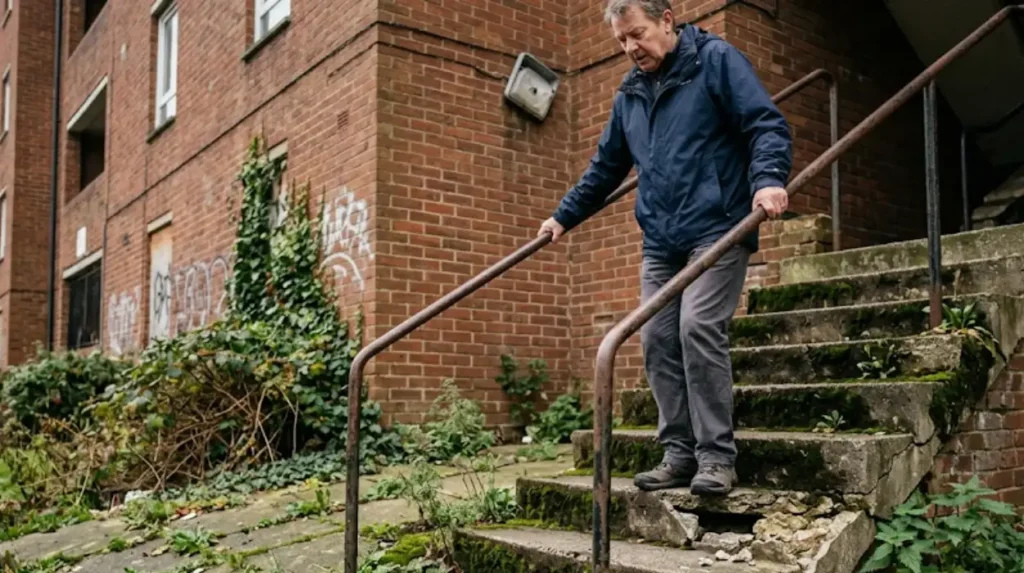
In Ponders End, broken steps and loose stones were described as health and safety issues, posing risks to residents and visitors. Weeds and litter degrade the environment and lower the perceived value of the estate. These issues reduce the attractiveness of the area and can affect property prices.
In Enfield Town, fire safety defects and lack of communication from the landlord left residents unable to sell or remortgage. This directly impacts property value and marketability. Poor maintenance and safety concerns can also lead to enforcement actions, which further affect reputation and value.
Residents should treat maintenance issues not just as aesthetic problems but as safety and financial risks. Documentation and action are essential to protect both.
What future improvements are expected for estate maintenance in Enfield?
Enfield Council is expected to continue refining estate standards, improving complaint handling, and working with residents and developers to address systemic neglect, guided by Housing Scrutiny Panel recommendations and Housing Ombudsman findings.
The council’s Estate Standards Guidance sets out expectations for maintenance, cleanliness, and safety on council estates. Future improvements may include clearer timelines, better communication with residents, and more proactive inspections.
The Housing Scrutiny Panel and Housing Ombudsman reports highlight areas for improvement, including response times, complaint handling, and maintenance standards. These findings are likely to influence policy and practice.
Residents can expect gradual improvements, but continued engagement and complaint escalation are necessary to ensure progress. Joint action by estate groups, councillors, and media remains a key driver of change.
What is estate maintenance in Enfield?
Estate maintenance refers to the upkeep of communal areas and shared facilities on housing estates, including pathways, lighting, landscaping, bin stores, play areas, parking areas, communal entrances, and safety features. Proper maintenance helps keep estates safe, clean, and accessible for residents.