The continuous degradation of asphalt surfaces creates severe financial and mechanical risks for road users across the United Kingdom. Potholes form when water penetrates macroscopic cracks in the road surface, freezes during sub-zero temperatures, expands, and weakens the underlying sub-base structural integrity. Subsequent mechanical load from passing vehicular traffic collapses the unsupported surface layer, leaving a depression with sharp structural edges. When a vehicle strikes these structural depressions, the sudden kinetic impact causes immediate or progressive mechanical degradation. Identifying the specific entity legally responsible for repairing this damage requires a detailed understanding of public highway law, local government boundaries, and statutory defense frameworks.
- Which entity is responsible for maintaining the roads in North London?
- What specific laws govern pothole damage claims in England?
- How do councils decide if a pothole is severe enough to justify compensation?
- What types of vehicle damage are caused by road surface defects?
- What evidence must a motorist collect to submit a valid claim?
- How do you submit a formal claim to a North London council?
- What steps should a driver take if a council rejects their claim?
Which entity is responsible for maintaining the roads in North London?
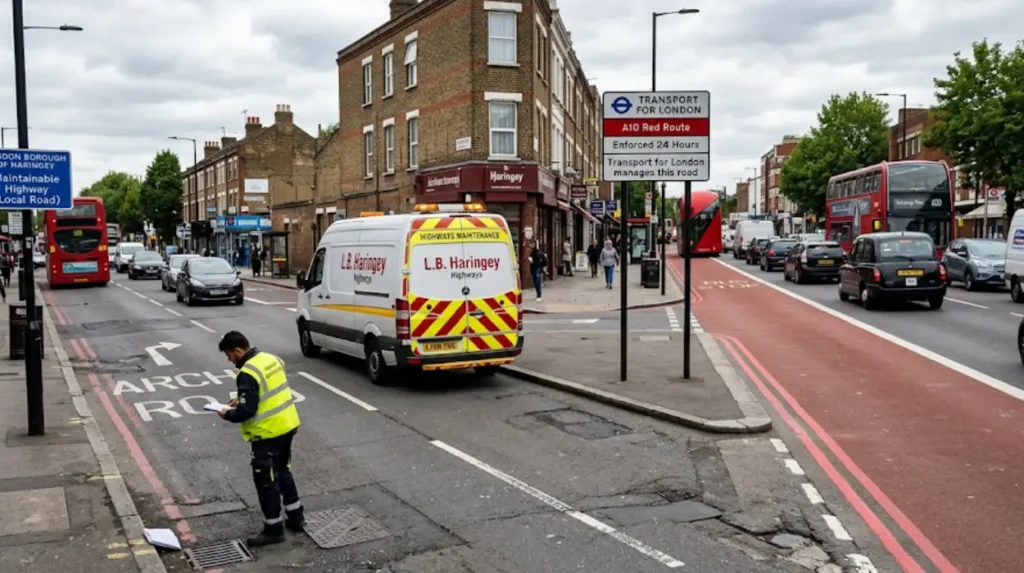
The local borough council holds legal responsibility for maintaining standard public roads in North London, while Transport for London manages all red routes. The specific governing authority depends entirely on the geographical boundary and the statutory classification of the highway.
Local Borough Boundaries
North London is divided into specific administrative zones managed by distinct local government authorities known as borough councils. The London Borough of Barnet, the London Borough of Enfield, the London Borough of Haringey, the London Borough of Camden, the London Borough of Islington, and the London Borough of Hackney each act as the local highway authority for the public streets within their municipal borders.
Under these administrative frameworks, the local council possesses a statutory obligation to inspect, maintain, and repair all adopted roads. Adopted roads are highways maintainable at the public expense. This category excludes unadopted or private roads, where the adjacent property owners hold collective civil liability for maintenance and surface defects.
Transport for London Transport Network
The administrative structure changes when a vehicle travels on the Greater London Road Network, which are designated as “red routes” due to the red line road markings indicating strict stopping restrictions. Transport for London, a functional body of the Greater London Authority established under the Greater London Authority Act 1999, serves as the highway authority for these specific strategic corridors.
Red routes constitute less than five percent of the total road network in London but carry over thirty percent of all London traffic. Examples of strategic North London red routes include the A406 North Circular Road, the A10, the A41, and portions of the A1. If vehicle damage occurs on an identified red route, Transport for London, rather than the local borough council, faces potential liability for the structural failure.
What specific laws govern pothole damage claims in England?
The Highways Act 1980 serves as the primary legislation governing road maintenance and civil claims for vehicle damage in England. Section 41 imposes an absolute duty to maintain highways, while Section 58 provides a statutory defense for local authorities.
The Statutory Duty of Maintenance
Section 41 of the Highways Act 1980 imposes a strict statutory duty on the designated highway authority to maintain the highways maintainable at the public expense. The legal term “maintain” translates to a continuous obligation to keep the fabric of the road in such a state of repair as to render it reasonably safe for ordinary traffic.
This legislative mandate means that if a structural defect arises that makes the road unsafe, the highway authority breaches its statutory duty under civil law. A claimant seeking financial compensation for vehicular damage must establish that the highway was maintainable at public expense, that the road surface was in a dangerous condition due to a lack of maintenance, and that this failure caused the specific mechanical damage.
The Section 58 Defense Framework
The statutory obligation under Section 41 is balanced by a powerful legal defense granted to highway authorities under Section 58 of the Highways Act 1980. Section 58 establishes that a highway authority is not liable for structural damage if it proves that it took reasonable care to ensure the highway was not dangerous to traffic.
To successfully execute a Section 58 defense in court, the local borough council or Transport for London must provide documented evidence of their operational protocols. The court examines specific legislative factors to determine whether the authority took reasonable care:
- The specific classification of the highway and the volume of traffic expected to use it.
- The standard of maintenance appropriate for a road of that character.
- The frequency and efficacy of official safety inspections.
- The actual state of repair a reasonable person expects to find on that specific highway.
- Whether the authority knew, or could reasonably be expected to know, that the condition of the road was likely to cause danger.
How do councils decide if a pothole is severe enough to justify compensation?
Councils use precise structural dimensions known as investigatory thresholds to determine if a pothole requires immediate intervention. Most North London boroughs establish a minimum depth of 40 millimeters on carriageways before accepting potential legal liability for damage.
Investigatory Threshold Dimensions
Local authorities do not inspect roads arbitrarily; they operate under national guidance documents, specifically the “Well-managed Highway Infrastructure” code of practice. This framework shifts maintenance from rigid standards to a risk-based assessment approach. However, for a structural defect to be classified as an actionable actionable hazard that binds the council to reactive repairs, it must meet specific physical metrics.
On standard asphalt carriageways throughout Barnet, Haringey, and Enfield, the established investigatory threshold for a pothole is a minimum depth of 40 millimeters combined with a horizontal diameter exceeding 300 millimeters. For pavement areas, footways, and dedicated cycle tracks, the intervention threshold drops to a minimum depth or vertical lip of 20 millimeters due to the increased vulnerability of pedestrians and cyclists.
Risk-Based Categorization Matrix
When a highway inspector identifies a surface defect, or when a member of the public submits a formal report, the defect undergoes categorization using a risk matrix. This process evaluates the likelihood of an incident occurring alongside the potential severity of the consequences.
- Category 1 Defects: Structural anomalies that present an immediate, critical danger to road users. These defects require an emergency response, forcing contractors to make the area safe or execute a temporary patch repair within 2 to 24 hours of identification.
- Category 2 Defects: Non-urgent structural failures that do not pose an immediate safety risk but exhibit progressive deterioration. These are scheduled for permanent repair within a specific timeframe, ranging from 7 to 28 working days, depending on road priority.
If a vehicle suffers a structural impact from a defect that falls below the 40-millimeter threshold, councils routinely reject the compensation claim. The authority argues that the road surface was in a reasonably safe condition for ordinary use, precluding any negligence or breach of Section 41.
What types of vehicle damage are caused by road surface defects?
Pothole impacts induce severe mechanical forces that damage specific vehicular sub-systems, including tires, wheels, suspension assemblies, and steering components. The sudden vertical acceleration strains components beyond their structural design limits, causing immediate failure or progressive alignment degradation.
Wheel and Tire Degradation
The tire acts as the primary contact point between the vehicle and the highway surface. When a wheel strikes the sharp edge of an actionable pothole, the tire casing undergoes extreme compression against the rigid metal rim of the wheel. This compression causes specific structural failures:
- Sidewall Bulges: Internal tearing of the structural cord plies, allowing inflation pressure to push out the outer rubber layer.
- Tread Lacerations: Deep cuts caused by contact with fragmented, sharp asphalt edges.
- Pinch Shocks: Immediate deflation due to a ruptured inner liner.
Wheels constructed from alloy materials face high rates of deformation and fracturing. The impact force can bend the inner or outer wheel lip, destroying the airtight bead seal and inducing structural vibrations. High-velocity impacts can crack the structural spokes of cast aluminum wheels entirely, necessitating complete component replacement.
Suspension and Steering Malfunctions
Beyond the wheel assembly, the kinetic energy from a road surface defect transfers directly into the suspension system. This energy damages complex mechanical links and joints:
- Shock Absorbers and Struts: The hydraulic fluid seals rupture under high pressure, causing fluid leaks and a complete loss of damping capability.
- Suspension Springs: Coil springs can snap under extreme, sudden vertical compression.
- Control Arms and Ball Joints: The steel or aluminum arms bend out of specification, while the protective rubber boots on ball joints tear, leading to rapid contamination and mechanical play.
The steering geometry is highly sensitive to external lateral and vertical forces. Impacts alter the precise angles of wheel alignment, specifically the toe-in, camber, and caster settings. This structural misalignment causes the vehicle to pull toward one side of the roadway, accelerates uneven tire tread wear, and degrades the steering rack internal gears.
Explore More Help & Resources
What Happens After Reporting Pavement Damage to Council in North London
How to Report Dangerous Potholes in Local Roads Across North London
What evidence must a motorist collect to submit a valid claim?
A motorist must compile comprehensive physical, geographical, and mechanical evidence to build a legally valid claim against a highway authority. The documentation must prove the exact location, the physical dimensions of the defect, and the direct causation of damage.
Scene Documentation and Geometry
An individual must document the scene immediately following an incident, provided it is safe to do so under traffic conditions. The claimant must capture clear photographs of the pothole, including wide-angle shots to establish the macro context of the road and close-up views showing the interior details of the defect.
To prove the defect meets the investigatory thresholds of North London councils, the claimant must measure the depth and width using a standardized measuring tool or a common reference object placed inside the depression. The exact geographical coordinates must be recorded using Global Positioning System data, cross-referenced with local landmarks, road names, and house numbers to prevent any ambiguity regarding borough jurisdiction.
Mechanical Reports and Financial Substantiation
The claimant must prove a direct causal link between the road defect and the mechanical failure. This requires immediate preservation of the damaged components and comprehensive professional inspection records:
- Independent Garage Diagnoses: A itemized diagnostic report from a certified automotive technician specifying the damaged components and confirming the damage matches a sudden impact event.
- Wheel Alignment Printouts: Pre-repair and post-repair geometric data sheets demonstrating deviation from manufacturer tolerances.
- Comprehensive Financial Invoices: Official receipts and VAT invoices detailing the costs incurred for parts, labor, and necessary vehicle recovery services.
How do you submit a formal claim to a North London council?
Submitting a claim requires using the specific online portal or risk management department of the borough where the incident occurred. The claimant must complete a formal public liability claim form and upload all supporting evidentiary documentation.
Digital Portal Submissions
Each North London borough maintains an independent administrative framework for processing highway liability claims. The claimant must navigate to the specific council website—such as the Barnet, Haringey, or Enfield portal—and locate the section dedicated to insurance, risk management, or highway maintenance.
The claimant must input the precise date, exact time, weather conditions, and speed of travel at the moment of impact. The digital system requires attaching the gathered photographic evidence and professional repair invoices. If the incident occurred on a boundary road splitting two boroughs, the claim must be submitted to the council responsible for maintaining that specific side of the carriageway, as defined by local administrative boundary maps.
Administrative Assessment Procedures
Once a claim enters the council system, it undergoes a formal review process managed by the authority’s internal insurance department or an external claims handling provider. The legal handlers request the specific inspection logs and maintenance records for that section of road covering the 12 months prior to the incident.
If the records show the council performed its scheduled safety inspections according to its code of practice and no prior reports of the defect existed, the handler issues a formal denial of liability under Section 58 of the Highways Act 1980. If the council failed to inspect the road within its mandated timeframe, or if it ignored a previously validated Category 1 defect report, the handler can offer a financial settlement to cover the proven repair costs.

What steps should a driver take if a council rejects their claim?
If a highway authority denies liability, the driver can challenge the decision by submitting a Freedom of Information request for detailed maintenance records. If the records reveal systemic maintenance failures, the claimant can pursue formal legal action through the Small Claims Court.
Freedom of Information Audit
A formal rejection letter from a council insurance handler is standard procedure and relies heavily on the Section 58 defense. To verify if the council actually fulfilled its legal obligations, the claimant must submit a formal request under the Freedom of Information Act 2000. The request must demand specific public documents for the highway in question:
- The road’s official maintenance category and its mandated inspection frequency.
- All inspection records, road surveyor logs, and defect reports for the preceding 24 months.
- Records of all public complaints or automated reports concerning that specific defect.
- The exact dates and structural descriptions of any repairs executed at that location after the claimant’s incident.
If the returned Freedom of Information data reveals the council missed its scheduled inspection cycles, or that multiple road users reported the exact pothole weeks prior without any remedial intervention, the Section 58 statutory defense fails. The claimant can present this data to the insurance handler to demand a formal reconsideration of the claim.
Small Claims Court Proceedings
If the council maintains its denial of liability despite evidence of administrative or operational failure, the claimant can initiate legal proceedings through the County Court Business Centre, commonly known as the Small Claims Court. The claimant must issue a formal “Letter Before Action” to the council, outlining the legal basis of the claim, the statutory breach under Section 41, the evidence debunking the Section 58 defense, and a final 14-day deadline for financial reimbursement.
If the council does not settle, the claimant files a claim via the online Civil Money Claims portal. The case undergoes evaluation by a District Judge in a local County Court hearing, such as the Barnet County Court or the Edmonton County Court. The judge reviews the physical evidence of the defect alongside the council’s inspection history to deliver a final, binding judgment on civil liability.
Who is responsible for maintaining roads in North London?
Local borough councils are responsible for maintaining most public roads in North London, while Transport for London maintains major Red Route roads such as parts of the A406 North Circular Road and other strategic transport routes.