Key Points
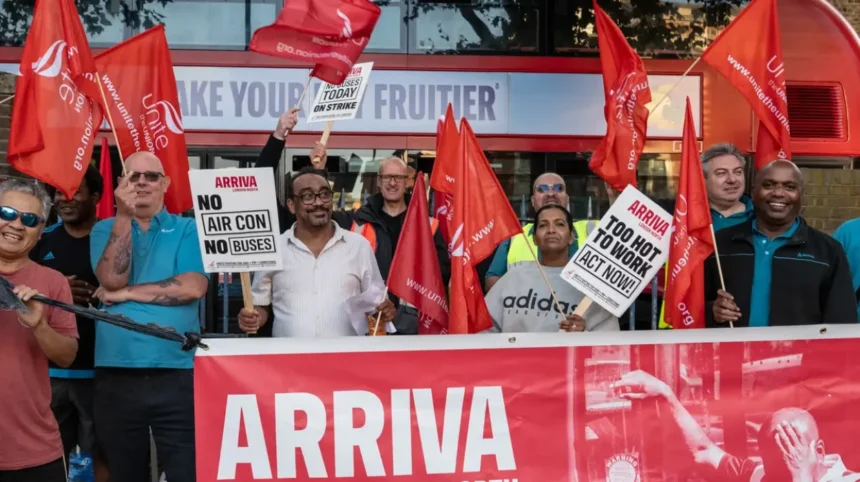
- Bus drivers working with Arriva North London have agreed to a new deal after staging strikes as a result of their conditions during summer heat waves.
- The trade union named Unite was negotiating on behalf of these workers who had gone on strike over the lack of proper air conditioning in the buses.
- The ballot resulted in a total of 667 votes being cast in favour of this agreement, while 339 voted against. This means that out of the eight garages in north and east London, seven of them have accepted the new deal, but two of them voted against it.
- It is not known to the public what financial and other benefits the deal entails.
- According to reports from union representatives, there is still a live strike mandate that will be valid for eleven months from now.
North London (North London News) September 5, 2026 – Arriva North London bus drivers represented by the Unite trade union have officially voted to accept an improved operational agreement, concluding a high-profile industrial dispute focused on extreme working temperatures in vehicle cabs. The ballot result, which passed by 667 votes to 339, led to the suspension of scheduled strike actions across eight bus depots situated throughout north and east London. The primary catalyst for the dispute was the absence or malfunction of cab air conditioning during record-breaking summer heatwaves, which drivers argued posed direct risks to workforce health and passenger safety.
- Key Points
- What Led to the Rejection of Previous Management Proposals?
- What Are Union Representatives Saying About the Accepted Deal?
- Could Industrial Action Resume in North London?
- Background of the Particular Development
- Prediction: How This Development Can Affect London Commuters and Transport Workers
Despite the overall majority in favour of accepting the management’s revised terms, the outcome revealed notable division amongst the workforce. Approximately one-third of voting members favoured continuing the industrial action to secure further concessions, with union members at two specific garages voting to reject the deal entirely. The precise terms, timelines, and technical provisions contained within Arriva’s accepted offer have not been made available for public disclosure by either party involved in the negotiations.
What Led to the Rejection of Previous Management Proposals?
The agreement follows weeks of strained negotiations between Arriva management and union delegates. A prior proposal presented by the company two weeks ago was rejected by a majority of Unite members, who cited a lack of enforceable timelines regarding the physical installation and maintenance of climate control systems within the fleet.
As reported by Charlie Kimber of Socialist Worker, an unnamed striking bus driver stated that
“Management had offered us some of the things we want, but we wanted more clarity on when the air conditioning would be installed.”
The worker added,
“We’ve had talk after talk, year after year—this time we wanted commitments.”
Drivers highlighted that operational delays in addressing vehicle maintenance had previously left staff exposed to excessive cabin temperatures during peak summer periods, driving the requirement for explicit, legally binding implementation dates rather than verbal assurances.
What Are Union Representatives Saying About the Accepted Deal?
Trade union officials have characterised the accepted offer as a substantial step forward for public transport workers nationwide, framing the dispute as a precedent for workplace standards under changing climate conditions.
As reported by Charlie Kimber of Socialist Worker, Peter, a Unite union shop steward stationed at the Wood Green bus garage, stated that the latest offer represented a “very significant improvement.” Peter noted that the industrial action had exerted measurable pressure on Arriva executives, forcing them to re-enter negotiations with enhanced terms. He remarked,
“Everybody is saying London is leading the way. This could be the best improvement in the country—the union wants to try to get it rolled out.”
However, representatives also noted that finalising written terms presented challenges during the closing stages of talks. As reported by Charlie Kimber of Socialist Worker, Peter stated:
“When we put across some specific points, they don’t want to agree to it. All of a sudden, they won’t put it in writing. Bus workers have done the hard yards. But now they want the detail. So there was a debate about whether to pocket the win or whether to say ‘now they are on the ropes—we are going to knock them out’.”
Could Industrial Action Resume in North London?
While the immediate strike action across the eight depots has been called off, union officials emphasized that the dispute is not permanently closed if implementation commitments are missed.
As reported by Charlie Kimber of Socialist Worker, Peter stated prior to the announcement of the ballot result:
“If we do accept the offer and they don’t stick to it, we do still have a live mandate for the next 11 months. And we only have to give ten days’ notice of more strikes—ten days’ notice and we are out again.”
The steward also addressed broader concerns regarding working conditions across varying seasons, stating:
“The heat in summer and the cold in winter affect every bus driver. It gets hot every summer and cold in winter and the bus companies act like this is a surprise. We have got climate change so we will get more summers like this. So fix the buses—or give us an agreement where we don’t have to work freezing cold or red hot.”
Background of the Particular Development
The dispute between Arriva North London and Unite forms part of a broader series of industrial actions within the United Kingdom’s public transport sector addressing working conditions, vehicle maintenance, and safety regulations amidst shifting environmental patterns. Over recent years, surface transport operators in London have faced increased scrutiny from health and safety regulators and trade bodies regarding cab temperatures. Under current UK health and safety regulations, there is no statutory maximum working temperature, though employers are legally required to maintain a “reasonable” thermal environment under the Health and Safety at Work etc. Act 1974.
As global temperature trends lead to more frequent and intense summer heatwaves across the UK, public transport fleets—many of which feature older rolling stock or retrofitted cooling systems—have frequently experienced mechanical failures. Transport for London (TfL) has previously introduced guidelines requiring functional driver air conditioning, but enforcement and retrofitting schedules across contracted private operators, such as Arriva, have remained a central point of friction between union branches and private sector transport management.
Prediction: How This Development Can Affect London Commuters and Transport Workers
The resolution of this strike action and the potential for future industrial enforcement carry immediate implications for both public transport operators and the travelling public across London.
- For Bus Passengers and Commuters: The immediate suspension of industrial action prevents widespread travel disruption across north and east London routes serviced by Arriva. However, because one-third of the unionised workforce voted against the deal and two garages rejected it, underlying workplace friction remains. If Arriva fails to meet scheduled deadlines for air conditioning upgrades, the existing 11-month mandate allows Unite to call further strikes on ten days’ notice, creating ongoing operational uncertainty for daily commuters.
- For Public Transport Workers and Operators: The outcome sets an industry precedent regarding health and safety demands tied to climate conditions. Transport operators across the UK may face heightened pressure from union branches to standardise cab environmental controls, leading to increased capital expenditure on fleet retrofitting and preventive maintenance. Other transport unions are likely to utilize this settlement as a benchmark to demand enforceable climate-control clauses in future collective bargaining agreements.