Key Points
- Mayoral Intervention: The Greater London Authority (GLA) has officially used its devolved statutory powers to “call in” and completely overturn Barnet Council’s previous rejection of two major housing developments.
- 1,768 Total Homes Approved: The structural decision greenlights a combined total of 1,768 new residential properties across two highly contested sites in north London.
- Great North Leisure Park Regeneration: A massive mixed-use masterplan in Finchley will replace a car-dominated brownfield leisure complex with 1,485 new homes across 20 buildings rising up to 25 storeys, alongside a new sports facility and outdoor lido.
- High Barnet Station Car Park Project: A secondary transit-oriented development will construct 283 low-energy passive-house apartments spanning five blocks between five and 11 storeys over an active London Underground parking facility.
- Affordable Housing Allocations: The Finchley site will feature 25 per cent affordable housing (341 units), while the High Barnet tube station site guarantees a 40 per cent affordable housing provision (approximately 113 homes).
- Political Fallout: The executive decision has triggered swift local political friction, drawing explicit public criticism from local Labour Members of Parliament and borough councillors who argued the designs violated local planning parameters and local context.
Barnet (North London News) May 30, 2026 – In a sweeping display of devolved regional authority, City Hall has formally intervened to strip Barnet Council of its planning jurisdiction, unilaterally reversing the local authority’s democratic decisions to reject two massive residential developments that will introduce more than 1,700 new homes to the outer London borough.
- Key Points
- How Did Local Communities and Civic Planning Officials Respond to the City Hall Overturn?
- What Justification Did the Greater London Authority Provide for Overriding Local Planning Democracy?
- What Specific Structural Details and Public Amenities Form the Basis of the Great North Leisure Park Masterplan?
- Why Is the High Barnet Tube Station Car Park Development Drawing Sharp Criticism From Members of Parliament?
- Background of the Development
- Prediction
- Regional Political Fallout
Acting on behalf of the Mayor of London, Deputy Mayor for Planning and Regeneration Jules Pipe issued an executive determination on Wednesday, May 27, 2026, following an exhaustive public call-in hearing. The sweeping ruling directly overrides the unanimous, cross-party refusals issued by Barnet Council’s planning committee in December 2025.
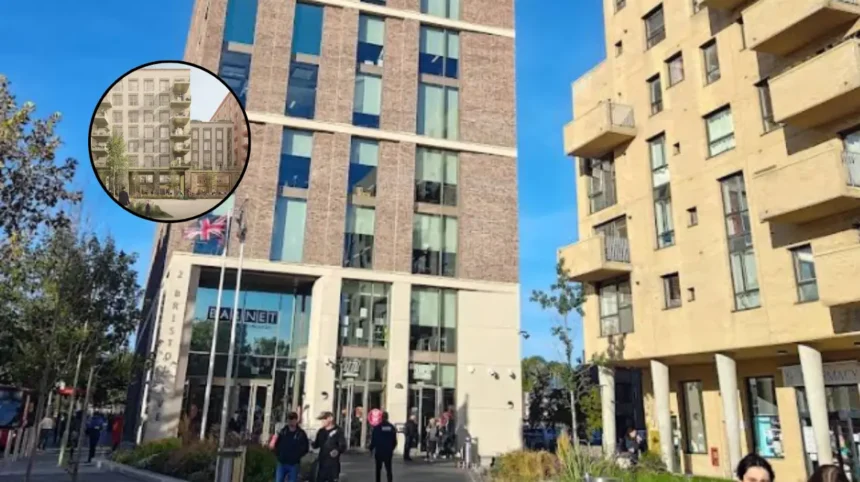
The primary target of the Mayoral intervention is the sprawling Great North Leisure Park site in Finchley, where international developer Arada London—formerly operating as Regal London prior to its acquisition by the UAE-based Arada Group in September 2025—will now construct 1,485 new properties across a dense network of 20 high-rise blocks scaling up to 25 storeys.
Simultaneously, Pipe granted binding planning permission for a secondary, transit-oriented development directly adjacent to High Barnet tube station, approving 283 flats on an underutilised commuter car park site managed via a joint venture between Barratt London and Places for London, the dedicated property arm of Transport for London (TfL).
The twin approvals underscore a highly calculated shift by the Greater London Authority toward an overtly “interventionist” planning model, purposefully designed to bypass localized political opposition and accelerate housing delivery across a capital city consistently lagging behind its statutory macro-development targets.
How Did Local Communities and Civic Planning Officials Respond to the City Hall Overturn?
The public hearing at City Hall exposed sharp ideological divisions between regional housing strategists, local authority representatives, and civic preservation societies over the physical limitations of suburban density.
As reported by Kumail Jaffer, Local Democracy Reporter for the Barnet Post, James Langsmead, a deputy planning manager at Barnet Council, formally testified to the public hearing panel that the local planning committee had initially rejected the applications because the collective height, scale, massing, and bulk of the residential blocks would be fundamentally “out of character” with the established low-rise suburban fabric of Finchley and High Barnet.
Langsmead further emphasized to regional officials that the developer proposals had initially failed to secure a finalized, legally binding Section 106 agreement to sufficiently guarantee local infrastructure funding.
Local resident collectives and preservation groups escalated their rhetoric during the formal proceedings, pointing to architectural incongruity. As documented by reporter Kumail Jaffer, Mary Hogben, a representative speaking on behalf of the long-standing civic group the Finchley Society, explicitly stated during the public hearing:
“This is not design-led optimisation, but numbers-led gross maximisation. This is bad housing design with the wrong mix of housing to support growth in Barnet.”
The community resistance was visually evident prior to the regional intervention. Activists associated with the campaign group “Our North Finchley” had previously staged public demonstrations outside Hendon Town Hall to protest the spatial impact of the towering 25-storey high-rises on local transport capacity and neighborhood sunlight access.
What Justification Did the Greater London Authority Provide for Overriding Local Planning Democracy?
In a comprehensive decision report published by the Greater London Authority, regional planning officers explicitly rejected the local council’s arguments regarding overdevelopment, counter-arguing that the architectural layout and spatial density of both projects were carefully optimized to maximize brownfield asset capacity without imposing unacceptably harmful impacts on neighborhood daylight or localized residential amenity.
Opening the formal hearing proceedings, Neil Smith, the senior project planning officer for the Greater London Authority, acknowledged that Barnet Council had acted within its local purview to reject the high-rise blocks due to concerns over excessive height and local character.
However, as noted in architectural logs compiled by the Barnet Society, Smith confirmed that the GLA’s independent assessment concluded the height and structural massing of the buildings successfully responded to the immediate transit context and would ultimately make a positive structural contribution to the sub-region.
In his final written conclusions delivering the verdict, Deputy Mayor Jules Pipe admitted that he had carefully weighed numerous valid community concerns regarding the sheer density and vertical massing of the Arada London scheme, noting specifically that the suburban Finchley plot had not been formally earmarked in the borough’s Local Plan as a designated zone for tall buildings.
Nevertheless, Pipe concluded that the broader strategic demands of the capital took precedence, stating that London must aggressively optimize this and other underutilized brownfield locations to prevent development pressures from spilling into the protected Green Belt.
What Specific Structural Details and Public Amenities Form the Basis of the Great North Leisure Park Masterplan?
The successful call-in fundamentally alters the future footprint of the Great North Leisure Park, a site that has been dedicated to public recreation since the opening of the historic Finchley Open Air Pool in the 1930s. The current commercial leisure park complex, constructed in the early 1990s, will be systematically demolished to make way for the high-density masterplan designed by JTP Architects.
According to technical specifications reviewed by Daniel Gayne, a specialist journalist for Housing Today, the Arada London development will consist of 1,485 homes nestled within 20 residential structures interspersed with landscaped courtyards. To offset the loss of the active commercial facility, the developer is legally bound to build a replacement two-storey municipal leisure center and an outdoor swimming lido, ensuring the existing sports facility remains operational until the new complex is completed.
The multi-million-pound masterplan also features:
- A modern, fully accessible sports pavilion adjacent to the neighboring Glebelands playing fields to replace a derelict council structure.
- Over 4,000 square meters of entirely open public realm.
- Roughly 2.5 acres of urban green space, ecological corridors, and green roofs designed to trigger a 150 per cent biodiversity net gain uplift.
Responding directly to the final approval, Steve Harrington, the Planning Director at Arada London, heavily criticized the localized institutional hurdles that delayed the project, stating to Housing Today:
“London continues to fall significantly short of its housing targets, with schemes such as Great North Leisure Park capable of contributing in a meaningful way to the capital’s housing needs. Having submitted our proposals for the site more than a year ago, in January 2025, and experienced unnecessary and costly delays, we are pleased to be progressing the scheme with the support of the Greater London Authority on one of the borough’s largest underused sites.”
Why Is the High Barnet Tube Station Car Park Development Drawing Sharp Criticism From Members of Parliament?
While the Finchley development represents the larger spatial transformation, the secondary approval of 283 homes over the High Barnet tube station commuter car park has generated intense political friction, specifically regarding a direct violation of the borough’s strict local planning laws.
As reported by the Barnet Society, Dan Tomlinson, the Labour Member of Parliament for Chipping Barnet and current Exchequer Secretary to the Treasury, released a highly critical public statement immediately following the City Hall hearing, reprimanding the regional government for pushing through an infrastructure scheme that openly violates local democratic consensus:
“Planning decisions aren’t mine to make as the local MP, but Barnet Labour has made its views very clear on these proposals. It is in black and white in Barnet’s local plan that seven storeys is the maximum for housing on this site.”
The High Barnet design, also drawn by JTP Architects, features five residential structures climbing up to 11 storeys in height, entirely bypassing the borough’s multi-year localized restriction.
In defense of the transit-adjacent scheme, a combined spokesperson for project partners Places for London and Barratt London expressed gratitude to the GLA for identifying the architectural integrity of the passive-house design. The corporate statement emphasized that the venture remains dedicated to delivering the highly sustainable, low-energy homes that London desperately requires, confirming that 40 per cent of the 283 station units will be legally locked into affordable housing tenures to directly benefit lower-income families within the borough.
Explore More Barnet Council News
Barnet Council Hung Vote Delay Control Bid 2026 Barnet
Barnet Council Gets £500k After Antisemitic Attacks; Barnet, 2026
Background of the Development
The political struggle over the 1,700 homes in Barnet is a direct manifestation of a long-running operational battle between the strategic housing targets of the London Mayoral office and the localized planning control of individual London boroughs. Under Section 2A of the Town and Country Planning Act 1990, the Mayor of London possesses devolved statutory powers to act as the local planning authority for applications of strategic importance—critically defined as developments containing more than 150 residential units—a mechanism colloquially known as a Mayoral “call-in.”
Historically, Barnet Council was a conservative stronghold that fiercely resisted high-density urban intensification. However, when control of the local authority shifted to a Labour majority, municipal planning officers sought to strike a delicate balance: supporting broad housing growth while strictly enforcing localized height restrictions to maintain suburban character.
In November 2023, Barnet’s local cabinet identified the aging, council-owned Finchley leisure center asset as an ideal target for financial restructuring and redevelopment.
When Arada London and TfL’s property division submitted their formal planning applications in January 2025, they maximized density to achieve commercial viability and meet the GLA’s rigid macro-housing numbers. This resulted in architectural designs featuring 25-storey and 11-storey towers.
Caught between grassroots community outrage over suburban overdevelopment and the structural guidelines of their own Local Plan, Barnet’s planning committee voted unanimously to block the schemes in December 2025.
This localized refusal prompted the Mayor’s office to execute its interventionist pledge, taking the final determination entirely out of the hands of local elected officials.
Prediction
The Mayoral override in Barnet is poised to reshape the political, economic, and physical landscape of north London, carrying profound long-term implications for local residents, commuters, and the broader London electorate.
For the immediate community in Finchley and High Barnet, the most immediate effect will be felt through localized construction disruption and a permanent shifting of transport dynamics. The complete removal of the surface-level car park at High Barnet tube station will permanently reduce park-and-ride capacity for outer-London commuters who rely on the Northern line terminus.
Local residents will face a heavily densified urban environment; the insertion of thousands of new occupants into an area that critics argue lacks matching expansions in healthcare, school places, and utility infrastructure will likely strain local public services in the short term. Conversely, local families frozen out of the property market will gain access to 454 newly constructed affordable homes.
For the wider London construction sector and real estate market, this determination serves as a landmark precedent. By aggressively pushing through high-rise brownfield projects over the express objections of a local council, City Hall has signaled to major international developers that regional policy will shield high-density investments from localized political pushback. This is highly likely to spark a wave of aggressive planning applications for transport hubs and commercial brownfield sites across outer London zones.
Regional Political Fallout
Politically, the move creates an uncomfortable rift within the Labour party itself, pitting local municipal leaders and local Members of Parliament against their own regional leadership at City Hall. By overriding a local plan that explicitly capped heights at seven storeys, the Deputy Mayor has effectively signaled that local planning frameworks can be bypassed if macro-level housing volumes are deemed insufficient. This centralisation of planning power could trigger a defensive backlash from outer-London voter bases, fueling grassroots suburban resistance movements against regional governance in upcoming electoral cycles.