Key Points
- Armed Police Intervention: Specialised armed officers intercepted and detained a 37-year-old male suspect on Finchley Road following urgent public reports of a visible firearm.
- Items Recovered: Police seized a backpack, a full-face camouflage helmet, and a black plastic device resembling a handgun directly from the scene of the arrest.
- Air Weapon Confirmation: Subsequent forensic and technical examination by the Metropolitan Police concluded that the recovered item was an air weapon rather than a conventional firearm.
- Suspect Detained: The 37-year-old suspect remains in police custody under suspicion of possessing a prohibited firearm, with official investigations continuing.
- Public Reassurance: The Metropolitan Police confirmed the operational response reflected standard protocols for reported firearms, ensuring public safety in the high-profile North London thoroughfare.
North London (North London News) May 23, 2026 -A 37-year-old man remains in police custody following a high-visibility operation by armed deployment units who intercepted a suspect carrying what was initially feared to be a viable prohibited firearm. The intervention occurred in broad daylight on Finchley Road at approximately 2:00 pm, drawing significant public attention as specialized officers converged on the scene to neutralise a potential threat to public safety. Witnesses observed the suspect being handcuffed and secured on the pavement, surrounded by tactical gear and a discarded black device. The Metropolitan Police later confirmed that an exhaustive technical evaluation of the object revealed it to be an air weapon, a category of device that utilizes compressed gas or atmospheric air to propel projectiles such as pellets or BBs. Despite the item being classified as an air weapon, the legal framework surrounding the public display and possession of realistic imitation firearms or air weapons in an alarming manner means the individual faces ongoing detention and formal interrogation.
- Key Points
- What Happened During the Armed Response Unit Intervention on Finchley Road?
- What Did the Metropolitan Police Statement Clarify About the Recovered Weapon?
- How Does UK Legislation Regulate the Public Possession of Air Weapons?
- Background of the Armed Response Operations in North London
- Prediction: How This Development Can Affect the Local Commuter and Business Community
What Happened During the Armed Response Unit Intervention on Finchley Road?
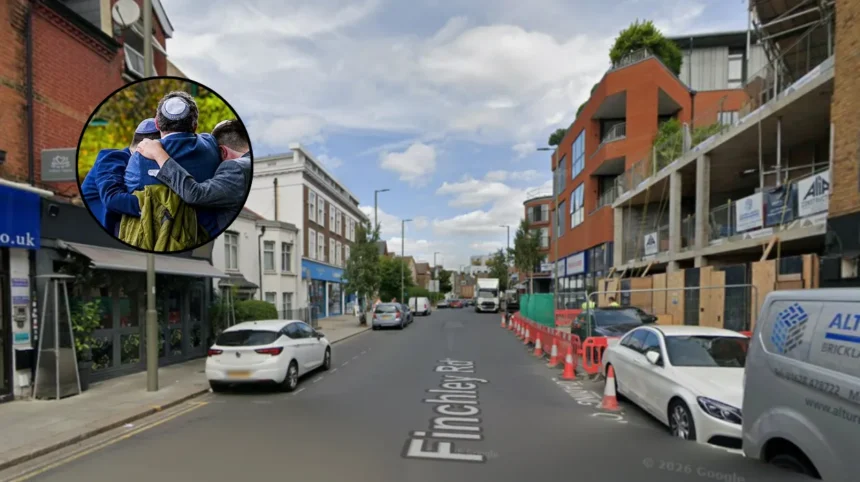
The operational timeline began in the early afternoon when the Metropolitan Police emergency control room received urgent communications from members of the public. Callers reported an individual walking along Finchley Road, an active commercial and residential artery within the Golders Green perimeter, visibly displaying what appeared to be a standard handgun.
Given the strict nature of UK gun laws, the presence of any suspected firearm in a public space triggers an immediate, non-negotiable dispatch of Authorised Firearms Officers (AFOs).
As detailed by on-scene witnesses and subsequent operational logs, armed units arrived rapidly at the location, executing a tactical interception at around 2:00 pm.
The suspect was immediately commanded to ground himself, a standard procedure designed to minimize the risk of a kinetic confrontation. Photographs and video clips captured by passers-by showed the suspect face down on the concrete while officers administered handcuffs.
Lying in immediate proximity to the detained man were several items of interest that were subsequently logged as evidence.
These included a heavy-duty tactical backpack, a full-face camouflage helmet engineered to obscure the wearer’s identity, and a matte-black plastic device designed to mirror the physical dimensions and aesthetic profile of a functional semi-automatic firearm.
The presence of the camouflage helmet alongside the replica weapon significantly heightened the initial perception of public danger, prompting a meticulous sweep of the surrounding pavement by responding units to ensure no secondary hazards were present.
What Did the Metropolitan Police Statement Clarify About the Recovered Weapon?
Following the containment of the scene and the safe transport of the suspect to a North London police station, Scotland Yard issued an official communication clarifying the precise technical nature of the seized item.
As reported by senior communications officers within the Metropolitan Police distribution network, specialized ballistics and armoury technicians inspected the object to determine its exact mechanism and legal status.
The Metropolitan Police statement explicitly confirmed that investigators concluded the suspect item recovered from the scene was an air weapon.
The force clarified that air weapons, which encapsulate standard BB guns, pellet rifles, and air pistols, do not utilize chemical propellants like gunpowder to discharge ammunition. Instead, they rely on mechanical systems to shoot projectiles using compressed air or gas canisters.
However, under the stringent terms of the Firearms Act 1968 and subsequent amendments, the Metropolitan Police emphasized that possessing an air weapon or an imitation firearm in a public place without a lawful authority or a reasonable excuse constitutes a severe criminal offence.
The official statement concluded by stating that the 37-year-old male suspect remains actively in custody at an undisclosed detention facility, where he is being interviewed under caution by standard criminal investigation detectives.
How Does UK Legislation Regulate the Public Possession of Air Weapons?
The legal differentiation between standard firearms and air weapons can often cause confusion among the general public, yet British statutory frameworks treat the unauthorized public carriage of both with extreme severity.
As outlined by legal correspondents analyzing the legislative parameters, the prosecution does not necessarily require a weapon to be capable of firing lethal live ammunition for an offence to have occurred.
Under Section 19 of the Firearms Act 1968, it is a strict offence to carry a loaded air weapon, or any imitation firearm—whether loaded or not—in a public space without a legitimate, verifiable legal defence.
The definition of a public place under British law is expansive, covering any highway, pavement, commercial establishment, or area to which the general populace has unrestricted access. Furthermore, the Anti-Social Behaviour Act 2003 explicitly tightened these restrictions, making it unlawful for anyone to manufacture, sell, or possess realistic imitation firearms that could easily be mistaken for modern military or law enforcement weaponry by a reasonable observer or an armed officer.
When an individual introduces a realistic air weapon into a public urban setting like Finchley Road, the law assesses the impact of that action on the community. If the appearance of the object causes alarm, distress, or fear of violence, the classification of the item as an air weapon does not absolve the carrier.
Armed units are trained to operate under the assumption that a visible weapon is viable and lethal until proven otherwise, meaning the public transportation of air weapons outside of a locked, secure case carries immense physical risks and severe judicial consequences.
Background of the Armed Response Operations in North London
The policing environment within Golders Green and the wider London Borough of Barnet has operated under heightened scrutiny and an intensified security posture over recent months.
This specific geographical sector features a unique demographic tapestry, including prominent faith communities, commercial centers, and dense residential zones, making any reports of weapon visible in public a matter of immense institutional priority for Scotland Yard.
The deployment of specialized armed units to handle suspected firearms incidents is part of a broader, long-term strategy by the Metropolitan Police to suppress violent crime and address localized public anxieties. Over the past year, North London has witnessed several complex security alerts and criminal inquiries that have required the activation of Counter Terrorism Policing resources alongside localized tactical support units.
Notably, in late April 2026, an unrelated knife attack in the Golders Green area resulted in the arrest and charging of a suspect, Essa Suleiman, for attempted murder following a major multi-agency deployment.
While that previous incident was legally classified as a localized terrorist event involving bladed weapons, its occurrence significantly altered the baseline operational response metrics for the region. The Metropolitan Police leadership, under Commissioner Sir Mark Rowley, has consistently maintained a policy of overwhelming force projection when responding to potential firearms threats to minimize response times and ensure absolute containment.
Consequently, when reports emerged regarding a man carrying a black plastic handgun while wearing a full-face camouflage helmet on Finchley Road, the emergency services responded with the maximum available specialized tactical units to prevent any escalation, reflecting a protective security umbrella designed to reassure a highly sensitive urban populace.
Prediction: How This Development Can Affect the Local Commuter and Business Community
This rapid tactical intervention and the subsequent realization that the item was an air weapon will have immediate, cascading effects on local commuters, business operators, and residential stakeholders utilizing the Finchley Road and Golders Green corridors.
For the local business community, the sudden closure of structural segments of Finchley Road during a busy afternoon period underscores the persistent vulnerability of high-street retail spaces to sudden security disruptions. Shopkeepers and restaurant owners within visual distance of the arrest face immediate operational stoppages when armed cordons are established. Moving forward, commercial associations in North London are highly likely to demand increased visible foot patrols and clearer communications from the Metropolitan Police regarding how businesses should handle rapid-onset security lockdowns. This development will likely accelerate the adoption of shared localized security networks, such as digital radio rings linking shop owners directly with community safety officers, allowing businesses to differentiate quickly between an active security threat and a contained police operation.