Key Points
- A little-known group calling itself HAYI has claimed responsibility for the stabbing of two Jewish men in Golders Green, north London.
- The group said the attack was carried out by one of its “lone wolves,” according to reporting cited by Euronews and SITE Intelligence Group.
- Police have treated the stabbing as a terrorist incident.
- The victims were men aged 76 and 34, and both were reported to be in stable condition in the hospital.
- A 45-year-old man was arrested after the attack, and officers used a Taser to detain him.
- Jewish security volunteers from Shomrim and the Hatzola volunteer ambulance service were among the first to respond.
- The incident came amid a series of recent arson attacks and other incidents targeting Jewish sites in north London.
- UK Prime Minister Keir Starmer said the attack was “deeply concerning” and that there must be no place for antisemitism in society.
- Israel’s foreign ministry urged the UK to take swift action against antisemitism after the stabbings.
Golders Green (North London News) April 30, 2026 – A little-known group believed to be linked to Iran has claimed responsibility for the stabbing of two Jewish men in north London, as police continue to investigate the case as a terrorist incident. The claim, reported by Euronews and the SITE Intelligence Group, said Harakat Ashab al-Yamin al-Islamiya, or HAYI, targeted the men in the Golders Green area through one of its “lone wolves.” Authorities have not publicly confirmed the claim, but the development has added to concern around a string of attacks affecting the Jewish community in the capital.
What did the police say?
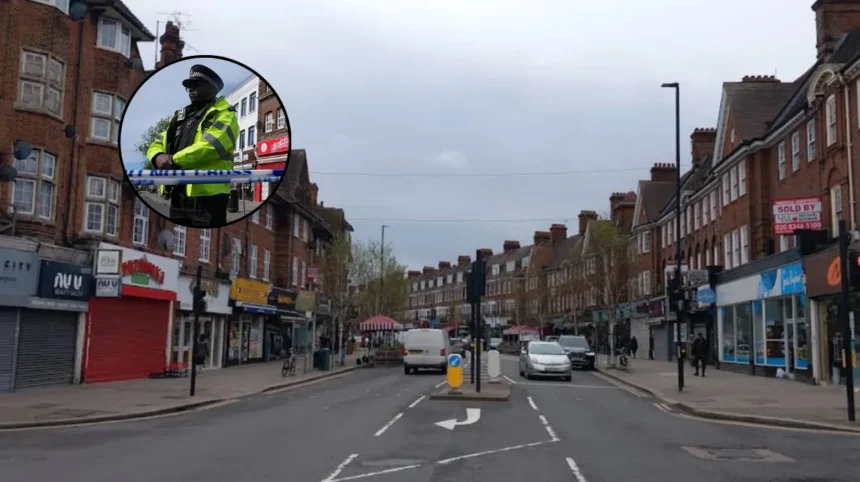
Police said the attack happened in Golders Green and left two men, aged 76 and 34, with knife injuries. The Metropolitan Police described the case as a terrorist incident, and counter-terrorism officers were involved in the investigation.
A 45-year-old man was arrested after officers responded to the scene, with reports that a Taser was used during the arrest.
As reported by Sam Tobin and Sarah Young of Reuters, the attacker ran down the street targeting Jews and was detained after officers stopped him with a Taser stun gun.
Reuters also reported that some officers were attacked during the arrest. The police have not disclosed the suspect’s name.
Who were the victims?
The two victims were identified in reporting as a 76-year-old man and a 34-year-old man. Both were taken to hospital and were said to be in stable condition following treatment. Their identities have not been publicly released in the reports reviewed.
Footage and eyewitness accounts described the attack as unfolding in a busy area of Golders Green, which has a large Jewish population. The area has also been the site of prior incidents involving Jewish-linked locations in recent weeks.
How did Jewish groups respond?
Jewish community organisations were among the first to respond after reports that a man was running along Golders Green Road with a knife and trying to stab Jewish members of the public. Shomrim said it received a hotline call about a man stabbing people and sent volunteers to the scene.
Hatzola, the Jewish volunteer ambulance service, treated the victims, while the Community Security Trust said it was working closely with police.
These organisations have played a visible role in local security responses during earlier incidents as well. Their involvement underlines the extent to which community groups have had to respond alongside the emergency services in recent weeks.
What is HAYI claiming?
According to Euronews, HAYI said in an online claim that
“the men were targeted by our lone wolves in the Golders Green area of London.”
Euronews said the group is believed to be linked to Iran and that it has claimed responsibility for attacks on Jewish-linked targets across Europe in the past two months. AFP, as carried by NAMPA, also reported that HAYI said
“Zionists were targeted by our lone wolves”
in Golders Green.
Those claims remain unverified by UK authorities in the material reviewed. Police have said the incident is being investigated on its own facts as a terrorist act, while also examining whether it is connected to broader recent attacks.
Why is the timing significant?
The stabbing came after a series of arson attacks and other incidents at Jewish-linked sites in north London. Euronews reported that four Hatzola ambulances were set on fire in late March, followed by attacks on the Kenton United Synagogue in Harrow, the premises of a Jewish charity, and the Finchley Reform Synagogue. Police have arrested 26 people for various attacks launched since the start of the US-Iran war on 28 February, according to that report.
This sequence has intensified concern among Jewish community leaders and security organisations. It has also raised questions about whether the violence is being directed at symbolic Jewish sites, people, or both.
What have leaders said?
UK Prime Minister Keir Starmer said the attack was “deeply concerning” and told lawmakers that police were investigating it. He added that London’s Jewish community had been the target of a series of “shocking antisemitic attacks” and said there must be
“absolutely no place for antisemitism in society.”
Israel’s foreign ministry also called for swift UK action, saying the government could no longer claim the situation was under control.
These comments show that the stabbing has become a wider political and diplomatic issue, not just a local criminal investigation.
The response from senior officials also reflects concern that the case may be part of a broader pattern of intimidation.
Why is the police investigation important?
Counter-terrorism officers are examining whether the assault was motivated by antisemitism and whether there is any link to previous incidents. Reuters reported that investigators are also looking at a possible Iranian connection to earlier arson attacks, although police have said it is too early to link those incidents definitively to the Golders Green stabbing.
That distinction matters because the legal classification of the case could affect charges, sentencing, and wider security measures.
The suspect’s background has also become part of the inquiry. Reuters reported that police chief Mark Rowley said the man had a history of serious violence and mental health issues.
Background of the development
Golders Green has long been associated with London’s Jewish community, which makes attacks there especially sensitive and symbolically significant. In the weeks before this stabbing, Jewish institutions and community property in north London had already been hit by arson and other vandalism, creating a growing climate of fear.
Against that backdrop, the claim by HAYI, if taken seriously by investigators, adds an international dimension to what began as a local violent attack.
The Golders Green case is therefore not an isolated event but part of a chain of incidents that has drawn in community security groups, police counter-terrorism teams, ministers, and foreign officials. Its background also includes the broader rise in concern over antisemitic threats in the UK and the use of online claims by extremist or alleged extremist groups.
Prediction: what could happen next?
For London’s Jewish community, this development is likely to mean tighter security around synagogues, schools, charities, and public spaces in areas such as Golders Green and nearby neighbourhoods. It may also lead to more visible patrols, faster coordination between police and community security volunteers, and increased reporting of suspicious activity.
For the wider public, the case may influence how antisemitic incidents are monitored and prosecuted in the UK, especially if investigators find links between separate attacks. For policymakers, it could intensify pressure to treat community-targeted violence as both a criminal and security issue, with implications for counter-terrorism resources and hate-crime enforcement.