Key Points
- The Rescue: The Black Horse, an iconic Barnet pub dating back to the 1720s, has officially reopened thanks to a campaign led by local regulars.
- The Founders: Three local residents—Simon Anderson, Martin Taylor, and Danny Daly—negotiated and secured a lease from building owner Star Pubs.
- Community Groundswell: The rescue campaign was galvanised by a local petition gathering 4,000 signatures alongside an Asset of Community Value (ACV) status designation.
- The Rapid Turnaround: Operators successfully converted the premises from an active building site into a fully operating pub in just over two weeks.
- Operational Reality: High consumer demand saw the pub nearly exhaust its entire beer supply by its third weekend of trading.
- Long-term Model: Operating under the newly established ‘Barnet Community Pubs Ltd’, the founders aim to transition their current one-year tenancy into a long-term lease.
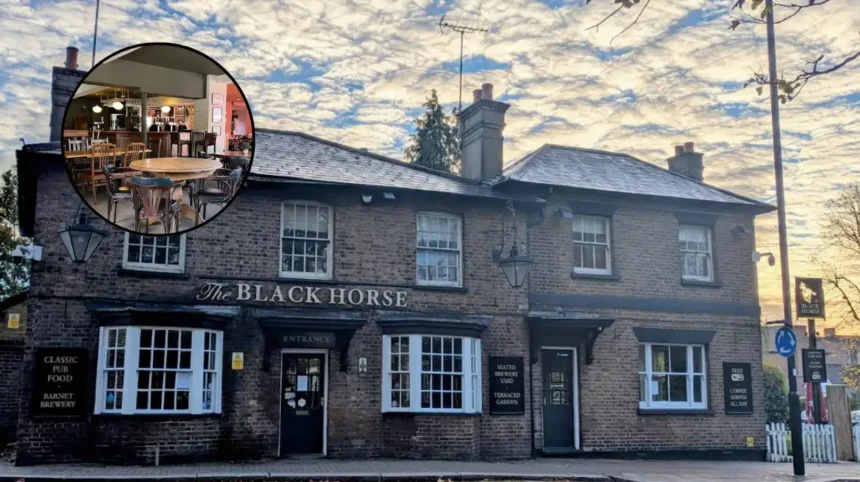
High Barnet (North London News) July 16, 2026 – The Black Horse, a historic public house positioned at the junction of Wood Street and Union Street in High Barnet, has officially reopened to the public following a determined community-led campaign that rescued the 18th-century landmark from indefinite closure and potential redevelopment. The pub had shut its doors unexpectedly in September 2025, triggering widespread local concern before three former regulars stepped forward to form Barnet Community Pubs Ltd, securing a fresh lease from Heineken-owned Star Pubs.
- Key Points
- Why Did the Black Horse Close in High Barnet?
- How Did a Local Petition of 4,000 Signatures Force Action?
- Who Are the Three Former Regulars Reopening the Pub?
- How Was the Building Site Transformed Into a Working Pub in Just Two Weeks?
- Why Did the Pub Almost Run Out of Beer on Its Third Weekend?
- What Is the Operating Model of Barnet Community Pubs?
- Background: How Have Community-Led Rescues Changed the UK Hospitality Sector?
- Prediction: How Will the Reopening of the Black Horse Affect the Local Barnet Community?
Why Did the Black Horse Close in High Barnet?
The sudden closure of The Black Horse in September 2025 left local residents shocked and raised immediate alarms regarding the future of the historic building. For over three centuries, the site has operated as a central pillar of the local social fabric, having originated as a coaching inn in the 1720s.
As reported by Grace Howarth, a Local Democracy Reporter for the Evening Standard, the sudden departure of the previous leaseholder caused immediate concern among ward councillors and residents alike, who feared the prominent town-centre location might be sold off and permanently converted into residential apartments.
In the immediate aftermath of the closure, owner Star Pubs confirmed they were actively searching for a new operator.
However, as noted in a subsequent report by The Barnet Society in November 2025, the parent company acknowledged that finding a suitable publican under challenging economic conditions made a reopening highly unlikely until well into 2026. This gap in operations catalysed a massive, community-wide effort to protect the structure from developers.
How Did a Local Petition of 4,000 Signatures Force Action?
The preservation of the former coaching inn was propelled by a massive grassroots effort. A petition launched by local resident Olly Gough quickly gained momentum, eventually drawing more than 4,000 signatures from individuals demanding that the site remain a pub.
As reported by The Barnet Society, High Barnet ward councillor Emma Whysall actively lent her voice to the campaign, urging residents to back the formal application to declare the pub an Asset of Community Value (ACV).
The ACV status, which was successfully granted by Barnet Council, proved to be a vital legal shield. Under UK planning law, an ACV designation gives community groups the preferred “right to bid” on a property if it is put up for sale, preventing sudden sell-offs to property developers.
Speaking to The Barnet Society, co-founder Danny Daly highlighted the power of this collective action, stating:
“All that community support and loyalty worked in our favour when negotiating with Star Pubs. Our nightmare vision was that we might lose the pub and see the site redeveloped with a block of flats.”
Who Are the Three Former Regulars Reopening the Pub?
The campaign shifted from a defensive protest to a proactive business venture when three long-time local regulars decided to pool their professional expertise and take on the lease directly.
Simon Anderson, Martin Taylor, and Danny Daly—all of whom live within a five-minute walk of the pub—established Barnet Community Pubs Ltd to formalise their bid.
The trio possess a highly complementary set of skills:
- Simon Anderson: A veteran of the hospitality sector and former owner of the acclaimed Albion pub in Islington, Anderson currently works as a professional food and drink consultant. He brings direct operational knowledge to the venture.
- Martin Taylor: A finance expert, Taylor took charge of the business’s financial forecasting, utility contracts, and complex lease negotiations.
- Danny Daly: A specialist in publishing and promotion, Daly directed the marketing, community outreach, and brand strategy for the reopening.
As reported by the Times Series, Simon Anderson reflected on the personal drive behind the project:
“We are all friends who met in the pub or as dads at the same school and we all live five minutes away. I am a firm believer that pubs are intrinsic to British society and a cultural institution—it’s really fulfilling and the ultimate hobby.”
How Was the Building Site Transformed Into a Working Pub in Just Two Weeks?
After months of delicate negotiations behind the scenes, the keys to the property were officially handed over to Barnet Community Pubs on June 8, 2026.
This marked the start of an incredibly intense, fortnight-long physical transformation. The property, which had sat empty for nearly nine months, was described as a virtual “building site”.
Converting a stripped, dormant commercial property back into a licensed premises is a highly regulated, logistically demanding process. The team had to execute a rapid sequence of essential tasks:
- Safety & Utilities: Restoring and testing gas, electrical installations, and water lines to meet stringent commercial regulatory standards.
- Structural & Cosmetic Overhaul: Clearing overgrown weeds and debris from the abandoned beer garden and carrying out internal redecorating.
- Bar Installation: Refitting the working bar, cellar systems, and cooling lines needed to serve quality draught beer.
- Licensing & Compliance: Navigating health and safety protocols and finalising retail alcohol licensing requirements.
Despite the tight schedule, the team successfully welcomed customers back through the doors just over two weeks later, on Tuesday, June 25, 2026.
Why Did the Pub Almost Run Out of Beer on Its Third Weekend?
The rapid speed of the turnaround, combined with an overwhelming wave of local enthusiasm, quickly tested the pub’s operational capacity.
By its third weekend of trading, the high volume of customers nearly exhausted the cellar’s entire stock.
Such stock shortages are a common hazard when reviving closed venues. When a business transitions from a complete closure to a high-capacity opening in a matter of weeks, synchronising supply lines with real-time customer demand is incredibly difficult.
The shortage at the Black Horse highlighted both the sheer level of local demand and the challenges of managing supply chains without historical sales data.
As reported in the Times Series, the pub opened serving seven beers, including several cask ales, under the day-to-day care of a newly hired manager and dedicated bar staff.
The founders have adjusted their logistics to stabilise delivery frequencies as they prepare for their next phase: rebuilding the kitchen to launch a high-quality food menu featuring Sunday roasts and rotisserie chicken.
What Is the Operating Model of Barnet Community Pubs?
The Black Horse is currently being run under the umbrella of Barnet Community Pubs Ltd. This venture represents a hybrid business model where local citizens transition from passive consumers or campaigners into active operators.
By pooling their own personal capital to fund the initial fit-out, the founders bypassed the need for speculative corporate investment, allowing them to remain focused on the community’s exact needs.
In exchange, Star Pubs granted the team an initial one-year tenancy.
The primary objective of the first year of trading is to establish commercial viability. If the business model proves profitable, the team hopes to secure a long-term lease from the building owners and potentially apply the model to rescue other struggling, historic public houses in the area.
Background: How Have Community-Led Rescues Changed the UK Hospitality Sector?
The closure and rescue of the Black Horse is far from an isolated incident; it mirrors a structural shift occurring across the wider United Kingdom hospitality sector.
Over the past decade, British pubs have faced a compounding storm of economic pressures, including skyrocketing energy costs, rising business rates, and changing post-pandemic social habits.
According to data from the Campaign for Real Ale (CAMRA), hundreds of pubs close permanently across the UK each year, with many being converted into supermarkets or residential housing.
To combat this loss of local heritage, communities have increasingly turned to collective ownership models. Legislation such as the Localism Act 2011 introduced the concept of Assets of Community Value (ACVs) in England, giving residents a legal mechanism to pause the sale of cherished community assets.
Across the country, community pub models have taken various shapes, including:
- Community Benefit Societies (CBS): Structured as co-operatives where local residents buy shares, giving them a democratic vote in how the pub is run.
- Charitably Backed Trusts: Where a local trust manages the property for social or historic preservation.
- Private Local Partnerships: Like Barnet Community Pubs Ltd, where qualified local residents use their own capital and business acumen to run the venue as a commercially viable small business focused on community retention.
These models succeed because they align the financial interests of the pub with the social desires of its clientele. When locals feel a sense of shared ownership, they are far more likely to patronise the venue, ensuring its long-term viability even during periods of broader economic stagnation.
Explore More Barnet News
Police Arrest Two Suspects for Drug Trafficking in Barnet 2026
Inner London Arts Funding Gap Strains Suburbs: Barnet 2026
Prediction: How Will the Reopening of the Black Horse Affect the Local Barnet Community?
The successful revival of the Black Horse is poised to have a highly positive, stabilizing effect on both the local economy and the community identity of High Barnet.
Positioned at the prominent junction of Wood Street and Union Street, the reopened pub will act as a major anchor for High Barnet’s town centre.
By drawing regular footfall back to this corner, neighbouring independent shops, cafes, and retailers are likely to experience a positive knock-on effect. A vibrant, active pub front reduces the visual blight of boarded-up windows, improving the overall aesthetic appeal and safety of the high street.
For residents, the rescue represents the preservation of a physical space where diverse groups of people can naturally gather.
With its links to the 1850s Barnet fire engine and historic well, the building acts as a living archive of Barnet’s history. Keeping this landmark public preserves the town’s distinct historical character.
Perhaps the most significant long-term impact of this development is the blueprint it creates for local activism.
The successful negotiations with Star Pubs prove that corporate pub companies can be persuaded to work with community groups when backed by a strong business plan and thousands of petition signatures.
This success has already inspired hope among residents looking to save other threatened local structures, such as the Builders Arms in New Barnet, demonstrating that communities possess the power to actively shape the future of their local spaces.