Key Points
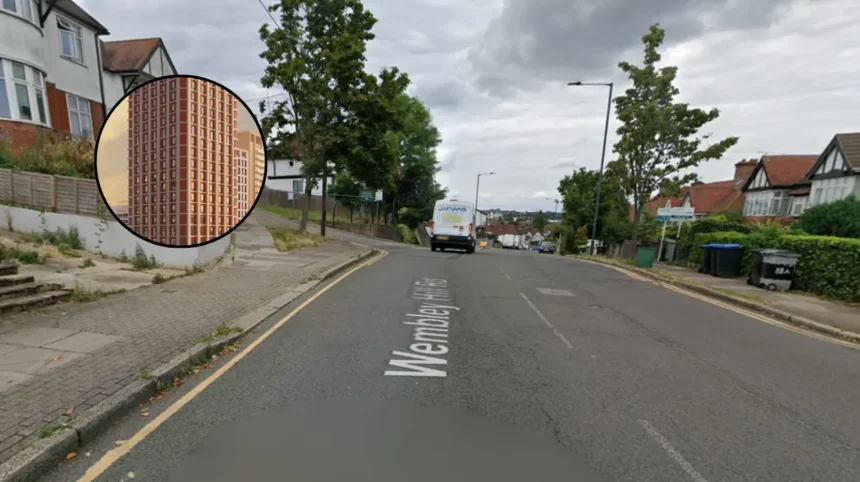
- Splendid Hospitality Group has submitted plans for a 25‑storey mixed‑use scheme on Wembley Hill Road in Wembley, north London.
- The development would redevelop an existing “underutilised” surface car park currently used by the Holiday Inn London–Wembley.
- The project would deliver a 90‑person care home over the first eight floors of the tower, with the remaining 17 floors housing a 329‑bed co‑living apartments scheme.
- Design work comes from architectural and landscape practices involved in the Wembley growth area, with proposals to provide new planting, green buffers, and public‑realm improvements along Wembley Hill Road and the Royal Route.
- The scheme is yet to be determined by Brent Council’s planning committee, with the developer arguing it responds to both the borough’s care‑home shortfall and demand for single‑occupancy rental housing.
Wembley, Splendid Hospitality (North London News) April 30, 2026
- Key Points
- What is being proposed at Wembley Hill?
- How is the scheme designed?
- What is the current site use?
- How does this fit into Wembley’s wider growth plans?
- What are the stated rationales in the planning documents?
- How does this relate to recent Wembley developments?
- What happens next in the planning process?
- Background: Care homes, co‑living and regeneration in Wembley
- Prediction: How this development could affect its audiences
What is being proposed at Wembley Hill?
Wembley planners are being asked to approve a 25‑storey tower on Wembley Hill Road that will combine a 90‑person care home and 329‑bed co‑living apartments on a site currently occupied by a surface car park serving the Holiday Inn London–Wembley.
As reported by Harrow Online, Splendid Hospitality Group (SHG), a privately‑owned hospitality company that operates hotels, care homes and restaurants, has tabled full planning consent for the scheme, which would replace what it describes as an “underutilised” car‑park area.
Documents prepared for the bid, including design boards and technical statements, indicate that the tower would rise to 25 storeys with the care home occupying the first eight floors and the remaining 17 floors dedicated to co‑living units.
As set out in the planning‑consultant materials, the project is framed as a way to “optimise the potential” of the site while responding to “growing demand for care beds” in Brent and for “single‑occupancy rental homes” across the wider London market.
How is the scheme designed?
The design team, working with SHG, has outlined a tall, slender block fronting Wembley Hill Road and the Royal Route, with the massing positioned to minimise overshadowing and to preserve views and sunlight into neighbouring streets.
According to the architect’s description, the scheme includes new planting beds, green buffers along street edges and a landscaped podium to soften the building’s scale and improve the character of the area.
The care‑home element is intended to provide 90 residential care places, with communal lounges, a library, laundry facilities, communal kitchens and dining areas, and social spaces intended to support residents’ day‑to‑day needs.
The upper floors would be configured as a co‑living development with 329 single‑occupancy beds, largely aimed at young professionals and others seeking flexible, short‑to‑medium‑term rental arrangements. Additional shared amenities are expected to include communal kitchens, lounges and two roof terraces, designed to encourage social interaction among co‑living residents.
What is the current site use?
The site lies immediately behind the Holiday Inn London–Wembley at 55–63 Wembley Hill Road, within the Wembley Growth Area as defined in the Wembley Area Action Plan.
As described in the developer’s planning‑consultant documents, the land is currently used as a surface car park for hotel guests and visitors, with separate basement parking for the hotel that would remain in use under the new scheme.
The proposal notes that demand for on‑site car parking at the Holiday Inn has declined, meaning that the surface car‑park area is considered “underutilised” and therefore suitable for redevelopment.
The consultant’s statement adds that the existing basement parking beneath the hotel would continue to serve hotel guests, while the surface car park would be re‑allocated to the care home and co‑living uses.
How does this fit into Wembley’s wider growth plans?
The Wembley Hill Road scheme is being presented as part of the broader Wembley Park–Wembley Centre regeneration trajectory, which has seen multiple high‑rise residential and mixed‑use projects approved in recent years.
Brent Council’s Wembley Area Action Plan sets out a target of delivering around 10,000–15,000 new homes by the early 2030s, alongside new jobs, public spaces and transport improvements.
As outlined in the council’s planning guidance, the Wembley Growth Area is intended to absorb higher‑density development around the stadium, station corridor and adjacent roads such as Wembley Hill Road, while improving public realm, walking routes and cycle links.
The current 25‑storey proposal is consistent with this direction, adding to a catalogue of other tower‑block schemes in the immediate area, including PRP‑designed co‑living blocks approved on Brook Avenue that will deliver more than 500 co‑living units plus 100 affordable homes.
What are the stated rationales in the planning documents?
Splendid Hospitality Group and its planning consultants have advanced several arguments in support of the scheme. First, they highlight local demographic trends, pointing to an ageing population in Brent and listing the care‑home component as a way to address a shortage of residential care beds.
Second, they emphasise demand for compact, single‑occupancy rental homes in an area where many people work in central London or nearby business hubs and are prepared to pay for convenience and shared facilities over larger private apartments.
The co‑living element is framed as a model that concentrates beds in a managed building, with on‑site staff, shared social spaces and flexible tenancies, rather than spreading single‑occupancy units across many smaller lets.
At the same time, the design team documents stress efforts to mitigate impacts on neighbours, including proposals for noise‑reducing façades, controlled lighting, and reduced surface‑level car parking to limit traffic and congestion on Wembley Hill Road.
How does this relate to recent Wembley developments?
The Wembley Hill Road proposal comes against a backdrop of multiple tower‑block approvals within walking distance. In October 2024, Brent Council’s planning committee approved a separate scheme on Brook Avenue that will see four blocks of up to 15 storeys delivering 517 co‑living units and 100 affordable homes, illustrating a pattern of large‑scale co‑living and build‑to‑rent in the Wembley Park fringe.
Other recent consents in the Wembley Centre area include a £41 million aparthotel and a seven‑block residential scheme near Wembley Central station, which has also been sold as helping to increase footfall and local spending.
These schemes, taken together, signal a shift towards higher‑density, mixed‑use redevelopment around the stadium and transport nodes, with co‑living and care‑home uses appearing as increasingly common components in the packaging of new towers.
What happens next in the planning process?
The application for the 25‑storey care home and co‑living block is listed for consideration by Brent Council’s planning committee, with officers expected to issue a formal report and recommendation to councillors before any decision. As with other large‑scale schemes in the borough, the submission will be subject to consultation with statutory consultees, including Transport for London, the Greater London Authority, the Environment Agency, and local resident groups.
If the recommendation is for approval, councillors could grant consent subject to conditions covering construction‑traffic management, affordable‑housing or community‑benefit contributions, and environmental‑mitigation measures.
Should the committee refuse the application, the developer would have the right to appeal to the Planning Inspectorate, where the case would be determined by a planning inspector rather than elected councillors.
Background: Care homes, co‑living and regeneration in Wembley
The Wembley Hill Road proposal sits within a longer history of regeneration around Wembley Stadium and the wider Brent borough. Since the mid‑2000s, the Wembley Park area has undergone substantial redevelopment, with the stadium’s refurbishment at the core, followed by new residential towers, leisure venues, retail and public‑realm upgrades. The Wembley Area Action Plan formalised this trajectory, setting out policies for high‑density, mixed‑use schemes, improved public transport, and expanded housing supply.
Care‑home provision has been a growing issue across Brent, where an ageing population and tightening public‑health budgets have increased pressure on local authority‑commissioned residential places.
The privately‑operated care‑home sector in Wembley already includes multiple facilities providing residential, respite and dementia care, often clustered near transport hubs and town‑centre locations. The proposed 90‑person care home on Wembley Hill Road would add to this stock, albeit in a mixed‑use, high‑rise format rather than a low‑rise, standalone building.
Co‑living, meanwhile, has become a more visible model in London over the past decade, as developers and investors respond to demand from young professionals, students and short‑term workers seeking flexible leases and shared amenities.
Wembley has featured several such projects, including the Wembley Ark scheme and the large Brook Avenue development, all positioned between the Stadium and Park, where land values and transport links are high. The 329‑bed element of the Wembley Hill Road tower follows this pattern, aiming to repurpose a low‑value car‑park area into a high‑density rental product.
Prediction: How this development could affect its audiences
If the 25‑storey care home and co‑living block is approved, several audience groups could be affected in measurable ways. For local residents, the tower could intensify footfall and traffic on Wembley Hill Road and nearby streets, potentially increasing pressure on existing parking, noise levels and public‑space capacity, while also bringing new amenities and improved street landscaping if the developers’ proposals are implemented.
For prospective residents of the care home, the scheme may expand the choice of residential care places in the immediate Wembley area, which could ease pressure on families trying to find local accommodation rather than sending relatives to more distant boroughs. At the same time, the high‑rise, mixed‑use configuration may raise questions for some families about privacy, access to outdoor space, and the operational separation between the care‑home and co‑living elements.
For young professionals and renters, the 329‑bed co‑living component would introduce another managed‑rental option in a part of London already well‑served by similar schemes, offering relatively compact rooms with shared facilities at a price point somewhere between private studios and shared private houses. This could appeal particularly to commuters working in central London or around the Wembley cluster of business parks and broadcast facilities, but may also contribute further to the area’s concentration of high‑density, short‑lets, which could affect the stability of long‑term residential communities.