Key Points
- Scrutiny over Operations: James Widdowson, owner of Harley’s Butchery and Rotisserie in Hampstead, faces local pushback and local council scrutiny over external seating and cooking odours.
- Financial Impact: Widdowson estimates a financial loss of approximately £20,000 due to ongoing compliance disputes, operational adjustments, and administrative hurdles.
- The Business Model: Opened in the summer of 2024, Harley’s functions as a dual-concept establishment—a traditional English butchery offering specialized cuts alongside hot takeaway options like rotisserie chicken and smash burgers.
- Neighbourhood Complaints: Objections from select local residents focus on persistent cooking smells from the burger stand and the placement of tables and chairs on the pavement outside the shop.
- Owner’s Perspective: Widdowson denies allegations of statutory nuisance, claiming he is the target of a selective “agenda” driven by a minority of affluent local residents.
- Regulatory Outlook: Camden Council continues to evaluate street trading compliance and environmental health guidelines regarding ventilation and outdoor furniture.
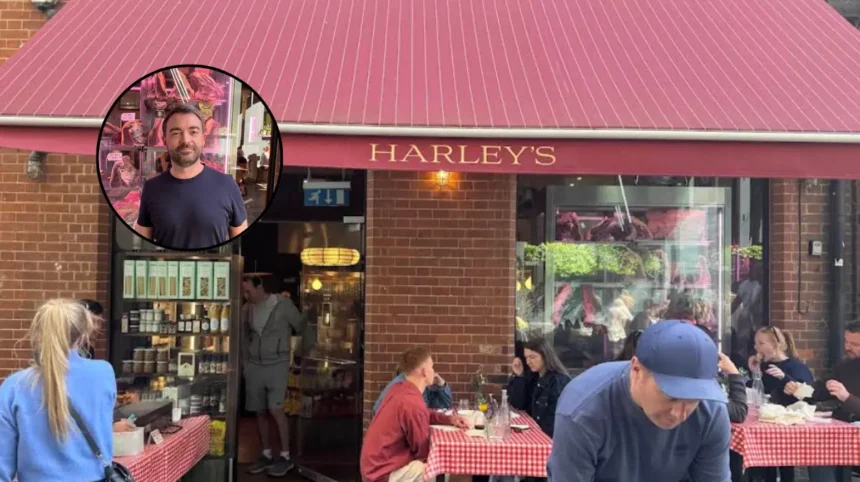
Hampstead (North London News) October 7, 2026 – A local business owner in Hampstead has claimed he is being unfairly targeted by a selective resident “agenda” following formal complaints regarding cooking odours and outdoor seating at his shop. James Widdowson, who established Harley’s Butchery and Rotisserie in the London Borough of Camden during the summer of 2024, reports that the ongoing regulatory scrutiny and local disputes have cost his business approximately £20,000. The establishment, which operates as a hybrid butcher shop and hot-food takeaway, has drawn criticism from nearby residents who allege that noise and fumes from the outdoor burger stand create a nuisance in the leafy neighbourhood.
- Key Points
- Why is Harley’s Butchery facing opposition from Hampstead residents?
- How has owner James Widdowson responded to the allegations?
- What are Camden Council’s regulatory requirements for street trading and extraction?
- Background of the particular development
- Prediction: How this development can affect independent small business owners and local residents
Why is Harley’s Butchery facing opposition from Hampstead residents?
The dispute centers on the dual-concept operational style of the premises located in Hampstead. Harley’s Butchery and Rotisserie was established by Camden native James Widdowson with the intention of blending a high-end British meat counter with a Basque-inspired culinary touch. Beside standard counter services offering venison wrapped in spinach, specialized poultry, and dry-aged beef, the shop operates a hot food counter producing smash burgers and rotisserie chickens.
Local residents near the shop have raised concerns with Camden Council regarding the extraction systems used for the burger grill, describing the resulting fumes as “foul” and excessive for a traditional residential high street. Additionally, objections have been lodged regarding the presence of outdoor tables and chairs positioned on the pavement, which complainants argue obstruct pedestrian thoroughfares and generate noise disturbances during peak operating hours.
How has owner James Widdowson responded to the allegations?
Widdowson has rejected claims that his establishment creates a public nuisance, attributing the friction to a small group of local objectors. He stated that the continuous complaints do not reflect the broader sentiment of the community, which has otherwise supported the addition of a independent butcher to the local high street.
Widdowson expressed that he feels “persecuted” by the level of scrutiny directed toward his venture. According to Widdowson, the shop has taken reasonable measures to comply with health and safety standards while providing a high-quality service. He emphasized that the financial strain resulting from council interventions, altered operating arrangements, and legal consultation has mounted to £20,000, presenting a significant burden for an independent business operating within its first two years.
What are Camden Council’s regulatory requirements for street trading and extraction?
Under the regulations enforced by Camden Council, commercial premises preparing hot food must maintain adequate ventilation and odor abatement systems to prevent cooking smoke and smells from affecting neighboring properties. Commercial extraction units are evaluated based on their filtration efficiency, height, and proximity to residential windows.
Furthermore, the placement of external furniture on public highways or footways in the borough requires a valid Pavement Licence under the Business and Planning Act. Councils evaluate these applications based on clear pavement widths, access for mobility-impaired pedestrians, and the overall character of the local conservation area. When formal complaints are received, local authority environmental health officers are required to conduct site visits to evaluate whether a statutory nuisance under the Environmental Protection Act 1990 exists.
Background of the particular development
The London Borough of Camden, particularly districts such as Hampstead, features strict planning controls and conservation guidelines designed to preserve the traditional aesthetic and residential amenity of its village high streets. Over recent years, the high street retail landscape across the UK has shifted significantly, with conventional retail space increasingly transitioning into food and beverage (F&B) operations to maintain footfall.
This structural shift frequently creates friction between commercial operators attempting to diversify revenue streams—such as adding hot takeaway food to traditional retail counters—and local resident associations focused on preserving neighborhood noise levels and air quality. Harley’s Butchery opened in mid-2024 within this regulatory framework, attempting a hybrid model that combines a high-street butcher’s shop with fast-casual food dining. Similar disputes regarding street trading licences, commercial extraction units, and outdoor seating have recurred across high-value residential conservation areas in Inner London, balancing high street vitality against local residential standards.
Prediction: How this development can affect independent small business owners and local residents
This development highlights an ongoing structural tension in affluent urban neighbourhoods that direct impacts two primary audiences: independent small business owners and local residents.
Impact on Independent Business Owners
For independent entrepreneurs and high-street traders, the outcome of regulatory disputes of this nature sets a notable operational benchmark. If enforcement measures around extraction units and pavement licences strictly favor residential complaints, small business owners face higher barrier-to-entry costs when attempting to launch hybrid commercial concepts. Traders operating on thin profit margins may find the financial burden of compliance disputes—such as the £20,000 loss cited by Widdowson—unsustainable. Consequently, independent operators may increasingly avoid opening experiential or hot-food retail concepts in established residential conservation zones, opting instead for fully commercialized areas with fewer planning restrictions.
Impact on Local Residents
For local residents, the resolution of such disputes reinforces enforcement standards regarding local environmental health, residential quiet enjoyment, and accessibility. A strict regulatory response ensures that commercial expansion does not compromise air quality or public footway access. However, if strict enforcement leads to the closure or curtailment of independent high-street businesses, residents may face a decrease in the diversity of local amenities, leading to vacant storefronts or a higher concentration of standardized chain stores capable of absorbing significant regulatory and legal compliance costs.