Key Points
- Record Depth: Hampstead Underground station features the deepest platforms on the entire London Underground network, located 58.5 metres (192 feet) below street level.
- Lift Shaft Record: The station houses the network’s deepest lift shaft, measuring approximately 55 metres (181 feet), which is only four feet shorter than Nelson’s Column.
- No Escalators: Passengers rely exclusively on lifts or a 320-step spiral emergency staircase to travel between the ticket hall and platforms.
- Geographical Factors: The extreme depth is caused by local topography, as the station building sits atop steep terrain in Hampstead while railway tunnels maintain a level depth beneath.
- Historical Design: Designed by architect Leslie Green and opened on 22 June 1907, the station predates the introduction of escalators on the London Underground by four years.
- Historic Signage: Platform tiling still displays the original proposed station name, “Heath Street”, reflecting its location at the junction of Heath Street and Hampstead High Street.
Hampstead (North London News) September 29, 2026 – Hampstead Underground station, located on the Edgware branch of the Northern line on the boundary of fare zones 2 and 3, holds the official record for housing the deepest passenger platforms on the entire London Underground network. Situated 58.5 metres (192 feet) beneath the surface, the station relies on high-capacity lifts rather than escalators to convey passengers between the upper ticket hall and the subterranean platforms. As confirmed by official documentation from the London Transport Museum, the physical structure of the station and the surrounding landscape make it one of the most distinctive engineering achievements of early 20th-century urban rail transport in the capital.
- Key Points
- Why are the platforms at Hampstead Underground station so deep?
- How do passengers navigate the station without escalators?
- Why were escalators never installed at Hampstead station?
- What historical features remain visible inside Hampstead station?
- Background of Hampstead station and the Northern line development
- Prediction: How will Hampstead’s unique depth affect commuters and transport operations?
Why are the platforms at Hampstead Underground station so deep?
The primary reason for the station’s extreme depth lies in the unique geographical landscape of North London. The surrounding area of Hampstead sits on a elevated ridge, creating a substantial vertical distance between the surface level and the railway running beneath.
When engineers constructed the line, railway tunnels were driven horizontally through the subsoil to maintain a practical gradient for trains running between Belsize Park and Golders Green. Because the station building was erected high on the hill at the junction of Heath Street and Hampstead High Street, the surface entry point sits far above the subterranean level of the tracks. The vertical separation resulted in platforms being positioned 58.5 metres beneath the street.
How do passengers navigate the station without escalators?
Unlike many deep-level stations across the capital, Hampstead does not feature escalators. Transport for London (TfL) operates high-speed lifts as the primary means of moving passengers between the ground-level ticket hall and the deep platforms.
Alongside its record-holding platform depth, Hampstead station holds a second network record for having the deepest lift shaft on the London Underground. According to data provided by the London Transport Museum, the main lift shaft measures approximately 55 metres (181 feet) from top to bottom. To contextualise this measurement, the shaft is only four feet shorter than the total height of Nelson’s Column in Trafalgar Square.
For alternative access or emergency situations, the station features an emergency spiral staircase. This staircase consists of more than 320 individual steps. Transport authorities advise that climbing this staircase is equivalent to ascending a 15-storey building, making the lifts the only practical daily option for public use.
Why were escalators never installed at Hampstead station?
The complete absence of escalators at Hampstead station is tied directly to the history and timeline of the London Underground’s construction.
Hampstead station officially opened to the public on 22 June 1907 as part of the Charing Cross, Euston and Hampstead Railway (CCE&HR). During this era of construction, escalator technology had not yet been implemented on Britain’s subterranean rail network. The first moving escalator on the London Underground was not installed until 1911 at Earl’s Court station—four years after Hampstead had already been completed and opened to passengers.
Because the initial architectural layouts were built entirely around vertical lift shafts, retrofitting long, diagonal escalator tunnels through the deep clay and complex surface infrastructure under Hampstead High Street was deemed impractical. Consequently, the station has retained its original lift-based operational model for more than a century.
What historical features remain visible inside Hampstead station?
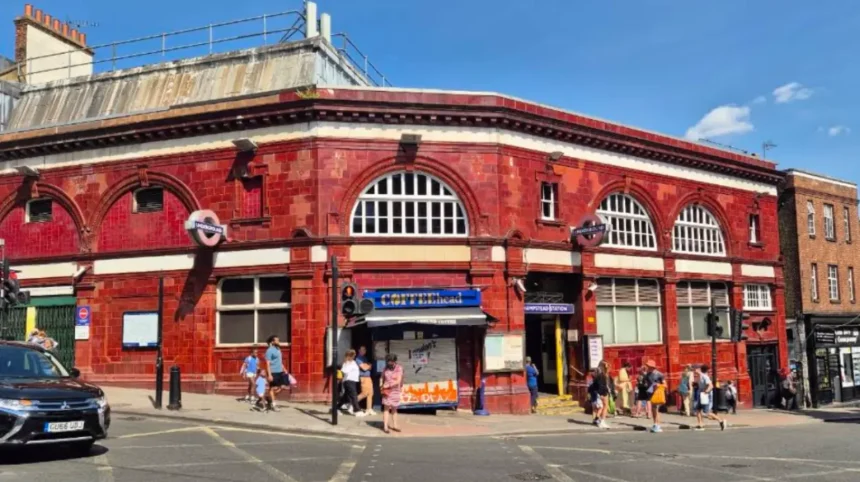
Hampstead station retains several original features dating back to its construction in the early 1900s. The surface station building was designed by the architect Leslie Green, who was responsible for dozens of iconic London Underground structures built during that era. Green’s design features a signature ox-blood red glazed terracotta facade, arched upper-floor windows, and structural framing intended to accommodate potential commercial expansion above.
Below ground, the platform level displays historic tile work that reflects early planning decisions. Before its official opening in June 1907, the station was designated to be named “Heath Street” due to its physical entrance location. Although transport directors altered the official name to “Hampstead” prior to the public opening, original tiled station name signs reading “Heath Street” remain preserved along the platform walls behind the modern running signage.
Background of Hampstead station and the Northern line development
The construction of Hampstead station was part of a major expansion of deep-level tube railways across London at the turn of the 20th century. The Charing Cross, Euston and Hampstead Railway (CCE&HR), colloquially known as the “Hampstead Tube”, was financed under the direction of American financier Charles Tyson Yerkes and his Underground Electric Railways Company of London (UERL).
The line was intended to connect northern suburbs with central London railway termini and the West End. Excavating through the elevated terrain of Hampstead presented unique engineering challenges for Edward Thomas, the resident engineer. Tunnelling through London Clay beneath high ground required specialized mechanical shields and iron segment lining to prevent structural collapse and manage groundwater pressure.
Following its opening in 1907, the line underwent multiple amalgamations, eventually merging with the City and South London Railway to form the modern Northern line during the 1930s. Today, Hampstead serves thousands of commuters daily on the Edgware branch, standing as an operational example of early Edwardian subterranean engineering.
Prediction: How will Hampstead’s unique depth affect commuters and transport operations?
The ongoing operational reliance on lifts and the extreme depth of Hampstead station will continue to present specific logistical considerations for passengers, local residents, and Transport for London operators.
- Passenger Journey Times and Congestion: Because passengers cannot walk up or down escalators, movement through the station is entirely dependent on lift capacity and cycle times. During peak morning and evening rush hours, passengers may experience localized bottlenecks in the ticket hall and lower lift lobbies as crowds wait for available lift cars.
- Accessibility and Step-Free Challenges: While the presence of lifts offers vertical transport, any maintenance outages or mechanical faults affecting the lift shafts can render the station completely inaccessible to mobility-impaired passengers, parents with pushchairs, and travelers carrying heavy luggage, as the 320-step spiral emergency staircase is unsuitable for routine public use.
- Maintenance and Asset Management: TfL will be required to maintain rigorous, specialized preventive maintenance schedules for the high-capacity lifts and deep shafts. Given that the lift infrastructure serves as the single point of entry and exit to platforms 58.5 metres down, long-term engineering upgrades will necessitate careful planning to prevent full station closures during refurbishment works.