
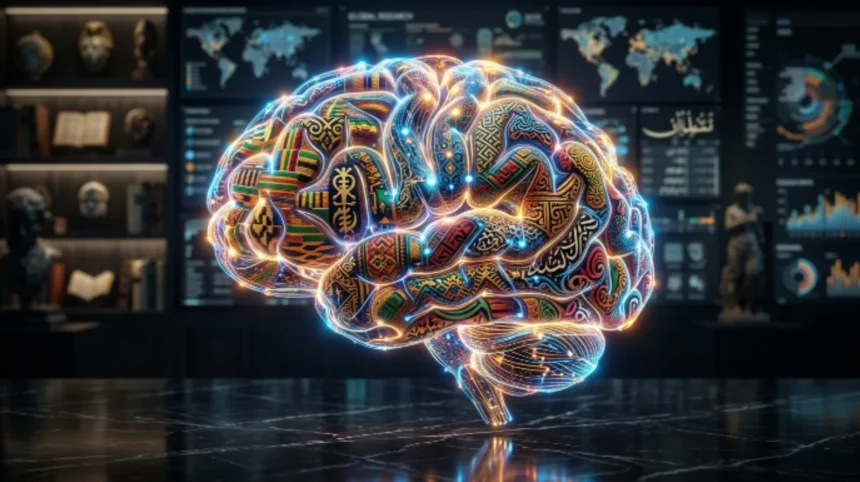
The booming growth of AI, along with its evolving engagement with everyday issues, reveals that AI is set to become a staple of daily life—mapping and shaping people’s choices across everything from food and friendship to family, health, and livelihoods. AI is going to be a crucial facilitator—and determinant—of human life in the future, and there are no two ways about it. Its inalienable presence in human life and society poses both opportunities and threats. The opportunity lies in further deepening citizenship rights, democratising, and decolonising all forms of knowledge, society, politics, culture, and the economy, steering them along a progressive path toward equality, justice, and liberty. The threats, however, come from the inherent bias embedded within AI systems and their Large Language Models (LLMs)—biases that originate in skewed methods of data collection, categorisation, management, and storage. This database infrastructure disproportionately privileges dominant subjects, knowledge traditions, and ideas, thereby reinforcing a narrow mainstream dominant narrative while leaving little room for critical interrogation.
Most AI models are designed and trained on European datasets, ideas, and languages. Such Eurocentric inputs inevitably produce Eurocentric biases, thereby perpetuating the conditions that uphold Eurocentric knowledge traditions as the dominant epistemic framework. For example, most of the data and archival records in the World Digital Library come from Europe—roughly 90 percent—while only 10 percent originate from outside it. When AI trains its LLMs based on these data, Eurocentric bias is the natural outcome. As a result, AI’s claim to universal scientific progress is seriously compromised, limiting its applicability and appeal for people across diverse social, economic, political, religious, regional, national, gender, and sexual groups and beyond.
AI actively promotes and reinforces a European worldview, often perpetuating existing perceptions and stereotypes about people outside the West. This carefully curated colonial narrative is elevated to the status of a universal truth and gradually becomes codified as scientific knowledge. In stark contrast, indigenous knowledge from Africa, Asia, and Latin America is routinely dismissed as little more than ethnography within the European scientific hierarchy. By entrenching this Eurocentric dominance, AI ultimately undermines the very scientific, digital, and technological revolution it claims to champion.
At the heart of AI lies the binary logic of ‘input’ and ‘output’—a duality whose historical and intellectual lineage can be traced directly back to Descartesian or Cartesian dualism. This foundational framework did not merely destroy the diverse knowledge traditions within Europe; it also systematically marginalised those across the rest of the world. By fundamentally promoting this Cartesian duality, AI inadvertently reinforces Eurocentric knowledge hierarchies while undermining its own democratic and emancipatory potential—namely, the goals of democratisation, decolonisation, and decarbonisation—alongside the very sustainability of diverse knowledge systems.
The Eurocentric and biased empiricist European knowledge tradition, reinforced by AI, produces dominant paradigms in economy, politics, and culture that champion digital capitalism and its profit-driven platform markets—destroying whatever is left of the social foundations of the market. Politically, it promotes authoritarianism by centralising power and decision-making in ways that benefit digital capitalism and its few platform capitalists, who control and domesticate people and their everyday lives across the world. Culturally, it promotes productivist culture and culture of mass consumerism, standardising everything from food and toys to entertainment, products, and services. Such standardisation encourages monolithic outlooks on life, destroying the diversity of everyday existence. Capitalism promised free choice, but instead offers standardised products and dreams in the name of the digital revolution. It reveals that capitalism is not a dynamic system.
AI has enabled systems and processes in which people’s lives, everyday activities, choices, dreams, desires, and needs are reduced to data. People are merely data subjects within AI’s LLMs. Such a reductionist knowledge tradition promotes causal relationships while showing little intent to understand the objective and subjective conditions that shape everyday life and human happiness. AI has not only increased labour productivity across various sectors but has also digitalised warfare. However, it has failed to grasp the complexity of human conditions and intergernerational knowledge to enhance peace and happiness. Despite these limitations, AI has revolutionised several sectors, potentially benefiting people, even as it fundamentally upholds the profit-driven systems of capitalism.
AI reduces its own potential by adhering to Eurocentric knowledge traditions and their associated assumptions, perceptions, stereotypes and biases. The call for the decolonisation of AI is therefore central to its capacity to engage with and enhance democratic and diverse knowledge traditions within its own epistemic frameworks. This can only be realised when AI and its systems are collectively owned, operated, and governed through genuine engagement with the full spectrum of diverse knowledge traditions worldwide.