
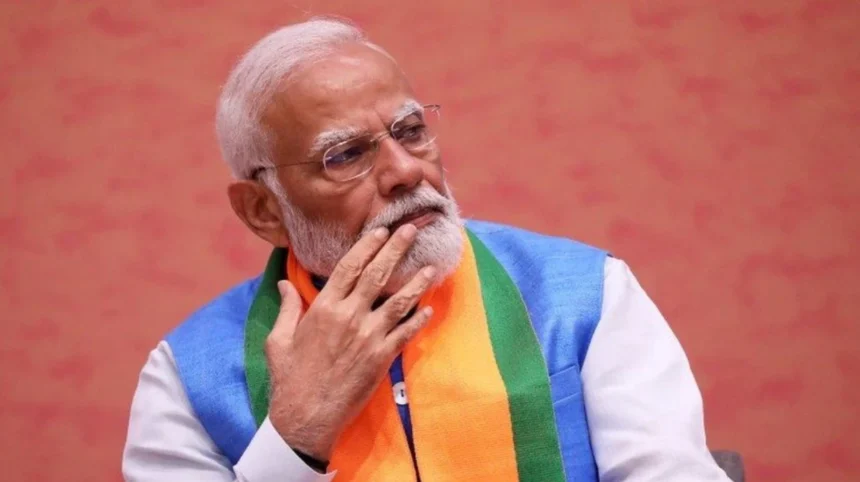
The hubris of the Hindutva government led by the BJP under Prime Minister Mr Narendra Modi is on its last leg. The youth and student movement across the country, along with the mass support it commands in its struggle against the Modi government, reveals a material crisis that is affecting all sections of the Indian population. The Modi government will definitely come to an end in the next general elections, scheduled sometime in April 2029.The fall of Modi government does not mean fall of Hindutva politics. But will the everyday ordeals of working people, women, students, youth, the rural population, the urban poor, and minorities finally end? Will India take a different direction in foreign policy as a truly sovereign country? Will India stand up for international peace without any hiccups? Will India repair the damages done to its social, secular, and democratic fabric? Will crony capitalism end to empower people in both economic and political terms? Will the politics of Hindutva hate finally end? These questions are central to imagining India after Modi and his brand of Hindutva politics of hate designed by the RSS.
Hindutva politics, as an ideological project of the RSS and its political front, the BJP, has ruined India domestically and tarnished its image abroad. India’s debt burden—both internal and external—has increased on an unprecedented scale in terms of the debt-to-GDP ratio. Indians are more in debt today than ever before. The economic illiteracy of this regime, combined with Hindutva crony capitalism and its rent-seeking approach, has led to a massive transfer of wealth from the working poor to the rich, making billionaires the primary beneficiaries of the Hindutva economic project. The meteoric growth of corporate houses like Ambani and Adani, and their unprecedented profit-making trajectory under the Modi-led BJP government, reveals the true nature of Hindutva politics—a project that fuses colonial capitalism with contemporary corporate capitalism, while ordinary people continue to suffer in their everyday lives.
On the social and cultural front, Hindutva politics constitutes a direct assault on science, secularism, society, and culture in India. The diversity that defines India, along with its social and cultural values, has been ruined by the BJP, which has intensified the colonial-era divisions between Hindus and Muslims. India has historically been a home for all kinds of persecuted minorities; these communities have not only contributed to the making of Indian diversity but have deepened its pluralistic culture, making India a garden of multiple faiths, religions, cultures, and languages. The RSS’s monolithic ideological project, which seeks to construct India as a land of ‘Hindu, Hindi, and Hindutva,’ is a narrow vision that diminishes India and its people, erasing their diverse and multiple identities that have lived together as a composite whole.
Indian foreign policy under the Hindutva government has undermined India’s international standing in terms of peace, solidarity, and support for the marginalised and weak. The Modi government has effectively surrendered India’s foreign policy to colonial European powers, imperialist America, and the Zionists in Israel. It has ruined India’s image as a country of reason, independence, and peace. Hindutva has a historical legacy of surrender to the British during the anti-colonial struggle for independence, and it continues to pursue the same cowardly politics today by surrendering to Yankee imperialism.
Hindutva regime represents a dark period in Indian politics, history, culture, society, and foreign policy. It remains a formidable political project, owing to its organisational strength, financial power, and the support of nearly 30 percent of the population, whose minds have been manipulated by relentless propaganda. However, 70 percent of India’s population continues to oppose Hindutva politics, which offers hope for restoring the future of India and its citizens in terms of citizenship rights, individual dignity, and constitutional democracy. This is the context in which the people of India must reimagine India after Modi. There are no shortcuts, but there are alternatives.
On the economic front, India must restore a radical welfare state and pursue distributive economic policies to uphold the interests of working people. This is crucial for consolidating the domestic market. Investment in manufacturing, small- and large-scale industries, and infrastructure can create employment and reduce poverty. Investment in research, development, education, and healthcare can accelerate economic growth and development through new innovations. Cooperative models for personal banking, insurance, and commercial business banking can bring stability to banks in both Indian and global contexts. India must increase corporate and wealth taxes to generate revenue for universal welfare programmes aimed at those suffering from poverty, unemployment, homelessness, old age, and ill health.
It is imperative to initiate social reform and harmony programmes to dismantle the gender-based Brahminical caste order and challenge religious fundamentalists, in order to restore a secular, scientific, and egalitarian society as mandated by the Constitution of India. Religious fundamentalists provide oxygen to Hindutva politics and its other variants across different parts of India.
In politics, it is essential to create a coalition of secular, democratic, and egalitarian forces that can agree on a political platform based on a common maximum programme to defeat Hindutva politics—not only in government but also in society, culture, and the economy. It is imperative to expose the reactionary ideology of the RSS and its anti-India history, in order to root out this organisation and its ideology forever from the country.
In terms of foreign policy, India must restore the principles of the Non-Aligned Movement (NAM) to reclaim its independence and dignity on the international stage, by decoupling itself from the clutches of European colonial powers, imperialist American hegemony, and the Zionist, racist, and warmongering state of Israel. This is the only way India can pursue its path of peace and diplomacy in international politics and relations. European and American foreign policy is fundamentally against the rise of India and Asia. Therefore, India must pursue unity and solidarity with Asian, African, and Latin American countries to restore its anti-war and anti-imperialist ethos for global peace.
These common maximum programmes are not utopian, but preludes to the genuine development of India and its people, irrespective of their backgrounds. India, a country rich in vast natural and human resources, cannot sustain itself while so many of its people remain poor. Distributive development is the way forward for those who believe in the radical transformation of Indian society, economy, and culture, based on equality, liberty, and fraternity as outlined in the Constitution of India. Defeat Hindutva for the survival, growth, and development of India.
The views expressed in this article are the author’s own and do not necessarily reflect (North London News) editorial policy.