
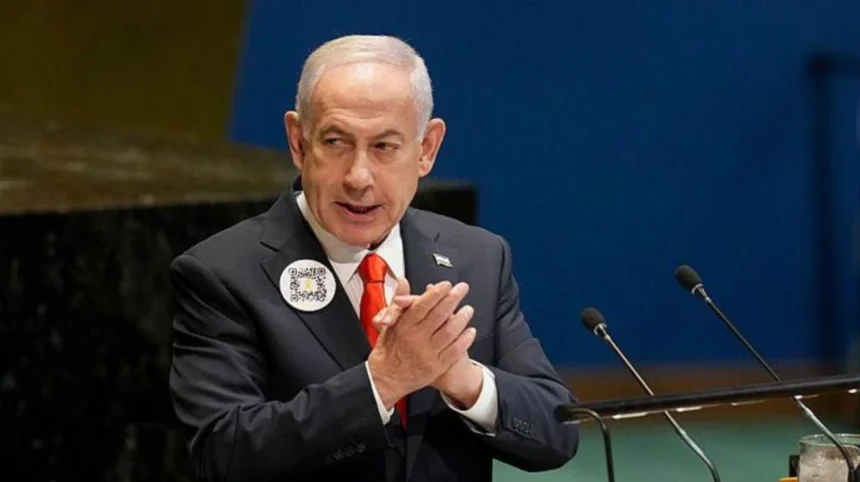
On September 24, 2026, Prime Minister Benjamin Netanyahu addressed the UN General Assembly before an almost empty hall. His objective was to impress voters back home with his characteristic grandiloquent propaganda and to keep his “Mr. Security” image intact. It seemed to be a farewell speech, punctuated by a series of oxymorons: genocide presented as self-defense, tribalist violence as civilized behavior, and apartheid as liberal democracy. His polished English placed Israel’s case in stark moral terms.
He has mastered the craft of using the UN forum to his advantage. Ever since his days as Israel’s Permanent Representative to the United Nations (1984–1988), he has followed the advice of the Lubavitcher Rebbe, who called the UN a “house of many lies,” and of another veteran Latin American diplomat, who said,
“The UN is a house of immortal life where no resolution truly ever dies.”
Yonatan Touval, writing in The Jerusalem Post in September 2026, recalled a 1988 interview with Netanyahu in which his method of mastering rhetoric was described thus:
“Establish irrefutable facts, use rhetoric, and score visible victories. Begin with what is true, cast uncertainty in its most threatening form, and turn danger into an argument for his own necessity.”
Israelis go to the polls on October 7, 2026. With a world of arguments delivered from the UNGA podium, will Netanyahu be able to sail through? The objective of this article is not to enter the unpredictable arena of psephology, but to analyze the trends running against Netanyahu both at home and abroad.
The Domestic Front
On the domestic front, several small pro-Netanyahu parties are competing with him. Instead of strengthening his hand, the hardline blocs led by cabinet ministers such as Itamar Ben-Gvir and Bezalel Smotrich are weakening his prospects by splitting the votes of his base. The October election will be a referendum on Netanyahu’s handling of the Hamas attack on October 7, 2023, and the unrelenting wars with Iran and in Gaza, Lebanon, and Syria, which have left Israeli soldiers war-weary and Israelis living in an atmosphere of fear and uncertainty. Israeli voters choose between political parties, not individual candidates. No single party has ever won the parliamentary majority required to form a government. The party leader whose coalition commands at least 61 of the 120 Knesset seats forms the government. Netanyahu now heads a coalition of religious and ultra-nationalist parties. But this coalition faces an uphill task in gaining public support because of inconclusive wars on several fronts and international isolation.
The division within his hardline base is a matter of concern for him. Two parties led by Smotrich’s Religious Zionism and Ben-Gvir’s Jewish Power have so far rejected Netanyahu’s call to merge again because of rocky relations between them. Smaller parties led by former members of Netanyahu’s Likud party, and another led by a hardline retired military general, are competing for the same voters. Sensing the impending danger, Netanyahu, with an alarmist tone in an interview with Channel 14, said that he alone can defeat Hamas and prevent the establishment of a Palestinian state. He called his opponents “the left.”
“The left is ready,” he said.
“If we do not unite, we will lose.”
International Standing
His international standing is at its lowest. Accusations of genocide and systematic war crimes in Gaza and the occupied West Bank, together with his fractious relationship with the UN, have dented his narrative as a defender against anti-Semitism and “Western civilization.” The Jewish Voice for Peace, a New York-based group, protested against Netanyahu, saying,
“The UN is playing host to a war criminal. Solidarity with Palestinian freedom has never been greater, and here in the US we are demanding with one voice: Stop arming Israel.”
In their book titled Israel Lobby: America in the Grip of a Foreign Power, Eli Clifton and Ian Lustick cite the startling findings of a survey conducted in July 2025 by the New York firm Stagwell Inc. and secretly sponsored by Israel’s Ministry of Foreign Affairs to measure American and European sentiment toward Israel and Palestine and to test messaging techniques for repairing Israel’s brand. The conclusion, based on 15 focus groups and 8,050 interviews in the US, Germany, the UK, France, and Spain, showed that Israel’s standing among Western publics had plummeted and that sentiment in favor of Palestinian rights was strong. This may have led the Israeli lobby in the US to reframe the narrative of the Jewish-American partnership as that of a defender of Western civilization.
There is a perceptible erosion of support for Israel among the American public. Trump’s absence from the UNGA during Netanyahu’s speech is interpreted by some as deliberate; perhaps Trump does not want to be seen helping him politically before the October election in Israel and the November election in the US. Netanyahu realizes this full well, which prompted him to say,
“Israel’s survival depends ultimately on itself.”
Electoral defeat awaits Netanyahu to define democratic disgrace to his murderous Zionist regime.
The views expressed in this article are the author’s own and do not necessarily reflect (North London News) editorial policy.