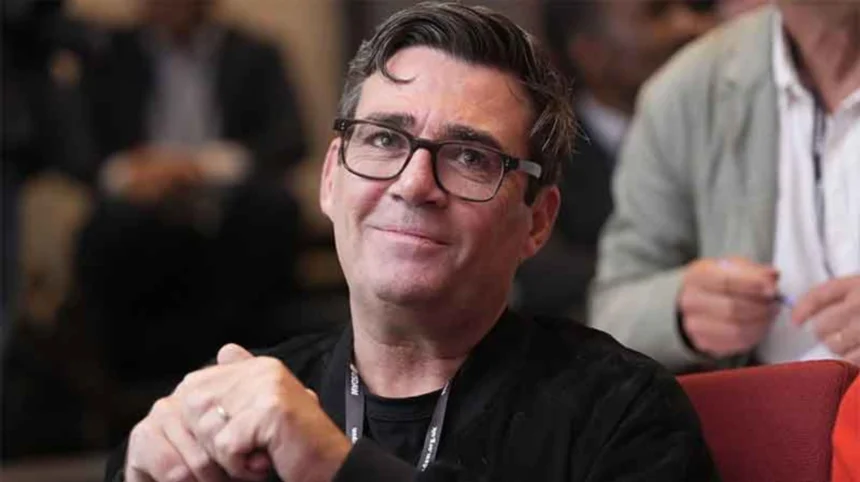
Nadia Urbinati, a political theorist at Columbia University, has succinctly argued that elections are periodic moments of popular authorisation and accountability for governing elites; the act of voting does not exhaust the democratic implications of popular sovereignty. The making of popular sovereignty, she contends, lies not merely in the ability to vote, but in the people’s capacity to rule over the polity. With Keir Starmer’s leadership now under severe strain, the question of how to facilitate genuine popular rule assumes critical importance within the poetics of Labour politics in the UK. Aspirants are many, but Andy Burnham currently leads the list of contenders.
Burnham’s victory in the closely watched Makerfield by-election has intensified opposition to Starmer’s leadership. His political journey is unusual. Born in the region between Liverpool and Manchester, he joined the Labour Party as a teenager, studied at Cambridge, and entered Parliament in 2001. He served under both Tony Blair and Gordon Brown, and twice sought the Labour leadership unsuccessfully. He left Westminster in 2017 to become Greater Manchester’s first elected mayor. During the pandemic, he criticised Boris Johnson’s London-centric approach to tackling the plight of COVID-affected working-class communities across Britain. His robust defence of Greater Manchester earned him the sobriquet “King of the North”—a reference to the popular television series Game of Thrones.
As mayor, Burnham has overseen major regeneration projects across the city-region and won accolades for bringing public transport under local control through the Bee Network. He has also become a prominent advocate for the Hillsborough families seeking justice over the 1989 disaster. His communication style is relatable to party members, and his image as a plain-speaking politician has helped him connect with broader audiences beyond traditional party loyalists. His vision stands apart, and his by-election victory is about more than a parliamentary comeback.
In his victory speech, Burnham stated that the UK needs a new political direction and described the result as a potential turning point. He has promoted his model of “Manchesterism”—a focus on local communities, regional investment, and economic renewal outside London. During his election address, he declared:
“What we have built in Greater Manchester needs to go national.”
He added, “I know what it is to turn places around.” His agenda includes lowering electricity bills and rail fares, expanding opportunities for young people, and ending trickle-down economics. Defeating Reform UK strengthens his claim that he offers something distinctive to Labour. Starmer, meanwhile, faces mounting pressure on multiple fronts—from Labour’s falling poll numbers to the growing threat posed by Reform UK. Burnham’s win over Reform has handed him a powerful argument at a time when Labour is struggling to contain Nigel Farage’s rising party.
It need hardly be reiterated that the Labour Party swept to power in 2024 with a landslide majority, securing 403 of the 650 seats in the House of Commons. Yet, within just two years, the Starmer government has squandered this opportunity, with Britain declining on economic, security, welfare, and public-service fronts. Opposition to his rule has grown steadily.
Whoever succeeds Starmer will have to grapple with the pressing issues of the time. The new leadership must overcome its aversion to strategic planning and create effective structures to channel funds towards domestic investment and infrastructure. Unnecessary regulations need to be reduced, and job creation must be given top priority. People are frustrated by prolonged economic instability, stagnant living standards, and rising taxes. UK productivity has dipped despite longer working hours. David Cameron’s harsh austerity policies—cutting back on infrastructure, skills, and R&D—have clearly not had the desired effect. According to the recent Economic and Fiscal Outlook report, if the UK’s economic trajectory had continued along its pre-2008 path, average real income today would be 31% higher than it currently is.
Under-investment is one key reason for this productivity loss. The UK is also notorious for over-regulation. The government has effectively outsourced planning to private firms, which in turn exploit loopholes in the system. The HS2 project, for instance, has remained in limbo for far too long, leading to a whopping £600 million being spent on consultancy alone.
Another vital task for the new leadership is to mobilise public opinion toward rejoining the EU. The UK’s exit from the EU was a disaster, resulting in a loss of 6% of overall GDP, even by the most conservative estimates. Yet the Labour Party’s mission is not merely to prepare for the next election in 2029, but to sustain continuous public mobilisation against neoliberal policies. The perverse neoliberal model has led the UK to outsource public services to private corporations while drowning institutions in red tape and paperwork, effectively washing its hands of accountability.
Unifying the deeply divided ruling Labour Party is another urgent priority for the new leader. Internal strife and the recent spate of resignations within the Starmer government are clear indicators of the political and ideological malaise. This requires careful navigation and deft political handling. To cap it all, handling the crises involving the US and West Asia to Britain’s—and NATO’s—advantage will also be a tall order for the new Labour leadership.