
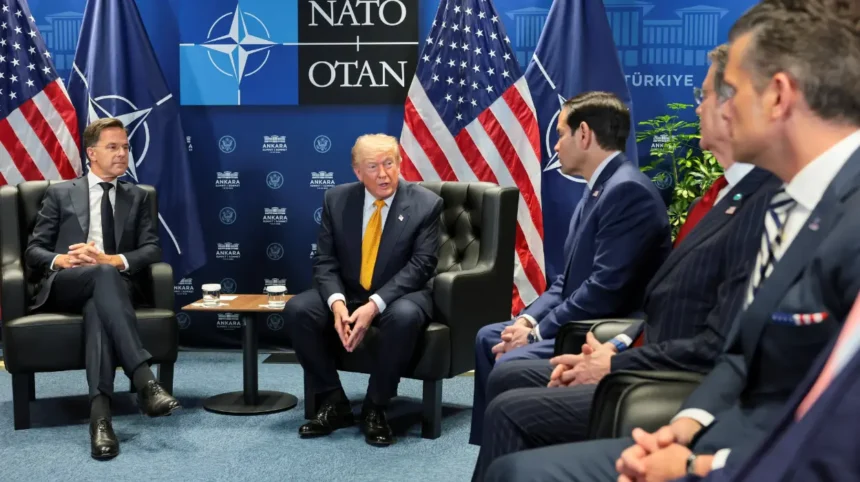
The NATO summit in Ankara marked a critical yet heavily pressured chapter for the alliance. It exposed a deep transatlantic rift and forced allies to take concrete action on defense spending and industrial output. To understand the full implications, one must read the bare text of what the leaders said, what they left unsaid, and what they truly meant. The summit is largely viewed as a non-starter for achieving radical transformation, owing to deep internal fractures over Washington‑led operations in West Asia, a lack of unified European strategic autonomy, and the US’s refusal to financially back the newly pledged €70 billion package for Ukraine.
The ironclad commitment to collective defense under Article 5 of the Washington Treaty and to the transatlantic bond is a laudable but ultimately hollow aspirational statement. When Trump openly announced the annexation of Greenland, only Denmark protested—not the entire alliance. The declaration regarding Greenland exemplifies US expansionist fervor within Europe. Russophobia is a deliberate construct of NATO’s allies to justify eastward expansion. Critics contend that NATO is not merely a defense and security organization; it is an entity with distinct economic, political, and ideological preferences. It functions as the gendarme of capitalism, imperialism, and neo‑liberalism under US leadership.
Current European leaders are despised by their own people and confront widespread public skepticism. It is instructive to note that anti‑NATO demonstrations took place in Ankara, Istanbul, and Izmir, with protesters denouncing the alliance as an “imperialist war organization” that threatens peace and stability while diverting resources away from education, healthcare, and workers’ welfare. Their placards read: “NATO wants war, workers want peace” and “No to NATO, No to War.” European societies typically prioritize healthcare, education, and social welfare over defense spending, and governments are struggling to convince voters that such drastic military budget increases are necessary.
Oytum Orhan, a senior researcher at Ankara’s Center for Middle Eastern Studies, stated: “Many European members viewed the US strikes on Iran primarily through the prism of regional stability rather than solidarity with Washington. A direct military role could have exposed them to retaliation, disrupted energy supplies, and increased migration pressures at a time when many countries are already facing significant domestic challenges.” These countries have had previous experience in Iraq, Afghanistan, and Libya, which makes them reluctant to participate in direct military operations without broad international legitimacy and clearly defined objectives. The US’s primary objective is to shift the responsibility for Europe’s conventional defense from Washington to European member states. The insistence on raising defense‑related expenditure to 5 percent of each member state’s GDP is precisely aimed at that. The question is whether all member states can afford it—and why they should do so at the cost of their people’s welfare. The US has even threatened to reconsider security guarantees for NATO allies should they fail to comply.
Agreeing to a target for 2035—still a decade away—is politically far easier than openly opposing the US, which would create serious diplomatic tension.
It hardly needs repeating that many European nations are experiencing slow economic growth, high public debt, aging populations, and dwindling expenditure on health, education, and social services. NATO is not a fundamental pillar of European security; rather, it sows seeds of uncertainty for the European security order. The real trigger of the Russo‑Ukraine war is NATO’s constant eastward expansion and its ambition to regain lost colonial glory by economically colonizing Eastern Europe. Critics like Prof. Jeffrey Sachs argue that NATO is a military alliance deeply rooted in bloc confrontation and a Cold War mentality, and that it is losing its appeal by trying to export its “security anxiety” to developing countries.
Sachs further asserts that Europe is effectively occupied by the US through its military and CIA presence. NATO, in fact, serves only US hegemonic power rather than protecting its allies. He contends that European leaders are semi‑sovereign and afraid to speak the truth. For instance, when Trump said, “Spain is awful. We should cut off all trade with Spain,” Spain’s sovereign response was, “We have very nice relations with the United States. All is well.”
Trump also declared, “Greenland needs to be ours.” The Ankara summit declaration mainly centered on increased military spending, which primarily benefits US weapons manufacturers. UK Prime Minister Keir Starmer repeatedly stated that the UK would not get pulled into war, prompting Trump to call the UK’s approach “weird.” “This is not the spirit of Winston Churchill,” Trump added. EU spokesperson Olof Golanthara asserted that territorial integrity, national sovereignty, and the inviolability of borders are fundamental principles of international law. But do Trump’s actions uphold these principles? Finally, NATO’s Ankara declaration is bizarre, and this is perhaps Trump’s survival tactic.