
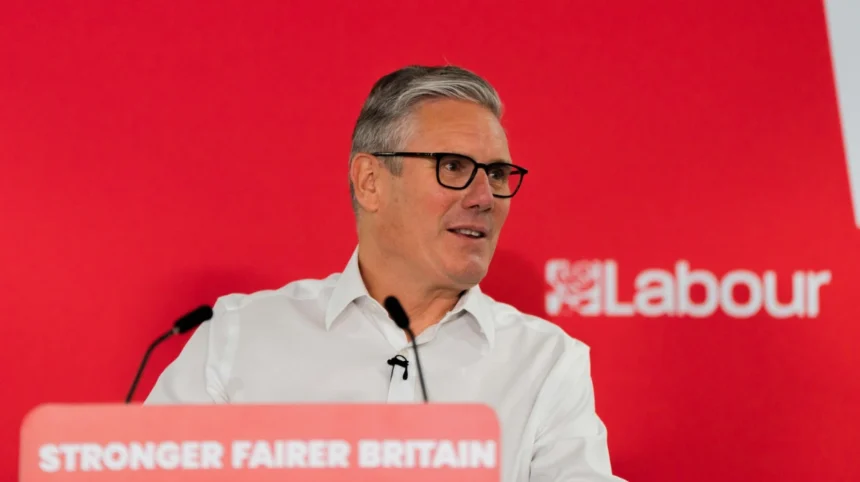
United Kingdom Prime Minister Keir Starmer is fighting desperately for his political survival. The Labour Party’s humiliating economic struggles, coupled with previous scandals, have massively depressed approval ratings, putting Labour’s large parliamentary majority at risk of further electoral setbacks. So much so that as many as 90 Labour MPs have urged Mr. Starmer to step down or set an exit timeline. Former Health Secretary Wes Streeting has stated that he has lost confidence in Starmer’s leadership.
Starmer’s Government has been in power since 2024, ending fourteen years of Conservative rule in a landslide victory. His popularity is on the wane due to the decision to cut the winter fuel allowance amid a cost-of-living crisis and the scandal over United States Ambassador Peter Mandelson’s links with Jeffrey Epstein.
In a make-or-break speech, Starmer took responsibility for the very tough results, promising to face up to the big challenges and make the Labour case for a “stronger, fairer Britain.” He admitted that Labour had made mistakes but argued that it was correct not to have been dragged into the US–Israel war on Iran. He also argued that reductions in National Health Service (NHS) waiting lists, child poverty, and immigration are sound. He added,
“We are not just facing dangerous times, but dangerous opponents. We are battling Reform and the Greens, but at a deeper level, we are battling the despair on which they prey. Despair that they exploit and amplify.”
He stated that neither Reform UK’s Nigel Farage nor the Green Party’s Zack Polanski offers the serious, progressive leadership that these times demand.
Boosting the morale of the party, he said that Labour is a “mainstream party of power, not protest.” He promised that the Government would introduce legislation to take ownership of British Steel and would be defined by rebuilding the UK’s relationship with Europe. He further promised a
“guaranteed offer of a job, training, or work placement for every young person looking for work. Standing shoulder to shoulder with countries that most share our interests was the right choice for Britain.”
As reported by Reuters and Christine Maguire in a recent article, Starmer’s address was “too little, too late.” What is best for the party and country now is an orderly transition. Labour MP Catherine West urged Cabinet ministers to move quickly to replace Starmer. She said,
“I am hereby giving notice to No. 10 that I am collecting names of Labour MPs to call on the Prime Minister to set a timetable for the election of a new leader in September.”
More than 30 Labour MPs have demanded the Prime Minister’s resignation or a timetable for departure, including Josh Simons, who wrote in The Times that Starmer had “lost the country.” The North Northumberland MP is reported to have called for a return to being a party of the working class and for Labour to be more radical in its solutions. Liberal Democrat Leader Ed Davey stated that the Government must end the cost-of-living crisis by getting rid of Keir Starmer’s red lines on Europe and fixing the botched Brexit deal, including a customs union.
Former Labour leader Jeremy Corbyn criticized Prime Minister Starmer in a post on X, pointing to his decisions to cut welfare to spend more on weapons and war, and to delay scrapping the two-child benefit tax credit cap. He noted that the Government has chosen not to bring water into public ownership, not to tax wealth, and not to implement rent controls. The Government chose to arm Israel and participate in genocide, he added, and chose to let the US use British air bases for its war in Iran.
On June 11, 2026, the UK Defence Secretary, John Healey, resigned. In his resignation letter, he stated,
“You have been unable, and the Treasury has been unwilling, to commit the resources that the nation needs to defend the country at this time of rising threats,”
adding that the forthcoming Defence Investment Plan falls short of what is required for defence and the country at this dangerous time. It has been argued that failure to provide funds as per the Strategic Defence Review (SDR) recommendation is a decision that would make the country less safe.
Prof. Bhabani Nayak as a political commentator, has pointed out in a perspective article that the Labour Government under Mr. Starmer’s leadership has unfairly cut welfare budgets, including reductions in child benefits, winter fuel allowances for the elderly, and other welfare supports for vulnerable populations. The country is grappling with rising unemployment and escalating child poverty, which reflect Mr. Starmer’s lack of moral and political compass to lead the country. His politics of “unburdened by doctrine” is far from value-free. In reality, there is nothing progressive about the Labour Party under the Prime Minister’s leadership today. Starmer is truly a conservative leader in labour party.
In fact, Rosie Duffield, Member of Parliament for Canterbury, has quit the Labour Party and exposed the “cruel and unnecessary” policies against the working class of Britain by the Starmer Government. Under the guise of economic growth, the Government is aligning with the interests of capitalism. His untenable positions on NATO, nuclear weapons, the Ukraine–Russia conflict, the US–Israel war on Iran, and the genocide in Gaza reflect his embrace and celebration of colonial, imperialist, and Zionist doctrines, all under the guise of the governance principle of being “unburdened by doctrine.” These underscore the disconnect between the government and the working-class values of justice, equality, liberty, and solidarity that once defined the Labour Party. It is time for political mobilization of the working class, whose struggles have the potential to deepen democracy and achieve radical democracy.