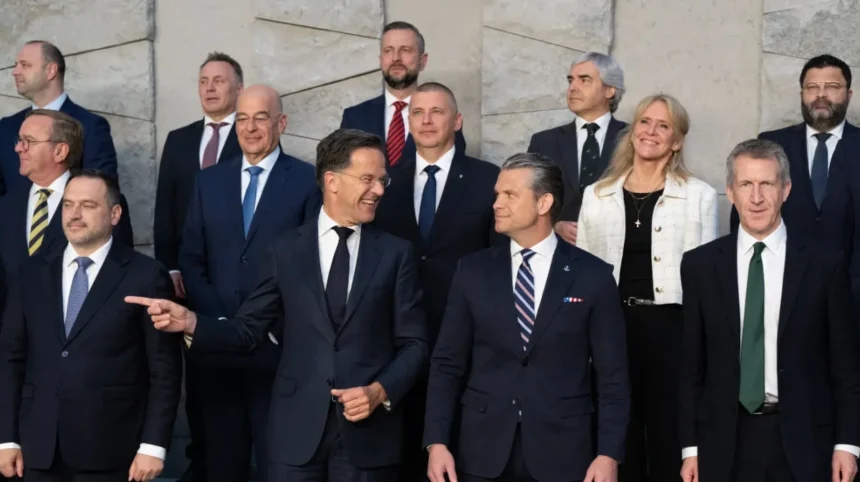
North American and European leaders will gather in Ankara on July 7–8, 2026, for the NATO Summit. Heads of state and government from all 32 member states are expected to attend, including U.S. President Donald Trump. The official agenda includes building on commitments to increase annual defence spending to 5 percent of GDP by 2035—up from the 2 percent benchmark set in 2014—addressing Russia’s ongoing war in Ukraine, managing the fallout from the U.S.-Israeli war on Iran (which several allies declined to join), and navigating the controversy surrounding Trump’s threats to annex Greenland, which have revived questions about Washington’s commitment to the alliance. Beneath these stated objectives, however, this year’s summit is chiefly about managing the United States and keeping its president—a long-standing NATO skeptic—engaged with the alliance.
Since returning to power, President Trump has fixated on burden-sharing within NATO. His administration has maintained a relentless focus on eliminating so-called “free riding,” while his musings about making Canada the 51st state and his decision to join Israel in launching a war against Iran without prior consultation with allies have created a profound trust deficit. When foreign ministers convened in May to prepare for the 2026 summit, burden-sharing dominated the discussions. In a thought-provoking article titled “Trump Is Shattering the Illusion of the West,” Professor Amitav Acharya observes that under Trump, something unusual has entered the grammar of U.S. foreign policy: imperial civilizationalism—the use of civilizational identity as an instrument of aggressive populist foreign policy. Acharya warns that the administration’s 2025 National Security Strategy speaks of “civilizational erasure” in Europe, driven largely by migration and the erosion of national identities, and predicts that Europe risks becoming “unrecognizable in 20 years or less.”
Vice President J.D. Vance, speaking at the 2025 Munich Security Conference, had already warned that the greatest threat to Western civilization came “from within”—namely, European tolerance of immigration, retreat from religious orthodoxy, and restrictions on free speech. He later spoke explicitly of Europe’s “civilizational suicide.” Yet another threat to NATO and its allies stems from Washington’s bulldozer politics under Trump. The U.S. approach to European security is now perceived as volatile, oscillating between reassurance, conditionality, and coercion. In the face of shifting signals from Washington, European ruling elites are striving to keep the United States engaged while simultaneously preparing for greater strategic autonomy. This suggests that Pax Americana can no longer serve as a universal norm of global governance. The Munich Security Report 2026 reiterates the importance of global trade, development cooperation, and humanitarian assistance, but it fails to conceal the empire in plain sight.
Professor Bhabani Nayak, in a compelling piece titled “Echoes of Racial Capitalism, Colonialism and Imperialism in Munich Security Conference 2026,” draws attention to the need for a united front against the ruling elites of Europe and America, who sustain their capitalism through colonial plunder, imperialist wars, and conflicts—all at the expense of peace, people, and prosperity. He argues that it is not the spectre of communism but the struggles of ordinary people confronting these elites that now haunt the wet dreams of imperialist powers. This, too, poses a potent challenge to the NATO summit in Ankara.
Marco Rubio’s address to the Munich Security Conference—calling for a revival of imperialist and colonial past—bears testimony to that lurking fear. He urged European and American unity to revive colonialism in the following terms: “This is the path that President Trump and the United States have embarked upon. It is the path we ask you here in Europe to join us on. It is a path we have walked together before and hope to walk together again. For five centuries, before the end of the Second World War, the West had been expanding—its missionaries, its pilgrims, its soldiers, its explorers pouring out from its shores to cross oceans, settle new continents, build vast empires extending out across the globe.”
This is a clarion call for the revival of European colonialism under American imperial domination. Rubio’s remarks betray a fear that without Western domination, there would be a rise of “godless communist revolutions and anti-colonial uprisings that would transform the world and drape the red hammer and sickle across vast swaths of the map in years to come.” While this message may reassure European allies, the gap between rhetoric and practice in U.S. policy continues to sow doubt among NATO members. The deeper paradox at the heart of Trump’s civilizationalism—which claims to defend Western civilization—is that it has done more to fracture the Western alliance than any external adversary. This became evident when, during the Iran war, France blocked Israeli planes from flying weapons through its airspace, Italy refused last-minute permission for U.S. bombers to land in Sicily, and Spain denied the U.S. use of its bases and airspace.
Compounding these tensions, the United States has recently announced drastic changes to the NATO force model, including scaling back the number of fighter jets, bombers, submarines, maritime surveillance aircraft, and aerial refueling platforms available to NATO in critical situations. Washington has also cancelled the deployment of a Multi-Domain Task Force long-range fire battalion to Germany, which will negatively affect Europe’s ability to deter Russian targets. These decisions further diminish U.S. commitments in Europe.
Anything could happen at this summit, making it a significant moment in the Alliance’s history. The Euro-Atlantic security order faces profound challenges: Russia’s ongoing confrontation with the West—extending far beyond the war in Ukraine—growing strategic competition with China, instability in West Asia, and uncertainty about the long-term U.S. role in Europe all combine to shape a complex security agenda. Marco Rubio summed up the summit’s objective as “the most important meeting in NATO’s history, because there is something that needs to be cleared up and fixed.” Whether it will resolve the West-versus-the-rest divide—or the imperialist plunder-versus-people’s struggle—remains to be seen.