
At a time when the unpopularity of far-right neo-fascist governments is reaching its peak, a series of summits are taking place at increasingly shorter intervals among strange bedfellows, seemingly designed to counter the optics and rhetoric surrounding their impending political collapse. The Quad summit on the sidelines of the ASEAN meetings and the Shenzhen summit are examples of such gatherings, where leaders meet, discuss, announce lofty declarations and disperse until the next summit. These meetings are taking place amid geopolitical turmoil, a polarised world, wars in Gaza and Iran involving the imperial forces of the US and Israel, the erosion of democratic legitimacy in Europe and the Global South, including India, and superpowers forcefully grabbing smaller states.
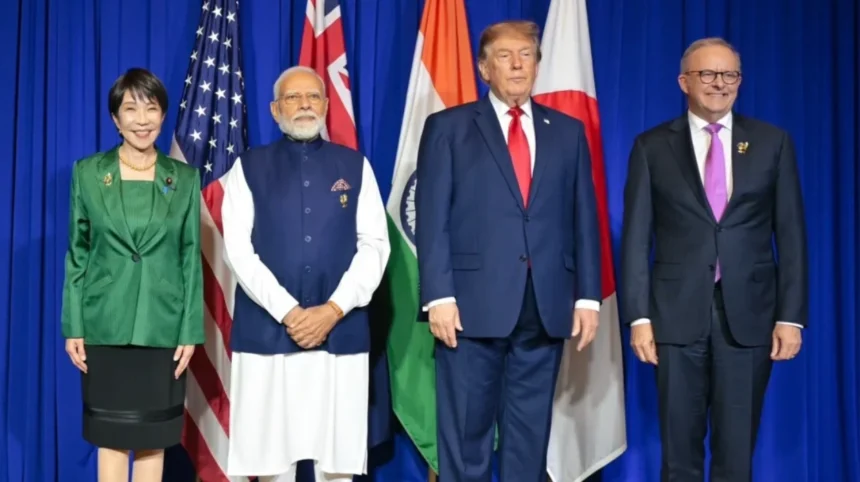
The Quad leaders of India, the US, Japan and Australia met in Manila, the capital of a non-Quad country, on November 17, 2026.
The timing of the summit was unusual. It took place just two days before US President Donald Trump was scheduled to meet Chinese President Xi Jinping and Russian President Vladimir Putin in Shenzhen. The proposed meeting and the Shenzhen Declaration have fuelled speculation that Washington, the so-called driving force behind the Quad, might be softening its stance on countering China, leaving its other three partners uncertain about whether the US is prioritising bilateral deals over multilateral alliances.
The summit exposed internal friction and transactional politics amid ongoing bilateral trade differences between the US and its partners, particularly over American tariff policies. Analysts, quoting The Straits Times, warned that “the Quad is not out of the woods”, noting that the grouping remains vulnerable to Trump’s transactional approach to foreign policy and his dealings with partner countries. This could create friction with India’s emphasis on strategic autonomy and the economic realities confronting all four members.
Ahead of the summit, Quad leaders had to clarify that the grouping was not “on life support”. Speculation about the Quad slipping into limbo gained rapid traction because the summit could not be held last year, when India was due to host it, and because of the ongoing attempts at US-China rapprochement. Trump’s two meetings with Xi Jinping this year, alongside the proposed meeting in Shenzhen on November 19, 2026, have fuelled speculation that Washington is losing interest in a grouping animated by the overarching agenda of countering Chinese aggression.
Following the crushing defeat of the Republicans in both the House of Representatives and the Senate in the recently held midterm elections, Trump is frantically trying to change the narrative about his administration’s commitment to the Quad. He has invoked the five Quad foreign ministers’ meetings held over the last two years to reinforce his case. The overarching focus of the Quad summit in Manila was to counter Chinese economic coercion, particularly in response to China’s restrictions on critical mineral exports to the US, India and other countries. With an eye on China, the summit culminated in concrete plans to strengthen critical mineral supply chains. Enhancing intra-Quad cooperation to establish reliable and resilient supply chains was one of its key outcomes.
With Chinese assertiveness growing across the Indo-Pacific, the Manila summit also focused on deepening maritime collaboration among the four nations. In this regard, the Quad countries will hold their first exercise under the Indo-Pacific Maritime Surveillance Collaboration Initiative during Sea Dragon 2027. The first Quad Maritime Domain Awareness Track 1.5 Symposium under the Quad Maritime Initiative for Training in the Indo-Pacific (MAITRI) is scheduled to take place in early 2027. It will provide a platform for regional partners to discuss maritime domain awareness approaches, technologies and information-sharing mechanisms. The Indo-Pacific Maritime Surveillance Collaboration framework is designed to boost information-sharing, monitor activities at sea and strengthen maritime domain awareness across the region.
The Quad is not a treaty-based military alliance. It has no permanent secretariat. Its members have built a network of cooperation through leaders’ meetings, foreign ministers’ consultations and practical initiatives. This distinction is important: the partners can coordinate on regional challenges without requiring members to adopt identical positions on every foreign policy issue. In Manila, the Quad leaders reaffirmed their support for ASEAN centrality and unity. This was a hollow reminder that the Quad’s stated Indo-Pacific vision is supposed to work alongside regional institutions rather than replace them.
Several initiatives were announced in the joint declaration at the Manila summit. These included the inaugural Quad Business Leaders’ Forum, scheduled to take place in Mumbai in early 2027. The forum will bring together business leaders, government officials and policy experts from the four countries to encourage commercial deals and private-sector partnerships. The leaders also announced that their maritime patrol aircraft would participate in an exercise for the first time in a Quad context in 2027. The leaders welcomed the Indo-Pacific Maritime Surveillance Collaboration (IPMSC) framework, launched in New Delhi in May 2026 following the Quad foreign ministers’ meeting. The initiative aims to strengthen information-sharing and maritime domain awareness capabilities across the region. In addition, the leaders reiterated their support for the AI Accelerator, a joint initiative announced during the Quad foreign ministers’ conference in Atlanta last month, alongside enhanced Quad cybersecurity cooperation.
Amid concerns about the declining importance of the Indo-Pacific in Trump’s foreign policy priorities, the Manila summit appeared to be a welcome development in terms of political signalling about Washington’s commitment to the region. Addressing the summit, Trump stated that “the Quad nations represent some of the most important partnerships in the entire world, and are among the most successful.” Critics, however, warn that these announcements may remain on paper. The joint statement, for instance, does not specify a shared cyber-response unit, a common database or a new mechanism for responding to cyberattacks.
The pre-meeting photo opportunity in Manila reflected the underlying friction and asymmetric power dynamics that define the Quad. While Trump answered all the questions on his own, the other leaders stood silently like statues. The Indian Prime Minister’s visible discomfort with Trump’s hijacking of the formal summit photo opportunity and its transformation into an impromptu press conference to wrap up the exchanges ran counter to the spirit of easy camaraderie among equals that had characterised the early years of the Quad’s revival.
The joint statement made no mention of the heightened tensions between Manila and Beijing, nor did it refer to the 2016 Arbitral Award, unlike the 2024 Wilmington Declaration. The statement was conspicuously silent on maritime disputes and refrained from condemning the illegal conduct of nations in the region. Surprisingly, it was Japan that explicitly mentioned the East China Sea and the South China Sea in the context of the four nations aligning their “strategic perspectives”. No such references appeared in the statements released by India, the US or Australia.
Similarly, it was only Tokyo that mentioned North Korea and West Asia, including the situation in Iran, while the other three Quad leaders remained silent, neither mentioning these issues nor proposing any action. The 2026 Manila Joint Statement also failed to mention the need to protect and preserve navigational rights and freedom in the Strait of Hormuz, the Red Sea and the Bab-el-Mandeb Strait, issues that had been explicitly highlighted at the Quad foreign ministers’ meeting on October 31. These omissions raise important questions about the extent to which India, as the host, was able to shape and curate the summit’s agenda.
All these factors point to the fact that none of the members appears willing to risk upsetting China. The absence of collective defence arrangements, hard security guarantees and mutual defence commitments is a defining feature of the Manila Declaration. Although the declaration advances operational maritime surveillance through the deployment of P-8 and P-3C aircraft, it contains no explicit collective defence guarantee, joint command structure or commitment to automatic military intervention in the event of a conflict.
The trust deficit between India and the US, fuelled by bilateral friction over tariffs, visa restrictions and India’s purchases of Russian oil, further limits the political weight of the grouping. The way the Quad summit was conducted under Trump’s leadership risks sending a message to the world that convenience, rather than serious strategic convergence, governs the worldview of the Quad.