Key Points
- A debate published in the Football365 Mailbox section has ignited widespread discussion amongst football supporters regarding the evolution of Premier League entertainment and fan engagement.
- Arsenal supporters have targeted Liverpool’s championship status, attempting to shift the moniker of “p***iest fans in English football” across rival fan bases following sustained online banter and editorial exchanges.
- Contributors to football media outlets have questioned whether modern tactical homogenization, data-driven analysis like expected goals (xG), and commercialisation have rendered top-flight football less enjoyable for match-going and broadcast audiences alike.
- Generational divides are emerging, with older fans pointing to classic physical clashes and contrasting stylistic encounters—such as Arsène Wenger’s Arsenal against Tony Pulis’s Stoke City—as a stark contrast to current uniform tactical setups.
- Commentators from across the country have highlighted growing fan apathy, reduced viewing habits, and the rise of corporate influence as key factors changing the landscape of English football.
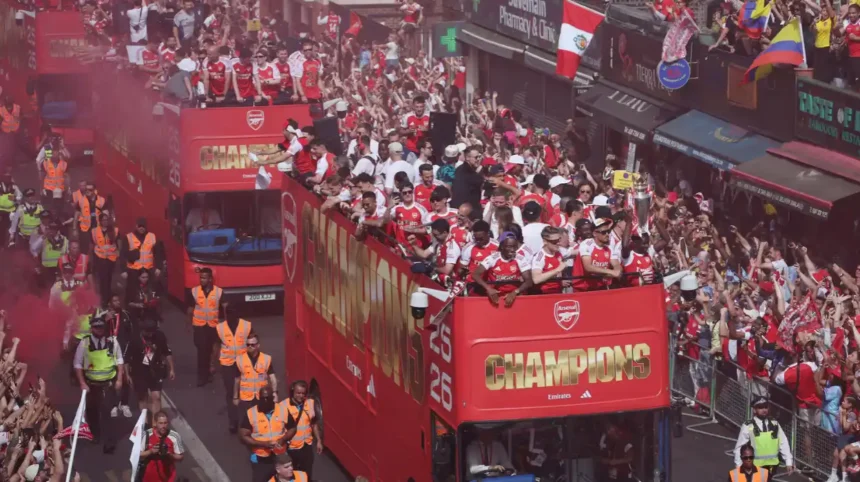
Arsenal (North London News) October 21, 2026 — Growing disaffection amongst supporters over modern tactical styles, hyper-commercialisation, and social media toxicity has reached a boiling point as Arsenal and Liverpool fans trade sharp barbs over the legitimacy and prestige of recent Premier League title victories. The debate, highlighted in the popular Mailbox section of sports outlet Football365, centers on claims that top-flight football has grown increasingly homogenous and less entertaining compared to previous eras. The dispute underlines broader concerns within English football culture regarding whether data-driven tactical systems and corporate branding have eroded the tribal joy and stylistic variety that historically defined matchdays for supporters.
- Key Points
- Why Are Football Fans Questioning the Entertainment Value of Modern Premier League Matches?
- How Have Rival Supporters Reacted to the Ongoing Arsenal and Liverpool Media Feud?
- Background of the Particular Development
- Prediction: How This Development Can Affect Premier League Broadcasters, Clubs, and Supporters
Why Are Football Fans Questioning the Entertainment Value of Modern Premier League Matches?
As reported by editor F365 on Football365, a prominent contributor identified as JB submitted a broad critique of contemporary top-flight football, asking whether supporters have “become the easiest to rile in the Premier League” and questioning if “football is actually any fun anymore”. Writing directly to the outlet’s Mailbox, JB highlighted a growing sentiment among fans in their thirties and older who find themselves spending less time watching, caring about, or discussing the sport.
In the submission, JB referred to earlier correspondence from another contributor, Chris from Croydon, noting that the shared feeling of apathy was becoming widespread across fan bases. As stated by JB of Football365, traditional matchday rituals and televised clashes appear to have lost their historical allure:
“Wasn’t football more fun when any given Super Sunday would be worth going to the pub for if you had the time, because seeing a few ‘crap’ teams on the fixture list didn’t mean it would be boring?”
JB further argued that modern tactical setups have stripped the game of its dramatic diversity. Drawing a direct comparison between historical managerial rivalries and contemporary football tactics, JB noted:
“Wasn’t football more fun when football could be a clash of styles – Wenger’s Arsenal vs Pulis’ Stoke or Fergie’s United vs Mourinho’s Chelsea – similar to when the UFC would be a great kick-boxer vs an excellent BJJ grappler. Much like the UFC has become a hegemony of well-rounded fighters with less specialties fighting on the White House lawn in front of military flyovers, it feels like football has become the same – carbon copy teams with different badges competing in cash grabbing product.”
Directing questions to younger supporters, JB asked whether this disconnect is simply down to nostalgia—recalling iconic physical moments such as “Dion Dublin headbutting Robbie Savage”—or whether football has genuinely become more mundane, questioning if younger audiences actively enjoy discussing underlying analytics like expected goals (xG) over a pint in the pub.
How Have Rival Supporters Reacted to the Ongoing Arsenal and Liverpool Media Feud?
As reported by editor F365 on Football365, the public exchange of views has also seen rival supporters trade jibes regarding fan behaviour and club reputations. In a satirical contribution published by Football365, an unnamed rival supporter sarcastically congratulated Arsenal Football Club on their latest online status, claiming they had taken “the honour of ‘P***iest Fans in English Football’ off Liverpool”.
The contributor went on to write:
“Proudly display the Pissiest Fans in English Football trophy alongside the Premier League Trophy, the golden Premier League trophy and innumerable Wenger-era Fourth-Place Trophies! To the Arsenal faithful, well done and keep up the great work!”
This exchange follows months of intense debates across media platforms, where Liverpool’s past title achievements and title defences have been scrutinized alongside Arsenal’s tactical evolution under Mikel Arteta. Disagreements over style, officiating decisions, and squad construction have consistently dominated online sports forums and reader-submitted opinion columns.
Background of the Particular Development
The public debate over fan engagement and tactical boredom comes against the backdrop of significant shifts in Premier League football over the past decade. The widespread adoption of positional play (Juego de Posición), high-pressing schemes, and intricate build-up mechanics—pioneered and popularized by managers like Pep Guardiola and Jürgen Klopp—has led to tactical standardization across the league. Lower-tier and mid-table clubs increasingly employ similar possession-based models or low-block counter-attacking schemes, replacing the stark physical and stylistic contrasts that characterized the league during the 1990s and 2000s.
Concurrently, the integration of advanced metrics such as expected goals (xG), expected assists (xA), and field tilt into mainstream broadcasting and fan discourse has altered how matches are analyzed and debated. While analytical tools provide deeper technical insight, a growing segment of traditional match-going supporters believes that over-analyzing performances has diluted the visceral, emotional experience of spectator sports. Coupled with rising ticket prices, shifting broadcast schedules, and multi-platform media coverage, fan bases have expressed heightened frustration and polarization online, resulting in intense tribal debates across digital football communities.
Prediction: How This Development Can Affect Premier League Broadcasters, Clubs, and Supporters
This ongoing shift in fan sentiment and tactical uniformity is likely to influence several key areas of English football in the coming seasons:
- Broadcast and Content Strategy: Television networks and sports digital outlets will likely re-evaluate how match previews and analysis are framed. To combat viewer fatigue and retain audiences who feel alienated by purely statistical breakdowns, broadcasters may pivot back toward storytelling, tactical diversity, and human-interest features rather than relying solely on high-level data metrics.
- Matchday Atmosphere and Ticket Allocation: As traditional, older match-going fans voice disconnect from what they perceive as a “cash-grabbing product,” clubs may face pressure to protect core supporter culture. If long-standing season ticket holders step away due to disillusionment, stadium atmospheres could undergo further demographic shifts toward casual and international tourism markets, forcing clubs to balance commercial revenue against traditional fan retention.
- Tactical Innovations by Managers: The current saturation of possession-based systems may incentivize a new wave of managerial counter-trends. As teams seek competitive advantages, coaches who reintroduce pragmatic, highly direct, or asymmetrical tactical styles could find renewed success and popularity by breaking away from the standard blueprint, offering the stylistic variety that supporters currently crave.