Key Points
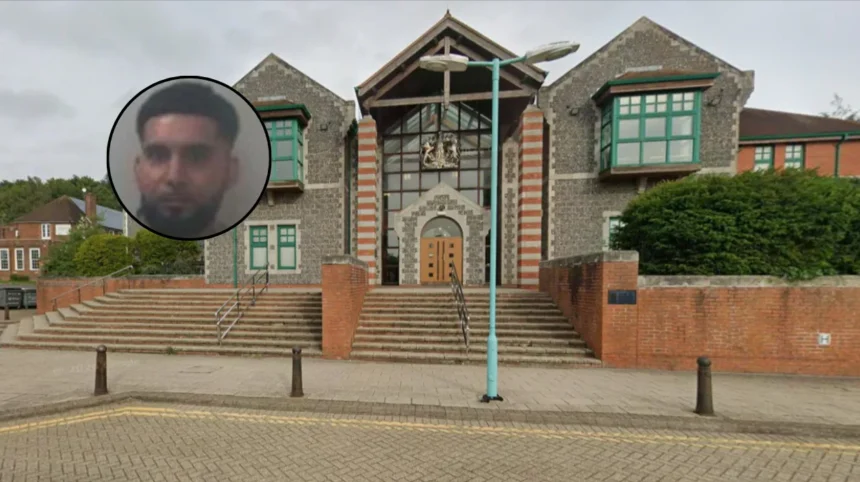
- Amar Bostan, 27, of Ruskin Road, Haringey, London, was jailed for 10 years at Canterbury Crown Court on Friday, 1 May.
- He had repeatedly stabbed a stranger during what police described as a “violent and unprovoked” robbery in Ashford, Kent.
- The attack happened on Hardinge Street at about 10.45 pm on 24 July last year, according to the report.
- The victim suffered multiple injuries to his leg and was robbed of his phone, car keys and a small amount of cash.
- Witnesses called 999 as the incident unfolded, and police later arrested Bostan after stopping an Audi on the M20.
- He was charged with robbery and possession of a bladed article, initially pleaded not guilty, and later changed his plea on day one of the trial.
Ashford, Kent (North London News) May 8, 2026 — A North London man has been jailed after a court heard that he repeatedly stabbed a stranger during a robbery in Ashford last year, in an incident that left the victim injured and robbed of his belongings.
As reported by the outlet, Amar Bostan, 27, of Ruskin Road, Haringey, London, was sentenced to 10 years in prison at Canterbury Crown Court on Friday, 1 May, after changing his plea on the first day of his trial. The case centred on a late-night attack on Hardinge Street in Ashford, where witnesses alerted emergency services after seeing a violent confrontation involving a knife.
What happened on Hardinge Street?
According to the report, the attack took place at around 10.45 pm on 24 July last year on Hardinge Street, a residential road in Ashford.
Multiple people dialled 999 as the scene unfolded, and witnesses told police that the suspect had kicked and held down the victim while brandishing a knife believed to be between 3in and 6in long.
Police and paramedics found the injured man nearby and took him to the hospital. The victim had suffered multiple injuries to his leg and had also been robbed of his phone, car keys and a small amount of cash. The reporting makes clear that the incident was treated as a serious violent robbery from the outset.
How did the police arrest Amar Bostan?
The report says armed police pursued an Audi as it travelled in the direction of Canterbury after the attack. The vehicle was brought to a stop on the M20, where officers arrested Bostan, who was said to have been sitting in the front passenger seat. He was then remanded in custody.
Kent Police later charged him with robbery and possession of a bladed article. He originally pleaded not guilty, but changed his plea on day one of the trial, according to the reporting. That change in plea meant the case moved directly to sentencing, culminating in the 10-year prison term.
What did the court decide?
As reported by the journalist behind the story, the sentence was handed down at Canterbury Crown Court on 1 May. The court imposed 10 years behind bars, reflecting the seriousness of the robbery, the use of a knife, and the injuries caused to the victim.
The available reports do not provide a full transcript of the sentencing remarks, but they do confirm the length of the prison term and the charges involved.
The case was presented in the reporting as a violent and unprovoked attack. That description appears in the article’s framing of the incident, alongside the account of the victim’s injuries and the items stolen.
No additional legal findings beyond the conviction and sentence are stated in the available source material.
Which sources covered the case?
The main details in the reporting were carried by MyLondon, which identified the attack location, the victim’s injuries, the stolen items, the police pursuit and the final sentence.
A separate report also repeated the essential court outcome, confirming that Bostan was sentenced to 10 years at Canterbury Crown Court after initially denying the charges.
Together, the sources align on the core facts: the date of the attack, the arrest route, the charge list and the prison sentence.
Background of the development
This case sits within a wider pattern of knife-enabled robberies and street violence that police and courts across Kent and London continue to address.
The reporting shows how quickly a late-night robbery can escalate into a serious assault when a blade is involved, especially when the attack happens in a residential area and emergency calls are made by multiple witnesses.
It also shows the role of armed police, road stops and custody decisions in bringing a suspect into the criminal justice process.
Prediction
For local residents, this development is likely to reinforce concern about knife crime and late-night street safety, particularly in areas where robberies may involve sudden violence. For police and courts, the case may remain a reference point for how serious sentencing can follow a plea change in a violent robbery with a bladed weapon. For victims and witnesses, the outcome may be seen as evidence that rapid emergency calls and police pursuit can help secure an arrest and a custodial sentence.