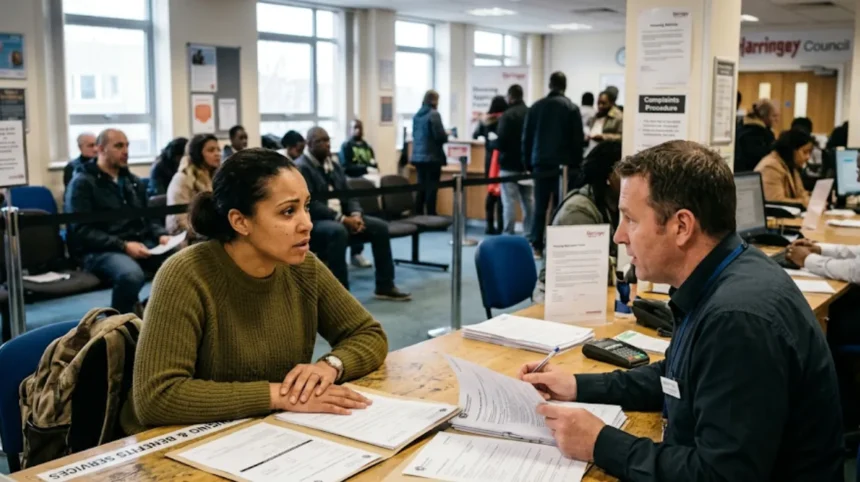
An unresolved housing application in North London requires a formal two-stage complaints process with your council first, then escalation to the Housing Ombudsman or Local Government and Social Care Ombudsman (LGSCO) within one year if the council fails to resolve it. Councils must acknowledge complaints within 5 working days, respond at Stage 1 within 10 working days, and respond at Stage 2 within 20 working days.
- What Is an Unresolved Housing Application and When Does It Become a Complaint?
- How Do You Start the First Stage Complaint With Your North London Council?
- What Happens at Stage 2 When You Escalate Your Complaint Within the Council?
- Which Ombudsman Handles Your Escalated Housing Application Complaint?
- How Do You Submit Your Formal Complaint to the Housing Ombudsman or LGSCO?
- What Outcomes Can You Expect If the Ombudsman Upholds Your Complaint?
- What Specific North London Council Housing Application Timescales Should You Know?
- How Do You Request a Review Instead of a Complaint for Housing Application Decisions?
- What Evidence Must You Prepare Before Escalating Your Housing Application Complaint?
- When Should You Contact Your Council Housing Officer Before Formal Complaint Escalation?
- What Are the Critical Time Limits for Each Stage of Housing Application Escalation?
What Is an Unresolved Housing Application and When Does It Become a Complaint?
An unresolved housing application is a council housing register, homeless application, or housing benefit request that exceeds the council’s published processing times without a decision, triggering your right to formal complaint under the Housing Act 1996 Part 6. The Local Government and Social Care Ombudsman found councils fault for delaying housing register decisions when processing exceeded eight weeks.
Housing applications in the UK fall into three main categories: housing register applications (joining the social housing waiting list), homeless applications (请求ing urgent housing assessment), and housing benefit claims (financial support for rent). Each has distinct processing timeframes. The council’s allocations policy must state response times.
North London councils face significant backlogs. Tower Hamlets Council admitted a six-month backlog in processing housing register applications in 2024, with the LGSCO recommending initial decisions should be made within eight weeks. Lambeth Council currently experiences seven-month-plus waiting times for reviewing applications before they join the social housing register. Hounslow Council typically takes 12 weeks to respond to housing register applications.
No statutory time limit exists for housing register application reviews, but the Housing Allocation Code suggests eight weeks for completion. Homeless applications must reach a final decision within 56 days (eight weeks) regarding priority need status. If your council exceeds these times without communication or decision, your application becomes unresolved and escalates to a formal complaint.
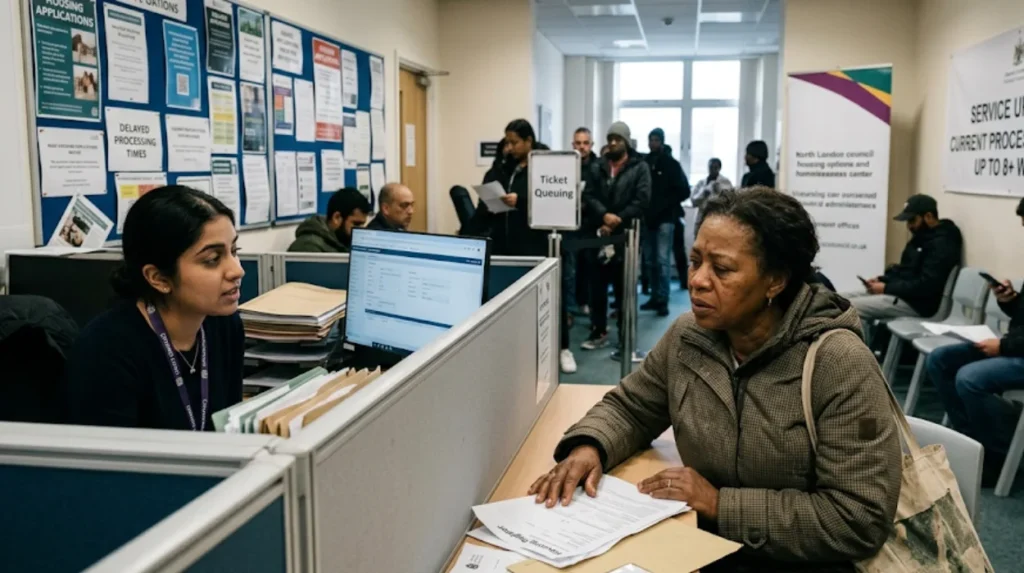
How Do You Start the First Stage Complaint With Your North London Council?
You must submit a formal written complaint to your council’s complaints team within three weeks of any written decision, or immediately if the application exceeds the council’s published timeframe with no response, requesting acknowledgment within 5 working days. Find your council complaints team on GOV.UK and ask for a copy of the complaints process before submitting.
Social landlords must accept complaints in multiple formats: in person, over the phone, by email or letter, and through their website. Email is recommended for creating written records. For North London Muslim Housing Association, send complaints to complaints@nlmha.com.
Your complaint must include specific details: the date you submitted your housing application, your application reference number, what went wrong (delay, no response, incorrect banding), and what you want the council to do (process application, provide decision, correct banding). Keep records of all correspondence including emails, letters, complaint reference numbers, and notes of missed appointments.
When you speak to council staff, document what was said and who you spoke to. This evidence becomes critical if you escalate to an ombudsman. The council must acknowledge your complaint within 5 working days from when they tell you they received it.
The council’s Stage 1 response must arrive within 10 working days from acknowledgment date. This response must provide a decision with reasons, any offer to put things right, and information on how to escalate if you’re unhappy. If the council fails to respond within this timeframe, you can immediately escalate to Stage 2.
What Happens at Stage 2 When You Escalate Your Complaint Within the Council?
You escalate to Stage 2 by requesting the council look at your complaint again within six months of the Stage 1 response, triggering a 5-working-day acknowledgment and a 20-working-day final response from a senior manager or review panel. This is the council’s final internal stage before ombudsman escalation.
Stage 2 involves a senior manager or independent review panel reconsidering your application. For Home-Options (serving parts of North London), a review panel of three officers from different departments re-considers your housing application within 15 working days, then takes five more working days to write the outcome.
You may request an oral hearing at Stage 2, where you meet with the review panel to explain why the decision should change. This face-to-face option allows you to present additional evidence or clarify circumstances the council may have missed. The panel will review all information you hold and consider your circumstances independently.
The Stage 2 response must arrive within 20 working days from the escalation acknowledgment date. This final response includes the council’s definitive decision, reasons, any compensation or corrective actions offered, and clear information about ombudsman escalation rights.
If you’re dissatisfied after Stage 2, or if the council fails to respond within 20 working days, you have reached “deadlock” and can escalate externally. Request a “deadlock letter” from your council confirming they’ve completed their complaints process—this document is required for ombudsman complaints.
Which Ombudsman Handles Your Escalated Housing Application Complaint?
You choose between the Housing Ombudsman (for social housing tenants/leaseholders regarding repairs, rent, tenancy rights) and the Local Government and Social Care Ombudsman (LGSCO) for council services including homeless applications, housing register banding, and urgent housing transfers, contacting them within one year of the council’s final response. The decision depends on your original problem’s nature.
The Housing Ombudsman handles complaints from social housing tenants and leaseholders about damp and repairs, disability adaptions, rent and service charges, tenancy rights and eviction, non-urgent housing transfers, home swaps, leaseholder problems, and complaints processes. Contact them via online complaint form, email at info@housing-ombudsman.org.uk, or phone at 0300 111 3000.
The LGSCO handles complaints about council services including homeless applications, urgent housing transfers, overcrowded housing, housing register applications and bands, housing benefit administration, safety inspection failures in private rented housing, lack of enforcement of private housing safety/repairs, and poor responses to harassment or illegal eviction. Contact them via online complaint form or phone at 0300 061 0614.
For housing register application delays (your likely situation), the LGSCO is the correct ombudsman since this relates to council allocation services rather than tenancy issues. The LGSCO found fault with councils for delaying housing register application decisions and processing homelessness applications.
Both ombudsmen can investigate the original problem and how your complaint was handled. Sometimes the two organizations work together on complaints. You must wait for the council’s final response before contacting an ombudsman.
How Do You Submit Your Formal Complaint to the Housing Ombudsman or LGSCO?
Submit your ombudsman complaint using the online complaint form within one year of the council’s final response, providing all supporting evidence including correspondence, photographs, complaint reference numbers, and a deadlock letter confirming the council’s complaints process is complete. If you cannot use the form, call the ombudsman directly.
Your complaint must clearly state what went wrong and what you want resolved. For the Housing Ombudsman, use their online form at housing-ombudsman.org.uk. For LGSCO, use their form at ombudsman.org.uk. Both forms require detailed case description.
Include all supporting evidence: emails and letters sent/received with the council, complaint or case reference numbers, notes of missed appointments or callbacks, photographs if relevant (for repairs issues), and documentation proving your attempts to resolve the matter. The more evidence you provide, the stronger your case.
If you speak with council staff, include records of what was said and who you spoke to. Add your deadlock letter confirming the council completed their two-stage complaints process. Without this, the ombudsman may reject your complaint as premature.
The ombudsman decides whether to investigate your complaint. They write to you with reasons if they decide not to investigate. The Housing Ombudsman may resolve problems within 2 months using their early resolution process without formal investigation. Most cases are decided within 6 months, but formal investigations can take up to a year.
The ombudsman can request more information from all involved parties during investigation. They often publish anonymised versions of decisions on their website, creating public accountability for councils.
What Outcomes Can You Expect If the Ombudsman Upholds Your Complaint?
If the ombudsman upholds your complaint, they can require the council to apologise, pay compensation (typically £250-£1,200 for delays), improve procedures, or make a decision/service they should have provided, though councils technically don’t have to follow decisions but usually do. The LGSCO recommended £500 compensation for housing application delays (£250 per year) plus £50 for complaint handling delays in one 2025 case.
Compensation amounts vary based on delay duration and impact. In a 2025 case, the Council apologised and paid £1,200, backdated the housing register application, and issued staff reminders to ensure proper application aspects were considered. The LGSCO found fault with councils for delaying housing register decisions and recommended initial decisions should be made within eight weeks.
The ombudsman can要求 councils improve their procedures to prevent future delays. This systemic change benefit helps other applicants avoid similar problems. The ombudsman can also require the council to make a decision or provide a service they should have done originally—this means your housing application gets processed.
While councils don’t legally have to follow ombudsman decisions, they usually do. Non-compliance creates reputational damage and potential regulatory scrutiny. The ombudsman publishes decisions publicly, creating accountability.
Beyond compensation, successful complaints can result in your housing application being backdated to the original submission date, preserving your priority ranking on the housing register. This is critical in North London where waiting times span several years.
Explore More Help & Resources
What Happens After Reporting Pavement Damage to Council in North London
How to Report Dangerous Potholes in Local Roads Across North London
What Specific North London Council Housing Application Timescales Should You Know?
North London councils have varying published timescales: Tower Hamlets admits six-month backlog (should be 8 weeks), Lambeth experiences 7-month+ review times, Hounslow takes 12 weeks for housing register applications, and homeless applications must reach decisions within 56 days—exceeding these without communication triggers complaint rights. These backlogs reflect national social housing shortage pressures.
Tower Hamlets Council admitted a six-month backlog in processing all housing register applications after LGSCO investigation. The ombudsman recommended initial applications should be decided in eight weeks and reviews within 56 days. Tower Hamlets will draw up an action plan for reducing delays.
Lambeth Council (North London) currently experiences seven-month-plus waiting times for reviewing applications before they join the social housing register. The council asks applicants not to contact them during this time as it could delay reviewing further, though this creates frustration for applicants seeking updates.
Hounslow Council typically takes 12 weeks to respond to housing register applications, with many applicants waiting several years for social housing offers. Applying for the housing register is not a solution to immediate homelessness threats.
Homeless applications have stricter statutory requirements: councils must make a final decision within 56 days (eight weeks) about whether you’re in priority need. If councils don’t respond after five working days from your initial assessment, you should chase them by calling or emailing your housing officer.
The National Housing Allocation Code suggests eight weeks for housing register review completion, but no statutory time limit exists. This ambiguity allows councils significant flexibility, making complaint escalation essential when delays exceed reasonable periods.
How Do You Request a Review Instead of a Complaint for Housing Application Decisions?
You must request a review within three weeks (21 days) of receiving a written council decision about your housing register, homeless application, housing benefit claim, or tenancy transfer—this is separate from complaints and deals with legal rights under legislation rather than service quality. You can still complain if unhappy with review outcomes.
Reviews address decision correctness rather than service quality. For housing register applications, you can request review if you believe your priority rating is incorrect or accommodation offered doesn’t meet needs. The council usually conducts reviews, though sometimes housing associations or other organisations handle them.
For appeals against tenancy type decisions (fixed-term vs. permanent), you must lodge within 21 days from receipt date with the Reviews and Quality Assurance Officer. This applies to fixed-term tenancies of three or five years.
Housing benefit claim reviews require reconsideration requests within one month of the decision letter date. Appeals to tribunals must be made within one calendar month of decision sending. If no written explanation accompanied the decision, you have one month from notification date to request a written “statement of reasons,” then 14 days to appeal after receiving it.
The law allows up to eight weeks for most review completions, though some referral decisions may take longer. You, your representative, or the review officer may request extensions to complete reviews properly.
Requesting a review first is often better than complaining when dealing with decision correctness. Reviews can change banding, priority ratings, or eligibility determinations. Complaints address service quality, delays, and communication issues.
What Evidence Must You Prepare Before Escalating Your Housing Application Complaint?
Prepare comprehensive evidence including your original housing application submission date and reference number, all correspondence with the council (emails, letters), complaint reference numbers from Stage 1 and Stage 2, notes of phone calls with staff names and dates, the council’s final response letter, and ideally a deadlock letter confirming complaint process completion. This evidence package proves your case to the ombudsman.
Start documenting from your application submission date. Keep copies of every email sent and received, every letter sent and received, and every complaint reference number issued. Create a chronological timeline of all interactions with the council including dates, times, staff names, and what was discussed.
For phone conversations, write immediate notes recording who you spoke to, what was said, and any promises or commitments made. If the council missed appointments or failed callbacks, document theseinstances with dates. This evidence demonstrates poor communication and service failure.
Request copies of your council’s allocations policy and complaints process. These documents establish what the council promised regarding timescales. Compare actual performance against published standards to demonstrate breach of their own policies.
Your deadlock letter is crucial—it confirms the council completed their two-stage complaints process and you’ve reached final internal resolution. Without this, the ombudsman may reject your complaint as premature. Request this letter explicitly if the council doesn’t provide it automatically.
Include the council’s final response letter showing their decision and reasons. This demonstrates you waited for proper completion before escalating. Add any compensation offers or corrective actions the council proposed, showing what resolution they attempted.
Organize evidence chronologically in a clear folder. Label documents with dates and descriptions. Create a summary document outlining your case timeline and key issues. This organization helps ombudsman investigators process your complaint efficiently.
When Should You Contact Your Council Housing Officer Before Formal Complaint Escalation?
Contact your housing officer immediately if your council hasn’t responded after five working days from assessment (for homeless applications) or if your application exceeds the council’s published timeframe without updates, using phone or email to chase progress before launching formal complaints. Early contact prevents months of silent delay.
For homeless applications, the council must respond within eight weeks of assessment with a decision. If they don’t contact you after five working days from your initial assessment, call or email your housing officer directly. This proactive approach often resolves delays without formal complaints.
Request application status updates routinely. Applicants have the right to receive information regarding their application status under housing allocations legislation. Ask specifically for your current banding, priority rating, and expected processing timeline.
Document all informal communications with housing officers. Even casual phone calls should be noted with date, officer name, and what was discussed. This creates evidence if informal resolution fails and you need formal complaint escalation.
If your application sits unattended for months without updates, this indicates potential breach of duty under the Housing Act 1985. Request a formal review highlighting delays at this point rather than waiting further.
However, don’t delay formal complaints indefinitely through informal chasing. If five working days pass without acknowledgment or eight weeks pass without decision, launch your Stage 1 complaint immediately. The three-week review request deadline (for decisions) and one-year ombudsman deadline (for final responses) are strict.

What Are the Critical Time Limits for Each Stage of Housing Application Escalation?
Critical time limits include: three weeks (21 days) to request reviews of written decisions, five working days for council complaint acknowledgment, 10 working days for Stage 1 response, 20 working days for Stage 2 response, six months to request Stage 2 escalation from Stage 1 response, and one year from council final response to contact an ombudsman. Missing these deadlines forfeits your rights.
The three-week review request deadline applies to housing register decisions, homeless application decisions, housing benefit claims, and tenancy transfer decisions. Calculate from the date you received the written decision letter. Late requests are typically rejected.
Council acknowledgment must arrive within five working days from when they tell you they received your complaint. Count from their acknowledgment notification date, not your submission date. If no acknowledgment arrives, contact the complaints team immediately.
Stage 1 response deadline is 10 working days from acknowledgment date. Stage 2 response deadline is 20 working days from escalation acknowledgment date. These are maximum limits; some councils respond faster. Holiday periods and weekends don’t count as working days.
The six-month Stage 2 escalation window runs from the Stage 1 response date. Request escalation within this period to maintain complaint validity. Late escalation requests may be rejected.
The one-year ombudsman contact deadline runs from the council’s final response (Stage 2) date. This is absolute—contact the ombudsman within this year regardless of investigation complexity. Late complaints are rejected.
The longest a complaint should take overall is 16 weeks (approximately four months) from initial submission to ombudsman eligibility, assuming councils meet all deadlines. Delays extend this timeline but don’t change your deadlines.
Start your escalation process immediately when deadlines pass. Don’t wait hoping for informal resolution while deadlines expire. The ombudsman requires proof you followed proper complaint procedures within time limits.
What is an unresolved housing application?
An unresolved housing application is a housing register application, homelessness application, housing transfer request, or housing benefit claim that remains undecided beyond the council’s published processing times. If a council fails to provide a decision or update within a reasonable timeframe, residents can begin the formal complaints process.