
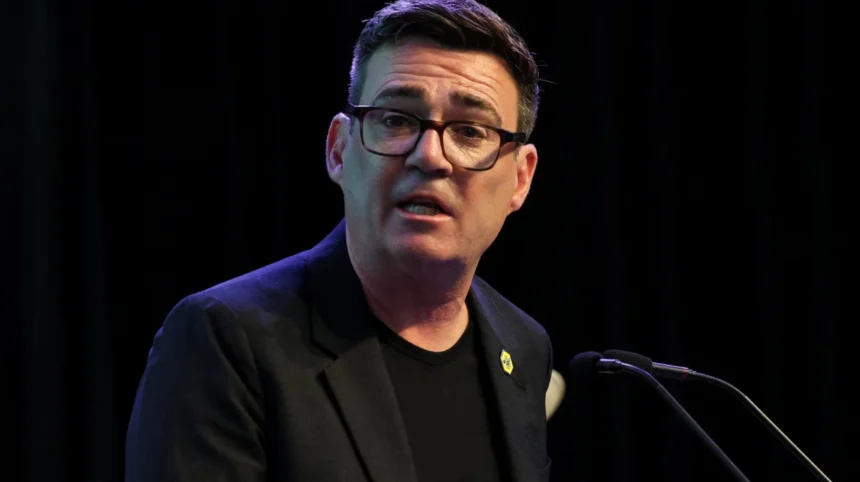
The unpredictable nature of British politics may mirror the spirit of the country’s equally unpredictable weather, but history is not a fickle heart but an undefeated witness. It documents the actions, ideologies, and principles of princes, political prostitutes, and saints in public life, serving as a recipe for radical political consciousness that helps working people shape the nature and character of their society. Despite all forms of reactionary propaganda, marginalisation and exploitation, it is the working class that follows the path of revolution in history—changing their present and shaping their future. The kleptocratic democracy led by the market has destroyed moral, ethical, and political values in Britain, politics is an ideology free in zone where its two mainstream political parties and their leaderships now follow similar ideas, ideologies, principles, and policies. Such a political condition has produced leaders like Mr Andy Burnham, who is poised to replace Sir Keir Starmer as prime minister.
But will he replace the policies of Mr Starmer before occupying 10 Downing Street? Let us seek answers from his political actions, past and present, to understand the ideology of the thick-rimmed-glasses-wearing Prime Minister in waiting. He has often spoken about the north-south divide in terms of uneven development in Britain. Will he be very different from the last six British prime ministers? Will he represent anti-Westminster northern sentiments in British politics? Will he address the everyday issues confronting working people in Britain? Will he break away from imperialist wars and advocate for world peace? Will Britain be a force for good within and beyond Europe?
The answers to these questions will be central to mapping out the ideological foundation and policy orientation of Mr Andy Burnham, who claims to follow “aspirational socialism”—a blend of collective welfare, public ownership, and individual aspirations of working people. Some call this pragmatic socialism, which is really a misnomer, but political leaders like Mr Burnham often use it to self-declare as socialists as a mode of political propaganda to capture working-class votes.
Mr Burnham’s 2010 Labour leadership manifesto promised to be “redistributive, collectivist, aspirational, sustainable and internationalist.” However, his support for the Iraq war, opposition to any investigation into its legality, and backing for overseas military interventions raise serious questions about his socialist politics, principles, and internationalist credentials. As Mayor of Greater Manchester, he has failed to tackle child poverty. The level of child poverty in Manchester today is higher than it was in the region during 1821. His ‘Live Well’ ambition has also failed to realise a redistributive and collectivist spirit in terms of budgeting for children, the poor, the unemployed, students, youth, and the elderly. His failures are part of economic policies that are not very different from those of the current Labour regime or the previous Tory regime. He is also responsible for deepening the privatisation of the NHS during his tenure as Health Secretary, which calls into question his politics of sustainability in public health.
The growth of rough sleeping across different areas of Manchester undermines his claims about the expansion of affordable social housing. There is little that is aspirational about his politics, principles, and policies, which call for partnership between government and businesses. Public-private partnership is fundamentally about securing profit-making mechanisms for private investment. The Mancunians have yet to see the promised boost in regeneration of their city from the £1bn Good Growth Fund. His neoliberal economic policies contradict the politics of devolution, as neoliberalism promotes a centralised single-window system and opposes the decentralisation of development.
On the social front, Mr Burnham’s apology for writing an article smearing Liberty’s Shami Chakrabarti is well known. It continues to raise questions about his commitment to both gender and racial justice. Mr Nigel Farage and Mr Burnham are not very different from each other when it comes to issues of immigration. It is also clear that Mr Burnham shares the politics, principles, and policies of the last six British prime ministers when it comes to support for Israel and its genocide against Palestinians. This calls into question his spirit of internationalism, which is supposedly based on a universalist vision of human dignity, liberty, and equality.
Mr Andy Burnham’s past political actions reveal that he is not only an insider but also the northern face of the British establishment in Westminster, committed to the Atlanticist political, economic, and imperial regimes of Washington and Pentagon that Britain follows. He is committed to the unacountable European Central Bank and its political architecture called European Union and its economic policies shaped by the Brussels which is fundamentally against a social Europe. Whether he will take a different trajectory in running the country from the last six British prime ministers or follow their rotten legacies to further ruin the nation, only time will tell.
History teaches us that insiders of the establishment lack the convictions and courage to take a different path from the allocated lines, as their leadership is built on borrowed ideas from the establishment and their power is shaped by it. Any other trajectory is unacceptable to the establishment. However, Mr Burnham’s future political actions, everyday principles, and economic policies will ultimately define his ideology as the likely next Prime Minister of Britain. Mr Andy Burnham’s ideological politics will determine his place in history and seal his political fate in public life. Like the rutherless world of politics, history is not kind to timids and puppets of the establishment.