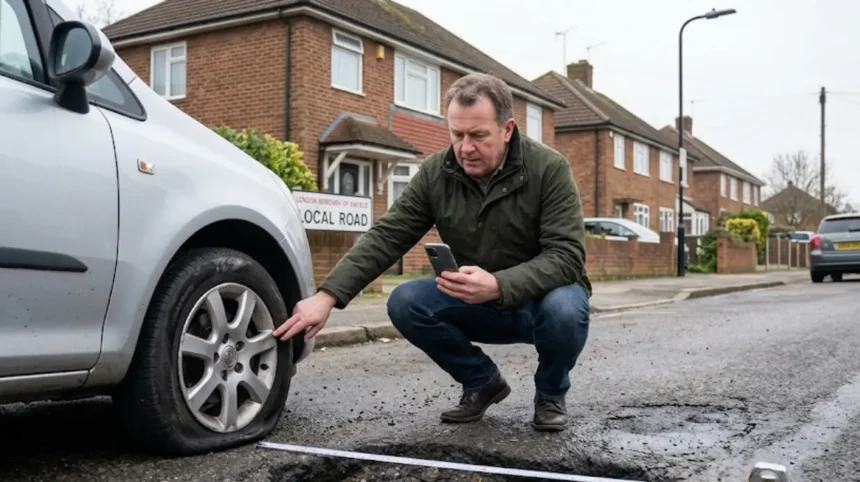
If your vehicle has been damaged by a pothole on an Enfield road, you can claim compensation from London Borough of Enfield if the council was negligent in its maintenance duties. The claim process involves reporting the pothole, gathering evidence, submitting a formal claim, and, if necessary, pursuing legal action. Success depends on proving the pothole was reportable, measurable, and that the council failed a reasonable inspection or repair standard.
- What is a pothole damage claim and why does it exist in Enfield?
- Who is responsible for potholes on different roads in Enfield?
- What legal test must you meet to succeed in an Enfield pothole claim?
- How do you report a pothole in Enfield before claiming compensation?
- What evidence do you need to collect for a pothole damage claim in Enfield?
- How do you submit a formal pothole damage claim to Enfield Council?
- What costs can you claim for pothole damage in Enfield?
- How long does it take for Enfield Council to process a pothole claim?
- What happens if Enfield Council rejects your pothole damage claim?
- What are common reasons Enfield Council rejects pothole damage claims?
- How can you improve your chances of a successful pothole claim in Enfield?
What is a pothole damage claim and why does it exist in Enfield?
A pothole damage claim is a request for compensation from the local council when a road defect (typically a hole or depression) causes vehicle damage. The legal basis is that councils must maintain roads safely under the Highways Act 1980. In Enfield, London Borough of Enfield is the responsible authority for most local roads.
Pothole damage claims arise from the statutory duty of highway authorities to keep roads in a safe condition. Under Section 41 of the Highways Act 1980, councils like Enfield must maintain the highway. However, Section 58 provides a defence: the council is not liable if it can show it took “reasonable care” to ensure the road was not dangerous. This means a claim succeeds only if the council’s inspection or repair practices were inadequate.
In Enfield, this applies to:
- Most A-roads and local residential streets managed by the council
- Non-trunk roads (trunk roads in London are managed by National Highways or Transport for London, not Enfield Council).
For example, if a driver hits a prominent pothole on a residential street in Southgate or Edmonton and suffers tyre, suspension, or wheel damage, the claim would be against Enfield Council, not a national highway agency.
Who is responsible for potholes on different roads in Enfield?
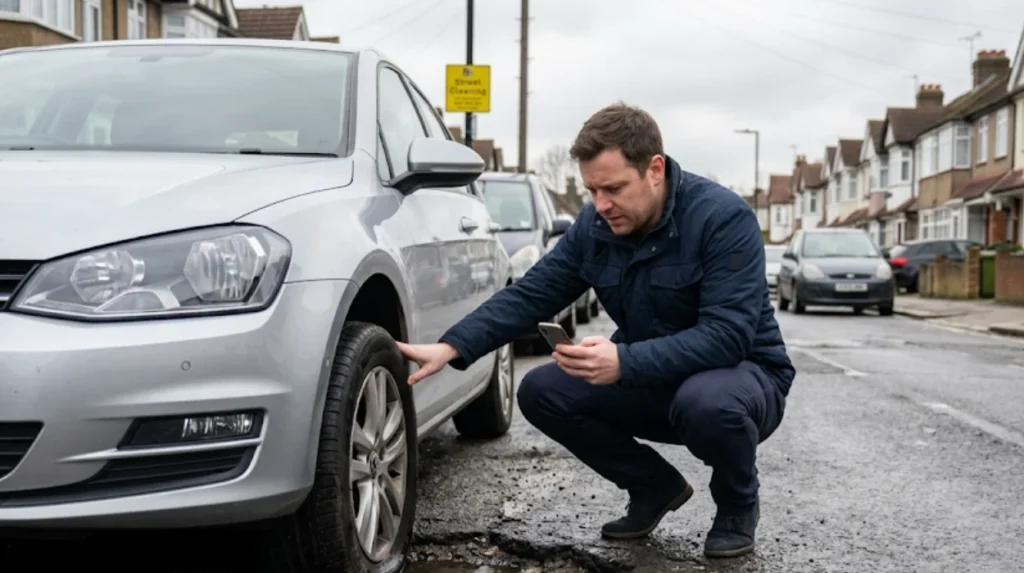
Responsibility depends on the road type. London Borough of Enfield is responsible for most local roads and A-roads within its boundary. National Highways manages trunk roads and motorways. Transport for London manages red routes. You must identify the correct authority before claiming.
Enfield Council is responsible for:
- Local residential streets (e.g. roads in Winchmore Hill, Grange Park, Newnham BeazONS)
- Many A-roads within the borough, unless they are designated as trunk roads.
National Highways is responsible for:
- Trunk roads and motorways that pass through or near Enfield, such as parts of the M25 or certain major A-roads if they are classified as trunk roads.
Transport for London (TfL) is responsible for:
- Red routes, which are major arterial roads in London managed under TfL’s red route network. Some roads near Enfield’s boundary may be red routes.
To determine responsibility:
- Use the UK government’s “Which council manages this road?” tool by entering the postcode where the damage occurred.
- Check Enfield Council’s website for road maintenance pages, which often list known issues and reporting forms.
- If unsure, call Enfield Council’s highways or customer services team and ask which authority manages the specific road.
For example, a pothole on a small street in Turkey Street will be Enfield’s responsibility, while a pothole on a major trunk road near the M25 may be National Highways’ responsibility.
What legal test must you meet to succeed in an Enfield pothole claim?
You must prove the council was negligent in its duty to maintain the road. This means showing the pothole was dangerous, reportable, and that Enfield failed a reasonable inspection or repair standard. The council can defend itself by proving it took reasonable care under Section 58 of the Highways Act 1980.
The key legal elements are:
- Existence of a dangerous defect – The pothole must be of a size or depth that a reasonable driver would regard as dangerous. Guidance often cites depths around 40mm or more as potentially dangerous, but context matters (speed of road, visibility, frequency).
- Council’s duty – Under Section 41, Enfield has a duty to maintain the highway.
- Breach of duty (negligence) – You must show Enfield did not take reasonable care. This is often demonstrated by:
- Showing the pothole had existed for a long period and was not repaired.
- Showing the council’s inspection regime was inadequate (e.g., inspections too infrequent for that road type).
- Showing the council knew about the pothole (e.g., previous reports) but did not act.
- Damage caused by the defect – You must link the vehicle damage directly to the pothole, not to driver error or another cause.
Section 58 of the Highways Act 1980 allows the council to argue it is not liable if it can prove:
- It had a reasonable inspection system.
- It carried out inspections at appropriate intervals.
- It repaired defects within a reasonable time after discovery.
If Enfield can demonstrate this, your claim may fail even if a pothole existed.
How do you report a pothole in Enfield before claiming compensation?
Report the pothole via Enfield Council’s online reporting form or by phone as soon as possible. Provide the exact location, date, and description. This creates an official record and may be used as evidence that the council knew about the defect.
Enfield Council offers:
- An online pothole reporting form on its website (usually under “Roads and transport” or “Report a problem”).
- A phone number for highways or customer services, where you can report potholes verbally.
When reporting, include:
- The road name and nearest landmark (e.g., “near the bus stop on XX Road, Southgate”).
- The date and time you observed the pothole.
- A description (e.g., “large hole in the centre of the lane, approximately 50cm across and 4cm deep”).
- If possible, a photo (taken from a safe position, without trespassing on the road).
The council will:
- Record the report.
- Assign it an ID or reference number.
- Possibly inspect and schedule repair.
This report is crucial evidence in a claim. If you later claim compensation, you can show that the council had prior knowledge of the defect, which strengthens the argument that it failed to act promptly.
What evidence do you need to collect for a pothole damage claim in Enfield?
You must gather proof of the pothole, the damage, and the link between them. This includes photos, measurements, repair invoices, witness details, and the council’s report reference. Without strong evidence, the council will reject your claim.
Key evidence includes:
- Photos of the pothole
- Clear images showing size, depth, and position on the road.
- Include a reference object (e.g., a ruler, coin, or known-size item) to indicate scale.
- Take photos from multiple angles if possible.
- Measurements
- Depth and width of the pothole, ideally measured soon after the incident.
- Note the location (road name, nearest house number, landmark).
- Vehicle damage evidence
- Photos of damaged tyres, suspension, wheels, or undercarriage.
- Independent mechanic’s report confirming the damage is consistent with pothole impact.
- Repair invoices showing the cost and nature of repairs.
- Incident details
- Exact date and time of the incident.
- Weather and road conditions (e.g., dry, wet, night).
- Your speed and driving behaviour at the time (to show you were driving reasonably).
- Council report
- The reference number from your pothole report to Enfield Council.
- Any correspondence (emails, letters) from the council acknowledging the report.
- Witness information
- Names and contact details of anyone who saw the incident or the pothole.
- Witness statements if available.
- Road classification
- Evidence that the road is managed by Enfield (postcode check, council map, or written confirmation).
This evidence bundle is what you submit when making a formal claim. It allows the council to assess whether the pothole was dangerous and whether they were negligent.
Explore More Help & Resources
Why does Enfield Council miss rubbish collections frequently?
What to do if bins are not collected in Enfield?
How do you submit a formal pothole damage claim to Enfield Council?
Submit a formal claim to Enfield Council’s highways or claims department, usually via an online form, email, or letter. Include all evidence, a clear description of the incident, and the repair costs. The council will then assess liability and decide whether to approve compensation.
Steps to submit:
- Locate the claims process
- Visit Enfield Council’s website and search for “claim compensation road damage” or “pothole damage claim”.
- Some councils have a dedicated online claims form; others require a letter or email.
- Prepare your claim document
- State:
- Your name, address, and contact details.
- The road name, location, date, and time of the incident.
- A clear description of the pothole and the damage.
- The total cost of repairs and any additional costs (e.g. towing, loss of use if relevant).
- Attach:
- Photos of the pothole and damage.
- Measurements.
- Repair invoices and mechanic’s report.
- Council report reference.
- Witness details (if any).
- State:
- Submit the claim
- Use the council’s online form, or send an email/letter with attachments.
- Keep a copy of everything you send.
- Council’s assessment
- Enfield will review:
- Whether the road is their responsibility.
- Whether the pothole was dangerous.
- Whether they had a reasonable inspection and repair system.
- Whether your evidence supports negligence.
- They may:
- Approve the claim and offer compensation.
- Reject the claim, citing Section 58 defence.
- Request further information.
- Enfield will review:
- If the claim is rejected
- You can:
- Ask for a detailed explanation of why the claim was rejected.
- Consider escalating the matter (e.g. through a complaints procedure).
- Seek legal advice and, if appropriate, pursue a court claim.
- You can:
The council typically responds within a set timeframe (often 2–4 weeks), though this can vary.
What costs can you claim for pothole damage in Enfield?
You can claim for reasonable repair costs directly caused by the pothole, such as tyre, suspension, wheel, and undercarriage repairs. You cannot claim for unrelated damage,wear and tear, or purely consequential losses unless specifically allowed.
Typical allowable costs include:
- Replacement or repair of damaged tyres.
- Suspension repairs (e.g. shock absorbers, control arms).
- Wheel or rim repairs or replacements.
- Undercarriage damage if directly linked to the pothole impact.
- Necessary towing or recovery costs if the vehicle was immobilised.
You generally cannot claim:
- Pre-existing damage or wear and tear.
- Indirect costs like lost time, unless the council’s policy allows it.
- Damage caused by your own driving error (e.g. speeding, failing to avoid an obviously visible hazard).
The council will assess:
- Whether the claimed damage is consistent with pothole impact.
- Whether the repair costs are reasonable (e.g. based on market rates).
- Whether the damage can be clearly linked to the pothole, not to another cause.
Always provide full invoices and, if possible, a mechanic’s statement confirming the cause of damage.
How long does it take for Enfield Council to process a pothole claim?
Enfield Council typically processes pothole damage claims within 2–6 weeks, depending on complexity and workload. Simple claims with clear evidence may be resolved faster; complex or disputed claims can take longer.
Factors affecting processing time:
- Clarity of evidence – Claims with strong photos, measurements, and clear invoices are assessed more quickly.
- Road responsibility – If the council must verify whether the road is theirs, this can add time.
- Disputed liability – If Enfield argues Section 58 defence (reasonable care), the assessment may involve more investigation.
- Volume of claims – High numbers of claims (e.g. after severe weather) can delay processing.
You can:
- Ask the council for an estimated timeline when you submit.
- Follow up if there is no response after the expected period.
- Record all communication (emails, letters, call dates) for potential escalation.
If the claim is rejected, the council usually provides a written explanation, which you can use if you pursue further action.
What happens if Enfield Council rejects your pothole damage claim?
If Enfield rejects your claim, you can request a detailed explanation, lodge a formal complaint, or seek legal advice. If you believe the council was negligent, you may pursue a court claim, but this involves cost and risk. Many claims are resolved at the council level without court action.
Possible steps after rejection:
- Request a detailed explanation
- Ask the council to explain:
- Why they consider the pothole not dangerous.
- How their inspection system was adequate.
- Why they believe they took reasonable care under Section 58.
- Ask the council to explain:
- Formal complaint
- Use Enfield Council’s complaints procedure to challenge the decision.
- This may lead to a review by a different department or senior officer.
- Legal advice
- Consult a solicitor experienced in highways or personal injury claims.
- They can assess:
- Whether the council’s defence is strong.
- Whether you have sufficient evidence to argue negligence.
- The likely cost and success of a court claim.
- Court claim
- If you proceed to court:
- You must file a claim in the appropriate court (often the County Court).
- You must prove negligence and link damage to the pothole.
- If successful, the court may order the council to pay compensation plus some costs.
- If unsuccessful, you may bear your own legal costs.
- If you proceed to court:
Many claimants find that strong evidence and persistent engagement lead to a settlement without court proceedings. However, if the council’s defence is robust (e.g. clear inspection records), court success may be uncertain.
What are common reasons Enfield Council rejects pothole damage claims?
Enfield typically rejects claims when the pothole is not considered dangerous, the damage is not clearly linked to the pothole, or the council can prove it took reasonable care. Driver behaviour and road classification also affect outcomes.
Common rejection reasons:
- Pothole not dangerous
- The council may argue the hole was small, shallow, or in a position where a reasonable driver could avoid it.
- They may cite inspection records showing the defect was recently assessed and deemed non-critical.
- Insufficient evidence
- Lack of photos, measurements, or mechanic’s reports.
- Invoices that do not clearly link damage to pothole impact.
- Section 58 defence
- The council demonstrates:
- A regular inspection regime.
- Repairs scheduled within a reasonable time.
- That the pothole was newly formed or not yet detectable.
- The council demonstrates:
- Driver behaviour
- If you were speeding, driving recklessly, or ignoring an obvious hazard, the council may argue you contributed to the damage.
- Wrong authority
- The road is managed by National Highways or TfL, not Enfield.
- The claim is sent to the wrong council initially.
- Pre-existing damage
- The council argues the damage was due to wear and tear or prior incidents, not the reported pothole.
Understanding these reasons helps you prepare a stronger claim and avoid common pitfalls.
How can you improve your chances of a successful pothole claim in Enfield?
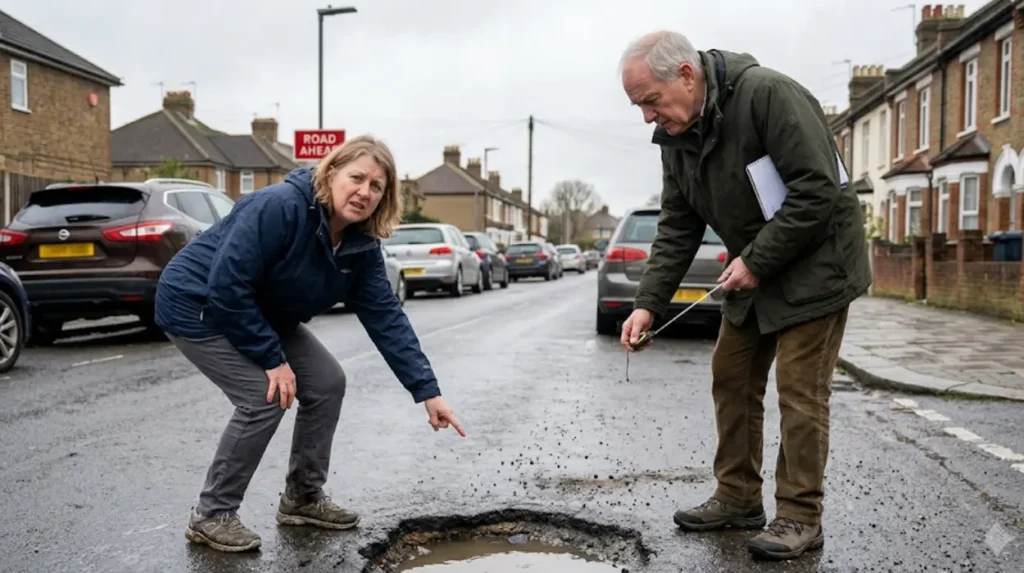
You improve your chances by reporting the pothole early, collecting strong evidence, linking damage clearly to the pothole, and presenting a clear, factual claim. Professional legal advice can help if the council rejects your claim.
Practical steps:
- Report the pothole immediately
- Use Enfield’s online form or phone service.
- Keep the reference number.
- Collect comprehensive evidence
- Photos with scale references.
- Measurements of depth and width.
- Mechanic’s report confirming cause.
- Full repair invoices.
- Present a clear claim
- Use a structured letter or form.
- State facts plainly: location, date, damage, costs.
- Attach all evidence.
- Follow up
- If there is no response, contact the council.
- Keep records of all communication.
- Seek legal advice if rejected
- A solicitor can assess whether the council’s defence is weak.
- They can help you prepare for negotiation or court.
Good evidence and a clear narrative significantly increase the likelihood of approval, especially when the council cannot demonstrate a robust inspection and repair system.
Can I claim compensation from Enfield Council for pothole damage?
Yes. If your vehicle was damaged by a pothole on a road maintained by Enfield Council, you may be able to claim compensation. You must show that the council failed to take reasonable care in maintaining the road and provide evidence linking the pothole to the damage.