Key Points
- Legacy System Overhaul: Barnet Council is modernising its sprawling video surveillance infrastructure after its previous 3,000-camera network fell into disrepair, leaving only 15 to 20 devices operational.
- Substantial Financial Savings: By opting for i-PRO’s edge-based Artificial Intelligence (AI) Processing Relay Application over traditional server-heavy infrastructure, the council projects an estimated saving of £600,000 over five years.
- Edge Processing Advantage: The new network utilizes edge-AI computing to process analytics directly on the cameras, transmitting lightweight metadata instead of heavy video files, drastically reducing network bandwidth and the need for server cooling and space.
- Multifunctional Data Analytics: Beyond basic security, the camera network acts as an urban sensor system, funneling real-time people and vehicle counting data into Microsoft Power BI to inform council infrastructure, public space planning, and local business footfall analysis.
- Multi-Phased Deployment: Backed by an initial £1 million investment, the first phase features 127 X-series bullet cameras, 10 library-bound fisheye cameras, and dual-view 5G redeployable units. Phase two has already secured approval for an additional 60 to 70 bullet cameras.
- Strict Privacy and Security Compliance: The system aligns with National Defense Authorization Act (NDAA) cybersecurity standards, follows stringent firewall policies, operates without facial recognition technology, and awaits formal governance approvals before making public data available.
- Enhanced Police Collaboration: Deep integration of i-PRO’s forensic capabilities into the upgraded Genetec Security Centre video management system (VMS) allows operators to filter specific object attributes, accelerating investigations alongside the Metropolitan Police.
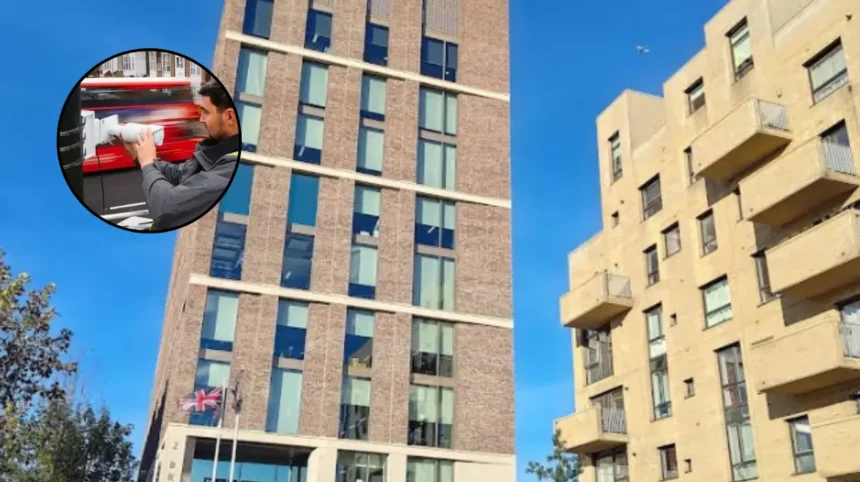
Barnet (North London News) July 9, 2026 – Barnet Council has commenced a sweeping, phased upgrade of its public space video surveillance network, transitioning from a defunct legacy estate to a sophisticated smart city network driven by i-PRO edge-AI hardware and Genetec video management software. Strategically covering a geographically diverse and culturally rich borough—which spans bustling urban hubs such as Hendon, Finchley, Golders Green, Friern Barnet, Chipping Barnet, Whetstone, and Edgware, alongside rural village communities like Totteridge and Arkley and protected Green Belt land—the local authority sought a modern, future-proofed solution to enhance public safety, optimize operational efficiency, and generate actionable urban insights for local stakeholders. July 9, 2026.
- Key Points
- Why Did Barnet Council Choose an Edge-Based AI Infrastructure Over Server-Heavy Options?
- How Are Local Businesses and Urban Planners Utilizing Real-Time Video Analytics?
- What Technologies Form the Foundation of Phase One, and What is Planned for Phase Two?
- How Does the Genetec VMS Integration Assist the Metropolitan Police?
- Background of the Barnet Smart City and CCTV Development
- Predictions: How This Edge-AI Development Will Affect Barnet Residents and Businesses
As documented in technical briefs and deployment updates compiled by municipal technology industry reporters, the council’s legacy surveillance infrastructure had suffered critical degradation over time. Out of an original estate comprising roughly 3,000 cameras across the borough, only 15 to 20 devices remained functional. This massive operational deficit prompted a complete rethink of Barnet’s approach to community safety and data gathering, driving a push toward intelligent, multifunctional technology that could maximize existing resources without demanding cost-prohibitive server infrastructure.
Why Did Barnet Council Choose an Edge-Based AI Infrastructure Over Server-Heavy Options?
The core architectural shift in Barnet’s new network centers on edge computing. According to reports published by industry analysts detailing the project’s financial and technical parameters, the council selected the i-PRO X-series AI Processing Relay Application. This specific technology allows the council to retroactively apply advanced AI-driven analytics to its existing infrastructure, including older, third-party cameras, eliminating the immediate economic necessity of replacing every installed device.
As stated by Aaron Stephens, Managing Director at DSSL Systems—the system integrator responsible for installing and configuring the new network—the physical framework of the system represents a departure from traditional closed-circuit television (CCTV) models. Stephens explained that, unlike traditional server-based AI systems which place an extraordinarily heavy burden on network infrastructure, the i-PRO cameras process analytics directly on the edge. This means the units transmit only lightweight metadata back to the central system rather than continuous, high-bandwidth video files.
This edge-processing model yields major fiscal benefits for the local authority. Public procurement documents indicate that the decision to implement i-PRO’s edge-AI architecture will deliver an estimated saving of £600,000 over a five-year period compared to conventional server-based analytics platforms. Because the system scales organically by adding processing power with each new camera, Barnet Council completely bypasses the need to invest in additional server hardware, dedicated data center space, or specialized power-hungry cooling systems.
How Are Local Businesses and Urban Planners Utilizing Real-Time Video Analytics?
The operational footprint of the upgraded network extends well beyond conventional crime prevention. The i-PRO hardware functions simultaneously as a security system and an advanced urban sensor network capable of detecting and counting individuals and vehicles in real time.
As reported by Stephens of DSSL Systems, a key factor driving the council’s procurement choice was this exact ability of the cameras to serve as multifunctional sensors. The real-time counting data generated by the cameras is automatically fed into Microsoft Power BI dashboards. This allows the council’s internal teams to generate data-driven reports, giving urban planners concrete metrics to assess how public spaces are utilized.
The resulting analytics are currently being leveraged to shape long-term deployment strategies across highly trafficked municipal locations, including public parks and railway stations. Beyond internal council operations, these visual insights are being extended to support the local commercial sector. By analyzing these footfall patterns, local businesses can better understand consumer behavior, helping them make more informed decisions regarding private infrastructure investments, localized marketing, and operational hours. Concurrently, the council uses the data to optimize traffic management schemes and public space design.
What Technologies Form the Foundation of Phase One, and What is Planned for Phase Two?
As details of the initial £1 million investment reveal, the first phase of the rollout features a tailored mix of specialized hardware deployed to meet distinct environmental and operational challenges across the borough.
- 127 X-Series Bullet Cameras: Deployed in prominent public spaces for general safety, crime deterrence, and continuous traffic monitoring.
- 10 Fisheye Cameras: Installed within unmanned libraries to provide 360-degree coverage, heat-mapping capabilities, and precise automated people counting.
- Dual-View 5G Redeployable Units: Mobile systems designed specifically for temporary deployment at large-scale community festivals, outdoor markets, and religious gatherings.
The deployment in the borough’s library network highlights the automated capabilities of the system. In unstaffed or “open plus” library hours, built-in audio detection analytics within the cameras are configured to flag acoustic anomalies, such as sudden loud arguments or shattering glass, automatically transmitting alerts to the central control room. Furthermore, the automated people-counting software provides definitive confirmation that the buildings are entirely empty before remote lockdown and security alarming procedures are initiated.
The mobile 5G redeployable units have similarly expanded the council’s community support capabilities. By tracking attendance numbers at large cultural and religious events across Barnet’s diverse population, the smart city team gathers crowd-density data that informs emergency logistics, health and safety planning, and future event scheduling. Stephens confirmed that Phase Two of the project has already received formal municipal approval, which will introduce an additional 60 to 70 new i-PRO bullet cameras to the network to broaden its geographic coverage.
Explore More Barnet Council News
Barnet Council Overhauls CCTV with i-PRO Edge AI: London 2026
Barnet Council Reconsiders Controversial Parking Scheme In Mays Lane 2026
How Does the Genetec VMS Integration Assist the Metropolitan Police?
Central to the utility of the network is the complete overhaul of the council’s central control room, anchored by an upgrade to the Genetec video management system (VMS). This integration bridges raw data capture with rapid tactical response.
As reported by Benjamin Durrant, Account Executive at Genetec UK & Ireland, the i-PRO forensic capabilities are directly embedded within the Genetec Security Centre platform. This deep software integration allows control room operators to rapidly isolate specific objects, vehicles, or events by filtering through distinct attributes and characteristics captured by the edge-AI cameras—such as clothing colors, vehicle types, or direction of movement—without needing to manually review hours of raw footage.
“This speeds up the investigative process and enhances collaboration with the Metropolitan Police,” stated Durrant of Genetec UK & Ireland, emphasizing that the cross-compatibility of the software drastically reduces the time required to securely compile and hand over evidentiary footage to law enforcement.
From a data security and compliance perspective, the entire network has been engineered to meet strict modern digital defense requirements. The infrastructure aligns with international regulations, including the United States’ National Defense Authorization Act (NDAA) guidelines, which mandate secure supply chains and ban components from high-risk telecommunications manufacturers. Installed with stringent firewall policies enforced by DSSL Systems, the system ensures that metadata and video streams are securely siloed and shielded from external cyber threats.
Addressing public privacy considerations, the smart city and community safety teams explicitly noted that the network operates strictly within data privacy regulations and does not employ facial recognition software. At present, an automatic number plate recognition (ANPR) trial is scheduled to begin to assist with traffic management, though wider deployment and the public release of aggregated analytics remain subject to pending internal governance approvals. Looking ahead, Barnet Council is actively assessing further Internet of Things (IoT) integrations, including connecting environmental sensors, localized flood detection units, and automated traffic signal coordination systems into its expanding smart city ecosystem.
Background of the Barnet Smart City and CCTV Development
The complete overhaul of Barnet’s video network comes after years of shifting strategies regarding public space surveillance across London local authorities. During the early 2010s, many UK councils faced intense budgetary pressures under central government austerity measures, which frequently led to deferred maintenance on expansive CCTV networks. Barnet’s legacy estate of 3,000 cameras fell into near-total operational failure as analog systems aged out and the costs of maintaining traditional fiber-optic lines and centralized server storage grew unsustainable.
Concurrently, the concept of the “Smart City” matured from a theoretical framework into a practical municipal strategy. Local councils realized that urban cameras could no longer be viewed merely as passive crime-recording devices; they had to evolve into active data-gathering nodes. The emergence of affordable edge-AI computing around 2020 marked a turning point, allowing raw visual data to be parsed directly on the camera hardware.
By selecting a hybrid model that blends security with urban analytics, Barnet Council’s latest move aligns it with forward-thinking smart boroughs worldwide. This strategy treats public safety funding as an investment that simultaneously optimizes traffic flow, monitors environmental health, and assists economic development through data-driven public planning.
Predictions: How This Edge-AI Development Will Affect Barnet Residents and Businesses
The transition to an integrated edge-AI network is poised to alter daily urban life for Barnet’s residents, local business owners, and commuters in several distinct ways.
Impact on Residents and Public Safety
For local citizens, the immediate consequence will be a noticeable return of active deterrence in public parks, town centers, and around transit hubs. Because the system links directly with the Metropolitan Police via the Genetec platform, response times for active incidents are expected to decrease.
In everyday public life, the integration of automated analytics inside public spaces like unmanned libraries will allow the council to maintain extended, flexible operating hours safely, providing residents with greater access to community services without increasing the risk of unmonitored vandalism or distress. Crucially, because the system relies heavily on metadata and explicitly excludes facial recognition, residents will experience enhanced security without experiencing invasive identity tracking.
Impact on the Business Community
Local businesses will gain access to an environment characterized by lower rates of anti-social behavior and commercial property crime, which historically suppressed evening footfall in degraded areas.
Furthermore, as the council begins processing traffic and pedestrian analytics via Power BI, commercial associations will be able to utilize hard data to plan seasonal events, optimize store hours, and pitch infrastructure improvements directly to the council. Understanding exactly how crowds move through shopping districts like Golders Green or Edgware allows small businesses to compete more effectively against e-commerce by optimizing their physical setups based on real-time pedestrian volume data.
Future Urban and Environmental Adjustments
As the council moves toward its planned IoT integrations, commuters and residents will likely experience optimized traffic management. By linking edge-AI vehicle analytics with automated traffic signal coordination, the council can dynamically adjust traffic light timings based on real-time congestion levels, reducing idling times and improving local air quality.
Finally, the future inclusion of environmental and flood detection sensors will provide early warning indicators for the borough’s low-lying areas and Green Belt zones, allowing the council to deploy emergency resources proactively before severe weather impacts residential property or local transport infrastructure.