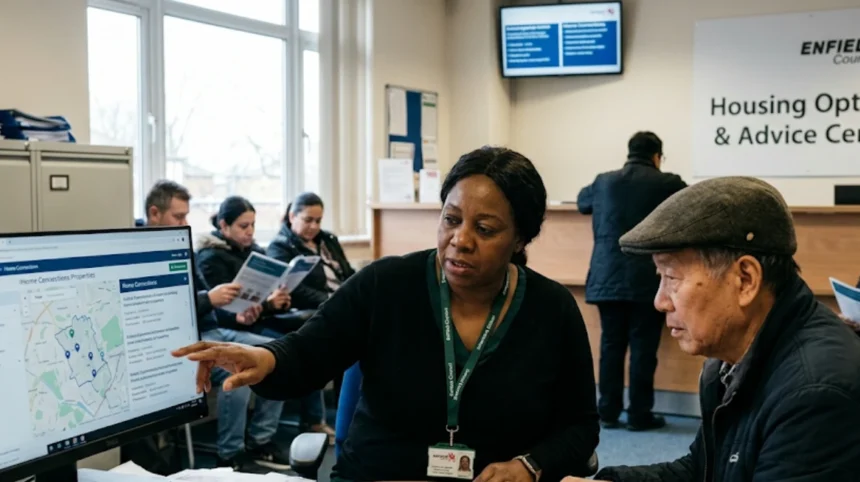
Enfield Council allocates social housing through a statutory “Housing Allocation Scheme” that places applicants on a points-graded Housing Register and then uses the Home Connections bidding system to offer properties to those in greatest need.
- How does Enfield Council decide who gets priority for social housing?
- Who is eligible to apply for social housing in Enfield?
- What is the Enfield Housing Register and how do people join it?
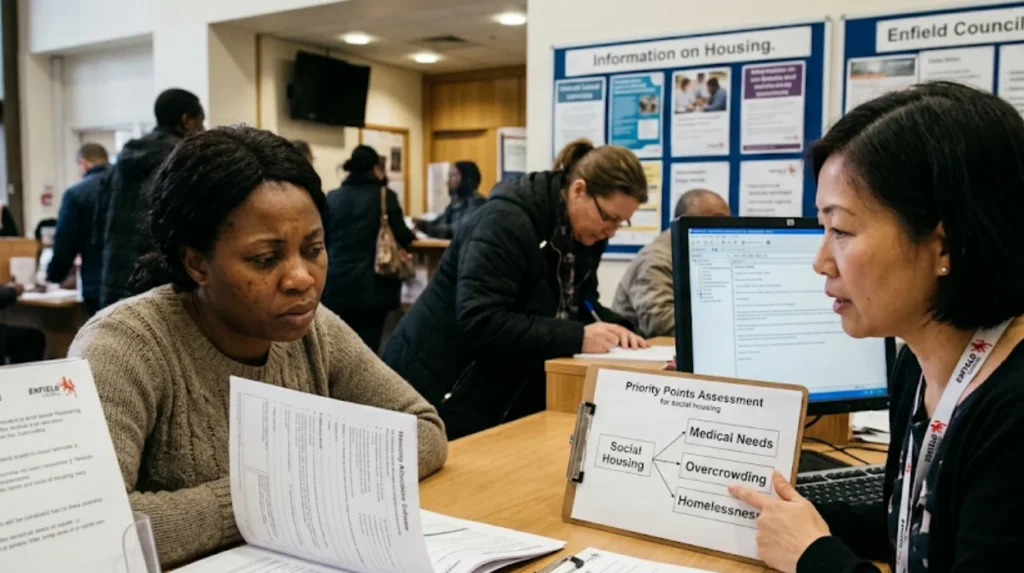
- How does Enfield Council’s points system work for housing allocation?
- How do people use Home Connections to bid for social housing in Enfield?
- How are shortlists created and how is the successful bidder chosen?
- What happens if someone is already a council or housing association tenant in Enfield?
- How does Enfield Council handle overcrowding and bedroom need assessments?
- What types of social housing properties are available through Enfield Council?
- How does medical or welfare need affect housing allocation in Enfield?
- What happens after someone is offered and accepts a social home in Enfield?
- How does Enfield Council support people who cannot bid online?
- What should applicants do if their circumstances change after joining the register?
- How long does it typically take to get social housing in Enfield?
- What are the implications of Enfield’s allocation system for households in need?
How does Enfield Council decide who gets priority for social housing?
Enfield Council gives “reasonable preference” to people who are homeless, overcrowded, have unsatisfactory or unsanitary housing, or need to move on medical or welfare grounds; additional priority is given to those needing to move locally for health or support reasons.
Under the Housing Act 1996, local authorities must follow a Housing Allocation Scheme that defines who receives priority and how properties are allocated. Enfield’s scheme identifies six main groups of applicants and applies a points assessment to rank them by need.
Reasonable preference categories in Enfield include:
- Applicants who need to move on medical or welfare grounds (for example, severe disability or chronic health conditions that their current home worsens).
- People living in overcrowded, unsanitary, or otherwise unsatisfactory housing (such as properties without basic heating, water, or with serious structural problems).
- People who need to move to a particular area, for example to be nearer medical facilities, support services, or schools.
- Homeless people, including those at risk of homelessness or in temporary accommodation.
The Council also may give “additional preference” to certain groups, for example those who have lived in Enfield for a long period or who have specific local needs, but this is discretionary and applied within the overall points framework.
Who is eligible to apply for social housing in Enfield?
You must be legally eligible for public housing, not have supplied false information, and have no serious misconduct involving violence, racial harassment, or abuse; immigration status, honesty, and behaviour all affect eligibility.
In Enfield, an applicant is not eligible for social housing if:
- They are subject to immigration control under the relevant UK legislation (for example, many people with “no recourse to public funds” conditions).
- They have supplied false or misleading information in their application or supporting documents.
- They have been convicted of, or have had legal action against them for, violence, racial harassment, or physical and verbal abuse.
These restrictions apply to all applicants, whether they are first-time applicants, existing council tenants looking to transfer, or people already living in housing association homes.
Eligibility also depends on whether the person meets the general criteria for being on the Housing Register: they must be aged 18 or over, have a genuine need for social housing, and be able to sustain a tenancy. The Council assesses household composition, income, health, and current housing conditions to determine whether someone qualifies.
What is the Enfield Housing Register and how do people join it?
The Housing Register is Enfield’s official list of people approved for social housing; applicants complete a detailed form, attend an assessment, and are placed on the register with a points score and a bedroom need.
To join the Housing Register, applicants must:
- Submit an application via Enfield Council’s housing services website or by phone.
- Provide supporting documents such as proof of identity, income, current housing, and any medical evidence.
- Attend a housing assessment with the Housing Assessment team, where their circumstances are reviewed in detail.
After assessment, the Council decides whether the applicant is eligible and, if so, assigns:
- A points score reflecting their level of need and time on the register.
- An assessed bedroom need (for example, 1-bedroom, 2-bedroom, etc.), based on household size and composition.
Only applicants who score enough points are allowed to bid on social rented properties. Those who score below the threshold remain on the register but cannot bid until their points increase, usually as their circumstances worsen or as they stay longer on the list.
How does Enfield Council’s points system work for housing allocation?
Enfield uses a points-based system where higher points reflect greater need and longer time on the register; points determine whether someone can bid and influence shortlisting priority for properties.
Applicants are placed into one of six groups, including:
- Council and Housing Association tenant applicants (transfers).
- People already in temporary accommodation.
- Homeless applicants.
- People overcrowded or in unsatisfactory housing.
- People with medical or welfare needs.
- Other applicants with a recognised need.
Points are awarded based on:
- The severity of need factors (for example, extreme overcrowding, serious medical conditions, or risk of homelessness).
- Time on the Housing Register (additional points accumulate over months and years).
- Special circumstances such as being a single parent, having a disability, or needing to move locally for health reasons.
The Council publishes the detailed points criteria in its Housing Allocation Scheme. Applicants receive a letter stating their points total and bedroom need. Only those with sufficient points can start bidding on properties via Home Connections.
How do people use Home Connections to bid for social housing in Enfield?
Home Connections is Enfield’s online bidding platform where registered applicants with enough points view advertised properties and place bids; they can bid on up to three properties per week.
The Home Connections process works as follows:
- Properties advertised weekly from Wednesday to Sunday.
- Applicants log in using their user ID and PIN.
- They search for homes matching their assessed bedroom need and location preferences.
- They place bids on up to three properties each week.
Applicants cannot bid on properties larger than their assessed need. They can choose to restrict bids by area, property type, or floor level, but the Council advises bidding broadly to improve chances.
Medical or welfare restrictions (for example, needing a ground-floor property) are recorded on the applicant’s Housing Assessment Letter and affect which properties they can successfully bid for. Priority for ground-floor or accessible properties is given to those with a medical recommendation stating they need such accommodation.
How are shortlists created and how is the successful bidder chosen?
Shortlisting happens within 72 hours after the bidding window closes; the top three bidders are contacted, invited to view the property together, and the Lettings Officer selects the successful bidder from that group.
After each bidding cycle:
- The system identifies all bidders for each property.
- Within 72 hours, the Rehousing Team shortlists the top three bidders based on points and other relevant criteria.
- These three bidders are contacted by phone and told their position (first, second, or third).
All three shortlisted bidders view the property at the same time, with a Rehousing Team member present. They must bring identification such as a utility bill, driving licence, or passport.
After the viewing, each bidder is asked whether they want to accept the property. If the first-choice bidder accepts, they become the successful bidder. If they decline, the offer moves to the second-choice bidder, then the third.
The Lettings Officer then arranges for the successful bidder to sign the tenancy agreement and sets a tenancy start date. New tenants typically receive an introductory tenancy for 12 months before it can become a full secure or assured tenancy.
What happens if someone is already a council or housing association tenant in Enfield?
Existing council or housing association tenants in Enfield can apply to transfer to a different property if their current home is too large or too small, or if they have health, welfare, or emergency reasons for moving.
Transfers are treated as a separate applicant group. Tenants who need to move because:
- Their home is too small or too big for their household.
- They have high health and well-being reasons.
- They have an exceptional or emergency reason (for example, domestic abuse, serious safety concerns, or extreme overcrowding).
Are assessed under the same points system. The Council may also offer “reciprocal” moves, where a housing association tenant is matched with a council property and vice versa, provided there is no material loss of stock to the Council. Reciprocal arrangements are discretionary and usually require the Council to receive back a property of equal or larger size, comparable in quality and type.
How does Enfield Council handle overcrowding and bedroom need assessments?
Enfield defines overcrowding based on the number of bedrooms needed for adults and children according to age and sex; lacking one bedroom does not give extra priority, but lacking two or more may lead to a home visit.
A property is considered overcrowded if it does not have one bedroom for:
- Each adult couple.
- Any two children of the same sex, regardless of age difference.
- Any two children of any sex under 10 years old.
- Any other child whose main home is not elsewhere.
If a household lacks only one bedroom, the Council does not give extra priority. If they lack two or more bedrooms, council and housing association tenants may receive a home visit to assess the impact on their family and confirm the bedroom need.
The outcome of this assessment determines the bedroom size the applicant can bid for on Home Connections. Applicants cannot bid on homes larger than their assessed need, to prevent under-occupation and ensure fair use of limited stock.
What types of social housing properties are available through Enfield Council?
Enfield offers council and housing association properties for social renting, including flats, maisonettes, and houses of various sizes, advertised weekly on Home Connections.
Available properties typically include:
- 1-bedroom flats and maisonettes.
- 2-bedroom flats and houses.
- 3-bedroom and larger houses for families.
- Some accessible or adapted properties for people with disabilities.
Properties come from:
- Enfield Council’s own stock (council homes).
- Housing associations and registered social landlords operating in Enfield.
The mix and number of properties change each week depending on vacancies, new completions, and transfers. Because there is a serious shortage of social housing in Enfield, most properties are let to people with the highest points and greatest need.
Explore More Help & Resources
Why are council housing waiting lists so long in Enfield?
How effective are anti-social behaviour reports in Enfield?
How does medical or welfare need affect housing allocation in Enfield?
Medical and welfare needs can significantly increase an applicant’s points and may restrict or prioritise certain property types, such as ground-floor homes for people with mobility issues.
Applicants who need to move on medical or welfare grounds can:
- Receive higher points based on the severity of their condition.
- Have specific property restrictions recorded, for example “ground floor only” or “no above third floor”.
- Be prioritised for accessible properties where a medical recommendation supports this need.
The Housing Assessment Letter includes health and wellbeing restrictions. These must be followed when bidding; otherwise, shortlisting may be unsuccessful even if the applicant has enough points.
Medical evidence, such as letters from doctors or specialists, strengthens the case for higher points and targeted property types. The Council may also request additional information to verify the need.
What happens after someone is offered and accepts a social home in Enfield?
Once a bidder accepts a property, the Lettings Officer arranges a tenancy agreement signing and sets a start date; new tenants receive an introductory tenancy for 12 months.
The process after acceptance includes:
- Signing the tenancy agreement with the Council or housing association.
- Agreeing on a tenancy start date and move-in arrangements.
- Receiving information about rent, service charges, and tenant responsibilities.
Introductory tenancies last for 12 months. During this period, the Council or landlord can more easily end the tenancy if there are serious breaches, such as persistent rent arrears or anti-social behaviour. After 12 months, if no significant issues arise, the tenancy usually becomes a full secure tenancy (for council homes) or an assured tenancy (for housing association homes).
Tenants must keep to the terms of their tenancy, pay rent, and report any changes in circumstances that might affect their housing needs.
How does Enfield Council support people who cannot bid online?
People without internet access can use free one-hour internet sessions in Enfield libraries, and library staff can assist with training and access to Home Connections.
Support options include:
- Free internet access in all Enfield libraries for one hour per visit.
- Library staff assistance with navigating the Home Connections system.
- Training sessions that can be booked in advance (with a charge) for those who do not know how to use the internet.
This ensures that the bidding system remains accessible to older people, those with disabilities, and households without private internet access. The Council emphasises that everyone on the register with enough points should have a fair opportunity to bid, regardless of their digital skills.
What should applicants do if their circumstances change after joining the register?
Applicants must inform the Housing Assessment team promptly if their circumstances change, such as a new baby, health deterioration, or change in income, to ensure their points and bedroom need are updated.
Examples of changes that must be reported:
- Birth of a child (submit full birth certificate with a covering letter to housing.assessment.team@enfield.gov.uk).
- New health conditions or worsening of existing conditions.
- Changes in household composition, such as someone moving in or out.
- Significant changes in income or employment status.
Failure to report changes can lead to incorrect bedroom assessments or points, which may result in bidding for unsuitable properties or delays in being offered a home. Updated information ensures the applicant’s position on the register reflects their current need.
How long does it typically take to get social housing in Enfield?
There is a serious shortage of social housing in Enfield, so wait times vary widely and depend on points, bedroom size, area preferences, and available stock; many applicants remain on the register for years.
Factors affecting waiting time include:
- Points level: Higher points mean more frequent shortlisting.
- Bedroom need: Larger properties (3+ bedrooms) are rarer and may take longer.
- Area and property type preferences: Narrow restrictions reduce chances.
- Local supply: Some neighbourhoods have more regular turnover than others.
The Council advises bidding on all types of properties, in all areas, and on all floor levels to improve chances. Limiting preferences significantly increases waiting time.
What are the implications of Enfield’s allocation system for households in need?
Enfield’s points and bidding system ensures that the most needy households are prioritised, but limited stock means many eligible people remain on the register for long periods without securing a home.
The system:
- Provides a transparent, rule-based way to allocate scarce social housing.
- Encourages applicants to keep their information updated and remain active in bidding.
- Creates pressure on households with high needs but low points, who may stay in temporary or unsuitable accommodation for extended periods.
For local authorities and communities, this model highlights the gap between demand and supply for social housing. It also shows why complementary measures, such as increased housing builds, support for temporary accommodation, and advice on private rental options, remain essential alongside the Allocation Scheme.
How does Enfield Council decide who gets priority for social housing?
Enfield Council prioritises applicants based on housing need, including homelessness, overcrowding, medical or welfare needs, and unsuitable housing conditions. Applicants receive points, with higher points indicating greater priority.