
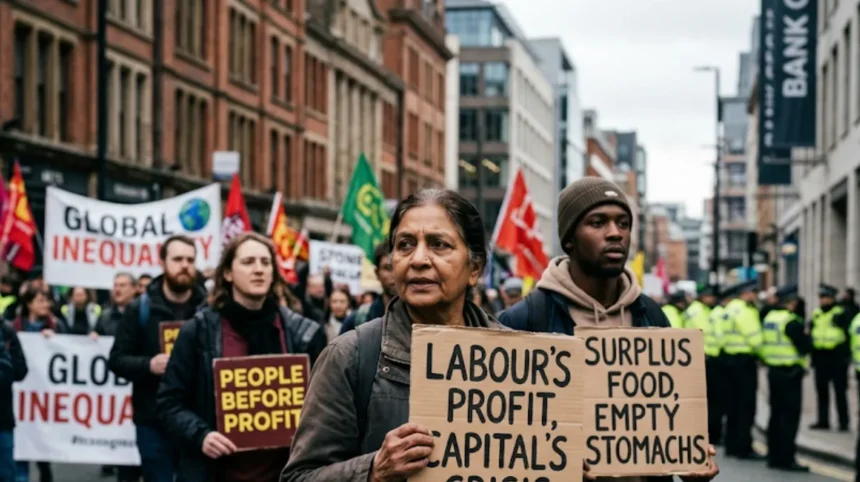
Various forms of crises, risks, and insecurities are intensifying, even as governing elites drum up patriotism, nationalism, and ethnic and religious unity to hide the failures of the ruling classess and their capitalist system with all its powers. Labour is more productive than ever before, yet it continues to face archaic forms of marginalization. Capitalism is accumulating greater in volume, size, and scope than at any point in history, but its inherent contradictions and embedded crises persist. The world produces more food than ever, yet food crises still exist in advanced capitalist societies. These capitalist contradictions continue to echo the early stages of capitalism’s own development—and they ultimately define the world today.
How does capitalism survive despite all its embedded crises? It survives by manufacturing new forms of social, economic, political, and cultural crises, alongside imperialist conflicts and wars that pose direct physical threats to people’s lives and livelihoods. Fear serves as a tool to domesticate human life and labour. Imperialism, in turn, is a key instrument of capitalism—one that sustains the system by creating various forms of inequalities and the very conditions necessary for the exploitation of labour.
Bourgeois intellectuals and their liberal counterparts in the media dismiss imperialism as merely a Marxist or socialist monologue—a distant theory confined to books, libraries, seminars, and academic conferences, with no real bearing on practical life. In reality, however, imperialism profoundly affects the everyday lives of working people. Every imperialist crisis over the last two centuries reveals that imperialist forces have manufactured these crises to domesticate labour and destroy the conditions necessary for radical, democratic, and progressive social transformation.
The creation of the North Atlantic Treaty Organization (NATO) after World War II ushered in a new era of American imperialism. The Moroccan and Suez Crises have effectively ended intra-imperialist rivalries among the colonial capitalist powers of Western Europe, consolidating U.S. hegemony. This new imperial order not only absorbed old imperialist forces under American leadership but also built a new security infrastructure by mobilizing the military-industrial complex—an apparatus that manufactures not only weapons but also the conflicts necessary to sustain its global market. At the regional and local levels, it has fostered security states that serve as permanent customers for weapons of mass destruction, all in the name of national sovereignty and protection.
From the partition of India to the Russian war on Ukraine, and from the American wars on Vietnam, Afghanistan, Iraq, Somalia, Libya, Syria, Yemen, Venezuela, Cuba, Pakistan and Iran to the East Asian economic crisis and successive global economic crises—all are products of imperialism. Imperialist wars and interventions have neither defended human rights nor transplanted democracy; instead, they have produced conditions in which working people either die fighting in wars under the guise of nationalism or become refugees in their own lands. Hunger, homelessness, poverty, unemployment, and all forms of insecurity are products of imperialism—conditions in which working people suffer while corporations profit. Every crisis confronting ordinary people becomes an opportunity for capitalist advancement and imperialist consolidation.
From the war on terror to regime change operations and interventions, the imperialist powers and their war machines—under the leadership of the United States—are working relentlessly to manufacture different crises at the cost of ordinary people’s everyday lives. It is not the rich but the poor who die in wars and bear their devastating impacts. It is the idealist poor who fight and die in the name of protecting the nation, while rich crooks and their families enjoy every comfort. The living crisis in advanced capitalist countries and across the world today is equally a product of imperialist conflicts and wars.
The world has plunged into deep crisis today, with rising oil prices having a knock-on effect on the cost of all goods and services essential to human survival. Oil and gas prices began climbing during the Russian-Ukrainian conflict and, more recently, amid the war imposed on Iran by the United States. Under U.S. leadership, imperialist forces are working towards the consolidation of the dollar and the American empire—at the cost of people’s lives across the world.
The ‘plundering of natural resources’; ‘the domestication of labour as a compliant rather than revolutionary force’; ‘the unquestionable hegemonic dominance of American imperialism’, backed by its European minions; and, finally, ‘unfettered profit for corporate capitalism’—these constitute the four core objectives of American imperialism. To achieve them, it forges alliances with authoritarian, reactionary, and religious forces, aiming to curtail the conditions that nurture secular, scientific, and working-class consciousness—conditions that are indispensable for deepening democracy and expanding citizenship rights. Fundamentally speaking, American imperialism and its global capitalist projects are opposed to all forms of democracy and human freedom.
All the crises witnessed across the world today are not natural occurrences but are manufactured by imperialism to undermine people and their capacity for global unity and solidarity. These crises are deliberately designed to domesticate working populations and erode their revolutionary potential to overcome hardship in their everyday lives. In this context, only united anti-imperialist and anti-capitalist struggles can shape a world of peace and internationalism, built on the solidarity of working people across the globe. There is no other path to a peaceful, prosperous, and progressive world without confronting and defeating all forms of imperialism and capitalism, which create havoc in the daily lives and livelihoods of ordinary people.
However, the revolutionary potential and collective power of working people pose a profound nightmare for imperialist and capitalist forces. In response, these imperialist forces and their media allies systematically divide populations along the lines of race, caste, gender, class, and sexuality—promoting hatred based on region, religion, and nationality. They actively manufacture narratives that frame ‘migrants, Muslims, and Marxists as the enemies within and anti nationals,’ while portraying ‘national capitalist classes and regional bourgeoisies as “the lesser evil,” and recasting ‘imperialist and capitalist rivalries as mere nationalist conflicts or civil wars’. All too often, revolutionary and progressive forces are drawn into these very narratives, which breeds defeatism before any meaningful resistance to imperialism and capitalism can even begin. Understanding this revolutionary defeatism is essential for launching any meaningful resistance to imperialism and capitalism.
Yet, a delayed revolution is not the absence of revolution. History reveals that no force can alter or halt the path by which the working classes pursue revolutionary change to improve their conditions and build a better tomorrow. It is only working people who can ultimately defeat imperialism and capitalism. Every epoch in history is the history of working-class struggle. It may be delayed, but it can never be prevented from achieving victory.