Key Points
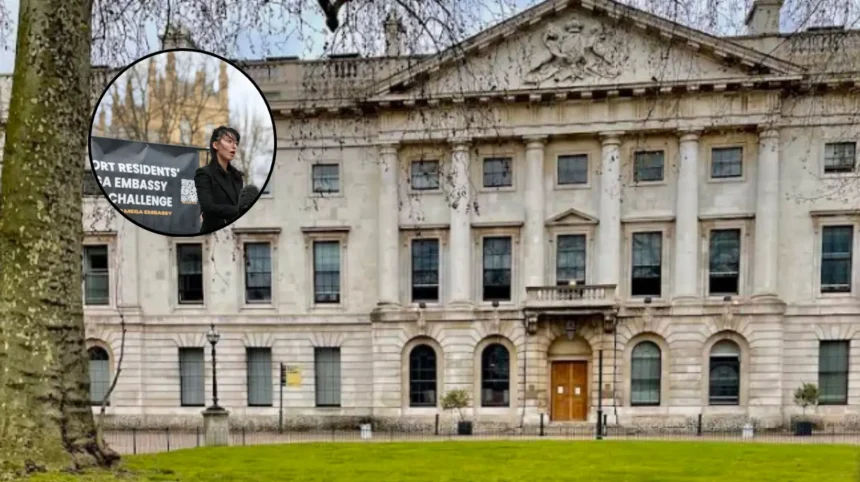
- High Court Dismissal: Two High Court judges rejected a legal challenge brought against the UK government’s approval of China’s proposed mega embassy complex at Royal Mint Court in central London.
- Planning Validity: The court affirmed that former Housing Minister Steve Reed and government officials acted lawfully, procedurally fairly, and conscientiously in granting planning permission.
- Human Rights Claims Rejected: The judges concluded that the Royal Mint Court Residents’ Association (RMCRA) failed to produce convincing evidence that personal human rights violations or unmitigated security risks would occur.
- European Flagship Compound: The 20,000-square-metre (5.4-acre) development near the Tower of London will consolidate seven existing Chinese state operations across London into Europe’s largest diplomatic facility.
- Vow to Appeal: Opponents, led by local resident groups and supported by human rights campaigners and cross-party parliamentarians, announced immediate plans to appeal the verdict to the UK Supreme Court.
London (North London News) July 31, 2026 – In a landmark judicial determination delivered on Friday, the High Court of England and Wales formally dismissed a legal challenge seeking to block the construction of China’s expansive new embassy complex in central London, concluding that the British government acted entirely within the boundaries of planning law. The ruling clears a pivotal legal obstacle for the Beijing administration to transform the historic 20,000-square-metre Royal Mint Court site into the largest diplomatic headquarters in the United Kingdom and continental Europe. Mrs Justice Nathalie Lieven, sitting alongside Lord Justice James Dingemans, found that the UK government had properly considered all material planning factors and that allegations of procedural unfairness advanced by local objectors were unfounded.
- Key Points
- What Did the High Court Rule Regarding the Legality of China’s Embassy Plan?
- What Arguments Did the Royal Mint Court Residents’ Association Present?
- How Did Political Figures and Human Rights Activists Respond to the Judgement?
- Background of the Royal Mint Court Embassy Project
- Prediction: How Will This Development Impact Affected Stakeholders?
What Did the High Court Rule Regarding the Legality of China’s Embassy Plan?
According to court filings and as reported by legal correspondents for Reuters, the High Court rejected every ground of review submitted by the Royal Mint Court Residents’ Association (RMCRA). The claimants had asserted that the Secretary of State for Housing, Communities and Local Government failed to adequately weigh safety hazards, potential diplomatic immunity barriers, espionage threats, and the suppression of civil liberties prior to granting approval in January.
Dismissing the lawsuit, the judicial panel determined that the planning process executed by the Ministry of Housing was rigorous and lawful. In the official summary of the judgment, as cited by Reuters, the High Court stated:
“The RMCRA did not produce reasonable and convincing evidence of the likelihood that a violation of human rights affecting them personally would occur.”
Furthermore, as detailed by media coverage in the Financial Times by legal reporters covering the Royal Courts of Justice, Mrs Justice Lieven noted in her written judgment that several arguments brought by the local residents relied primarily on “suspicion and conjecture.” The court also rejected claims concerning the withholding of specific unredacted security and blast assessment documentation, ruling that core safety summaries had been made publicly available and that “there was no unfairness to the claimant by reason of these documents not having been disclosed” in their entirety during earlier inquiries.
What Arguments Did the Royal Mint Court Residents’ Association Present?
As reported by journalists at India Today, the legal action was launched and crowdfunded by the Royal Mint Court Residents’ Association (RMCRA), an entity representing families and commercial leaseholders operating on the perimeter of the former mint facility. The group had raised more than £220,000 to fund the judicial review against the Ministry of Housing, Communities and Local Government alongside the London Borough of Tower Hamlets.
The residents contended that converting the 5.4-acre site into a heavily fortified diplomatic fortress would severely degrade their living conditions, create a high-profile target for potential terror activities, and expose local citizens to intrusive digital and physical surveillance. They further argued that their procedural rights under human rights conventions were breached when national ministers “called in” the planning application for central government determination after local municipal authorities initially opposed the project.
Following the court’s verdict, as recorded by The Pioneer, an official spokesperson for the RMCRA declared that the group would not abandon its legal fight:
“The Royal Mint Court Residents Association has always been prepared to take this all the way to the Supreme Court.”
As reported by India Today, the spokesperson further asserted:
“The stakes remain unchanged: we cannot accept the severe, unaddressed security risks this mega-embassy brings to our residents, and; we refuse to let our historic neighbourhood be turned into the CCP’s (Chinese Communist Party) European power base.”
How Did Political Figures and Human Rights Activists Respond to the Judgement?
The court decision drew immediate reactions across the political spectrum and within dissident communities residing in the UK. As reported by RTL Today, Luke de Pulford, Executive Director of the Inter-Parliamentary Alliance on China (IPAC), issued a statement emphasizing that the judicial outcome would be contested. As cited by RTL Today, de Pulford stated:
“Beijing thinks this judgement is the final word. It isn’t. The appeal is already in the works. If they expect us to roll over and allow our own capital to become a CCP power centre, they have completely misjudged the strength of opposition to this mega embassy.”
As reported by India Today, former Conservative Shadow Foreign Secretary Priti Patel highlighted that while the judiciary examined procedural lawfulness, broader strategic concerns remained unaddressed. As cited by India Today, Patel stated:
“The court has ruled on the lawfulness of the planning process. It has not removed the serious national security concerns surrounding this site, answered the fears of Hong Kongers and Chinese dissidents living in Britain.”
She added:
“This ruling is not the end of the matter. Conservatives will continue to scrutinise this issue, stand with those threatened by the Chinese Communist Party and demand that the government puts the safety and security of the British people first.”
As noted by RTL Today, senior Conservative parliamentarian Sir Iain Duncan Smith expressed grave concern over state concessions, stating at a news briefing organized by the claimants:
“The price we pay when we kowtow to China is in human lives.”
Concurrently, as reported by RTL Today, Hong Kong pro-democracy campaigner Chloe Cheung reiterated that the dispute represented a broader debate over civil liberties and the protection of political exiles operating on British soil.
Background of the Royal Mint Court Embassy Project
The origin of the controversial diplomatic facility dates back to 2018, when the Chinese government purchased the historic 5.4-acre Royal Mint Court site—located directly opposite the Tower of London—for a reported £225 million. The property, which formerly housed the Royal Mint until the late 20th century, was designated by Beijing as a central headquarters to consolidate its diplomatic operations. Under the proposal, China intends to integrate seven separate facilities currently spread across London—including its primary embassy on Portland Place near Marylebone—into a single, unified 20,000-square-metre diplomatic compound.
The planning pathway for the mega embassy has been marked by substantial political friction and municipal refusal:
- December 2022: The local planning committee of Tower Hamlets Borough Council unanimously rejected China’s planning application, citing acute safety risks, disruption to local heritage, traffic congestion, and security threats to nearby residents.
- July 2024: Following the British general election, the incoming Labour administration exercise state prerogative to “call in” the planning application, shifting the final decision from municipal authority level to the Secretary of State for Housing as a matter of national significance.
- January 2026: Housing Secretary Steve Reed formally granted government approval for the construction. The approval was backed by security assessments from British intelligence services, including MI5 and GCHQ, which concluded that potential espionage and security risks associated with the centralized site could be effectively mitigated.
- Diplomatic Strategy: Government officials noted that consolidating Chinese state functions into one monitored location offered distinct operational and intelligence oversight advantages for UK authorities, while facilitating renewed bilateral economic engagement ahead of major diplomatic summits.
Prediction: How Will This Development Impact Affected Stakeholders?
The High Court’s validation of the planning framework represents a decisive structural shift that will reverberate across local residents, foreign policy frameworks, and international dissident networks.
Impact on Local Residents and Business Communities
For leaseholders and commercial entities residing within and surrounding the Royal Mint Court perimeter, the ruling establishes a near-term pathway toward major structural redevelopment. Residents will likely face prolonged construction disruption, heightened permanent law enforcement presence, and potential drop-offs in surrounding residential property liquidity due to ongoing security concerns and anticipated public demonstrations. Should the Supreme Court refuse or dismiss the upcoming appeal, residents will have to adapt to living in immediate proximity to a heavily fortified state zone.
Impact on Dissident Groups and Political Exiles
For Hong Kong democracy advocates, Uyghur rights campaigners, and Mainland Chinese dissidents based in the UK, the establishment of Europe’s largest Chinese embassy in central London presents a altered psychological and operational landscape. The proximity of the unified super-embassy to financial and civic districts may act as a deterrent for peaceful public assembly, with activists expressing concern over centralized surveillance capabilities and potential extraterritorial pressure. Consequently, protest movements are expected to adapt their physical gathering strategies and demand explicit, formal safety guarantees from the UK Home Office and Metropolitan Police.
Impact on UK-China Diplomatic and Bilateral Relations
From a strategic perspective, the dismissal of the legal challenge provides the British government with the legal certainty needed to advance diplomatic normalization with Beijing. By satisfying China’s longstanding demand for a consolidated diplomatic flagship in London, the UK administration consolidates bilateral channel stability. However, as opposition MPs maintain parliamentary pressure regarding state security, the Starmer government will remain under scrutiny to demonstrate that economic engagement does not compromise national security or human rights commitments.