London has long taken pride in being a city where people from different faiths, cultures and backgrounds live side by side. Its diversity is one of its greatest strengths. Yet for many Muslim Londoners, that sense of belonging is being increasingly tested.
New figures released this week should prompt a serious discussion about where London goes from here.
Tell MAMA has recorded 1,031 reports of anti-Muslim hate and prejudice in London in the first six months of 2026. That is already higher than the 1,028 reports recorded during the whole of 2023. In 2025, the number reached a record 1,909 reports.
These figures are deeply concerning. But statistics can only tell us so much.
Behind each report is a person. It may be a Muslim woman being abused on public transport, a young person facing hostility because of their faith, someone being targeted online, or a family worried about their safety after an incident at a mosque.
And there are likely to be many experiences that never get reported at all.
So, we need to ask a more difficult question: are we doing enough to prevent Islamophobia, rather than simply recording it after it happens?
Recording hate is important, but it is only the beginning
The work of organisations such as Tell MAMA is vital. Recording incidents gives us evidence of the scale of the problem and provides a way for victims to seek support.
The Metropolitan Police has also said that tackling anti-Muslim hate remains a priority and has reported a 57 per cent increase in positive outcomes, including arrests and charges, for anti-Muslim hate crime over the past year.
That progress is welcome and should be acknowledged.
But policing individual incidents cannot, by itself, address a wider culture of prejudice.
If reports continue to rise, policymakers need to look beyond what happens after an incident. They need to ask what is happening before it.
Why are some people becoming increasingly comfortable expressing hostility towards Muslims in public?
Why do some victims experience repeated abuse?
And why do some people still choose not to report what has happened to them?
These are not questions that policing alone can answer.
Islamophobia does not begin with a hate crime
There is a risk that focusing only on recorded hate crime gives us too narrow a picture of Islamophobia.
Not every experience of discrimination will lead to an arrest or prosecution. Some people may not report it at all.
Islamophobia can take many forms: prejudice, stereotyping, exclusion, suspicion and everyday hostility. It can affect people’s experiences at work, in education, in public services and in their local communities.
It can be a woman wearing a hijab being subjected to abuse on a bus. It can be a child being mocked at school because of their faith. It can be a family wondering whether their local mosque is safe.
These experiences matter, even when they do not meet the legal definition of a hate crime.
That distinction is important. Criminality and discrimination are not the same thing, and tackling Islamophobia requires us to understand both.
A lack of prosecution does not mean that no harm has been done.
The wider political environment matters
We also need to consider the wider environment in which these incidents take place.
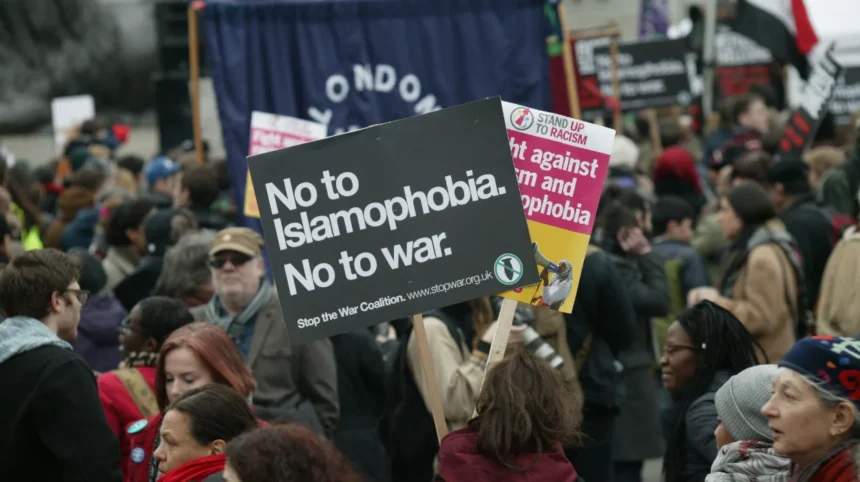
London has recently seen highly polarised political debate and demonstrations where anti-Islam messages have been expressed. Reporting around the May Unite the Kingdom rally organised by Tommy Robinson included calls for the “removal of Islam” and other statements directed against Muslims.
There is nothing wrong with political disagreement. Criticism of a religion, an ideology or a political movement does not automatically constitute Islamophobia.
But there is a clear difference between legitimate criticism and language that portrays an entire religious community as a threat or questions whether Muslims belong in Britain.
That distinction matters.
Politicians, public figures and media organisations have particular responsibilities because their words can influence the wider public debate.
When hostility towards Muslims becomes normalised, it can create an environment in which discrimination becomes easier to express and, in some cases, easier to justify.
We cannot ignore what happens online
Social media has made this problem even more complicated.
Misinformation, conspiracy theories and manipulated content can spread to thousands of people within minutes. The growing use of artificial intelligence also creates new opportunities for false or misleading material to be produced and circulated.
Recent reporting on the rise in anti-Muslim hate has highlighted concerns about misinformation, AI-generated content and far-right activity.
The answer cannot be to restrict legitimate political debate or freedom of expression. Those freedoms are fundamental to a democratic society.
But freedom of expression should not mean that institutions simply stand aside when hatred is deliberately spread or communities are repeatedly targeted.
There is a need for better digital literacy, stronger action against demonstrably harmful misinformation and greater support for people who are targeted online.
Schools, universities, local authorities and community organisations all have a role to play.
What should London do differently?
London needs a broader approach to tackling Islamophobia.
First, prevention needs to receive as much attention as response.
Public authorities should use the evidence available to identify patterns of discrimination and repeat victimisation rather than waiting for incidents to happen.
Second, communities need to be involved meaningfully.
Muslim communities should not be brought into discussions only after a serious incident. They should have a genuine voice in decisions about community safety, policing, education and social cohesion.
Third, local authorities should treat Islamophobia as an equality issue as well as a community-safety issue.
Councils are often the part of government closest to people’s everyday lives. They are therefore well placed to understand local tensions and build relationships with communities before problems become more serious.
Fourth, reporting needs to be accessible and trusted.
Someone who experiences discrimination should know where to turn and should feel confident that their concerns will be taken seriously.
Finally, success needs to be measured differently.
Arrests and prosecutions matter, but they are not the only measures of success. We should also ask whether Muslim communities feel safer, whether repeat incidents are declining, whether trust in public institutions is improving and whether discriminatory attitudes are being challenged.
Human rights belong at the centre
At its heart, this is a human rights issue.
Human rights are sometimes discussed as though they belong mainly in courtrooms or academic debates. In reality, they are also about everyday life — dignity, equality, participation and protection from discrimination.
Muslim Londoners should be able to go to work, use public transport, attend school, worship and participate in public life without having to worry about being targeted because of their faith or identity.
A society committed to equality cannot wait until prejudice becomes a criminal offence before taking it seriously.
It must also challenge the attitudes and conditions that allow discrimination to become normal.
That requires political leadership, but it also requires strong local institutions and genuine engagement with communities.
London can do better
The latest figures should not simply leave us shocked for a few days before attention moves elsewhere.
They should lead to action.
There is already important work being done. The Metropolitan Police has highlighted improvements in its response to anti-Muslim hate crime, while London has funding and programmes aimed at supporting communities and tackling hate.
But the continuing rise in reported incidents tells us that more needs to be done.
London should not become accustomed to receiving another set of worrying figures every year, followed by expressions of concern and promises to do better.
The ambition should be much greater.
We should want to live in a London where people are not simply able to report Islamophobia after experiencing it, but where they are less likely to experience it in the first place.
That means moving from recording hate to preventing hate.
It means recognising that Islamophobia is not simply a policing problem. It is also an equality issue, a human rights issue and a question of community safety and social cohesion.
Most importantly, it is a question about the kind of city London wants to be.
London rightly celebrates its diversity.
The challenge now is to make sure that every community can experience that diversity as a source of belonging and security — rather than fear.
Recording Islamophobia is necessary. But recording it is not enough. The real test is whether London can prevent it, challenge it and ultimately reduce it.
The views expressed in this article are the author’s own and do not necessarily reflect (North London News) editorial policy.