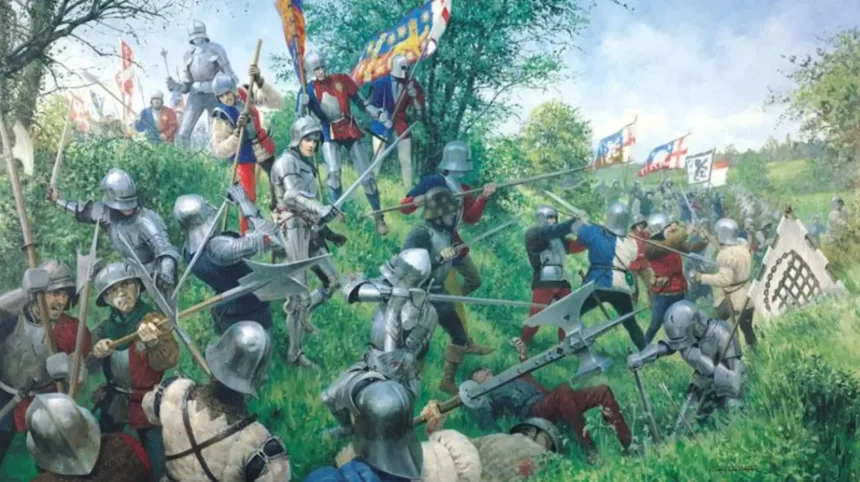
The Battle of Barnet was fought on 14 April 1471 during the Wars of the Roses. It was a decisive Yorkist victory for Edward IV over the Lancastrian forces commanded by Richard Neville, Earl of Warwick, better known as the Kingmaker.
- What was the Battle of Barnet?
- Why did Edward IV and Warwick fight at Barnet?
- Who fought in the Battle of Barnet?
- Why was the geography of Barnet important to the battle?
- How did fog affect the Battle of Barnet?
- Why was the death of Warwick the Kingmaker so important?
- How did the Battle of Barnet change the Wars of the Roses?
- What happened to the battlefield after 1471?
- What can visitors see today that connects Barnet with the battle?
- Why is the Battle of Barnet important to North London’s history?
- What does the Battle of Barnet reveal about medieval warfare?
- Why does the Battle of Barnet still matter today?
- What is the historical significance of the Battle of Barnet in one conclusion?
The battle was historically important because it removed one of the most powerful political figures in medieval England, weakened the Lancastrian cause, restored Edward IV’s authority and directly contributed to the Yorkist victories that followed at Tewkesbury. The battlefield also survives as one of England’s officially registered historic battlefields.
For visitors exploring North London, Barnet provides an unusual opportunity to connect a modern suburban landscape with one of the defining conflicts of fifteenth-century England. The battlefield is associated with Hadley Highstone, historic routes through the Barnet area and surviving landscape features that help explain why armies fought there.
What was the Battle of Barnet?
The Battle of Barnet was a major Wars of the Roses battle fought on Easter Sunday, 14 April 1471, near Barnet. Edward IV’s Yorkist army defeated forces loyal to Henry VI and commanded by Richard Neville, Earl of Warwick, who was killed during the fighting.
The battle formed part of the prolonged struggle for the English throne between the House of York and the House of Lancaster. The conflict is commonly known as the Wars of the Roses and lasted from 1455 to 1485, although fighting occurred intermittently rather than continuously.
Edward IV belonged to the Yorkist dynasty. He had taken the English throne in 1461 after defeating Lancastrian forces. Henry VI belonged to the Lancastrian dynasty and had previously ruled England before Edward’s accession.
Richard Neville, Earl of Warwick, was one of the most influential nobles in fifteenth-century England. His political and military influence helped Edward become king, which earned Warwick the later historical nickname “the Kingmaker”.
The relationship between Edward and Warwick eventually collapsed. Warwick opposed aspects of Edward’s policies and became increasingly hostile towards the king. In 1470, Warwick joined forces with former enemies of the Yorkists and helped restore Henry VI to the throne.
Edward responded by returning from exile in 1471. His campaign rapidly gathered momentum. London fell back into Yorkist control, and Edward captured Henry VI again.
Warwick then moved against Edward. Their armies met north of London at Barnet on 14 April 1471. Historic England identifies the battlefield as a pivotal clash in the Wars of the Roses.
Why did Edward IV and Warwick fight at Barnet?
Edward IV and Warwick fought at Barnet because Warwick had switched allegiance to Henry VI and attempted to restore Lancastrian power. Edward’s return from exile threatened that settlement, creating a direct military confrontation between the former allies.
The political background explains why Barnet became so important.
Warwick had initially been a leading supporter of Edward IV. His influence helped Edward secure the throne, but their political relationship deteriorated. Edward favoured policies and alliances that Warwick considered damaging to his own political objectives.
Warwick eventually rebelled against Edward. He briefly captured the king in 1469, but controlling Edward did not provide Warwick with a stable political settlement.
By 1470, Warwick had allied with Margaret of Anjou, Henry VI’s queen and one of the principal Lancastrian leaders. Warwick helped restore Henry VI to the throne while Edward fled to Burgundy.
The settlement did not last.
Edward returned to England in March 1471. He landed in Yorkshire and moved south, gathering support during the campaign. His brother Richard, Duke of Gloucester, who later became Richard III, accompanied him.
Edward entered London on 11 April 1471 and regained control of Henry VI. Warwick was then forced to confront Edward directly.
Historic England records that Warwick had hoped to prevent Edward from securing London. When that plan failed, Warwick chose the high ground near Barnet, approximately ten miles north of London.
This geographical position mattered. Barnet stood on an important route between London and the north. The elevated ground offered a useful military position and placed the armies close to the capital.
Who fought in the Battle of Barnet?
The Yorkist army was led by Edward IV, supported by commanders including Richard, Duke of Gloucester, and William, Lord Hastings. The Lancastrian army was commanded by Warwick, with John Neville, Earl of Northumberland, and other senior nobles supporting the campaign.
Edward IV was the Yorkist king and the central figure on the Yorkist side. He was a military commander as well as a claimant who had already established himself on the English throne.
Richard, Duke of Gloucester, was Edward’s younger brother. He later became Richard III, ruling England from 1483 until his death at Bosworth in 1485.
William, Lord Hastings, was another important Yorkist commander.
The Lancastrian side contained several powerful figures. Warwick commanded the army, while his brother John Neville, Marquess of Montagu, was also a major military leader.
The Lancastrian cause remained centred on Henry VI, although Henry himself was not directing the army in the field. Barnet Museum records that Henry VI was effectively Edward’s hostage by the time the armies confronted each other.
The battlefield therefore brought together several major figures from England’s dynastic struggle.
Barnet Museum estimates the Yorkist force at approximately 10,000 to 13,000 men and the Lancastrian force at approximately 13,000 to 15,000 men. Medieval army numbers remain estimates because surviving sources do not provide modern-style military records.

Why was the geography of Barnet important to the battle?
Barnet’s elevated position north of London made it strategically important in 1471. The battlefield included open heathland, hedged areas, roads and uneven ground, while the armies’ positions were affected by darkness, fog and limited visibility.
The geography of Barnet shaped how the battle unfolded.
The battlefield was north of what is now High Barnet. Historic accounts describe the armies occupying ground around the main road between London and St Albans.
Historic England’s battlefield research highlights the importance of the terrain. Contemporary and near-contemporary accounts describe open ground, hedges and a road running through the area. A report by the Hanseatic merchant Gerhard von Wesel also described Warwick’s army camping beside the St Albans road while Edward’s force occupied ground opposite it.
The landscape was considerably more open in the fifteenth century than the modern urban environment.
Historic England records that much of the battlefield consisted of common pasture and heathland with hedged enclosures. Parts of the historic open character remain sufficiently visible to help visitors understand the military geography.
The location also explains why Barnet was a logical battlefield. Armies travelling between the Midlands and London could use major routes through the area. Controlling the approaches to London had direct political and military significance.
The terrain therefore formed part of the battle’s strategic importance rather than simply providing a backdrop.
How did fog affect the Battle of Barnet?
Heavy fog created severe visibility problems during the Battle of Barnet. The opposing armies became confused about their positions, and the mist contributed to mistaken identification, battlefield disorder and the famous incident in which Lancastrian troops attacked allies.
Fog was one of the defining features of the battle.
The fighting began early on 14 April 1471, Easter Sunday. Historic England records that Edward’s army advanced while the ground was obscured by heavy mist. The conditions contributed to confusion among troops on both sides.
The problem became particularly significant because the armies were not positioned exactly as their commanders intended.
The Lancastrian army included the contingent commanded by John de Vere, Earl of Oxford. Oxford’s troops attacked the Yorkist position and achieved significant success.
However, fog made identification difficult.
A symbol associated with Oxford was interpreted incorrectly by another Lancastrian contingent. The resulting confusion contributed to cries of “treason” and an attack against men who were actually fighting on the same side.
This incident had serious consequences. The Lancastrian army became increasingly disorganised, while Edward’s forces recovered from the initial pressure.
Barnet therefore demonstrates how battlefield conditions influenced medieval warfare. Military success depended not only on numbers and weapons but also on visibility, communication, formation and command control.
Why was the death of Warwick the Kingmaker so important?
Warwick’s death at Barnet removed one of the most powerful political and military figures in fifteenth-century England. His defeat weakened the Neville family’s influence and removed a central force behind the Lancastrian restoration of Henry VI.
The death of Richard Neville was one of the battle’s most important consequences.
Warwick had played a central role in English politics for more than a decade. His influence had helped Edward IV become king, but his later rebellion had also helped restore Henry VI.
His ability to switch political allegiance demonstrated the extraordinary power of leading medieval nobles.
At Barnet, that political career ended.
Historic England states that Warwick’s death broke the power of the influential Neville family.
The result was more than the death of a military commander. It changed the political balance of the kingdom.
Warwick’s removal reduced the ability of the Lancastrian cause to challenge Edward through one of the country’s strongest noble networks.
His brother John Neville also died at Barnet. The losses further damaged the family’s political position.
The consequences extended into the next generation. Warwick’s daughter Anne Neville later married Richard, Duke of Gloucester, the future Richard III. This connected the Neville inheritance to the Yorkist royal family.
For this reason, the Battle of Barnet is closely connected with the later history of Richard III and the political transformation of England during the final phase of the Wars of the Roses.
How did the Battle of Barnet change the Wars of the Roses?
The Battle of Barnet strengthened Edward IV’s position and removed Warwick as a political and military threat. The victory enabled Edward to pursue remaining Lancastrian forces, leading directly into the decisive Battle of Tewkesbury later in 1471.
Barnet did not immediately end every element of Lancastrian resistance.
Its importance came from the way it transformed the strategic situation.
Edward IV emerged from the battle with control of London and with his most dangerous former ally dead. The Lancastrian political structure was severely weakened.
The next major confrontation occurred at Tewkesbury on 4 May 1471, only three weeks after Barnet.
Margaret of Anjou and her son, Edward of Westminster, attempted to rebuild Lancastrian resistance. Edward IV moved rapidly to intercept them.
Historic England describes Tewkesbury as a decisive defeat for the Lancastrian cause. The victory followed Barnet and helped establish a period of Yorkist rule lasting approximately fourteen years.
The sequence is crucial when assessing Barnet’s historical importance.
Barnet removed Warwick.
Tewkesbury then destroyed much of the remaining organised Lancastrian military resistance.
Henry VI died in the Tower of London later in May 1471. The Lancastrian dynasty’s ability to challenge Edward IV was consequently reduced dramatically.
Barnet therefore formed one of the central stages in Edward IV’s restoration and consolidation of power.
What happened to the battlefield after 1471?
The battlefield gradually became part of Barnet’s changing landscape, but its historical identity survived through local tradition, memorialisation and archaeological research. The site is now protected as a registered battlefield because of its special historic interest.
The landscape around Barnet changed substantially after the medieval period.
The battlefield was once predominantly open countryside. Urban development later transformed the surrounding area, but important elements of the historic landscape remain.
The Hadley Highstone is the most recognisable memorial associated with the battle.
Historic England records that the stone monument was erected around 1740 by Sir Jeremy Sambrook. It commemorates the Battle of Barnet and the defeat and death of Warwick. The monument was moved approximately 200 yards north to its present location around 1840.
The memorial is itself historically significant because it demonstrates how eighteenth- and nineteenth-century communities interpreted and commemorated the medieval battlefield.
The battlefield received formal national recognition in 1995, when it was added to the Register of Historic Battlefields. Historic England lists it as Battlefield 1000001.
The designation recognises the site’s special historic interest and provides a framework for protecting its heritage significance.
As you explore the modern site, you are crossing land with a deep heritage. Read about the full to understand its origins.

What can visitors see today that connects Barnet with the battle?
Visitors can connect the modern Barnet landscape with the 1471 battle through Hadley Highstone, surviving landscape viewpoints, local heritage interpretation and Barnet Museum. These sites provide practical ways to understand the battlefield without requiring a dedicated medieval archaeological monument.
Modern Barnet does not resemble the landscape seen by soldiers in 1471. Much of the original heathland and pasture has disappeared beneath roads, buildings and later development.
However, the battlefield remains accessible as a heritage landscape.
Hadley Highstone provides the clearest physical memorial. Historic England identifies it as a listed Grade II structure associated with the Battle of Barnet.
The wider battlefield also retains viewpoints and public footpath access. Historic England notes that the open character of parts of the landscape helps visitors understand the events that took place there.
Visitors should remember that some battlefield land is associated with a golf course. Historic England specifically advises caution when crossing the golf course and identifies public viewpoints and footpaths within the registered area.
Barnet Museum provides another important resource.
The museum is a volunteer-run local history museum in North London. Its collection covers the history of Chipping Barnet, East Barnet, New Barnet, Hadley and surrounding areas. Its collections include artefacts and archival material extending from the Bronze Age to the modern period.
The museum also maintains dedicated material about the Battle of Barnet, including battlefield research and educational resources.
For visitors interested in medieval history, combining the museum with a visit to the battlefield provides a stronger understanding of the event than visiting either location independently.
Why is the Battle of Barnet important to North London’s history?
The Battle of Barnet is important to North London’s history because it brought a major national power struggle directly into the region. The battlefield represents a rare surviving connection between modern London and the dynastic conflicts that shaped medieval England.
Barnet occupies an unusual position in London’s historical geography.
Today, Barnet forms part of Greater London. In 1471, it was a settlement north of London situated along important routes connecting the capital with northern England.
That position gave Barnet strategic significance.
The battle demonstrates how events in the national struggle for the English crown directly affected areas surrounding London.
Historic England identifies the Battle of Barnet as a registered battlefield partly because the surviving landscape retains enough character to communicate the historical setting.
Barnet Museum also identifies the battlefield as the only officially registered battlefield in Greater London.
This distinction gives the site particular significance for North London heritage.
The battlefield also links local history with national political history. Edward IV, Henry VI, Richard Neville, Richard of Gloucester and other major figures in fifteenth-century England were connected directly to the event.
The site therefore has value for visitors interested in medieval warfare, royal history, London history, archaeology and the Wars of the Roses.
What does the Battle of Barnet reveal about medieval warfare?
The Battle of Barnet reveals how medieval warfare depended on political alliances, battlefield geography, troop organisation, communication and command. Its fog, mistaken identities and shifting formations demonstrate the practical difficulties faced by fifteenth-century armies.
The battle provides a useful case study in medieval military organisation.
Army sizes were substantial. Barnet Museum estimates between 10,000 and 13,000 Yorkists and 13,000 and 15,000 Lancastrians. The estimated death toll ranges from approximately 1,500 to 4,000.
These figures illustrate the scale of the conflict, although medieval casualty and army figures require careful interpretation.
The battle also involved artillery and firearms. Barnet Museum’s historical material refers to artillery and hand-guns being used during the fighting.
The fog demonstrates another important aspect of medieval warfare: the difficulty of maintaining coordination once battle began.
Commanders depended heavily on banners, messengers, visual signals and the recognition of allied formations. When visibility failed, these systems became unreliable.
The battle therefore demonstrates that military technology alone did not determine outcomes.
Leadership and communication were equally important.
Edward’s victory also demonstrates the significance of operational speed. His rapid return from exile, march towards London and subsequent confrontation with Warwick prevented the Lancastrians from establishing a secure political settlement.
Explore More Area Guide
What Is the History of High Barnet? North London 2026
When Was Barnet First Established? History Guide
Why does the Battle of Barnet still matter today?
The Battle of Barnet still matters because it changed the political balance of medieval England, weakened the Lancastrian cause and shaped the succession of events leading to Tewkesbury and later Yorkist rule. Its registered battlefield also preserves North London’s medieval heritage.
The importance of Barnet extends beyond the battlefield itself.
The battle removed Warwick, one of the most influential nobles of the fifteenth century. His death weakened the Neville political network and strengthened Edward IV’s position.
Barnet also demonstrates how rapidly medieval political authority could change.
Edward IV had been forced into exile in 1470. Less than a year later, he had returned to England, recovered London and defeated the man who had previously helped place him on the throne.
The consequences were long-lasting.
After Barnet and Tewkesbury, Edward IV enjoyed a period of comparatively stable rule. The Yorkist victory established the political conditions for the later reign of Richard III and the continuing dynastic struggle that eventually produced the Tudor victory at Bosworth in 1485.
For North London, the legacy is physical as well as political.
Historic England’s registration protects the battlefield as a site of special historic interest. Hadley Highstone provides a visible memorial, while the surrounding landscape retains enough historical character to support interpretation of the battle.
The Battle of Barnet is therefore not simply an event from medieval history. It is a nationally significant historical event preserved within the modern landscape of North London.
What is the historical significance of the Battle of Barnet in one conclusion?
The Battle of Barnet was historically important because Edward IV defeated Warwick the Kingmaker on 14 April 1471, ending Warwick’s political career, weakening the Lancastrian cause and creating conditions for the Yorkist victory at Tewkesbury.
The battle brought together several of the defining forces of fifteenth-century English history.
It involved the competing Houses of York and Lancaster. It featured Edward IV, Henry VI, Warwick the Kingmaker and the future Richard III. It occurred during a period when control of the English crown repeatedly shifted between rival dynasties.
The outcome was decisive.
Edward IV survived the challenge from his former ally. Warwick died. The Neville family’s political influence was weakened. The Lancastrian cause lost one of its most capable commanders.
Within weeks, Edward defeated another Lancastrian army at Tewkesbury. That victory further secured his position and helped establish a prolonged period of Yorkist rule.
The battlefield also has continuing heritage value.
Historic England officially registered the site in 1995, while the Hadley Highstone provides a physical memorial dating from approximately 1740.
For modern visitors, the significance of Barnet lies in this combination of national history and local landscape. A contemporary North London neighbourhood preserves the setting of a battle that changed the balance of power in medieval England.
The Battle of Barnet is therefore historically important not only because of who won, but because of what the victory changed: the political authority of Edward IV, the power of Warwick, the strength of the Lancastrian cause and the direction of the Wars of the Roses.
What was the Battle of Barnet?
The Battle of Barnet was a major battle of the Wars of the Roses fought on 14 April 1471 near Barnet in North London. Edward IV’s Yorkist army defeated the Lancastrian forces led by Richard Neville, Earl of Warwick.