Historic public buildings in Barnet, North London, reveal how local government, education, religion, transport and community life developed over several centuries. From the historic High Barnet town centre to older civic buildings and former institutional sites, the borough offers visitors a way to explore its architectural and social heritage.
- What makes Barnet’s historic public buildings important?
- Where can you find historic civic buildings in Barnet?
- Which historic libraries in Barnet are worth visiting?
- Where can you discover Barnet’s historic educational institutions?
- Which historic religious buildings help explain Barnet’s public history?
- What can visitors learn from Barnet’s Physic Well?
- Which historic houses and institutional buildings should you explore in Finchley?
- How can you identify protected historic buildings in Barnet?
- How can you plan a historic public-building walk around Barnet?
- Why should Barnet’s historic public buildings be preserved?
- Where can you find reliable information before visiting Barnet’s heritage sites?
For visitors interested in civic and institutional history, the key is to distinguish buildings that remain in public use from historic structures that survive as listed properties, converted premises or protected architectural landmarks. Barnet is a large London borough with historic settlements including Chipping Barnet, Finchley, Hendon, High Barnet and Edgware. Each has a different relationship with London’s expansion.
What makes Barnet’s historic public buildings important?
Barnet’s historic public buildings document the development of local administration, education, religious life and community services. Their architectural features and original functions reveal how villages and market towns developed into parts of modern North London. Some buildings retain institutional uses, while others survive as protected landmarks or adapted properties.
Public buildings are structures built or used to support civic administration, public services, education, justice, transport or community activities. Examples include town halls, libraries, schools, court buildings and former workhouses. The term also covers certain historic institutional buildings that now serve different purposes.
Barnet’s heritage reflects several important periods. Medieval and early modern settlements established local centres around churches, roads and markets. During the eighteenth and nineteenth centuries, improved transport and population growth increased the demand for schools, public institutions and administrative facilities. The twentieth century brought further expansion as residential development connected Barnet’s settlements more closely with London.
The London Borough of Barnet was established in 1965 through the reorganisation of local government in Greater London. Its modern boundaries brought together communities with distinct histories, including Finchley, Hendon and the former municipal borough of Barnet.
This history explains why historic public buildings are distributed across the borough rather than concentrated in a single civic quarter. A visitor exploring High Barnet encounters a different historic environment from someone walking through Hendon or Finchley.
Historic buildings also provide evidence of changing public expectations. Victorian libraries, schools and town halls, for example, reflect the expansion of municipal services and organised community life. Their materials, plans and decorative details help researchers identify their period and original purpose.
Where can you find historic civic buildings in Barnet?
Historic civic buildings in Barnet are found across High Barnet, Hendon and Finchley, where former local authorities established administrative facilities before the creation of the modern borough in 1965. Historic town halls and municipal buildings are particularly relevant to understanding how local government evolved
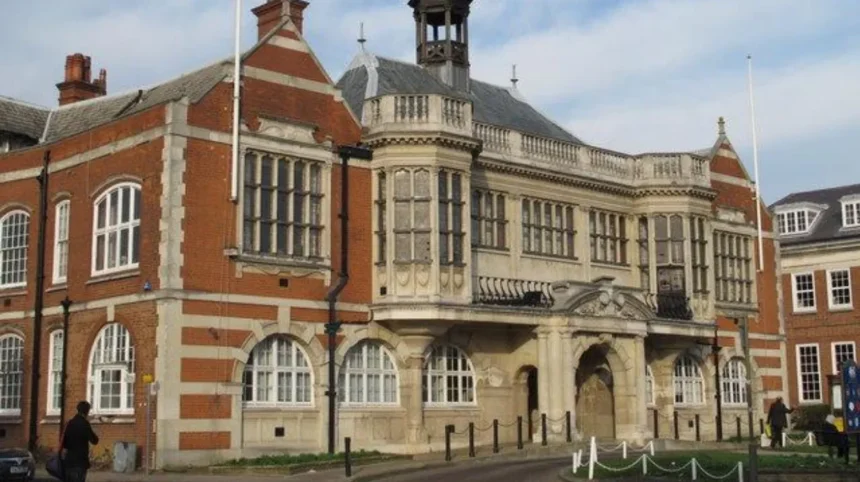
Hendon Town Hall
Hendon Town Hall is an important starting point for exploring the borough’s municipal heritage. Hendon developed as a distinct urban community before becoming part of the wider London Borough of Barnet. Its former municipal institutions reflect the period when local councils managed services for growing suburban populations.
Town halls historically provided venues for council meetings, administrative work and public ceremonies. Their architectural design often communicated permanence and civic identity through formal entrances, symmetrical façades and substantial public rooms.
When visiting Hendon’s historic civic environment, check the building’s current access arrangements and permitted uses. A historic exterior does not guarantee that the interior is open to visitors.
Finchley’s municipal heritage
Finchley developed its own civic identity before the 1965 local government reorganisation. Historic municipal buildings in the area help explain the administration of the former local authority and the growth of suburban North London.
Finchley’s civic history is particularly relevant to the study of twentieth-century urban expansion. New housing, roads, schools and public facilities supported a growing population and increased the responsibilities of local government.
High Barnet’s historic centre
High Barnet provides a different perspective on civic development. Its historic streetscape reflects its origins as a market town and settlement on an important route north of London.
The High Street and surrounding historic properties offer opportunities to examine traditional commercial buildings, older street patterns and the relationship between local trade and community services. Not every historic building in this area is a public building, so visitors should distinguish private commercial premises from former civic institutions.
These locations demonstrate how Barnet’s administrative history developed through several local centres. Exploring them together provides a more complete understanding of the borough than visiting a single building.
Which historic libraries in Barnet are worth visiting?
Hendon Library and East Finchley Library are notable examples of Barnet’s historic public library architecture. Their listed status reflects architectural and historical interest, while their locations illustrate how local authorities developed public learning facilities for growing suburban communities during the twentieth century.
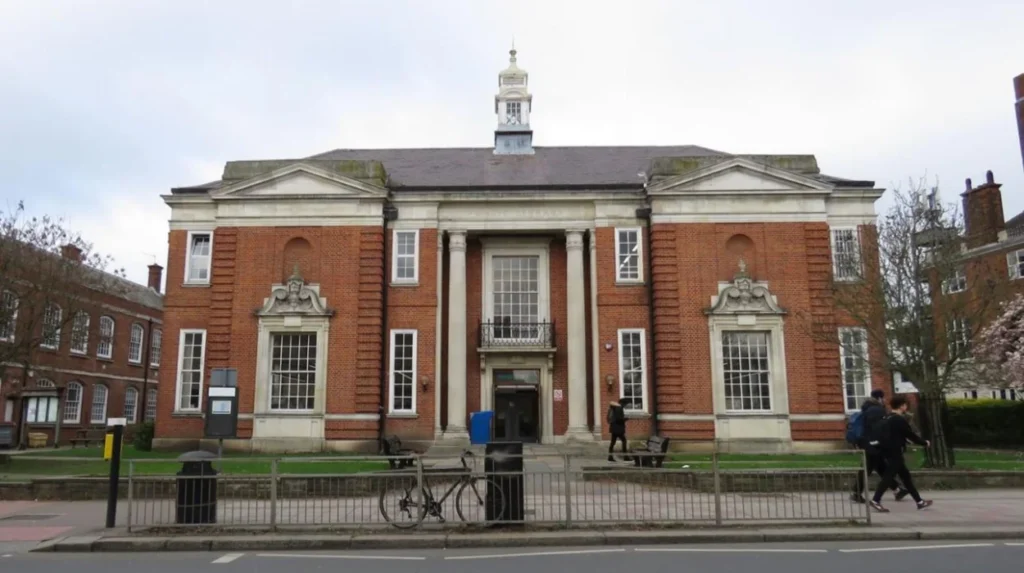
Hendon Library
Hendon Library stands at The Burroughs, Hendon, NW4 4BG. The building dates from 1929 and was designed by T. M. Wilson for Hendon Urban District Council. Its red-brick exterior, stone detailing and slate roof reflect the civic architecture of the interwar period. Barnet Council’s heritage register identifies the library as a Grade II listed building.
The library represents the expansion of public education and access to information. During the early twentieth century, public libraries provided residents with books, reference materials and opportunities for independent study. Their presence also reflected municipal investment in community facilities beyond essential administration.
Visitors interested in architectural details should examine the building’s overall proportions, brickwork and stone dressings from public areas. Check current library opening hours before planning an interior visit.
East Finchley Library
East Finchley Library is located at 226 High Road, N2 9BB. It dates from 1938 and was designed by Percival T. Harrison, the borough architect and engineer, with assistance from C. M. Bond for Finchley Borough Council. It is also listed at Grade II.
Its late-1930s date places it within a period of substantial suburban development. Public libraries were important neighbourhood institutions because they offered access to reading and educational resources without requiring residents to purchase books or travel into central London.
Comparing East Finchley Library with Hendon Library reveals how different local authorities invested in public learning before the formation of the London Borough of Barnet in 1965. Both buildings also demonstrate why public architecture belongs within a wider study of social history, not just architectural design.
Where can you discover Barnet’s historic educational institutions?
Barnet’s historic educational heritage includes Mill Hill School, older school buildings in Finchley and institutional architecture associated with the borough’s suburban expansion. These sites reveal changing approaches to education, school design and the relationship between learning institutions and their surrounding communities.
Mill Hill School
Mill Hill School is one of the borough’s significant historic educational institutions. Historic England’s Barnet heritage information identifies its main building as designed by Sir William Tite around 1825, with important additions by T. E. Collcutt in 1905. The architecture records more than one period of institutional development.
The site’s history illustrates how education developed alongside the expansion of residential communities in North London. Historic school buildings frequently combine an original institutional design with later additions for changing educational needs.
Visitors should distinguish publicly accessible grounds from buildings that operate as a school. Access restrictions apply to active educational premises, so exterior viewing from permitted public areas is the appropriate approach unless the school advertises an event or visit.
Christ’s College Finchley and the Hendon Lane area
Finchley’s educational history is visible around Hendon Lane, near the historic Church End settlement. Barnet Council’s local history account records that an older building known as Finchley Hall became the school Christ’s College Finchley in 1858. A new school building followed in 1860, with a distinctive tower. The older hall later served as council offices from 1902 before being destroyed in 1940.
This sequence illustrates how buildings changed functions as local needs evolved. A structure initially associated with one community purpose became an educational institution and later accommodated municipal administration.
The story also demonstrates why historic public buildings should be studied through archival records as well as surviving architecture. A demolished structure can remain important to the history of a place even when no original fabric survives.
Which historic religious buildings help explain Barnet’s public history?
St Mary’s Church in Finchley and other historic religious sites across Barnet preserve evidence of long-standing community institutions. Their architecture, memorials and changing layouts document worship, burial practices and local identity across several centuries, although religious buildings are not automatically civic buildings.
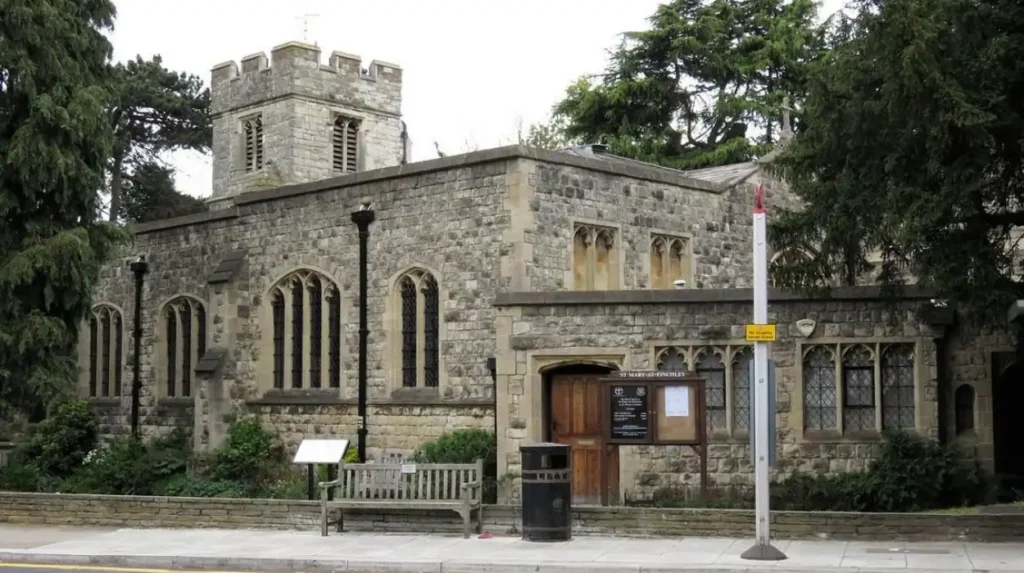
St Mary’s Church, Finchley
The Parish Church of St Mary stands on Hendon Lane, Finchley, N3. Historic England lists it at Grade II*. The building contains surviving elements associated with a medieval church, including fragments dating to the twelfth century. The tower and other architectural features reflect later periods of construction and alteration. Major restoration took place in 1872, followed by further additions in 1932.
The church’s architectural history makes it a useful point of reference for understanding Finchley before the expansion of modern suburban London. Its memorials and monuments also preserve evidence of individuals connected with the local community.
Religious buildings occupied central positions in many historic settlements. Parish churches supported worship, ceremonies and burial, while churchyards preserve memorials that help researchers investigate local family and social history.
Visitors should check whether the church is open for worship, heritage visits or other activities before entering. Respect services and any restrictions on photography.
Why religious buildings matter to civic heritage
Religious institutions often performed functions that overlapped with community administration before modern public services developed. Parish records documented baptisms, marriages and burials, while church buildings provided venues for local gatherings.
This does not make every church a government building. Instead, these sites provide context for understanding the development of public life, especially in settlements that existed long before the modern borough.
For a broader historical overview, use the single contextual link below when publishing this article within a Barnet heritage content hub.
As you explore Barnet’s surviving civic landmarks, you are also crossing streets shaped by centuries of settlement and suburban growth. Read the full [Barnet’s Historic Development and Growth Through the Centuries] to understand how its villages, market centres and institutions developed into modern North London.
What can visitors learn from Barnet’s Physic Well?
Barnet’s Physic Well is a surviving historic structure associated with a mineral spring that attracted visitors during the seventeenth and eighteenth centuries. Located near Well Approach and Pepys Crescent in Chipping Barnet, it connects local public heritage with historic beliefs about health and mineral water.
The Physic Well provides a different perspective on public history because it was associated with a natural spring rather than a conventional council building. Barnet Council records that a well house was constructed in 1656, when the parish owned the well and appointed a keeper.
The spring was classified as chalybeate, meaning its mineral water contained iron salts. During the period, people believed that drinking particular mineral waters supported health. The spring became popular enough for its water to be bottled and sold in London.
The diarist Samuel Pepys visited the well in 1664 and recorded his experience. His account provides a historical reference for the site’s reputation beyond Barnet itself. The well later lost popularity, underwent changes and was rediscovered in the twentieth century. A new well house was constructed in 1937.
The present structure includes a seventeenth-century underground well chamber beneath a Tudor-style building. Restoration work took place between April and November 2018, with support from Barnet Council, Historic England and the Heritage of London Trust.
Barnet Museum manages public openings. The underground chamber is reached by steep stone steps and has limited space, so visitors should check access arrangements before travelling. This site is especially relevant to people researching the history of public health beliefs, local tourism and historic water sources.
Which historic houses and institutional buildings should you explore in Finchley?
Avenue House, now known as Stephens House, is a significant historic property in Finchley. Built in 1859 and later developed by ink manufacturer Henry Stephens, it combines a historic villa with landscaped grounds that became a public park in 1928.
Avenue House stands on East End Road, Finchley, N3 3QE. Historic England identifies the house as a Grade II listed building. Its grounds are separately registered as a historic park and garden, also at Grade II.
The house was purchased by Henry Stephens in 1874. He commissioned improvements to the property and its grounds, with landscape advice associated with Robert Marnock. The estate developed to include landscaped features and service buildings, such as a water tower, lodge, coach house and stable block. The grounds opened regularly to the public in 1900 and became a public park in 1928.
Avenue House is not a conventional town hall or public-service building. Its importance lies in its later community use and the relationship between a private estate and public green space. It demonstrates how historic private properties became part of the borough’s public heritage.
The house and gardens provide a useful stop for visitors interested in Victorian architecture, landscape design and the development of public recreation. Check the current opening arrangements for the house, gardens and any scheduled events before visiting.
How can you identify protected historic buildings in Barnet?
Historic England’s National Heritage List for England and Barnet Council’s heritage resources identify buildings and structures recognised for architectural or historic interest. Listing grades, conservation-area appraisals and official descriptions help visitors distinguish protected landmarks from buildings that are simply old.
A listed building is a structure formally recognised for special architectural or historic interest. The principal grades in England are Grade I, Grade II* and Grade II. Grade I identifies buildings of exceptional interest, Grade II* identifies particularly important buildings of more than special interest, and Grade II covers nationally important buildings of special interest.
Hendon Town Hall and the two libraries discussed above are Grade II listed. St Mary’s Church in Finchley is Grade II*. These designations help establish why each property is significant and provide a starting point for further research.
Barnet also contains conservation areas. These are designated areas with special architectural or historic interest, where the character of the wider streetscape matters alongside individual buildings. The council identifies areas including Finchley Church End, Hendon Church End, Hendon The Burroughs, Monken Hadley, Totteridge and Wood Street.
Before visiting a building, use the following process:
- Search the building’s name on the Historic England website to check its official listing description and grade.
- Consult Barnet Council’s conservation-area information for details of the surrounding historic environment.
- Check the building owner’s website for opening hours, visitor arrangements and access restrictions.
- Confirm whether the property is a public venue, an active institution or a privately occupied building.
These steps help visitors plan accurate heritage walks and avoid assuming that a listed building is open to the public.
How can you plan a historic public-building walk around Barnet?
A Barnet heritage walk works best when buildings are grouped by location and historical theme. Visitors can explore High Barnet’s historic centre and Physic Well separately from Hendon’s municipal buildings and Finchley’s libraries, church and historic estate, reducing unnecessary travel.
High Barnet and Chipping Barnet
Explore the historic High Street and surrounding streets before visiting the Physic Well when a public opening is scheduled. Check the route and access details in advance.
Hendon civic heritage
Visit the exterior of Hendon Town Hall and Hendon Library at The Burroughs. Their proximity makes this area useful for studying how local government and public education developed together.
Finchley’s historic institutions
Explore St Mary’s Church on Hendon Lane, East Finchley Library on the High Road and Stephens House and Gardens on East End Road. Plan transport between these sites according to your available time.
These routes are suggested groupings rather than measured walking itineraries. Check current opening hours and transport connections before setting off. Active schools and administrative premises often restrict access to their interiors.
Explore More Area Guide
What Makes Barnet’s Suburban Architecture Distinctive?
Barnet Listed Buildings: Historic England Guide to Key Sites
Why should Barnet’s historic public buildings be preserved?
Preserving Barnet’s historic public buildings protects architectural evidence, local identity and records of changing community services. Listed-building protection and conservation-area controls help manage alterations, while responsible reuse allows historic properties to remain relevant to residents and visitors.
Historic buildings provide information that modern structures do not always retain. Original materials, room layouts, inscriptions and decorative details help explain how people worked, learned, worshipped and accessed public services.
Preservation also supports local research and heritage tourism. Buildings such as Hendon Town Hall and Hendon Library connect visitors with the history of local government and public education. The Physic Well records a different aspect of community life, while Stephens House and Gardens illustrates the transition from private estate to public recreation space.
Protection does not mean that every historic building remains unchanged. Conservation decisions balance historic significance with maintenance, accessibility, safety and appropriate new uses. Listed-building controls apply to works affecting the special interest of a listed structure, while conservation-area controls protect the character of designated places.
Barnet Council publishes information about its conservation areas and listed buildings, while Historic England provides official listing descriptions and historical records. These resources help property owners, researchers and visitors understand why individual places matter.
Where can you find reliable information before visiting Barnet’s heritage sites?
Barnet Council, Historic England and Barnet Museum provide reliable information about historic buildings, conservation designations and local history. Their official records help visitors verify building dates, architectural features, locations and access arrangements before planning a heritage visit.
Barnet’s historic public buildings are spread across its former market towns, suburban centres and institutional districts. Hendon Town Hall and its neighbouring library reveal the development of municipal services; East Finchley Library and St Mary’s Church preserve different aspects of public learning and community history; and the Physic Well and Stephens House connect local heritage with earlier traditions of recreation and public access. Exploring these sites together provides a grounded understanding of how North London’s civic and institutional landscape developed.
Where can you find historic public buildings in Barnet?
Historic public buildings are found in Hendon, Finchley and High Barnet. Key sites include Hendon Town Hall, Hendon Library, East Finchley Library and the Physic Well in Chipping Barnet.