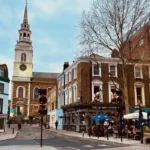
Finsbury is a distinctive historic district in the south-east of the London Borough of Islington, North London. Its identity comes from its historic connection to Finsbury Fields, religious heritage, Georgian and Victorian architecture, public spaces, social housing developments and proximity to the City of London. The neighbourhood combines centuries of history with a contemporary urban environment.
- What Is Finsbury and Where Is It Located in Islington?
- How Did Finsbury Develop from Open Fields into an Urban Neighbourhood?
- Why Is Finsbury’s Historical Connection with Religion and Nonconformity Important?
- What Makes Bunhill Fields Historically Significant?
- What Is the Connection Between Finsbury and John Wesley?
- How Did St Luke’s Church Influence the Area?
- Which Architectural Landmarks Make Finsbury Different from Other Islington Neighbourhoods?
- Why Is Finsbury Health Centre Architecturally Important?
- What Makes Ironmonger Row Baths a Historic Landmark?
- How Do Finsbury’s Residential Buildings Reflect Its Social History?
- How Did Finsbury Become an Important Centre for Public Housing and Social Reform?
- What Was the Former Metropolitan Borough of Finsbury?
- How Did Public Housing Change Finsbury?
- Why Does Finsbury’s Social History Matter Today?
- What Green Spaces and Public Areas Can Visitors Explore in Finsbury?
- What Can Visitors Discover at Bunhill Fields?
- What Is the Connection Between Finsbury and Finsbury Square?
- How Do Conservation Areas Protect Finsbury’s Character?
- What Cultural and Recreational Activities Make Finsbury Attractive to Visitors?
- Can Visitors Experience Music and Cultural Events in Finsbury?
- What Leisure Facilities Are Available Around Finsbury?
- How Does Finsbury Connect with London’s Creative Neighbourhoods?
- How Does Finsbury’s Location Benefit Residents, Tourists and Business Travellers?
- Which Transport Connections Serve Finsbury?
- Why Is Finsbury Convenient for Business Travellers?
- Is Finsbury Suitable for Digital Nomads and Remote Workers?
- What Makes Finsbury Different from Other Neighbourhoods in Islington?
- How Does Finsbury Compare with Clerkenwell?
- How Is Finsbury Different from Angel and Highbury?
- Why Does Finsbury Retain a Distinct Local Identity?
- How Can Visitors Explore Finsbury’s Main Historical Attractions?
- Which Places Should Visitors Include in a Finsbury Walking Route?
- When Is the Best Time to Explore Finsbury?
- What Is the Future Significance of Finsbury within Islington?
Finsbury stands out because it represents several important stages in London’s development. Its landscape once included open fields and wetlands. It later became a centre for archery, military activity, religious dissent and industrial employment. During the twentieth century, public housing, healthcare and civic improvements reshaped the district. Today, its streets reflect this combination of historical and modern influences.
For visitors, Finsbury offers access to historic burial grounds, architectural landmarks, independent businesses and cultural attractions. For residents and professionals, its location provides convenient connections to central London, Clerkenwell, Old Street and the City.
Understanding what makes Finsbury unique requires looking beyond its geographical position. Its historical development, architectural character, community identity and urban regeneration explain why it remains an important part of Islington.
What Is Finsbury and Where Is It Located in Islington?
Finsbury is a historic district in south-east Islington, London, associated particularly with Bunhill and St Luke’s. It sits close to Clerkenwell, Old Street and the City of London, providing an important connection between Islington’s residential neighbourhoods and central London’s commercial districts.
Finsbury is not a separately governed London borough. It forms part of the London Borough of Islington, which was established in 1965 through the merger of the former Metropolitan Boroughs of Finsbury and Islington.
The name Finsbury has historical and geographical significance. In contemporary local descriptions, Finsbury commonly refers to the Bunhill and St Luke’s area in the south-east of Islington. Its boundaries are not universally defined by one administrative line.
The neighbourhood occupies a strategic position between several recognisable London districts:
- Bunhill: A historic area associated with Bunhill Fields burial ground and religious dissent.
- St Luke’s: An area recognised for its historic church, residential streets and civic buildings.
- Clerkenwell: A neighbouring district with a strong association with London’s printing, manufacturing and creative industries.
- Old Street: A major transport and commercial area connecting Islington with the City and Shoreditch.
- Finsbury Square: A historic landscaped square near the City of London.
City Road and Goswell Road are important routes through this part of London. They connect residential streets with commercial areas and public transport facilities.
Finsbury’s location makes it relevant to several audiences. Tourists use the district as a starting point for exploring Clerkenwell and the City. Professionals benefit from its proximity to employment centres. Residents access local shops, green spaces and community facilities.
How Did Finsbury Develop from Open Fields into an Urban Neighbourhood?
Finsbury developed from a landscape of wetlands and open fields into an urban district through drainage, recreation, military activity, industrial expansion and residential construction. Its transformation reflects London’s growth beyond its historic central boundaries during the early modern and industrial periods.
The earliest landscape of south-east Islington differed considerably from its present built environment.
According to Islington Council’s local history publication, the area was once part of the Great Fen, a wetland associated with an obstruction in the River Walbrook. The landscape was subsequently drained in 1527.
The area became known as Finsbury Fields. Its name is connected with the Fiennes family, whose manor house stood in the surrounding area.
Following drainage, the fields became associated with outdoor recreation. Archery was particularly important because London required suitable open spaces for practising military skills.
By 1594, more than 150 archery targets were recorded across Finsbury Fields. This demonstrates the area’s importance as a recreational and military training landscape.
In 1658, the Honourable Artillery Company established a permanent base on City Road. The organisation remains associated with the site.
Finsbury also became connected with early sporting and scientific developments. Its grounds hosted early cricket matches during the eighteenth century. In 1784, the area witnessed England’s first hydrogen balloon flight.
These historical events demonstrate that Finsbury’s identity developed through several different activities rather than one dominant industry.
How Did London’s Expansion Change Finsbury?
London’s population growth gradually transformed the open landscape into a densely developed urban district.
Housing, workshops, religious buildings and commercial premises replaced much of the former countryside. New roads connected Finsbury with surrounding settlements and central London.
Industrial activity became increasingly important during the nineteenth century. Clerkenwell and neighbouring districts developed associations with printing, clockmaking, metalworking and other manufacturing trades.
The growth of employment attracted workers and their families. This increased demand for housing, transport and public services.
As you explore modern Finsbury, you are crossing land with a deep heritage. Read about the full [History of Finsbury and Its Transformation from Fields to an Urban District Here] to understand its origins and historical development.
Why Is Finsbury’s Historical Connection with Religion and Nonconformity Important?
Finsbury has a significant religious history because it became a centre for Protestant nonconformity, independent religious communities and influential writers. Bunhill Fields, Wesley’s Chapel and the historic St Luke’s Church demonstrate how religious activity shaped its cultural and architectural identity.
Religious dissent is an important part of Finsbury’s historical character. Nonconformists were Christians whose religious practices differed from those of the established Church of England.
During the seventeenth and eighteenth centuries, Bunhill Fields became an important burial place for religious dissenters. The burial ground opened in 1665 and remained in use until 1854.
What Makes Bunhill Fields Historically Significant?
HISTORIC LANDMARK
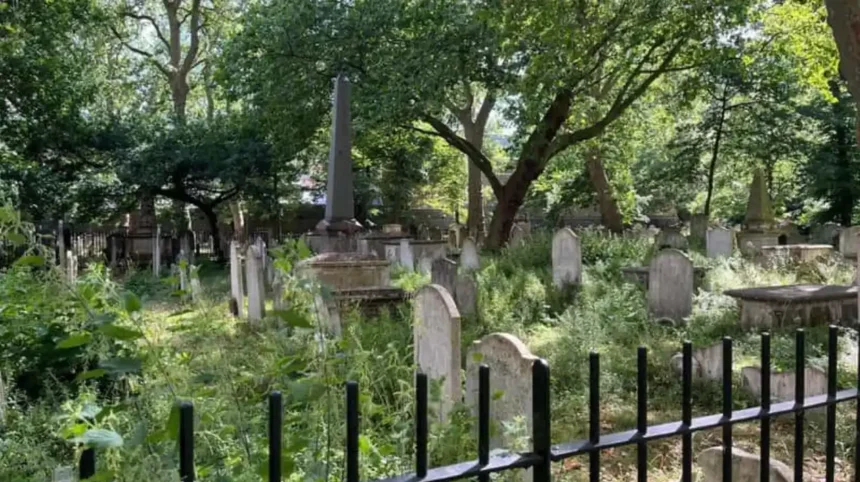
Bunhill Fields is one of Finsbury’s most recognisable historical landmarks.
The City of London Corporation manages the burial ground. It contains more than 2,300 memorials and is associated with approximately 123,000 burials.
Several important historical figures are buried there:
- John Bunyan: English religious writer best known for The Pilgrim’s Progress.
- William Blake: English poet, artist and printmaker.
- Daniel Defoe: English novelist and author of Robinson Crusoe.
- Isaac Watts: English hymn writer and theologian.
Their presence connects Finsbury with important developments in British literature, religious thought and intellectual history.
Bunhill Fields also functions as a public garden. Its trees, memorials, pathways and planted areas provide an accessible green space within a densely developed urban environment.
The site is particularly valuable for visitors interested in historical burial grounds, religious heritage and London’s literary history.
What Is the Connection Between Finsbury and John Wesley?
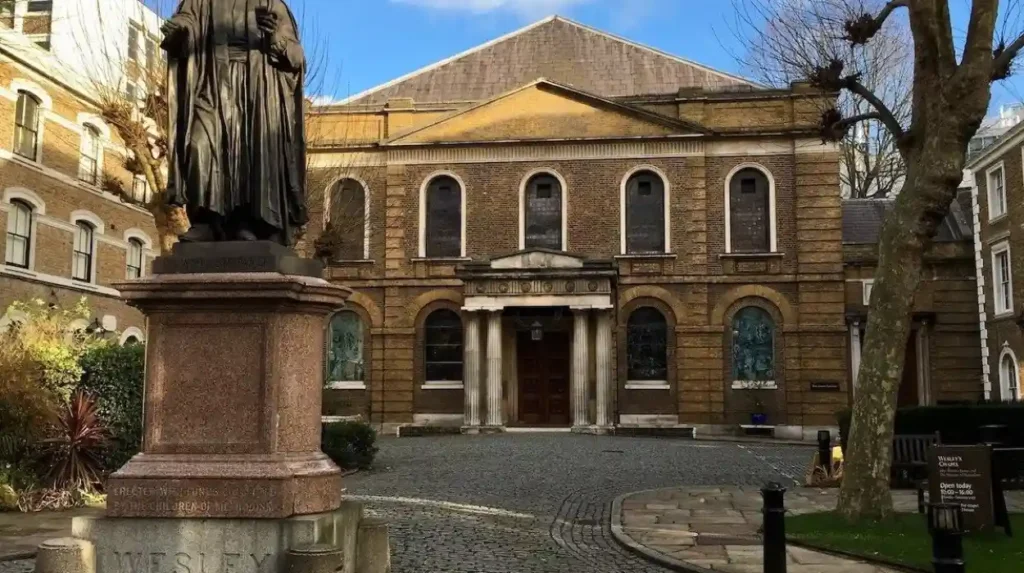
Wesley’s Chapel on City Road is another important historical landmark near Finsbury.
The Methodist preacher John Wesley established his chapel and mission on City Road in 1777. The site became an important centre for the development of Methodism.
Methodism is a Christian movement that developed from the eighteenth-century religious activities of John Wesley and his associates.
The chapel remains connected with Methodist worship and heritage. Its museum and historic surroundings help visitors understand the movement’s influence on British religious and social history.
How Did St Luke’s Church Influence the Area?
St Luke’s Church is an important architectural and cultural landmark.
Designed by Nicholas Hawksmoor, an English architect associated with the English Baroque architectural movement, the church was built during the early eighteenth century.
The church was declared unsafe in 1959 and remained unused for several decades. A major restoration subsequently transformed it into a cultural venue.
It now accommodates the London Symphony Orchestra’s LSO Discovery programme, which delivers music education, concerts and community activities.
The building demonstrates how historic religious structures can acquire new cultural functions while retaining their architectural importance.
Which Architectural Landmarks Make Finsbury Different from Other Islington Neighbourhoods?
Finsbury combines Georgian and Victorian streets, historic religious buildings, twentieth-century modernist architecture and civic infrastructure. Its distinctive architectural character reflects changing approaches to housing, public health, recreation and urban planning across different periods of London’s development.
Architecture is one of the clearest ways to understand Finsbury’s development.
The district contains buildings associated with different architectural movements and public functions. Their designs reflect the economic conditions, social priorities and construction methods of their respective periods.
Why Is Finsbury Health Centre Architecturally Important?
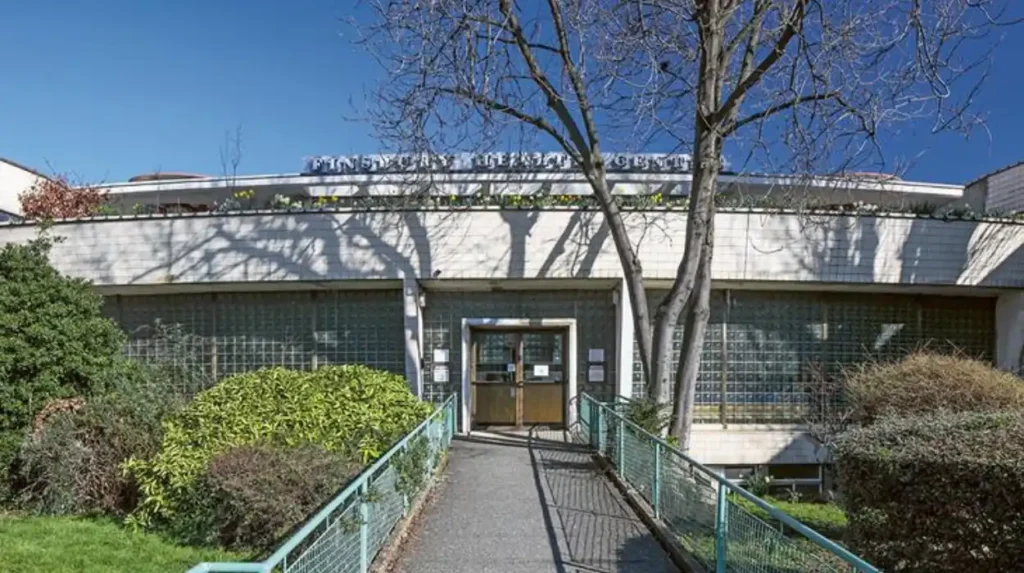
Finsbury Health Centre is among the district’s most important architectural landmarks.
Architect Berthold Lubetkin and the architectural group Tecton designed the building for the former Borough of Finsbury.
Construction took place between 1935 and 1938. The centre opened to patients in 1938.
Its modernist design introduced a different architectural approach to public healthcare. Modernism is an architectural movement that emphasises functional planning, modern materials, geometric forms and reduced decorative detailing.
The building features:
- A distinctive curved architectural composition.
- Reinforced concrete construction.
- Large areas of glazing.
- Carefully organised internal spaces.
- An H-shaped overall plan.
The centre received Grade I listed status on 29 September 1972. Grade I is the highest category of listed-building protection in England.
Its historical significance extends beyond architecture. The centre represented a public health initiative designed to improve access to medical services in a community affected by poverty and overcrowded housing.
In September 2024, NHS Property Services reported the completion of the first phase of restoration work. The announced restoration investment totalled £1.5 million.
This project demonstrates the continuing importance of preserving Finsbury’s modern architectural heritage.
What Makes Ironmonger Row Baths a Historic Landmark?
Ironmonger Row Baths represents an important chapter in the development of public health and recreation.
Finsbury Borough Council commissioned the building to provide bathing and washing facilities for local residents.
The first phase opened in 1931. A further extension in 1938 introduced a swimming pool, children’s pool and Turkish baths.
The building was designed by Alfred William Stephens Cross and Kenneth Mervyn Baskerville Cross.
Its Grade II listing was awarded in November 2006.
Ironmonger Row Baths addressed a significant social problem. A 1928 survey of the former Borough of Finsbury found that only 4% of homes had baths.
Public bathing facilities therefore provided an essential service for residents who lacked adequate washing facilities at home.
The building subsequently underwent refurbishment and reopened in 2012. Its historic Turkish baths received further refurbishment following a fire in 2022, with the renovated spa reopening on 5 January 2024.
Today, the building combines its historic identity with swimming, fitness and wellbeing facilities.
How Do Finsbury’s Residential Buildings Reflect Its Social History?
Finsbury’s residential architecture reflects the transition from an expanding industrial district into a densely populated urban neighbourhood.
Georgian buildings, Victorian terraces and twentieth-century housing developments represent different stages of residential growth.
Older streets reflect traditional urban development, with narrow frontages, brick construction and buildings positioned close to pavements.
Later housing developments introduced larger residential blocks and planned communal spaces.
The district’s architecture also demonstrates how public authorities responded to overcrowding and poor housing conditions.
This history makes Finsbury particularly relevant to visitors interested in London’s social architecture rather than only its major royal or commercial landmarks.
How Did Finsbury Become an Important Centre for Public Housing and Social Reform?
Finsbury became an important centre for public housing and social reform because its former borough faced serious problems involving overcrowding, poverty and inadequate healthcare. Twentieth-century council initiatives introduced improved housing, public bathing facilities and community-focused medical services.
The former Metropolitan Borough of Finsbury experienced considerable social challenges during the early twentieth century.
Many residents lived in overcrowded accommodation with limited access to private bathrooms, fresh air and suitable healthcare.
Historical figures demonstrate the scale of these problems.
A historical account published by Friends of Islington Museum records that Finsbury’s population fell from 101,463 in 1901 to 57,833 in 1938.
This represented a decline of approximately 43%.
Despite the population reduction, 12,187 residents still lived in overcrowded homes during the mid-1930s.
These conditions influenced local government priorities.
What Was the Former Metropolitan Borough of Finsbury?
The Metropolitan Borough of Finsbury was established in November 1900 under the London Government framework introduced by the Local Government Act 1899.
It brought together several historic administrative areas, including Clerkenwell and St Luke.
The borough operated as an independent local authority until 1965.
On 1 April 1965, the former Metropolitan Boroughs of Finsbury and Islington merged to create the present London Borough of Islington.
This administrative change explains why Finsbury retains a separate historical identity despite being part of a larger modern borough.
Islington Archives preserves important records from the former borough, including council minutes, rate books, photographs and local government publications.
How Did Public Housing Change Finsbury?
Public housing became an important part of Finsbury’s twentieth-century development.
Local authorities introduced housing programmes to address overcrowding and improve residential conditions.
Post-war rebuilding introduced new architectural approaches, including purpose-built flats and larger residential developments.
One important example is Bevin Court.
Designed by Berthold Lubetkin, Bevin Court was constructed after the Second World War on the site of Holford Square, which had suffered bomb damage during the Blitz.
The development illustrates the relationship between post-war reconstruction, modernist architecture and public housing.
These developments also changed the physical structure of the neighbourhood. Traditional street patterns were supplemented by residential blocks, communal areas and planned pedestrian spaces.
Why Does Finsbury’s Social History Matter Today?
Finsbury’s social history explains why several of its most important landmarks were designed around everyday public needs.
Its health centre addressed access to medical services. Ironmonger Row Baths addressed domestic sanitation and recreation. Public housing developments addressed overcrowding and residential quality.
These projects demonstrate how urban architecture can respond directly to social conditions.
They also provide historical context for contemporary discussions about housing affordability, public healthcare, accessible leisure facilities and the quality of urban living.
What Green Spaces and Public Areas Can Visitors Explore in Finsbury?
Finsbury offers historic green spaces and landscaped public areas that provide recreation, relaxation and heritage experiences. Bunhill Fields and nearby Finsbury Square are important examples, combining accessible outdoor environments with historical monuments and connections to London’s urban development.
Green spaces contribute to Finsbury’s character by providing outdoor environments within a densely developed part of London.
The neighbourhood’s historic open spaces also demonstrate how land use has changed over several centuries.
What Can Visitors Discover at Bunhill Fields?
Bunhill Fields is both a historic burial ground and a public garden.
Visitors can explore its memorials, historic gravestones, planted areas and walking routes. Its association with prominent religious and literary figures gives the site considerable educational value.
The burial ground also has ecological importance. Its vegetation and established trees provide habitat within an urban environment.
The City of London Corporation maintains the site and provides public access.
Its location near Old Street and Moorgate makes it convenient for visitors exploring Finsbury and neighbouring districts.
What Is the Connection Between Finsbury and Finsbury Square?
Finsbury Square is a landscaped public square near the historic Finsbury district and the City of London.
Its location demonstrates the relationship between Finsbury’s historic recreational landscape and the expansion of London’s commercial centre.
The square provides landscaped surroundings, seating and pedestrian space between nearby office buildings and streets.
Its historic environment also forms part of the wider Bunhill Fields and Finsbury Square conservation area.
Visitors interested in urban history can explore the square alongside Bunhill Fields and the surrounding architectural landmarks.
How Do Conservation Areas Protect Finsbury’s Character?
Conservation areas help protect neighbourhoods with special architectural or historical significance.
Islington Council identifies conservation areas as places where historic buildings, street layouts, materials, landscaping and other environmental characteristics contribute to local identity.
The Bunhill Fields and Finsbury Square conservation area was designated on 21 April 1987 and subsequently amended in December 2002.
Conservation designation introduces additional planning controls to protect important characteristics.
These controls cover certain demolition works, alterations and tree management activities.
The purpose is to ensure that new development respects the established architectural and environmental character of the area.
What Cultural and Recreational Activities Make Finsbury Attractive to Visitors?
Finsbury offers cultural, educational and recreational activities connected with its historic buildings, public facilities and neighbouring creative districts. Visitors can explore literary heritage, attend musical events, use leisure facilities and discover the area’s connections with London’s wider cultural scene.
Finsbury’s cultural identity is closely connected with its historical institutions and modern public facilities.
Its attractions serve different interests, including architecture, music, literature, fitness and local history.
Can Visitors Experience Music and Cultural Events in Finsbury?
LSO St Luke’s provides an important cultural connection within the neighbourhood.
The former church now operates as a venue associated with the London Symphony Orchestra.
Its LSO Discovery programme supports music education, concerts and activities for local organisations and schools.
The building demonstrates how historic architecture can support contemporary cultural activities.
Visitors interested in classical music can investigate the venue’s published performance programme and educational events.
What Leisure Facilities Are Available Around Finsbury?
Ironmonger Row Baths remains an important recreational destination.
Its facilities connect the district’s history of public bathing with contemporary leisure activities.
The building provides swimming, fitness and spa facilities.
The surrounding area also offers access to walking routes, public gardens and nearby cultural venues.
For residents and visitors, these facilities provide opportunities to combine sightseeing with physical activity.
How Does Finsbury Connect with London’s Creative Neighbourhoods?
Finsbury benefits from its proximity to several established creative and cultural districts.
Clerkenwell has historical associations with printing, design and manufacturing. Old Street and Shoreditch are recognised for technology businesses, creative companies and independent commercial spaces.
These neighbouring areas create opportunities for visitors to explore different aspects of London’s cultural economy.
A visitor can explore Bunhill Fields in the morning, discover Clerkenwell’s historic streets and continue towards Old Street’s contemporary commercial environment.
This geographical relationship strengthens Finsbury’s position as a useful destination for cultural and architectural exploration.
How Does Finsbury’s Location Benefit Residents, Tourists and Business Travellers?
Finsbury benefits from its position between Islington, Clerkenwell and the City of London. Its proximity to Underground stations, commercial districts, cultural attractions and residential neighbourhoods makes it accessible for tourists, local residents, students and business travellers.
Location is one of Finsbury’s most important contemporary characteristics.
The district provides access to central London without losing its connection with Islington’s residential and historical environment.
Which Transport Connections Serve Finsbury?
Old Street is one of the principal transport connections for the neighbourhood.
Old Street Underground Station serves the Northern line and provides National Rail services.
Moorgate and Barbican stations also provide access to nearby parts of the district.
Transport connections support journeys towards:
- The City of London, including Bank and Liverpool Street.
- King’s Cross and St Pancras International.
- Camden and other northern London destinations.
- Shoreditch and the wider East London area.
- Central London commercial and cultural districts.
Bus routes along City Road, Old Street and Goswell Road provide additional connections.
Visitors should check Transport for London’s journey planner for current services, disruptions and accessible travel information.
Why Is Finsbury Convenient for Business Travellers?
Finsbury’s location makes it relevant to people travelling to London’s commercial districts.
The City of London is within convenient reach, while Clerkenwell and Old Street provide access to professional services, technology businesses and creative companies.
Business travellers benefit from the area’s combination of transport connections, accommodation options, restaurants and local amenities.
The neighbourhood also provides access to quieter public spaces, including Bunhill Fields, for breaks between professional commitments.
Is Finsbury Suitable for Digital Nomads and Remote Workers?
Finsbury’s surrounding commercial districts provide a range of environments for remote workers.
Old Street and Clerkenwell contain independent cafés, restaurants and work-friendly businesses. The wider area also has access to shared offices and professional workspaces.
Digital nomads can benefit from the district’s transport connections and proximity to central London.
However, visitors should check individual businesses for Wi-Fi availability, laptop policies, charging facilities and seating arrangements.
Finsbury is also suitable for combining working hours with local sightseeing. Historic buildings, public gardens and cultural venues provide activities outside professional commitments.
What Makes Finsbury Different from Other Neighbourhoods in Islington?
Finsbury differs from other Islington neighbourhoods through its combination of historic religious landmarks, early recreational landscapes, modernist public architecture and social reform projects. Its identity reflects both its former independent borough status and its continuing connection with central London.
Islington contains several distinctive neighbourhoods, each with different architectural and historical characteristics.
Finsbury’s identity is particularly connected with its south-eastern location and its historical development as an independent metropolitan borough.
How Does Finsbury Compare with Clerkenwell?
Clerkenwell and Finsbury share important historical connections.
Clerkenwell is particularly associated with medieval religious institutions, industrial workshops, printing and the creative industries.
Finsbury has a stronger historical association with Finsbury Fields, Bunhill Fields, St Luke’s and twentieth-century social reform.
Their geographical proximity means that visitors can explore both districts within the same walking itinerary.
The distinction is useful when understanding local history because the areas developed through overlapping but different historical experiences.
How Is Finsbury Different from Angel and Highbury?
Angel is widely recognised for Upper Street, independent businesses, restaurants and its commercial activity.
Highbury is associated with residential streets, green spaces and Arsenal Football Club.
Finsbury has a more concentrated collection of landmarks connected with religious dissent, public healthcare, modernist architecture and the former Metropolitan Borough of Finsbury.
These characteristics give it a different historical and architectural profile within the wider borough.
Why Does Finsbury Retain a Distinct Local Identity?
Finsbury’s identity comes from its long historical development and its former administrative independence.
Although the Metropolitan Borough of Finsbury ceased to exist in 1965, its name remains visible in local landmarks, historical records and neighbourhood descriptions.
The former borough’s records are preserved through Islington Archives and local history collections.
These records include census material, local authority documents, photographs and historical publications.
The continued presence of these resources helps residents, researchers and visitors understand the district’s development.
Explore More Area Guide
What Is Clerkenwell Known For in Islington, London?
What Makes Highbury a Distinctive North London Neighbourhood?
How Can Visitors Explore Finsbury’s Main Historical Attractions?
Visitors can explore Finsbury through a walking route connecting Bunhill Fields, Finsbury Square, Wesley’s Chapel, St Luke’s and Ironmonger Row Baths. This approach introduces the area’s religious, architectural and social history while keeping the journey within a manageable geographical area.
Which Places Should Visitors Include in a Finsbury Walking Route?
The following locations provide a useful introduction to the neighbourhood:
- Bunhill Fields: Explore the historic burial ground and memorials associated with influential writers and religious figures.
- Finsbury Square: Discover a landscaped public space near the City of London.
- Wesley’s Chapel: Learn about John Wesley and the historical development of Methodism.
- St Luke’s: Examine the architecture of the former church and its present cultural role.
- Ironmonger Row Baths: Discover the history of public bathing and municipal recreation.
- Finsbury Health Centre: Explore an important example of twentieth-century modernist public architecture from the exterior.
Visitors should check opening arrangements before travelling. Some historic buildings operate as active religious, cultural or healthcare facilities rather than unrestricted tourist attractions.
When Is the Best Time to Explore Finsbury?
Finsbury can be explored throughout the year.
Spring and summer provide longer daylight hours for walking between historical landmarks and enjoying public gardens.
Autumn offers opportunities to explore the area’s architecture and historic streets in cooler conditions.
Winter visits remain practical because several cultural and leisure attractions operate indoors.
Weekday visits provide opportunities to observe the neighbourhood’s commercial activity. Weekends can offer a different atmosphere around public spaces and leisure destinations.
Visitors should check individual attraction schedules, public transport information and seasonal opening arrangements before setting out.
What Is the Future Significance of Finsbury within Islington?
Finsbury’s future significance rests on protecting its historic environment while supporting housing, public services, commercial activity and sustainable urban development. Its listed buildings, conservation areas and accessible public spaces remain important assets for the wider Islington community.
Finsbury’s development continues to reflect the relationship between historical preservation and changing urban requirements.
Its central location creates pressure for new housing, commercial premises and infrastructure improvements.
At the same time, its architectural heritage requires careful management.
How Does Heritage Protection Influence Future Development?
Listed-building protection and conservation-area designation provide important planning safeguards.
Historic England maintains the National Heritage List for England, which records buildings and sites with special architectural or historical significance.
Finsbury Health Centre and Ironmonger Row Baths demonstrate the importance of maintaining historic public buildings.
Their restoration and continued use show how heritage protection can support contemporary services.
New developments must also consider the established character of surrounding streets and buildings.
This balance is important because poorly designed development can damage the architectural qualities that make historic neighbourhoods distinctive.
Why Will Finsbury Remain Relevant to London’s Urban Development?
Finsbury occupies a strategically important position between central London and established residential districts.
Its historic landmarks attract cultural and architectural interest. Its transport connections support employment and business activity. Its public facilities contribute to everyday residential life.
The neighbourhood also provides an example of how social infrastructure shaped London’s development.
Its former health centre, public baths and housing initiatives demonstrate the relationship between urban planning and community wellbeing.
Future regeneration therefore involves more than constructing new buildings. It also requires maintaining public access, protecting historic architecture and supporting the needs of residents.
Finsbury’s continued relevance depends on preserving this combination of heritage, community infrastructure and urban accessibility.
Where is Finsbury located in London?
Finsbury is a historic neighbourhood in south-east Islington, North London. It is close to Clerkenwell, Old Street, Bunhill and the City of London.