

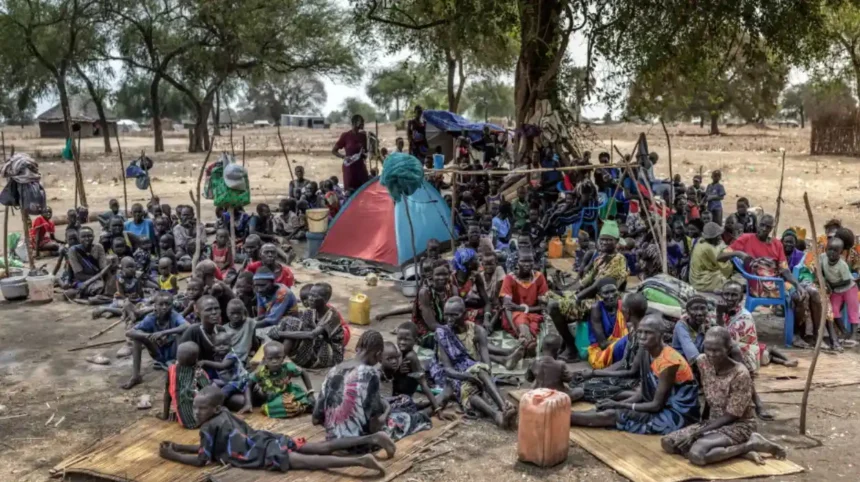
Since gaining independence in 2011, South Sudan has experienced recurring civil wars, subnational clashes, and severe humanitarian crises. This year, renewed fighting in Jonglei and Upper Nile has displaced hundreds of thousands more people, adding to the more than two million already internally displaced. More than two million also remain displaced outside of South Sudan.
When the South Sudanese civil war began on December 15, 2013, it quickly sparked largescale and cross border displacement, exacerbating food insecurity in a country with a domestic production deficit. Today, South Sudan has become a textbook for us to reflect on the dangers in rushing into statehood against a history marked by debilitating circumstances. And to reflect also about the effects displacement has on the social, economic, and political life of displaced South Sudanese beyond its borders.
The economy of information in conflict-affected zones runs high on readers’ appetite for violent content. There is no point denying it, despite conflict researchers’ long familiarity with the ethics behind displaying images of violence. In my line of work, I do not take pictures of people and places that might strip away the story from its author, in other words, the people who tell me stories about their experiences living in dangerous circumstances. But I am not ignorant of the fact that I too, use people’s narratives to publish a work that carries my name. During my longterm attachment to Sudan and South Sudan, I waited in the long line of books and articles that came out about the region at an ever higher speed. My research centres the experiences of hundreds of South Sudanese with South Sudan’s recurring conflicts and displacement, with the State-making processes that have for the past hundred years or so, paved the way for the country’s secession from the north. In ‘South Sudanese Displacement and State-making: The previous war was better than this one’, we learn that the militarisation and modernisation of the Sudanese warfare is imprinted in the minds of citizens who have known no other reality than moving from one conflict to the other, and from one displacement context to the other. Mobility is destabilising, and it is also a way of life.
The powerful practice of mobility – forced, voluntary or negotiated – that influences Statemaking in South Sudan weaves people’s experiences with the cross-border political economy of mobility. As the scaffold to the living experiences of my interlocutors and interviewees in the borderland region, the economy of movement absorbs the displacement context into the informal markets that sustain households across the region. In the borderlands between South Sudan and Uganda, where I spent six continuous months conducting qualitative field research, the displaced South Sudanese cross back and forth in a series of cross-border movement patterns that not all constitute ‘legal’ under International refugee Law: once in Uganda to seek protection in one of 13 refugee settlements, the displaced are not meant to cross back into South Sudan. People who do so, told me they do not think of themselves as ‘refugees’, since they have crossed back and forth these borders for centuries, and do not like being labelled ‘refugees’. Being formally registered as such also impedes them from crossing back into their country, so many I have interviewed prefer not to register. Because of this, they also do not receive the food ration or cash allowance.
This brings into the picture the strength of the informal cross-border economy that has sustained thousands of families across generations in this region. The hardening of African borders and the securitisation of the borderland have only added to the complex mix of strategies people adopt to shuttle things and people across internal and external borders. A Uganda police officer once admitted that it is impossible to deny passage to people, since ‘we are the same’. He meant that people have sought refuge and support on each other’s territories for so long, it would come to no good if the movement of people would be flatly denied.
The dynamic borderland governance which regulates mobility, accrue profits to authorities turning a blind eye to ‘illegal’ cross-border movements, and in doing so, demonstrate how “practical norms” override legal systems. A common social logic explained by travellers and authorities guarding the borderlands, attributes the payment of bribes through a shared understanding that people’s financial struggles explain a moral economy, where what outsiders may call corruption, is framed as mutual aid rather than exploitation. Paying smaller fees several times along one’s journey, as it was often the case for most people who spoke about it, is better than paying formal fees to officials whom one does not have a relationship with. Displaced South Sudanese in and around the South Sudan – Ugandan borderland remain sceptical about gambling with fees and taxes which might not produce the desired outcome of passage, and certainly does not guarantee security along the transport routes, once national borders are crossed.
Once more, South Sudan’s continuum of violence, displacement and attempt at building a modern State proves that people and their relationship with one another is at the centre of everything conditioning people’s lives. Amidst all the chaos, and large cutbacks by major donors, particularly the United States and the UK it is hardly surprising that famine is returning, along with an outbreak of cholera that has already cost thousands of lives. According to the International Rescue Committee, 10 million people require humanitarian assistance, 10% of the population, yet according to the UN OCHA Financial Tracking Service, the 2026 South Sudan Humanitarian Needs and Response Plan is 40.8% funded. Attacks on humanitarian organisations have been significant, with Médecins Sans Frontières pulling out of large parts of Central Equatoria following a series of abductions. Meanwhile, President Salva Kiir insists the country’s first presidential elections consistently delayed since 2011 – will materialise. Yet, he has once again postponed it, moving polling from December to February amid concerns about insecurity, funding shortages and the country’s readiness to vote.