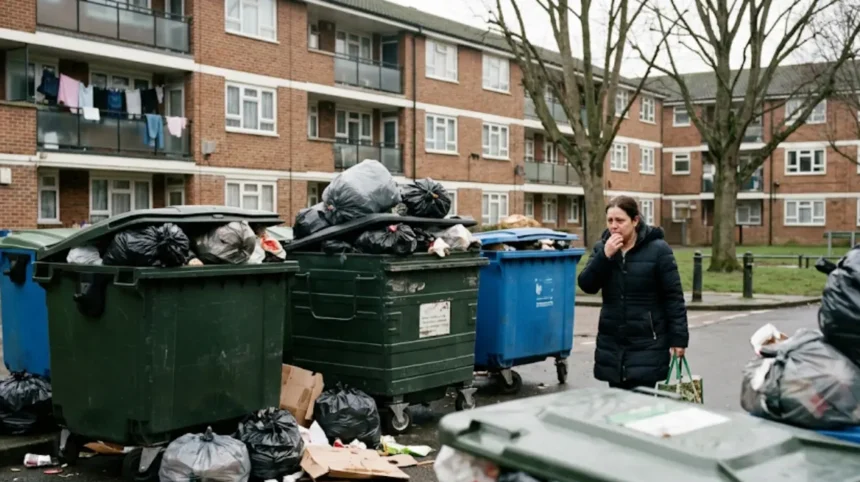
Overflowing communal bins in Enfield estates should be reported through Enfield Council’s rubbish and recycling service, using the council’s online reporting route or the contact details shown on the relevant estate or housing page. The problem should be described as a communal-bin issue, not as a missed individual household collection, because shared estate bins and door-to-door collections follow different service processes.
- What counts as an overflowing communal bin?
- Why does Enfield use communal bins on estates?
- How do you report it in Enfield?
- What details should the report include?
- Is overflowing waste the same as fly-tipping?
- What happens after you report it?
- What should residents do while waiting?
- What if the bin is full every week?
- Who is responsible for estate bins?
- Why does overflow matter for public health?
- How do councils classify a bin complaint?
- What evidence helps the council act faster?
- What can residents do to prevent overflow?
- Why is this issue important in Enfield now?
- What is the practical reporting sequence?
- How does this affect tenants and leaseholders?
- Why accurate wording matters
- What should a strong local report say?
- Why does this matter for estate cleanliness?
- What should readers remember?
What counts as an overflowing communal bin?
An overflowing communal bin is a shared bin on an estate that is full, blocked, or unable to close properly because waste has built up around it. Shared bins serve several homes, so the issue affects multiple households and communal access, not one property alone.
Communal bins appear in flats, housing estates, bin stores, and shared waste areas. They differ from a standard kerbside bin because several residents use the same container. The practical test is simple: if the bin is full and waste is being left beside it, the condition is a communal waste problem.
Why does Enfield use communal bins on estates?
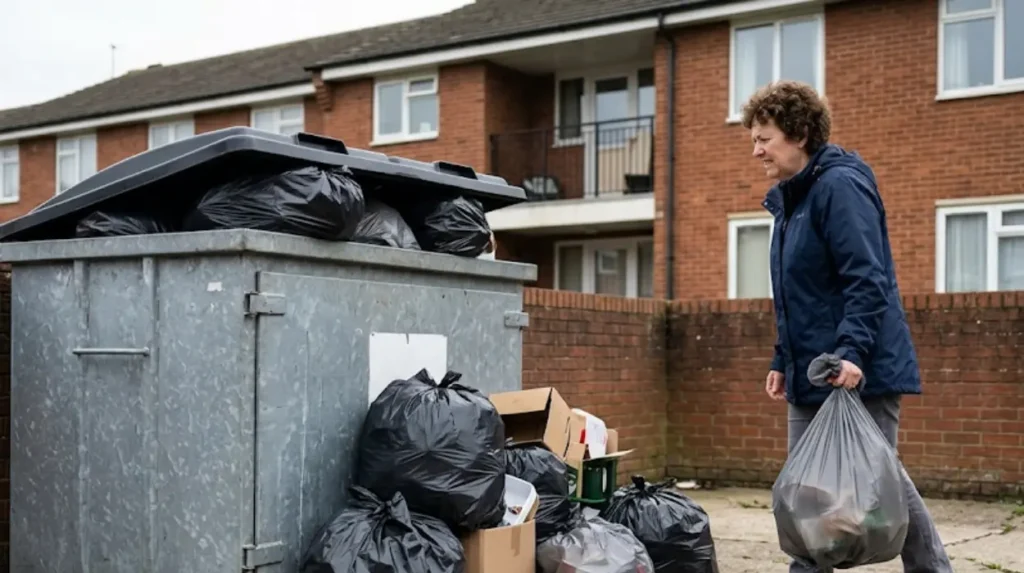
Communal bins exist because many estates use shared waste storage instead of individual wheelie bins at every home. This arrangement suits blocks of flats, maisonettes, and estate developments where access, collection routes, and storage space shape the waste system.
Shared waste systems are part of local housing management and environmental services. They reduce the need for repeated door-to-door collections in dense housing areas, but they also depend on regular lifting, enough bin capacity, and resident cooperation. Where demand rises faster than collections, overflow appears quickly.e
How do you report it in Enfield?
Report the overflowing communal bin to Enfield Council through the rubbish and recycling service and include the exact estate location, bin store, block name, and a photo if possible. Clear location details help the council identify the correct collection point and separate the issue from general litter or fly-tipping.
The strongest report includes the estate name, block number, nearest landmark, whether the waste is inside the bin or left beside it, and how long the problem has lasted. If the bin serves a housing block, report it as a communal estate issue rather than a missed domestic collection. That distinction matters because councils triage waste complaints by service type.
What details should the report include?
A strong report includes the exact location, the type of bin, the extent of overflow, and evidence such as a dated photo. This reduces delays and gives the council a usable record for dispatching a collection crew or escalating the matter to housing management.
The most useful details are the estate name, street, block, bin store door, what material is overflowing, and whether access is blocked. If the bin area is shared by several homes, say so directly. If bags are piled beside the bin, note that separately because councils often treat waste beside bins as a different enforcement or clearance issue.
Is overflowing waste the same as fly-tipping?
No. Overflowing waste and fly-tipping are related but not identical. Overflowing communal bins involve waste that cannot fit into the shared container, while fly-tipping means rubbish deliberately dumped outside normal disposal routes.
This distinction matters because councils route the two issues differently. A mattress, sofa, or dumped black bags beside communal bins can be classed as fly-tipping, while a full bin store with no capacity is a collections problem. The same site can contain both issues at once, and the report should mention both if they appear together.
What happens after you report it?
After a report, Enfield Council checks the location, confirms the collection point, and arranges action through waste services or estate management. The response depends on whether the problem is a missed uplift, a capacity issue, access obstruction, or a wider estate waste-management fault.
In practice, the council may send a crew to empty the bin, inspect the site for access problems, or refer the matter to housing teams if the bin store sits within a managed estate. If contamination or blocked access caused the overflow, the council can ask residents to correct the problem before the next round of collection.
What should residents do while waiting?
Residents should keep waste inside the bin area, avoid leaving bags on the ground, and use another approved communal bin if one is available nearby. Leaving rubbish beside the bin creates extra mess, attracts pests, and increases the chance that the site is treated as a fly-tipping incident.
If the nearest communal bin is full, the cleanest short-term step is to place waste in a different authorised bin or hold it until the next collection, where local rules allow that approach. Public guidance in other UK councils uses the same principle: do not leave bags beside a full communal bin, because that creates a separate waste problem.
What if the bin is full every week?
A bin that overflows every week points to a capacity, frequency, or access problem rather than a one-off missed collection. Repeated overflow means the estate system is not matching resident demand, and the issue needs escalation through housing or waste management.
Common causes include too few bins for the number of homes, missed uplift times, contamination that stops safe collection, narrow access routes, or residents placing waste outside the bin because lids are already closed. Repeated reports help establish a pattern, which matters when the estate needs extra bins, more frequent collections, or redesign of the bin store.
Who is responsible for estate bins?
Responsibility depends on the estate and the housing arrangement. In council-managed housing, waste problems inside the estate often involve both the waste service and the housing landlord, especially where the bin store sits within a managed block.
If the issue is on a council estate, the council can act as both landlord and waste authority. If the site belongs to another housing provider or managing agent, the landlord may need to clear access, maintain the bin store, or increase bin capacity. Residents should report the problem through the correct route so the case reaches the team that controls the site.
Why does overflow matter for public health?
Overflowing communal bins create hygiene risks, pest problems, and blocked access in shared housing areas. Waste left in bin stores can attract rats, gulls, foxes, insects, and odors, and it can make shared paths harder to use safely.
Local reporting on Enfield has repeatedly linked large waste build-ups with smell, nuisance, and resident frustration. Those impacts matter because communal housing has concentrated foot traffic and limited space, so a blocked bin store affects many people at once. The issue becomes more serious during hot weather, when decomposition and odor rise quickly.
How do councils classify a bin complaint?
Councils usually classify bin complaints by service type, location, and fault. The main categories are missed collection, full communal bin, blocked access, contaminated recycling, and fly-tipping beside the bin area.
That classification determines the response. A missed collection goes to waste operations. A blocked bin store may involve housing or estates staff. Fly-tipping often triggers environmental enforcement or removal teams. Accurate classification speeds up action and prevents the complaint from sitting in the wrong queue.
What evidence helps the council act faster?
Photos, dates, time stamps, and repeat reports help the council verify the scale and frequency of the overflow. Good evidence shows whether the problem is one full bin, a bin store blocked by waste, or a long-running collection failure.
The best evidence is a clear image of the full bin and the surrounding area, taken from a safe distance. Add the date, the time, and the precise estate location. If the same issue returns each week, keep a brief record. Pattern evidence helps show whether the site needs more capacity or a service review.
Explore More Help & Resources
Why does Enfield Council miss rubbish collections frequently?
What to do if bins are not collected in Enfield?
What can residents do to prevent overflow?
Residents can reduce overflow by using the bin correctly, flattening cardboard, closing lids fully, and avoiding side waste. Shared-bin estates work best when waste goes inside the container and bulky items go through the proper collection route.
Recycling guidance from Enfield stresses proper separation and correct presentation of waste, because rejected or contaminated loads can disrupt collection. On communal estates, the same principle applies even more strongly: bulky bags, loose cardboard, and side waste quickly fill shared containers and create overflow.
Why is this issue important in Enfield now?
Overflowing communal bins remain important because higher-density housing needs reliable waste capacity and regular service control. When collections do not match estate use, shared areas deteriorate quickly and resident complaints increase.
Enfield has seen continued public attention on bin collection and waste pressure, including petitions and local reporting on rubbish accumulation. That context shows that communal waste is not a minor nuisance issue. It is a recurring service and housing-management problem that affects cleanliness, confidence in local services, and the liveability of estate areas.
What is the practical reporting sequence?
The practical sequence is identify the exact communal bin, document the overflow, submit the report through the council route, and follow up if the problem returns. That process gives the complaint a clear location, a service category, and a record for escalation.
Start with the estate name and block. Confirm that the issue is communal and not an individual household bin. Add a photo and mention whether the waste is inside the bin or outside it. If the overflow continues after collection, report it again so the council can see the pattern and inspect the site for capacity or access problems.
How does this affect tenants and leaseholders?
Tenants and leaseholders are affected because shared waste systems are part of estate living, not only council operations. Poor bin management lowers amenity, creates odors, and can affect the cleanliness of entrances, paths, and bin stores.
For tenants, the issue usually goes through the landlord or council estate team as well as waste services. For leaseholders, the managing agent or housing provider can also have duties around bin store maintenance and access. Reporting through the correct route matters because it places responsibility on the team that controls the shared area.
Why accurate wording matters
Accurate wording gets the complaint routed correctly. Saying “overflowing communal bin on the estate” sends a stronger signal than “rubbish problem,” because the first phrase identifies the object, location, and service failure.
Use direct terms such as “communal bin,” “bin store,” “shared estate waste area,” “overflowing,” “side waste,” and “blocked access.” Those terms match how councils organize waste reports and help the issue move to the right team faster.
What should a strong local report say?
A strong report says where the bin is, what is overflowing, how long it has been full, and whether waste is left beside it. That gives the council enough detail to verify the issue and choose the right response.
A clear example is: “Overflowing communal bin at [estate name], [block number]. Waste is piled beside the bin store entrance. The bin has been full since [date]. Please arrange collection and inspect capacity.” That style works because it is specific, factual, and easy to route.
Why does this matter for estate cleanliness?
Clean estate waste systems support healthier shared spaces and better day-to-day living. Overflowing bins damage that standard by spreading litter, smell, and vermin risk into shared walkways and entrances.
A well-managed communal bin site reduces conflict between neighbours, lowers cleanup costs, and keeps service issues visible before they spread. On North London estates, where many homes share compact service areas, that makes regular reporting an important part of everyday housing management.

What should readers remember?
The correct action is to report overflowing communal bins as a shared estate waste problem, not as a normal household bin issue. Enfield residents should give the council the exact location, note any side waste, and treat repeated overflow as a service fault that needs escalation.
Clear reporting, accurate wording, and prompt follow-up give the best chance of a faster response. On estates, small delays become visible fast, so the most effective approach is factual reporting with location detail and evidence.
What should I do if a communal bin is overflowing on my Enfield estate?
Report it to Enfield Council as an overflowing communal bin rather than a missed household bin collection. Include the estate name, block number, exact bin location, and, if possible, a recent photo showing the overflow.