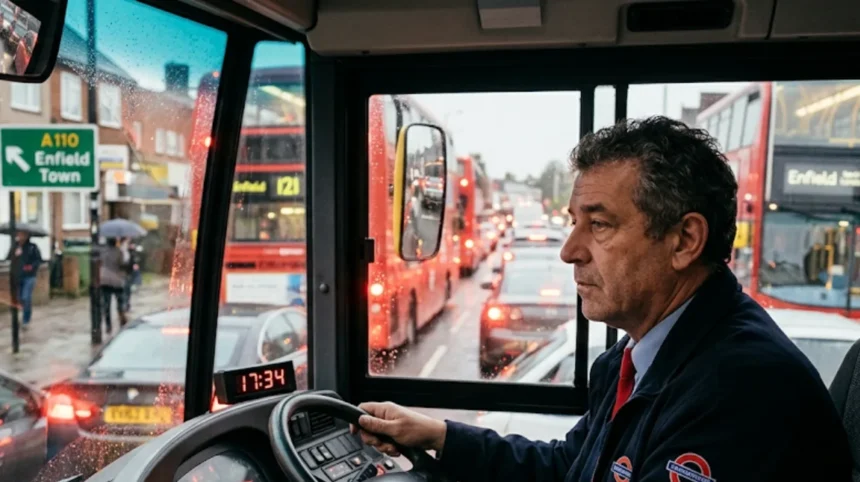
Enfield bus services are frequently delayed because several structural and operational issues stack on top of each other rather than a single cause. These include how the network is designed, how roads operate, how operators perform, staffing issues, and wider transport policies across North London.
- What is Enfield’s bus network and how is it managed?
- How reliable are Enfield bus routes and what patterns are visible?
- How does traffic congestion contribute to bus delays in Enfield?
- How do roadworks and street changes affect bus punctuality?
- How do changes in bus operators and contracts cause disruption?
- How do driver shortages and strikes impact Enfield bus services?
- How does timetable design and excess waiting time lead to delays?
- How does digital information and system resilience affect perceived delays?
- What real‑world examples illustrate combined causes of Enfield delays?
- How do frequent delays affect Enfield residents and local businesses?
- What measures are used to improve Enfield bus reliability?
- Why does understanding Enfield bus delays matter for the future?
What is Enfield’s bus network and how is it managed?
Enfield’s bus network is part of the London Buses system, planned and controlled by Transport for London, but day‑to‑day services are run by private operators under contract. TfL sets routes, timetables and performance targets, while operators supply drivers, buses and depots and are paid based on reliability and mileage.
Enfield is an outer London borough in North London with a mix of radial and orbital bus routes linking local centres such as Enfield Town, Edmonton Green, Southgate, Ponders End and Brimsdown. These routes connect to other boroughs and to rail services and hospitals. Transport for London defines the network, specifies frequencies, sets fares and monitors reliability through formal performance indicators.
Private bus companies operate Enfield routes under fixed‑term contracts. They provide drivers, vehicles and operational management and are accountable to TfL for punctuality and the proportion of scheduled distance actually run. Performance is tracked using measures such as excess waiting time on high‑frequency routes, on‑time performance on lower‑frequency routes and the percentage of scheduled kilometres that are delivered, often called “lost mileage” when they are not.
How reliable are Enfield bus routes and what patterns are visible?
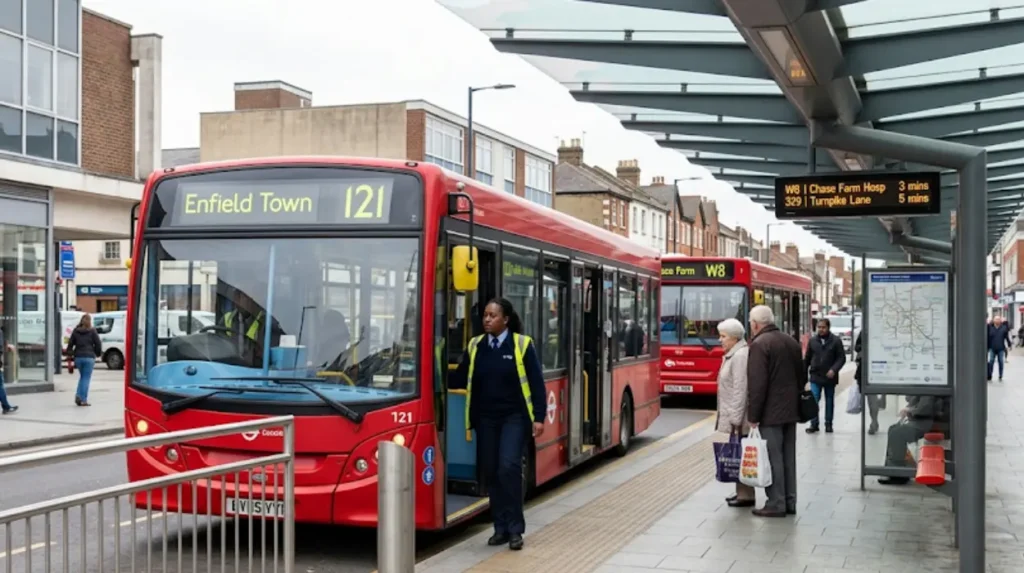
Enfield includes some of London’s least reliable bus routes, with high levels of missing services and long average waiting times. On certain routes a significant share of scheduled journeys does not operate, and passengers routinely wait longer than advertised, indicating persistent problems rather than isolated incidents.
Performance reports and local monitoring show that some Enfield routes consistently underperform against London‑wide benchmarks for reliability. On specific high‑frequency routes, average waiting times remain well above what the timetable suggests. Passengers experience long gaps between buses followed by clusters of vehicles arriving together, a pattern known as bunching.
Some individual routes stand out for missed journeys and irregular service. On one hospital‑link route, roughly one in five scheduled buses does not operate. On another corridor, serving both Enfield and neighbouring boroughs, passengers encounter the longest average waiting times recorded for a high‑frequency London route. Lower‑frequency routes, which might run every 30 minutes, also struggle to keep to time, with only around four in five buses arriving as scheduled.
How does traffic congestion contribute to bus delays in Enfield?
Traffic congestion on main roads such as the A10, A406 and key local corridors increases journey times and makes it difficult for buses to keep to timetable. Collisions, signal failures and local gridlock cause sudden shocks that delay several buses at once and create gaps and bunching along routes.
Enfield’s road network carries heavy general traffic, including private cars and freight, on strategic routes and busy local corridors. Buses share most of this road space rather than running in fully segregated lanes. During peak periods or when traffic levels rise because of events or seasonal activity, buses are slowed by the same queues that affect other vehicles.
When accidents block roads, or when signals fail at major junctions, buses are forced to divert or queue, creating immediate and sometimes severe delays. A collision at a key radial road, combined with a signal fault, can produce complete closures in both directions, forcing multiple routes to divert and lengthening their journey times. These incidents not only delay the buses directly involved but also disrupt the entire sequence of departures further along the line, increasing waiting times for passengers across the route.
How do roadworks and street changes affect bus punctuality?
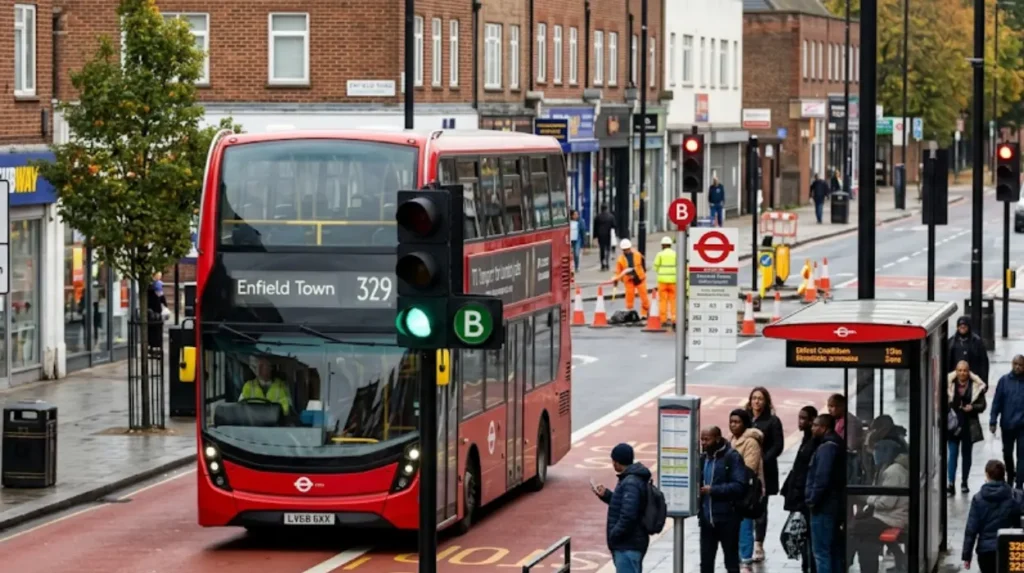
Planned and emergency roadworks, plus changes to street layouts, reduce road capacity and create diversions that slow Enfield buses. Experimental schemes such as low traffic neighbourhoods and new filters can displace traffic onto main corridors that carry buses, increasing congestion and variability in journey times.
Maintenance and construction works are regular features of Enfield’s streets. Resurfacing, utility repairs, junction upgrades and bridge works often require lane closures or temporary traffic management. When these works happen on roads used by multiple bus routes, buses are confined to narrower running lanes, join longer queues or follow diversion paths that add distance and delay.
Street‑level experiments, such as low‑traffic neighbourhood schemes and traffic filters designed to limit through‑traffic in residential areas, can change how drivers move through a district. While these schemes often aim to reduce congestion and improve air quality, they can also push more vehicles onto boundary roads that host key bus corridors. If boundary roads become more congested or junctions more complex, buses experience longer and less predictable journey times. Timetables may lag behind these changes, leaving insufficient running time to handle the new conditions until adjustments are made.
How do changes in bus operators and contracts cause disruption?
Sudden changes in bus operators and contractual disputes can trigger sharp drops in reliability in Enfield. When a company withdraws at short notice or a new operator takes over, bedding‑in problems often lead to missed trips, inconsistent timetables and confusion for passengers.
When TfL retenders routes or when contractual disputes escalate, an existing operator may lose a route or decide to withdraw. In one notable case affecting North London, a contractor ended several routes abruptly because of cost and payment disagreements. This decision affected multiple routes that run in or near Enfield, including key services linking town centres and hospitals.
Replacement operators often step in quickly, but they need to mobilise buses, recruit or reassign drivers and integrate with TfL’s information systems. During this transition period, there can be teething problems such as incorrect destination displays, mismatched schedules, missing real‑time data and inconsistent adherence to the published timetable. Even if the number of buses eventually returns to planned levels, the initial instability creates a noticeable phase of delays and cancellations for local users.
How do driver shortages and strikes impact Enfield bus services?
Driver shortages and industrial action remove buses from the road, causing cancellations and weaker frequencies on Enfield routes. When strikes occur, whole days of service can be lost on multiple routes, and knock‑on effects continue after the official strike period ends.
Bus services depend on an adequate supply of trained drivers willing and able to work shifts that cover early mornings, late evenings and weekends. Recruitment pressures, retention problems, sickness and working‑conditions concerns can all reduce the available driver pool. When staffing levels drop, operators may need to cancel particular trips or thin out service during off‑peak periods, leading to longer waits and higher lost mileage.
Industrial action triggered by disputes over pay or working conditions has affected several routes serving Enfield. During strike days, many routes operate with severely reduced frequencies or no service at all. Where some buses do run, they are often crowded and subject to longer boarding times, adding further delay. After a strike, it can take time to restore normal patterns, as vehicles and crews return to standard duties and residual queues and displaced passengers work through the system.
How does timetable design and excess waiting time lead to delays?
Timetable design and the amount of recovery time at termini strongly influence how reliably Enfield buses run. If schedules underestimate real‑world journey times, delays accumulate through the day, forcing some trips to be cut and creating excess waiting time for passengers.
High‑frequency routes are scheduled based on expected journey times and headways, often measured in minutes between buses rather than exact departure times. If the scheduled running time assumes less congestion than actually occurs, drivers are under constant pressure to catch up. Delays on early journeys cause late arrivals at termini, reducing the time available for rest, preparation and punctual departure for the next trip.
When delays become severe, controllers sometimes decide to terminate a bus short of its full route to get it back on time going the other way. This practice can restore the timetable on one end but leaves passengers in the skipped section without their expected bus, increasing their wait beyond what the schedule promises. On routes already struggling with missing services, these short‑run decisions exacerbate irregular service intervals and drive up excess waiting time.
Explore More Help & Resources
Why is fly-tipping common in Enfield backstreets?
How to report fly-tipping in Enfield residential areas?
How does digital information and system resilience affect perceived delays?
Real‑time information systems shape how passengers perceive and respond to bus delays in Enfield. When data feeds fail or updates lag, passengers experience uncertainty and frustration, and delays feel worse even when some services still run.
Passengers now rely heavily on countdown displays, journey planner apps and other digital tools to decide when to leave home, whether to walk to a different stop and which route to choose. When these systems operate accurately, they provide early warning of diversions, cancellations and abnormal gaps, enabling passengers to adjust their plans and reducing the perceived impact of disruption.
However, when back‑office systems are disrupted, for example by cyber incidents or technical faults, the accuracy of live information drops. Displays may show buses that never arrive or fail to show buses that are actually running. During periods when operator changes and timetable updates are not correctly reflected in data feeds, passengers experience conflicting information between signs, apps and on‑bus announcements. This erodes trust and makes it harder to distinguish between genuine cancellations and information errors, amplifying the impression of delay and unreliability.
What real‑world examples illustrate combined causes of Enfield delays?
Specific events in Enfield demonstrate that delays often result from multiple overlapping problems rather than a single issue. Collisions, signal failures, operator changes and system glitches interact to create sustained disruption across several routes at once.
A collision on a major road, combined with a simultaneous traffic signal failure, can close both directions of a key corridor used by several bus routes. In such a case, buses must follow diversions, often via narrower residential streets or longer alternative paths. The additional distance and congestion on unfamiliar routes cause substantial lateness, and drivers may reach their legal driving limits earlier than planned, resulting in further cancellations.
In another example, routes already known for high levels of missing services are affected by an operator withdrawing suddenly. New operators step in while a cyber incident slows the updating of timetable and vehicle data. At the same time, industrial disputes affect routes in neighbouring areas, pushing extra demand onto whichever Enfield services remain. Passengers on these corridors experience a prolonged period of irregular service, long waits and inconsistent information, even though different underlying causes are at work on different days.
How do frequent delays affect Enfield residents and local businesses?
Frequent bus delays in Enfield lengthen journey times, reduce access to employment and services, and undermine confidence in public transport. People without cars, including many low‑income households, are most affected because they have fewer alternatives when buses are unreliable.
Residents use buses to reach jobs, schools, colleges, hospitals and shopping centres. When buses run late or fail to appear, people face a higher risk of being late for work or appointments. To compensate, many leave home earlier than strictly necessary, sacrificing personal or family time just to hedge against delays. This makes everyday life more stressful and less predictable.
Local high streets and town centres also feel the impact. Shops, restaurants and other services rely on both customers and staff arriving on time. When bus reliability drops, some people choose to visit less frequently or switch to destinations that are better served. Employers may struggle with staff punctuality, especially for early shifts or late finishes when alternative transport choices are limited. Over time, these effects can weaken the economic vitality of bus‑dependent areas.
What measures are used to improve Enfield bus reliability?
Improvement efforts focus on timetable changes, stricter performance management, better bus priority on roads and careful monitoring of new street schemes. TfL and Enfield Council use reliability data to identify problem routes and adjust services and infrastructure over time.
Transport authorities review reliability metrics regularly to identify routes with high excess waiting time or high lost mileage. For these routes, they may increase scheduled running times, add recovery time at termini or adjust frequencies to match realistic operating conditions. In some cases, they can allocate additional vehicles or reassign resources between routes to strengthen service where demand and delays are highest.
On the infrastructure side, targeted bus priority measures can help: new or extended bus lanes, revised signal timings that give buses earlier or longer green phases, and restrictions on parking or loading at critical pinch points. When implementing low‑traffic neighbourhoods or other street changes, Enfield and its neighbours monitor bus journey times and reliability to spot unexpected negative effects. Schemes can then be modified, for example by adjusting filters, changing junction layouts or altering bus routings, to protect public transport performance.
Why does understanding Enfield bus delays matter for the future?
Understanding why Enfield bus services are frequently delayed supports better policy decisions, improves service planning and shapes realistic expectations for passengers. As London seeks to reduce car use and emissions, reliable buses in outer boroughs like Enfield remain central to a sustainable transport system.
Policy strategies for London emphasise shifting trips from cars to public transport, walking and cycling, especially in outer areas where car ownership is relatively common and distances are often suitable for bus or bike. Buses are the most flexible and widely available form of public transport in Enfield, so their reliability directly influences whether residents feel confident leaving the car at home.
By identifying the mix of congestion, infrastructure constraints, operator performance, staffing and digital information issues that drive delays, authorities can design more focused interventions. For passengers and local stakeholders, having clear, factual explanations supports constructive engagement with consultations and helps them use the system more effectively. As improvements are introduced, this understanding also provides a baseline to judge whether reliability is genuinely getting better over time.
Why are Enfield bus services frequently delayed?
Enfield bus services are frequently delayed because of a combination of traffic congestion, roadworks, operator performance issues, driver shortages, timetable pressures, and occasional incidents such as collisions or signal failures. These factors often overlap, creating longer waits and irregular services.