Key Points
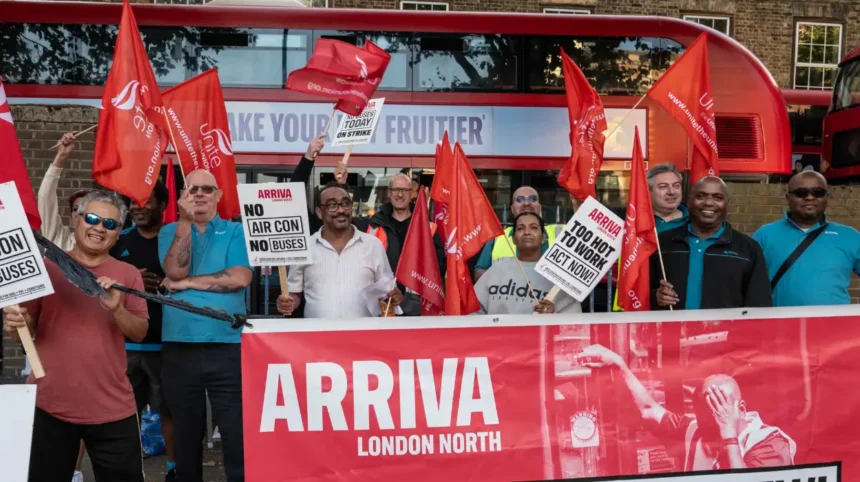
- More than 1,500 Arriva North London bus drivers have resumed strike action over high temperatures inside driver cabs.
- The latest strike began at 4am on Tuesday and is due to run until 4:30am on Friday, affecting more than 40 bus routes across North London and Essex.
- The strike was suspended briefly for negotiations, but Unite members rejected Arriva’s proposed deal, saying it did not adequately address working conditions during heatwaves.
- Drivers said cab temperatures have reached 40°C, and in some cases 45°C, during summer heatwaves, causing heatstroke, dehydration, severe fatigue and near-misses on the road.
- The dispute centres on Arriva’s use of standard air-cooling units, which drivers say reduce temperatures by only 2°C to 3°C. They are calling for full air-conditioning upgrades across the fleet.
- Arriva said five of its eight garages supported the deal and expressed disappointment over the strike, while maintaining that driver safety remains its top priority.
- Up to 10 more strike days are planned for September and October, which could cause further disruption during planned Piccadilly Line closures on the London Underground.
North London (North London News) August 27, 2026 – More than 1,500 bus drivers across North London and parts of Essex have resumed strike action after rejecting a proposed settlement from transport operator Arriva regarding unbearable working conditions during summer heatwaves. The four-day walkout began at 4:00 am on Tuesday and is set to run until 4:30 am on Friday, directly affecting more than 40 key bus routes across the capital. The industrial action follows a temporary suspension of strikes last week to allow union members to ballot on an agreement negotiated between Arriva North London and officials from the Unite union. However, drivers voted to turn down the offer, arguing that the company’s proposal did not offer a sufficiently fast or comprehensive solution to the dangers posed by extreme heat inside driver compartments.
- Key Points
- Why Have Arriva Bus Drivers Voted to Resume Industrial Action?
- What Have Union Leaders and Drivers Said Regarding the Dispute?
- How Has Arriva North London Responded to the Walkouts?
- What Is the Operational Scope of the Transport Disruption?
- Background of the Development
- Prediction: How This Development Can Affect London Commuters and Transport Workers
Why Have Arriva Bus Drivers Voted to Resume Industrial Action?
The decision to return to the picket line stems from deep-seated frustrations over temperature control inside bus cabs. Drivers involved in the dispute work out of eight key depots: Barking, Edmonton, Enfield, Grays, Palmers Green, Stamford Hill, Tottenham, and Wood Green. Members at three of these garages ultimately voted down the proposed deal, triggering the resumption of region-wide strikes.
As reported by Gwyn Topham of The Guardian, drivers have voiced severe concerns that proposals to overhaul ventilation across Arriva’s fleet of 730 buses would take far too long to implement, leaving staff exposed to extreme heat through upcoming summers. Staff have stated that existing air-cooling systems are fundamentally inadequate, frequently reducing ambient cab temperatures by a mere 2C to 3C. During recent summer heatwaves, temperatures inside driver compartments have reportedly soared to 40C, with some workers sharing photographs of thermometers registering up to 45C. These thermal conditions have led to reports of drivers suffering from heat exhaustion, dehydration, severe fatigue, and heatstroke, creating potential safety hazards for passengers and road users.
What Have Union Leaders and Drivers Said Regarding the Dispute?
Unite the Union has maintained firm backing for its members, insisting that Arriva must introduce immediate and meaningful safety interventions.
As reported by ITV News London, Unite General Secretary Sharon Graham stated that “London bus drivers do a vital job, but are putting themselves at risk due to these appalling conditions.” Graham added that
“Arriva can fully afford to make meaningful changes our members can accept. Until that happens, strike action will continue and our members at Arriva North London will continue to have the full backing of Unite.”
In separate comments provided to ITV News London, Graham noted that drivers were reaching a “crisis point” over cumulative pressures including severe heat, lack of adequate welfare facilities, fatigue, and workplace safety.
As reported by Tony Robson of the World Socialist Web Site, driver dissatisfaction was heightened by the nature of the previous ballot, with workers expressing frustration that strike action had been paused before they were granted an opportunity to scrutinise the fine print of Arriva’s offer. According to union sources cited by Robson, the rejected deal offered to install upgraded air-conditioning across the fleet prior to the summer of 2027, but lacked a firm, binding completion date. The ballot resulted in 587 members voting against the offer, overriding the 501 members who voted in favour.
How Has Arriva North London Responded to the Walkouts?
Arriva North London management expressed deep disappointment at the continuation of industrial action, pointing out that a majority of depots had initially supported the terms negotiated with union representatives.
As reported by The Guardian, a spokesperson for Arriva London stated:
“We are disappointed that this strike is going ahead when five out of eight of our north London garages have said they don’t want [a strike]. We have already reached agreement with Unite officials on every demand – and we continue to seek feedback from Unite to understand what concerns remain at the three garages that voted to strike.”
The spokesperson further added:
“The safety and wellbeing of our colleagues and customers will always be our highest priority and measures have been introduced this summer to help drivers cope with extreme heat, while we are also investing in air conditioning upgrades for driver cabs across our London fleet.”
As reported by Channel 4 News, Wasim Mohammed, Managing Director of Arriva London, noted that extreme weather patterns were “creating challenges across many sectors, including London’s bus network,” while reiterating that staff welfare remains the company’s “top priority”. Mohammed highlighted that additional welfare measures, such as enhanced check-ins and hydration support, had been deployed throughout the summer, calling on Unite to return to direct talks to prevent further operational disruption.
What Is the Operational Scope of the Transport Disruption?
The strike action impacts a vast section of the capital’s public transport infrastructure, with over 40 routes across North London and Essex seeing severe service reductions or total cancellations.
Transport for London (TfL) has confirmed that its Extreme Weather Taskforce—which includes representatives from transport operators and trade unions—is actively working to address the wider operational challenges posed by climate extremes. However, further disruption remains on the horizon. Unite has mandated up to ten additional strike days extending into September and October if a resolution is not reached. Transport analysts note that several of these planned walkouts are scheduled to coincide with major engineering closures on the London Underground Piccadilly Line, threatening compound transport bottlenecks across North London during the autumn commuting period.
Background of the Development
The dispute over bus cab temperatures in London is rooted in longer-term structural and environmental shifts across the capital’s public transport infrastructure. Over recent years, the United Kingdom has experienced increasingly frequent and severe summer heatwaves, pushing urban infrastructure past its historical design limits.
Historically, much of London’s bus fleet was designed without heavy-duty air conditioning units in driver cabs, relying instead on ambient air-cooling vents or forced-air circulation systems. While functional during moderate British summers, these systems have proven insufficient during extreme heat events, where large glass windshields act as heat traps, elevating internal compartment temperatures well above the ambient outdoor level.
Under the current privatised London bus model, Transport for London contracts out route operations to several private transport groups, including Arriva, Go-Ahead, Stagecoach, and Metroline. While TfL sets overall vehicle specifications for new fleet acquisitions, retrofitting existing vehicles requires substantial capital expenditure from individual private operators. Furthermore, UK workplace health and safety legislation does not currently enforce a legal maximum working temperature, leaving trade unions such as Unite and the TUC to campaign for explicit thermal caps (typically 30C) and mandatory climate-control standards across public transport contracts.
Prediction: How This Development Can Affect London Commuters and Transport Workers
The ongoing standoff between Arriva North London and its driving workforce is likely to trigger significant ripple effects across multiple stakeholder groups over the coming months.
Impact on Commuters and the Travelling Public
For North London residents, school pupils, and daily commuters, the immediate impact will be continued travel disruption, extended waiting times, and overcrowded alternative routes. If the dispute extends into September and October as planned, the overlap with scheduled Piccadilly Line closures will leave severe transport voids across major corridors such as Wood Green, Edmonton, and Tottenham. Commuters will face higher travel costs as they are forced onto overland rail or rideshare services, while local businesses may see reduced footfall due to outer-borough travel friction.
Impact on Bus Drivers and Transport Operators
For bus drivers, maintaining industrial pressure could potentially establish a critical benchmark for working conditions across the entire UK transport sector. A successful negotiation that secures expedited air-conditioning retrofits may prompt similar demands from workers across the remaining private bus operators in Greater London. Conversely, prolonged strikes without immediate structural fixes leave drivers facing ongoing physical strain during warm spells, alongside loss of earnings during strike days.
For Arriva and other franchised operators, the escalation of heat-related disputes poses commercial and reputational risks. Failure to resolve working conditions swift enough to satisfy safety standards could impact performance-related contract payouts from Transport for London, while accelerating the necessity for unbudgeted capital outlays on fleet-wide climate control retrofits.