Key Points
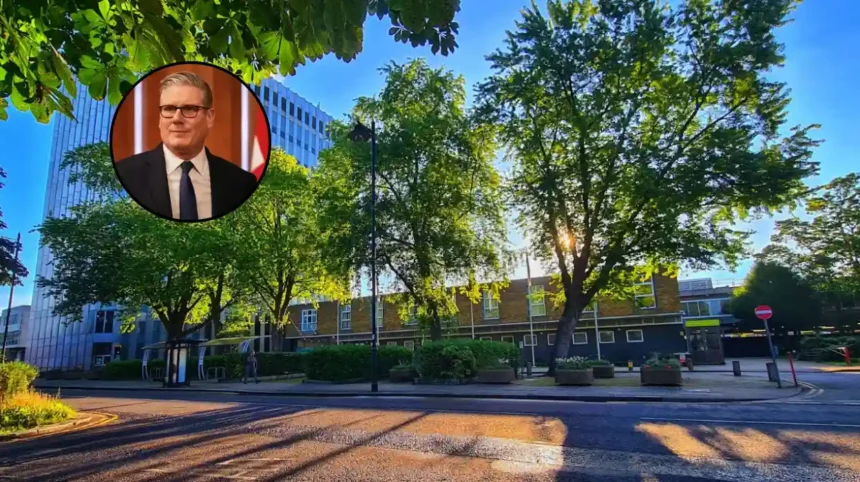
- Prime Minister Sir Keir Starmer has directly criticised Enfield Council’s new minority Conservative administration for formally withdrawing from the government’s 21,000-home new town development programme.
- The proposed new town spans across Crews Hill and Vicarage Farm, requiring the de-designation of hundreds of hectares of Green Belt land.
- Councillor Alessandro Georgiou, the newly elected Conservative leader of Enfield Council, issued a formal withdrawal letter to the Ministry of Housing, Communities and Local Government (MHCLG) immediately after taking office.
- 10 Downing Street explicitly named Enfield Council in a major statement targeting “the naysayers and the blockers” accused of halting economic and housing growth.
- The political standoff follows the May 2026 local elections, which ended 16 years of majority Labour control in the borough after 77% of voters backed parties pledging to protect the Green Belt.
Enfield (North London News) June 22, 2026 – Why has Prime Minister Sir Keir Starmer launched a direct, high-profile intervention against Enfield Council following the local authority’s decision to formally withdraw from the national new towns programme? In a significant escalation of the brewing conflict between central government and local leadership, 10 Downing Street has explicitly named and condemned the newly established minority Conservative administration in Enfield for blocking a proposed 21,000-home development project at Crews Hill and Vicarage Farm. The prime minister’s remarks came on Wednesday evening, just ahead of a scheduled summit with regional leaders, including the Mayor of London, Sir Sadiq Khan, designed to accelerate infrastructure delivery and override local planning barriers across the United Kingdom.
- Key Points
- How did the dispute between Downing Street and Enfield Council intensify?
- What led to the council’s sudden withdrawal from the new town scheme?
- Why is the central government targeting this specific location?
- How are community campaign groups responding to the layout?
- Background to the Development
- Future Predictions
How did the dispute between Downing Street and Enfield Council intensify?
As reported by James Cracknell of the Enfield Dispatch, the extraordinary public rebuke from the Prime Minister appears to signal a coordinated effort by central government and City Hall to potentially strip the local authority of its independent planning powers.
The friction centers entirely on the de-designation of hundreds of hectares of designated Metropolitan Green Belt land in the rural north-west of the borough. While the national administration regards the location as an essential hub for addressing acute housing shortages, the local council maintains that its withdrawal directly fulfills a democratic mandate from residents to safeguard local green spaces.
The prime minister’s statement drew a sharp battle line between national housebuilding goals and local government autonomy. Sir Keir Starmer stated:
“For too long, Britain has been held back by a system that says no, delaying projects, blocking growth and leaving communities behind. We’re turning that on its head by backing our mayors to get Britain building again, with spades in the ground and more jobs across the country. There will always be the naysayers and the blockers, but we cannot afford to give into them – because it will be the next generation that suffers.”
What led to the council’s sudden withdrawal from the new town scheme?
The local policy shift occurred immediately following the political re-alignment at the Enfield Civic Centre. As documented by James Cracknell and local democracy reporters, Councillor Alessandro Georgiou sent an official letter to Housing Minister Matthew Pennycook at the MHCLG declaring that the local authority would no longer support or participate in the infrastructure plan.
The move reversed the position of the outgoing Labour administration, which had actively championed the project as a critical remedy for the borough’s housing shortages.
According to the text of the letter published by the Enfield Dispatch, Councillor Georgiou emphasised that the borough itself acts as a major landowner within the designated area. Councillor Georgiou wrote:
“77% of the Enfield electorate voted for parties whose 2026 manifestos explicitly committed to opposing the proposed New Town and this decision directly reflects the democratic will of the residents we have been chosen to represent. In taking this step, it is important to note that the London Borough of Enfield is itself a major landowner within the designated New Town area. As the principal custodian of this land, our administration has resolved to use our strategic position and ownership rights to actively ensure that these vital natural assets are preserved, rather than being surrendered to unsustainable urban sprawl.”
Why is the central government targeting this specific location?
The Ministry of Housing, Communities and Local Government has defended the selection of Crews Hill, citing its proximity to existing transport networks.
In a formal press communication, government officials explicitly highlighted Enfield’s refusal to cooperate, pointing out that the proposed development sits within an area characterized by deep housing needs and is situated immediately adjacent to an under-used railway station. Furthermore, Transport for London (TfL) has voiced intentions to assume direct control over rail services at Crews Hill Station to support future density requirements.
A spokesperson for the MHCLG re-affirmed the administration’s broader intent, stating:
“Our landmark national new towns programme will restore the dream of homeownership for people across the country. We recently consulted with local people on the proposals and will respond in due course.”
How are community campaign groups responding to the layout?
The intervention from Downing Street has drawn mixed reactions from local advocacy bodies, who question the viability and timeline of mega-developments on protected land. Representing the campaign group Better Homes Enfield, Matt Burn voiced significant skepticism regarding whether the new town framework can address immediate crises.
As reported by James Cracknell, Matt Burn stated:
“We want the homes Enfield needs to be built quickly, and in sustainable locations. We object to the proposed new town because it will not deliver the homes Enfield needs at speed. It’s likely to take years before it even begins, and several decades to build out. It is not a solution to the current housing crisis. The council has already identified more than 700 viable brownfield sites in Enfield, that could help deliver tens of thousands of homes.”
The council’s leadership has similarly advocated for a alternative strategy. Councillor Georgiou clarified that the rejection of the Green Belt expansion does not equal an abandonment of growth targets. Councillor Georgiou stated:
“This does not mean stepping back from the challenge of delivering homes and jobs. We are committed to working with government to meet housing need, but in a way that protects our precious green spaces. Our focus will be on a brownfield-first approach. This means unlocking underused land, regenerating our town centres and delivering the high-quality family homes that local people need.”
Background to the Development
The political crisis in Enfield is the direct consequence of the local elections held on May 7, 2026, which fundamentally transformed the composition of the local authority.
For 16 years, Enfield Council was governed by a stable Labour majority that consistently aligned itself with the broader regional planning policies of City Hall and the Mayor of London.
Under the previous leadership of Ergin Erbil, the council actively cooperated with the central government’s initiative to identify substantial parcels of land capable of alleviating London’s structural housing deficit. In March 2026, the MHCLG formally shortlisted Crews Hill and Chase Park as one of seven nationwide locations designated for the new towns programme, designed to create large-scale communities with up to 50% affordable housing allocations.
However, the proposed de-designation of the Metropolitan Green Belt became the central fault line of the 2026 municipal election campaign.
The Enfield Conservatives, led by Alessandro Georgiou, constructed their platform on explicit promises to halt high-rise block developments, review local traffic schemes, and entirely block construction on the borough’s rural fringes.
When the ballots were counted, Labour lost its absolute majority, leaving the council under no overall control. The Conservatives emerged as the largest single party with 31 seats, falling exactly one seat short of an outright majority, while Labour secured 27 seats and the Green Party won 5 seats.
A minority Conservative administration was successfully formed on May 27, 2026, after the Green Party group chose to abstain during the critical leadership vote, effectively uniting the two opposition parties on their shared platform of absolute Green Belt preservation. The immediate withdrawal letter sent to Whitehall on May 28 was the first executive action taken by the new administration.
Future Predictions
This development is highly likely to accelerate a profound constitutional and legislative clash between central government executive powers and local democratic accountability, directly impacting residents, developers, and local voters across Greater London.
For the local electorate in Enfield, the immediate consequence will be a period of intense institutional uncertainty. Because the prime minister has explicitly backed regional mayors with
“the biggest devolution drive in a generation,”
the government is heavily predicted to bypass the local authority entirely.
This would likely involve statutory interventions where the Ministry of Housing or the Mayor of London uses call-in powers to strip Enfield Council of its planning determination rights, transferring the legal authority to approve the 21,000-home development directly to City Hall. Consequently, local residents who voted to protect the Green Belt may find their local representatives legally powerless to stop the modification of local zoning boundaries.
For the broader housing sector and younger generations seeking homeownership, the outcome of this specific dispute will establish a critical national precedent.
If Downing Street successfully forces the Crews Hill development through despite local council withdrawal, it will signal to private developers and municipal planners across the UK that green belt status will no longer serve as an absolute barrier to large-scale infrastructure under the current parliamentary term.
Conversely, if the minority Conservative administration successfully uses its position as a primary landowner to legally tie up the development in prolonged statutory litigation, the delivery of affordable housing units in North London will face severe delays, extending the timeline of the project by years or even decades.