
Learning is agonising and demanding experience. The process of learning is often unpleasant and boring before it becomes joyful. After many years of self-doubts, self-disappointments, confusions, and being lost in the wilderness of world of letters, words, and ideas, clarity comes only through uninterrupted learning marked by commitment, dedication, self-discipline and collaboration in a competition free environment. It is the duty of teachers as co-learners to transform difficulties in learning into a joyful journeying of learning, fun in reading, research, self-discovery, and discovery of the world around. It is the duty of schools, colleges, institutions of higher learning, and universities to create and facilitate conditions of joyful learning by providing a curriculum that is relevant to reflect on everyday realities of students and their life experiences. It is also the duty of institutions of learning to provide infrastructure—good classrooms, libraries, laboratories, sports, and accommodation facilities—to facilitate joyful learning that takes away the painful and difficult aspects of learning.
The idea of joyful learning and teaching is a collaboration between teachers and students, where most difficulties are solved to rejuvenate an egalitarian and democratic space that enables critical thinking to produce and reproduce knowledge in a safe environment where mistakes are not weaknesses but stepping stones of learning. If any of these conditions are not met, a toxic culture develops within the learning environment, putting learners—both teachers and students—under immense stress. These conditions are further exacerbated by structural inequalities and exploitative, feudal, patriarchal, and capitalist conditions based on class, gender, caste, race, sexuality, region, religion, and other forms of marginalisation in society, which reproduce themselves in classrooms and campuses. Instead of challenging and rejecting these reactionary ideas, curriculums, classrooms, and campuses reproduce them, threatening the very idea of knowledge, learning, and teaching for scientific consciousness.
This creates unequal conditions in which students and teachers from marginalised backgrounds suffer the most, while other students and teachers continue to uphold erroneous dominant narratives and knowledge traditions, reproducing conditions, processes, and institutions based on inequality and exploitation within classrooms, campuses, and beyond. The conditions of marginalisation breed different forms of alienation and alienating conditions that push students and teachers into depression and suicide is the net result of structural violence; a cocktail of overburden, marginalisation and alienation.
The rise of privatisation of education, the ranking of educational institutions, funding gaps, the location of institutions, the reactionary project of employability, measures of success in terms of money and high paying employment, and assessment criteria in terms of grades, marks, and scores—all take away the very foundation of joyful learning. Joyful learning should create a critical mind based on science, secularism, and reason, one that engages with learning as a continuous process of self-discovery, explores the world with ideas, and engages with the everyday essence and long-term emancipation of human beings from all forms of reactionary ideas and conditions of inequality and exploitation based on class, gender, caste, race, sexuality, and other forms of marginalisation. The marketisation and commodification of education further marginalise students and deepen alienation and alienating conditions, making students vulnerable in both the present and the future.
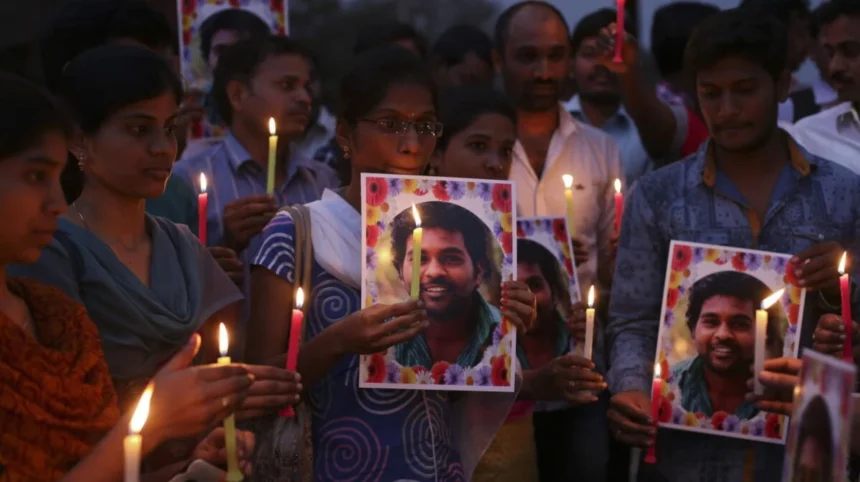
These insecure, marginalised, and exploitative conditions create a recipe in which students prefer to take their own lives rather than engage with such marginalised and alienating conditions. Therefore, student suicide in particular, and suicide in society in general, is not an isolated individual problem. Blaming individuals who die by suicide is itself a product of the institutions that create suicidal conditions. It is not an isolated event and cannot be resolved permanently through counselling and mental health support, which help only temporarily. Suicides in Indian educational institutions at all levels, from schools to universities, are becoming a very serious issue: young minds unnecessarily become body bags when they could have contributed immensely to the development of their families, society and the growth of India.
The National Crime Records Bureau (NCRB) report on Accidental Deaths & Suicides in India 2024 (published in 2026) reveals a pandemic of student suicide growing at an unprecedented scale. It reveals that suicide rates are higher among urban, educated, and male populations in India. The report also documents that students constitute 8.5% of all suicide deaths (14,778 victims in a year). This figure indicates that more than 40 students commit suicide every day in India. Who is responsible? Is there any accountability? The following graph presents the grim figures and the reasons behind each suicide case.
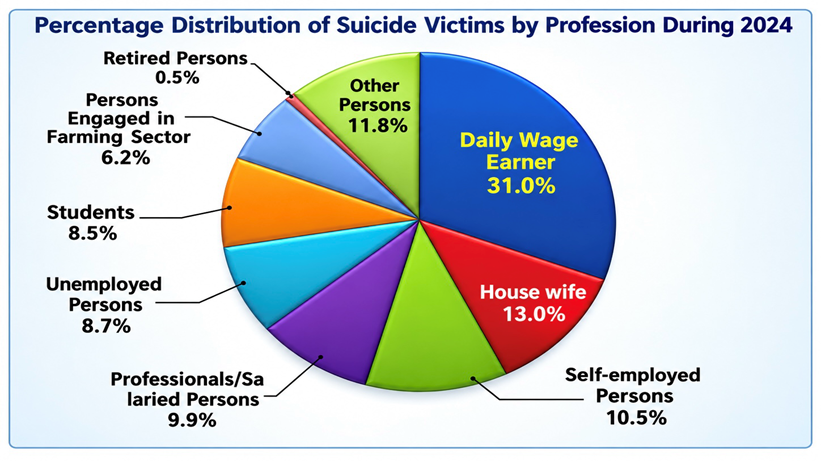
These figures reveal that economic distress, agrarian crisis, unemployment, poverty, patriarchy, and other social and emotional alienations cause suicidal deaths in general.
Why Do Indian Students Commit Suicide?
Popular writers such as Chetan Bhagat argue that reserved-category students from lower-caste backgrounds are unable to compete with “national-level, Olympiad-level mathematical geniuses” in the IITs because reserved-category students enter with lower thresholds; therefore, failure to compete drives lower-caste students in particular, and students in general, to commit suicide. Such sleazy casteist arguments have no empirical foundation. Unequal social, economic, and educational conditions breed unequal grounds for competition. And unequal outcomes There is no competition between privilege and marginalisation. Despite all forms of marginalisation and humiliation in everyday life, lower-caste students outperform their general-category peers once they gain only access to education and suitable learning conditions.
However, so-called liberals like Chetan Bhagat and many others peddle illiberal arguments to hide the feudal, caste-based discriminatory culture within the Brahminical social order—a culture based on hierarchy, inequality, and exploitation. This order breeds a performance-driven culture of competition based on grades, ranks, and scores, which are not necessarily markers of quality, creativity, or innovation. Yet young students are pushed into such a ruthless culture in the name of success, social status, and future career. Such an educational, social, and economic system, based on individualism, performance, and competition, breeds mental health issues and creates fertile ground for student suicides on educational campuses in general, and in elitist institutions such as the Indian Institutes of Technology (IITs), National Institutes of Technology (NITs), Indian Institutes of Management (IIMs), Indian Institutes of Information Technology (IIITs), state and central universities in India.
Mr. Chetan Bhagat and his ilk must know that the culture of competition destroys the conditions of learning and creates alienating pressure that leads to student suicide. These silent deaths are products of sanitised places of performance, competition, and the desire for high-paying careers based on assessment performance. The fairy tales of people like Mr. Chetan Bhagat, and their arguments breed suicide. Learning is about collaboration, not competition. People like Mr. Chetan Bhagat create non-existent meritocratic arguments for the illiberal escapism of the Brahminical ruling class and caste order with a liberal face. Such illiberal arguments from so-called liberals provide oxygen to reactionary, feudal, and marketised Brahminical social, economic, and educational orders, alongside crony capitalists in the education market. The teaching heavy curriculums only teach students to be successful in finding a job without creating critical consciousness about life beyond professional work. Therefore, 9.9% of salaried professionals also commit suicide in India.
So, alienation and alienating conditions shaped by feudal caste-, class-, and gender-based social, economic, and educational orders are centrally responsible for the death of young dreams: the students of India. Counselling and mental health support can provide temporary relief, but the permanent solution to ending suicide is to end all alienation and alienating conditions created and nourished by feudalism, patriarchy, and crony capitalism in India. There is no other illusion and liberally illiberal escapism to fix accountability for the death of students and destitution of their families in India. To end student suicides in India, we must end all conditions that breeds suicide in the country by nurturing a collaborative, cooperative, egalitarian, friendly and joyful learning environment to seek knowledge that emancipates.
The views expressed in this article are the author’s own and do not necessarily reflect (North London News) editorial policy.