
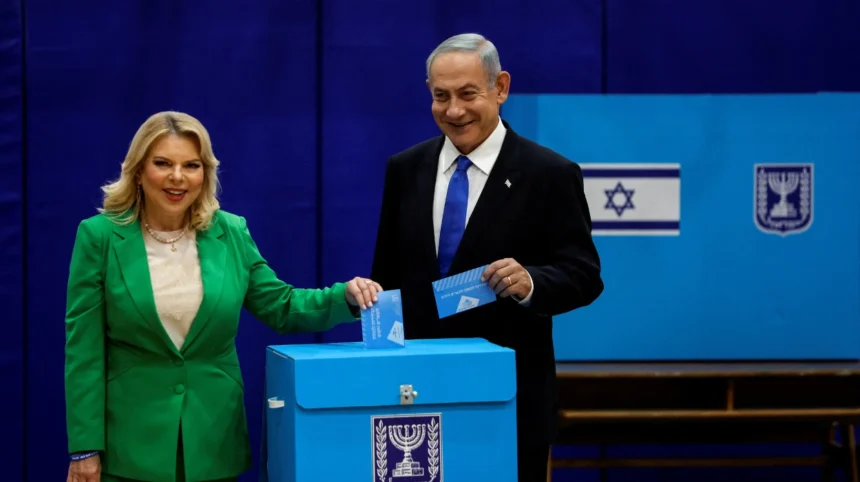
Netanyahu is desperate to win the October 27 election to the Israeli Knesset. He used the platform of the UN General Assembly with little success. At home, the backlash over reports that he was warned about a Hamas attack days before October 7, 2023, is too serious a matter to be brushed aside. According to a report by Haaretz, Netanyahu was informed about Hamas’s deadliest attack in Israel’s history, which resulted in the deaths of around 1,200 people and the abduction of more than 250 others to Gaza. This has now become a central election issue. Gadi Eisenkot, a leading challenger to Netanyahu, is reported to have said that Netanyahu led Israel blindly towards the October 7 failure and renewed his pledge to establish a state commission of inquiry if elected to power. More than three years after the attack, the Prime Minister has resisted demands from bereaved families and survivors for an independent commission of inquiry into the security and intelligence failures that enabled Hamas to conduct the operation. It has been alleged that Netanyahu and his associates promoted a narrative blaming security chiefs for failing to wake him during the night before the attack, despite intelligence inputs about an imminent Hamas offensive.
The Prime Minister’s Office dismissed the Haaretz report as an “absolute lie”, but his opponents seized the opportunity to place responsibility directly at his door. In a joint statement, opposition leaders Gadi Eisenkot, Naftali Bennett, Avigdor Lieberman and Yair Golan demanded an immediate and thorough investigation into what they described as Netanyahu’s failures and malfunctioning. They also demanded answers to a fundamental question:
“The Israeli public is entitled to know: what did Netanyahu know, when did he know, why didn’t he update the security establishment, and why didn’t he act to protect Israeli civilians?”
Naftali Bennett, the former Prime Minister, posted on X that the report was “true” and alleged that Netanyahu’s disregard of the warning amounted to “criminal negligence”. Yair Lapid, another former Prime Minister, said that he too had publicly warned of an attack before it happened, as had senior Israeli security officials and Egyptian officials.
“If Netanyahu had fulfilled his role, the massacre would have been prevented,” Lapid stated.
The Haaretz report was based on findings from an upcoming book, Kidnapped: 843 Days of Abandonment, by Israeli journalists Shlomi Eldar and Ruti Yuval. The book examines the events surrounding the hostages taken by Hamas and their captivity. Excerpts published by Haaretz revealed that the President of the United Arab Emirates, Mohammed bin Zayed Al Nahyan (MBZ), had allegedly called Netanyahu and personally warned him about an impending Hamas attack roughly ten days before the October 7 assault. The report further claimed that MBZ had warned Netanyahu that Yahya Sinwar, the Hamas leader, was planning major actions against Israel that could lead to bloodshed, destabilise the region and potentially jeopardise the Abraham Accords. According to the report, MBZ was taken aback by Netanyahu’s response. Netanyahu was reported to have said that any threat from Hamas might instead come from the West Bank and that Israel was prepared for any scenario.
Amid these allegations, Netanyahu’s unannounced visit to the UAE has created further suspicion about whether pressure was exerted on Mohammed bin Zayed to deny that any information about the Hamas attack had been shared before October 7, 2023. Emirati sources cited by Maariv described the pressure as very heavy, reportedly involving telephone calls, approaches through associates and international intermediaries.There has been no official confirmation that MBZ personally refused to meet Netanyahu. However, Maariv reported that the UAE had withdrawn from an earlier planned visit at the eleventh hour. A source quoted by Maariv at the time of the cancellation said that MBZ did not want to involve himself in Netanyahu’s election campaign and that relations between the two leaders had been troubled for some time.
Despite these developments, efforts by Israel to secure a meeting continued and eventually resulted in a meeting in Abu Dhabi on September 27, 2026. According to Reuters, Netanyahu met Mohammed bin Zayed during the visit, accompanied by senior Israeli security officials, including the Mossad chief, the National Security Adviser, senior officials from Shin Bet’s VIP protection unit, and senior officials from the Prime Minister’s Office. Haaretz, citing Emirati sources, reported that during the meeting Netanyahu requested that Mohammed bin Zayed deny the report concerning their alleged pre-October 7 telephone conversation. Such a denial would, in all likelihood, be politically significant for Netanyahu on the eve of the election. However, these reports have not been publicly confirmed by either Netanyahu’s office or the UAE.
Another major irritant for Netanyahu is the deepening rift with European allies over Israel’s West Bank settlement policies. Israel revoked the diplomatic status of Dutch envoys to the Palestinian Authority following new Dutch restrictions on imports from Israeli settlements, weeks after ordering the closure of the UK’s East Jerusalem consulate over similar trade restrictions. The Dutch measures followed coordinated action by 12 Western countries, including Britain and France, against goods originating from Israeli settlements. Whatever explanation Netanyahu may offer regarding the intelligence warnings and his recent meeting with MBZ, the opposition has seized the opportunity to renew its attacks on him. Gadi Eisenkot, one of the Prime Minister’s principal rivals in the upcoming election, has said that Netanyahu’s actions “leave no room for doubt: Netanyahu led, with blindness, arrogance and irresponsibility, the State of Israel to the greatest disaster in its history.”
The controversy over the election itself has also raised broader questions about the state of Israeli democracy. Israel’s Central Elections Committee has voted to ban an Arab party from contesting the upcoming elections. Among the most prominent parties affected is Ra’am, also known as the United Arab List, which currently has five members in the Knesset. The ban also applies to the Joint List, a coalition of three parties: Hadash, a left-wing Jewish-Arab party; Ta’al, an Arab nationalist party; and Balad, a Palestinian nationalist party. The alliance was primarily formed to prevent the fragmentation of the Arab vote and to ensure that the participating parties could clear Israel’s 3.25 percent electoral threshold.
All said and done, the crisis surrounding Netanyahu’s leadership, the October 7 intelligence failures, the treatment of Arab political parties and Israel’s growing confrontation with sections of its Western allies have exposed deep tensions within the country’s political system. The continuing support of the United States has also provided Netanyahu’s government with substantial diplomatic, political and military backing. The scale of American assistance to Israel remains significant, particularly in the context of the devastating consequences of the war in Gaza.
The election, therefore, is not merely a contest over Netanyahu’s political survival. It is also unfolding against the backdrop of the October 7 security failure, the continuing war in Gaza, the political representation of Arab citizens, Israel’s settlement policies and its increasingly contentious relationship with European allies. The political battle over Netanyahu’s future is consequently inseparable from a much larger struggle over the direction of Israeli democracy, the country’s relations with Palestine and the wider Middle East, and the role of American power in sustaining the existing political order shaped by Yankee imperialism and its collaboration with Zionist regime in Israel.
The views expressed in this article are the author’s own and do not necessarily reflect (North London News) editorial policy.