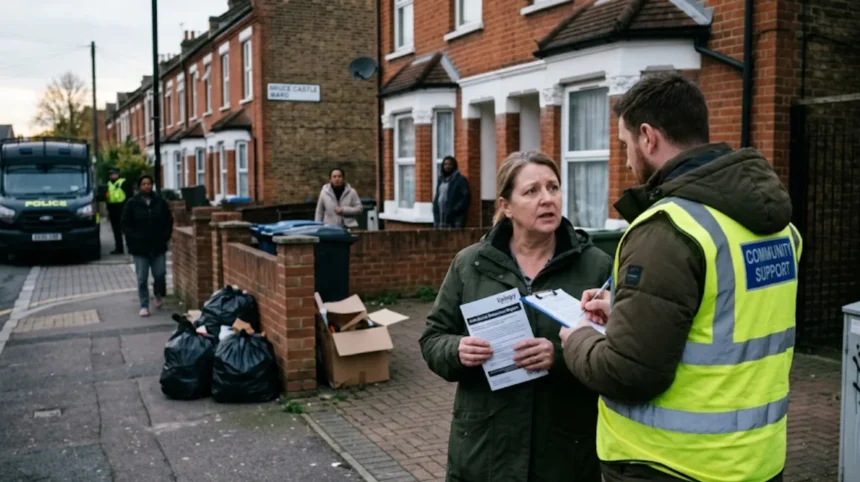
Anti-social behaviour is any activity that harms quality of life for residents, including noise nuisance, harassment, drug dealing, and vandalism. Councils define it broadly under the Anti-social Behaviour, Policing and Neighbourhoods Act 2014, covering harassment, alarm, distress, noise nuisance, and environmental damage.
- How do residents report anti-social behaviour to their local council?
- What response times should residents expect after submitting an ASB report?
- What actions do councils take after receiving an anti-social behaviour report?
- How successful are council ASB reports in stopping the behaviour?
- What evidence do residents need to provide for councils to act on ASB reports?
- Why do some council ASB reports fail to produce results?
- How do North London councils compare in ASB report effectiveness?
- What legal powers do councils have to enforce anti-social behaviour actions?
- What should residents do if their council ASB report fails?
- How effective is the overall anti-social behaviour reporting system in North London?
Anti-social behaviour (ASB) encompasses a wide range of disruptive activities affecting residential communities. The UK government defines ASB as conduct causing or likely to cause harassment, alarm, or distress to persons not of the same household. Councils in North London—including Haringey, Barnet, Camden, Enfield, Islington, and Waltham Forest—apply this definition consistently when processing reports.
Specific ASB types include noise nuisance from loud parties or music, verbal harassment and racial incidents, drug dealing and substance abuse on residential property, vandalism and property damage, aggressive neighbour behaviour, boundary and land disputes, youth nuisance in public spaces, and persistent rubbish dumping. Each council maintains its own ASB policy detailing acceptable thresholds for intervention.
Haringey recorded 10,220 ASB incidents between February 2023 and January 2024, making it the 12th highest ASB volume in London. The borough’s ASB rate per 1,000 population is 34.6, which sits 18% above the London average of 29.3. Bruce Castle ward in Haringey experiences the highest volume (1,083 incidents) and rate (74.9 per 1,000 population) of ASB among all borough wards.
How do residents report anti-social behaviour to their local council?
Residents report ASB through council websites, online forms, phone lines, or email. Most North London councils provide dedicated ASB reporting portals with structured questionnaires capturing incident details, dates, times, and evidence. Reports require specific information including perpetrator details, behaviour description, and impact on the reporter.
North London councils operate multiple reporting channels. Haringey Council offers an online ASB reporting form on its website, requiring residents to log in or create an account. Barnet Council provides a dedicated “Report anti-social behaviour” page with a structured form. Camden Council accepts reports via its website, by phone at 020 7974 4444, or through the 101 non-emergency police number for serious cases.
Enfield Council operates an online reporting system with mandatory fields capturing incident type, frequency, and location. Islington Council requires residents to complete a detailed ASB diary tracking each incident over time before formal action begins. Waltham Forest Council accepts reports through its website portal and telephone line at 020 8496 3000.
The reporting process follows consistent steps across councils. First, residents submit initial details through the online form or phone call. Second, councils assess the seriousness using risk-rating systems categorising cases as high, medium, or low risk. Third, councils assign the case to an ASB officer or housing officer for investigation. Fourth, officers contact the reporter within specified timescales to request evidence and additional information.
Evidence requirements include ASB diaries documenting incident dates, times, and descriptions, audio or video recordings of noise nuisance, witness statements from other affected residents, photos of vandalism or property damage, and police crime reference numbers if the incident was reported to law enforcement. Councils reject reports lacking sufficient evidence or those describing single isolated incidents without patterns.

What response times should residents expect after submitting an ASB report?
Councils respond based on risk ratings: high-risk cases within 24 hours to one working day, medium-risk cases in 2-5 working days, and low-risk cases in 5-10 working days. Lambeth Council explicitly states these timescales, and most North London councils follow similar frameworks.
Risk assessment determines response priority. High-risk cases include threats of physical assault, serious intimidation or harassment, racial incidents, domestic violence, serious property damage, and insecure or abandoned premises. Councils must respond within 24 hours to one working day for these cases.
Medium-risk cases cover allegations of criminal activity, drug dealing, verbal abuse, youth nuisance, and noise nuisance. Response times for medium-risk cases range from 2-5 working days. Low-risk cases include minor neighbour disputes, minor tenancy breaches, and boundary or land issues, with response times of 5-10 working days.
Haringey Council typically responds within 5 working days for standard ASB reports, though high-risk cases receive faster attention. Barnet Council aims to respond within 3 working days for initial contact. Camden Council responds within 5 working days for most cases, with high-risk incidents prioritised within 24 hours.
The complaint handling process has maximum duration limits. According to the Local Government Ombudsman’s Complaint Handling Code, the longest a complaint should take is 16 weeks. Councils must provide updates during this period, including notifications when responses will take longer than expected. Council policies should explicitly state response times, and officers must follow these published standards.
Actual response times vary significantly based on council resources and case volume. Haringey’s high ASB volume (10,220 incidents annually) potentially delays responses compared to boroughs with lower incident rates. Councils experiencing staffing shortages or budget constraints often exceed published timescales.
What actions do councils take after receiving an anti-social behaviour report?
Councils assess case seriousness, then select interventions including warning letters, mediation, community safety orders, tenancy enforcement, or eviction. High-risk cases may involve police collaboration and immediate protective measures. Low-risk cases often receive mediation or informal resolution first.
Upon receiving an ASB report, councils follow a structured action framework. First, officers assess the incident’s seriousness using risk-rating criteria. Second, they determine the perpetrator’s housing status—whether they are council tenants, private renters, or homeowners. Third, they select appropriate interventions based on behaviour type, frequency, and severity. Fourth, they implement the chosen action and monitor outcomes.
For council tenants, councils enforce tenancy agreement breaches. Anti-social behaviour constitutes a serious breach of the tenancy agreement all tenants sign when moving into council homes. Enforcement options include issuing formal warning letters, applying for ASB injunctions through courts, pursuing community safety orders, initiating tenancy reviews, and seeking eviction through court proceedings.
Warning letters serve as the first formal step for low-to-medium risk cases. These letters detail the behaviour, state it violates the tenancy agreement, and require cessation within specified timeframes. Repeated warnings lead to escalated enforcement. Tenancy reviews evaluate whether tenants should retain their homes, considering ASB history and impact on neighbours.
ASB injunctions are court orders prohibiting specific behaviours. Councils apply for injunctions under the Anti-social Behaviour, Policing and Neighbourhoods Act 2014. Injunctions can include exclusion zones preventing perpetrators from entering certain areas, prohibited contact orders, and mandatory behaviour modification requirements. Breaching injunctions results in arrest and potential imprisonment.
Community Safety Orders (formerly Crime Prevention Orders) require perpetrators to attend counselling, education programmes, or behaviour modification courses. These orders apply to individuals aged 10+ and target root causes of ASB. Private renters face different enforcement—their landlord holds responsibility, and councils contact landlords to address tenant behaviour.
Mediation serves as an alternative intervention for neighbour disputes. Councils partner with mediation services facilitating face-to-face discussions between affected parties. Mediation agreements document agreed behaviour changes and conflict resolution strategies. Success rates vary, with some disputes resolving permanently and others requiring escalated enforcement.
How successful are council ASB reports in stopping the behaviour?
Council ASB reports achieve varying success depending on case severity and evidence quality. GOV.UK’s 2025 Resident Panel report shows 85% of panel members experienced ASB, with 48% experiencing it within the past 12 months, indicating persistent reporting gaps. Local Government Ombudsman upheld 51 of 69 investigations (74%), finding council fault in most cases.
Success measurement requires examining multiple metrics: behaviour cessation rates, enforcement completion rates, resident satisfaction scores, and repeat incident frequencies. The Local Government Ombudsman investigation data reveals significant council performance issues. Of 69 ASB complaints investigated, the Ombudsman upheld 51 cases (74%), meaning councils were found faulty in how they acted.
This 74% fault rate indicates systemic problems in ASB handling. Common faults include delayed responses exceeding published timescales, inadequate evidence collection, failure to follow published policies, insufficient communication with reporters, and premature case closures without behaviour verification. These failures reduce overall effectiveness.
The 2025 GOV.UK Social Housing Resident Panel report provides resident experience data. Eighty-five percent of panel members experienced ASB, demonstrating widespread prevalence across social housing. Of those experiencing ASB, almost half (48%) reported incidents within the past 12 months, indicating recent and ongoing problems.
High ASB prevalence alongside significant council fault rates suggests reporting effectiveness remains limited. Residents experiencing repeated ASB despite reporting indicate councils struggle achieving permanent behaviour cessation. Success depends heavily on perpetrator cooperation, evidence quality, and council resource availability.
Haringey’s seasonal ASB patterns show higher levels during summer months. This pattern affects reporting effectiveness, as increased summer incidents may overwhelm council capacity, reducing response quality and success rates during peak periods.
What evidence do residents need to provide for councils to act on ASB reports?
Councils require ASB diaries documenting incident dates, times, and descriptions, plus supporting evidence like recordings, photos, witness statements, and police references. Single isolated incidents without patterns rarely trigger action. Evidence must demonstrate persistent behaviour causing harassment, alarm, or distress.
Evidence quality determines whether councils pursue cases. Minimum requirements include completed ASB diaries covering at least 2-4 weeks of incidents, detailed descriptions of each event specifying behaviour type and impact, and documentation showing behaviour persistence rather than isolated occurrences.
ASB diaries serve as primary evidence. Residents record each incident with date, time, duration, behaviour description, witnesses present, and impact on their wellbeing. Diaries must be consistent, detailed, and contemporaneous (written immediately after incidents). Councils rejectdiaries with gaps, inconsistent entries, or retrospective additions.
Audio and video recordings strengthen noise nuisance cases. Recordings capture actual noise levels, duration, and timing. Residents should timestamp recordings and store them securely. Councils accept recordings from smartphones, security cameras, or noise monitoring devices. Videos showing vandalism or property damage provide visual proof of behaviour.
Witness statements from other affected residents establish behaviour impact beyond the reporter. Statements should include witness names, contact details, observation dates, and descriptions of witnessed behaviour. Multiple witnesses increase credibility. Anonymous statements receive less weight but may support other evidence.
Photographic evidence documents physical damage, rubbish dumping, or property vandalism. Photos should include timestamps, clear angles showing damage extent, and context demonstrating location. Before-and-after photos show damage progression.
Police crime reference numbers link ASB to criminal activity. When ASB involves criminal behaviour (assault, drug dealing, vandalism), residents should report to police via 101 or 999 for emergencies. Police references validate criminal elements and enable council-police collaboration.
Councils reject evidence lacking specificity, including vague descriptions (“they were loud”), undated documentation, single isolated incidents without patterns, or evidence suggesting minor breaches below intervention thresholds. Reports describing boundary disputes without harassment elements or occasional noise without persistence typically receive no action.
Why do some council ASB reports fail to produce results?
Reports fail due to insufficient evidence, inability to identify perpetrators, lack of council resources, perpetrator non-cooperation, or behaviour below intervention thresholds. The 74% Local Government Ombudsman fault rate shows councils frequently mishandle cases through delayed responses, inadequate investigation, or premature closures.
Insufficient evidence represents the primary failure cause. Councils cannot act without documented patterns proving persistent harassment, alarm, or distress. Single incidents, vague descriptions, or undated reports lack the specificity required for enforcement. Reports failing ASB diary requirements or lacking supporting recordings/photos receive no action.
Perpetrator identification problems prevent enforcement. Councils need perpetrator names, addresses, and housing status to proceed. Anonymous reports or those lacking perpetrator details cannot trigger tenancy enforcement, injunctions, or eviction proceedings. Residents unable to identify who causes behaviour face inactive cases.
Council resource constraints delay or prevent action. High ASB volumes strain officer capacity. Haringey’s 10,220 annual incidents (18% above London average) likely cause response delays reducing effectiveness. Staffing shortages, budget cuts, and competing priorities reduce available officers for ASB investigation.
Perpettor non-cooperation undermines interventions. Warning letters, mediation, and community safety orders require perpetrator participation. Refusing mediation, ignoring warnings, or continuing behaviour despite injunctions necessitates escalated enforcement. Eviction proceedings take months, allowing continued ASB during litigation.
Behaviour below intervention thresholds fails action. Councils set minimum thresholds for harassment, noise levels, or frequency. Minor disputes, occasional noise, or boundary issues without harassment elements fall below thresholds. Councils advise these cases require private resolution rather than enforcement.
Legal barriers limit enforcement options. Injunctions require court approval, subject to judicial discretion. Eviction requires proving tenancy breach through court proceedings, with judges considering proportionality. Some perpetrators exploit legal protections, delaying enforcement indefinitely.
Communication failures between councils and reporters reduce effectiveness. The 74% ombudsman fault rate includes inadequate updates, poor communication, and failure to explain decisions. Residents losing contact with officers or receiving no updates may withdraw cases prematurely.
How do North London councils compare in ASB report effectiveness?
North London councils show varying effectiveness based on ASB volume, resources, and policy implementation. Haringey ranks 12th highest in London ASB volume with 34.6 incidents per 1,000 people (18% above London average), potentially impacting response quality. Response times follow consistent risk-based frameworks across boroughs.
Council comparison requires examining ASB rates, response times, enforcement completion rates, and resident satisfaction. Haringey’s high ASB volume (10,220 incidents annually) and rate (34.6 per 1,000 population) suggest capacity challenges affecting effectiveness. The borough’s 18% above-average ASB rate indicates persistent community impact.
Response time frameworks remain consistent across North London. Lambeth Council’s published timescales (high-risk: 24 hours-1 day; medium-risk: 2-5 days; low-risk: 5-10 days) represent the standard most councils follow. Variations exist in actual performance rather than published policies.
Council resource allocation differs significantly. Larger boroughs like Barnet and Enfield may have more ASB officers than smaller boroughs like Islington. Budget allocations for community safety teams affect investigation capacity. Councils with dedicated ASB units typically achieve faster responses than those combining ASB with general housing duties.
Policy implementation consistency varies. Some councils actively pursue injunctions and evictions, while others prioritise mediation. Enforcement aggressiveness affects perceived effectiveness. Councils with strong tenancy enforcement records show higher behaviour cessation rates.
Resident satisfaction data reveals effectiveness gaps. The 74% ombudsman fault rate across councils indicates widespread handling problems, not isolated to specific boroughs. This suggests systemic issues affecting all North London councils rather than individual council failures.
Seasonal patterns affect all boroughs. Haringey’s higher summer ASB levels likely apply across North London, creating seasonal capacity pressures reducing effectiveness during peak periods.
What legal powers do councils have to enforce anti-social behaviour actions?
Councils hold powers under the Anti-social Behaviour, Policing and Neighbourhoods Act 2014, including ASB injunctions, community safety orders, tenancy enforcement, and eviction proceedings. They can also collaborate with police on criminal ASB and apply for closure orders for premises used for drug dealing or harassment.
The Anti-social Behaviour, Policing and Neighbourhoods Act 2014 provides the primary legal framework for council ASB enforcement. This legislation grants councils injunction powers, community safety order authority, and expanded tenancy enforcement options.
ASB injunctions under Section 1 of the 2014 Act prohibit specific behaviours. Injunctions can include exclusion zones preventing entry to certain areas, prohibited contact orders stopping perpetrator communication with victims, and mandatory requirements for behaviour modification. Breaching injunctions constitutes a criminal offence punishable by arrest and imprisonment up to 2 years.
Community Safety Orders (previously Crime Prevention Orders) apply to individuals aged 10+. Orders require attending counselling, education programmes, or behaviour modification courses addressing root causes. Councils apply through courts, and judges decide order approval based on evidence presented.
Tenancy enforcement powers enable councils to act against council tenants breaching agreements. Anti-social behaviour constitutes serious tenancy breach. Enforcement options include formal warnings, tenancy reviews, demotion orders (reducing tenancy security), and eviction proceedings through court.
Eviction requires court proceedings proving tenancy breach. Judges consider proportionality, behaviour severity, and impact on neighbours. Successful evictions result in tenants losing homes and being barred from reapplication. Eviction processes take 3-6 months minimum, allowing continued ASB during litigation.
Closure orders under the 2014 Act enable councils to close premises used for drug dealing, harassment, or ASB. Closure orders last up to 48 hours initially, with court extensions possible up to 6 months. Premises include houses, flats, shops, and public spaces.
Police collaboration powers enable joint action on criminal ASB. Councils share information with police under the 2014 Act, enabling coordinated investigations. Police crime references validate criminal elements, strengthening council enforcement cases.
Explore More Help & Resources
How to report noisy neighbours anonymously in UK?
How Long Do Road Repairs Take After Reporting Damage in North London?
What should residents do if their council ASB report fails?
Residents should escalate through council complaint processes, contact the Local Government Ombudsman if unresolved after 16 weeks, involve police for criminal ASB, seek support from housing associations, or join collective action with other affected residents. The ombudsman handles complaints exceeding 16 weeks or unresolved council complaints.
Council complaint processes provide the first escalation step. All councils maintain two-stage complaint procedures per the Local Government Ombudsman’s Complaint Handling Code. Stage 1 involves formal written complaints to council customer services. Stage 2 involves senior officer review if Stage 1 fails.
Complaint requirements include detailed case descriptions, dates of previous reports, evidence of council fault (delayed responses, poor communication), and desired outcomes. Complaints should reference published council policies showing council failures.
The Local Government Ombudsman handles complaints unresolved after council processes or exceeding 16 weeks maximum duration. Ombudsman investigations examine council fault, and upheld complaints result in remedies including case reinstatement, compensation, or policy changes. The 74% ombudsman uphold rate shows strong success for properly documented complaints.
Police involvement suits criminal ASB. When ASB involves assault, drug dealing, vandalism, or harassment, residents should report to police via 101 (non-emergency) or 999 (emergencies). Police crime references validate criminal elements and enable council-police collaboration.
Housing association support applies to private renters. Councils contact landlords about tenant ASB, but residents can independently contact landlords demanding action. Landlords hold enforcement powers against private tenants through lease agreements.
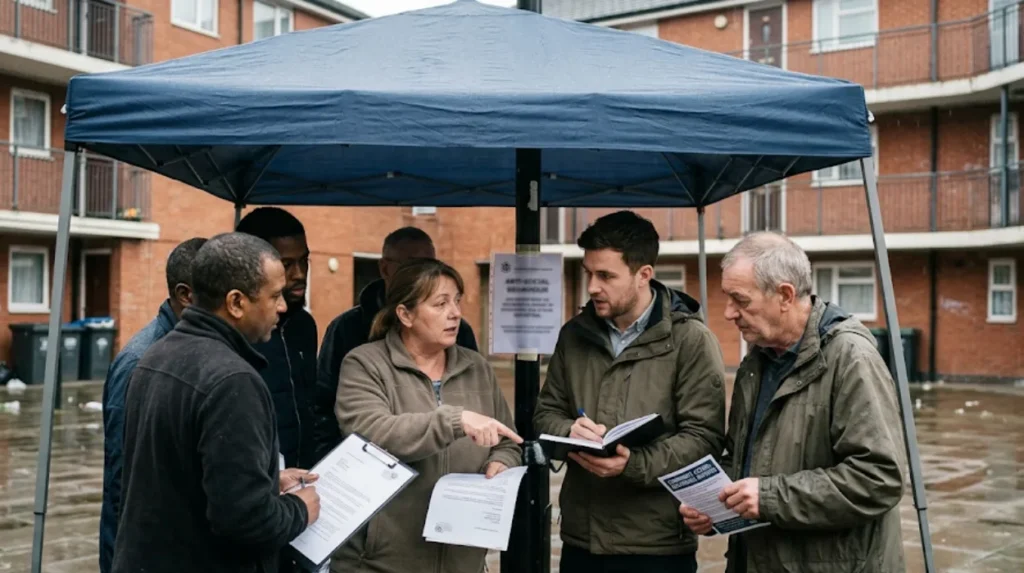
Collective action with affected neighbours strengthens cases. Multiple reporters documenting the same perpetrator increase credibility. Joint complaints demonstrate wider community impact, pressuring councils for faster action. Neighbour groups can share evidence, coordinate ASB diaries, and present unified cases.
Legal advice through citizen’s advice bureaus or housing lawyers provides options for complex cases. Legal professionals explain injunction possibilities, eviction timelines, and compensation claims for council failures.
How effective is the overall anti-social behaviour reporting system in North London?
The ASB reporting system achieves limited effectiveness due to high prevalence (85% of social housing residents experience ASB), persistent recent incidents (48% within 12 months), and significant council fault rates (74% ombudsman upholds). High ASB volumes like Haringey’s 10,220 annual incidents strain resources, reducing response quality.
System effectiveness requires examining multiple metrics: reporting accessibility, response times, enforcement success, behaviour cessation rates, and resident satisfaction. Current data reveals significant gaps across all metrics.
ASB prevalence remains high. The 85% experience rate among social housing residents demonstrates widespread community impact. Nearly half experiencing ASB within 12 months indicates ongoing, unresolved problems despite reporting.
Council fault rates indicate systemic failures. The 74% ombudsman uphold rate shows councils frequently mishandle cases through delays, inadequate investigation, or premature closures. This fault rate reduces overall system effectiveness significantly.
Resource constraints affect all boroughs. Haringey’s 10,220 annual incidents (18% above London average) demonstrate capacity challenges. High volumes strain officer resources, delaying responses and reducing investigation quality.
Response time adherence varies. Published frameworks exist (high-risk: 24 hours-1 day; medium-risk: 2-5 days; low-risk: 5-10 days), but actual performance likely exceeds these targets given the 74% fault rate.
What is anti-social behaviour (ASB)?
Anti-social behaviour (ASB) is conduct that causes harassment, alarm, distress, nuisance, or disruption to other people. It can include noise nuisance, harassment, vandalism, drug-related activity, intimidation, and persistent neighbour disputes.