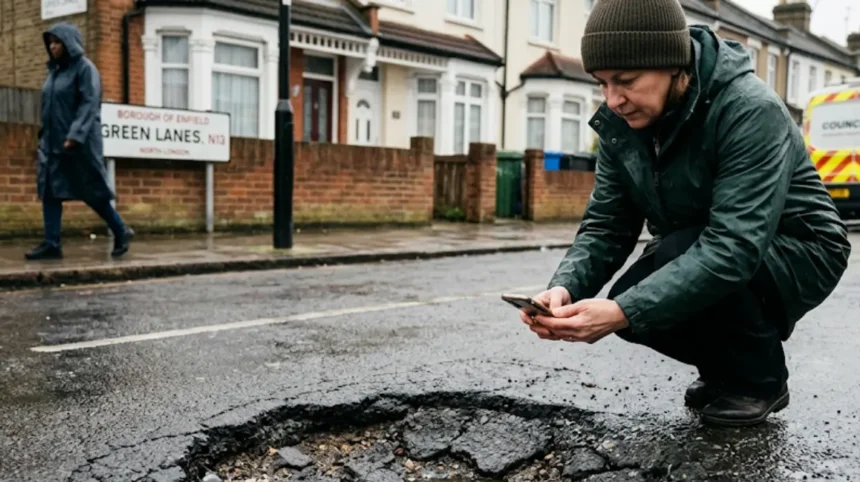
Dangerous potholes in Enfield should be reported to Enfield Council through its pothole reporting service, with the road name, exact location, and a photo if possible. For roads managed by National Highways, the report goes to National Highways instead, and emergencies should be reported by calling 999 immediately.
- What is a dangerous pothole?
- How do you report a pothole in Enfield?
- Which roads does Enfield Council handle?
- What details should you include?
- What happens after you report it?
- Why does location accuracy matter?
- Can you use apps or online maps?
- What if the pothole causes damage?
- How bad is the pothole problem in Enfield?
- Why is reporting important for road safety?
- What should Enfield residents remember?
- Enfield reporting checklist
- Why this process stays relevant
What is a dangerous pothole?
A dangerous pothole is a road surface defect that creates a safety risk for drivers, cyclists, motorcyclists, and pedestrians. In practice, this includes holes, deep breaks in the carriageway, sharp-edged damage, and defects that can cause loss of control, tyre damage, or falls. Enfield Council encourages residents to report potholes they find in their neighbourhood, and national guidance directs people to the correct road authority based on location.
Dangerous potholes matter because they affect road safety and maintenance priorities. A defect becomes more urgent when it is large, deep, on a busy route, near a junction, or in a place where cyclists and motorcyclists travel close to the surface. Local reporting helps councils identify patterns, schedule inspections, and organise repairs before more damage or injuries occur.
How do you report a pothole in Enfield?
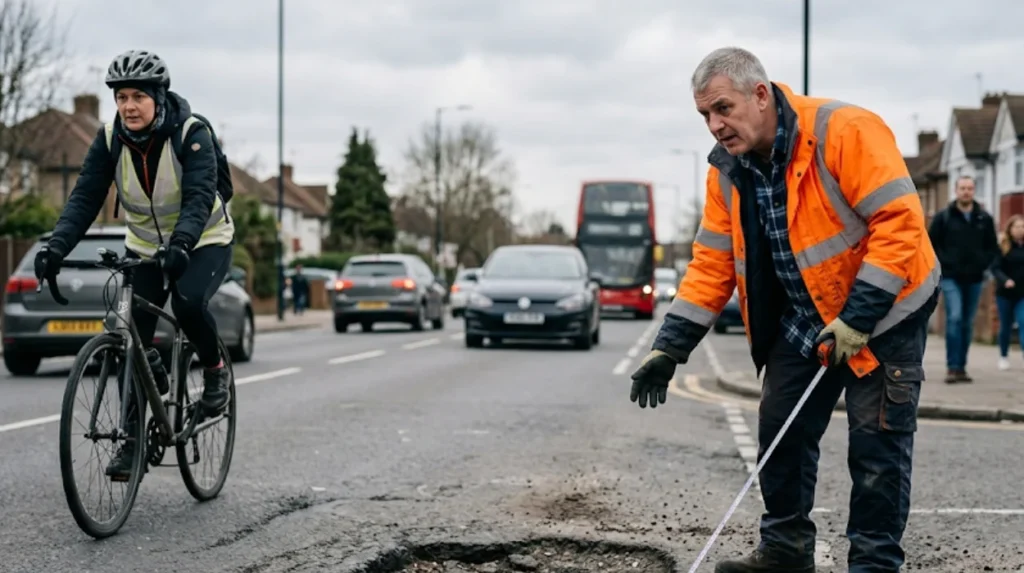
You report a pothole in Enfield by using Enfield Council’s online reporting route and giving clear location details, or by using the national reporting service that points you to your local council. Enfield Council has publicised FixMyStreet as a quick way to report potholes and other local issues, while the government pothole page directs people to enter the postcode of the road and find the local council responsible.
The most effective report includes the road name, nearest house number, nearby landmark, and a photograph. If the pothole is on a local Enfield road, the council route applies. If the defect is on a motorway or major A road managed by National Highways, the report goes to National Highways instead.
Which roads does Enfield Council handle?
Enfield Council handles pothole reports for local roads it maintains, while National Highways handles motorways and some major A roads. The national pothole reporting guidance says to contact the local council for roads in England and Wales unless the road is managed by National Highways. National Highways also provides a separate reporting process for roads in its network.
This distinction matters because the wrong report delays repair action. A pothole on a residential street, local distributor road, or borough-maintained road belongs with the council. A pothole on a motorway or a National Highways-managed A road belongs with the national authority. Correct routing improves response time and reduces duplicate submissions.
What details should you include?
A strong pothole report includes the exact location, visible size, supporting evidence, and a clear safety description. Councils and highway services commonly ask for a description of the problem, the location, evidence such as a photo, and in some cases contact details. Clear detail helps officers assess risk, confirm the defect, and send the right crew.
Useful details include the road name, direction of travel, nearby junction, lamp column number, house number, and whether the pothole is on the edge of the road or in the wheel path. Add the words “deep” or “dangerous” where that is accurate, because those terms signal an immediate hazard. If there is more than one pothole, report each one separately or describe the cluster clearly.
What happens after you report it?
After you report a pothole, the council or road authority logs the defect, checks the location, and decides whether it needs inspection or repair. Some council systems send an immediate acknowledgement, while others use a case reference so you can track progress. Road teams then assess the defect against safety and maintenance priorities.
In the case of many council reporting forms, the process starts with confirmation that the report has been received. Some local authorities state that they email confirmation straight away and issue a response within five working days for road and pavement problems. National Highways says it will investigate reported issues through its problem-reporting system.
Why does location accuracy matter?
Location accuracy matters because highway teams use the report to find the defect quickly and send the correct repair team. A vague report such as “big pothole in Enfield” creates delays, while a precise report pinpoints the road segment and reduces the chance of misrouting. Accurate reports also help staff avoid duplicate inspections and missed hazards.
A good location description gives a clear reference point. The best examples are a street name plus a house number, a junction name, a nearby landmark, or a map pin placed directly on the defect. If the pothole is close to a school, bus stop, crossing, or bend, include that detail because it affects the urgency of the hazard.
Can you use apps or online maps?
Yes, Enfield residents can use online reporting tools, including FixMyStreet, to submit pothole reports quickly. Enfield Council promoted FixMyStreet as a simple way to report local problems such as potholes, graffiti, fly-tipping, and broken streetlights. FixMyStreet is designed to map the issue and route it to the responsible authority.
Online reporting is useful because it combines location, description, and photo evidence in one submission. It also helps residents track whether the issue has already been reported. This reduces repeated calls and makes the reporting process more efficient for both residents and council teams.
What if the pothole causes damage?
If a pothole causes damage, keep the evidence, record the location, and gather repair and incident details immediately. A claim usually depends on proving where the defect was, when the damage happened, and what loss occurred. Good records include photos, receipts, repair invoices, and notes about the road condition at the time.
The first step is still to report the defect to the correct highway authority. That creates a record that the road problem existed and shows when the authority was informed. For serious incidents, especially where someone is injured or traffic is blocked, emergency services should be called first if there is immediate danger.
How bad is the pothole problem in Enfield?
Enfield has faced a significant pothole maintenance burden, with local reporting and repair activity remaining an important part of borough road management. In January 2025, local reporting said the council had funding to fill 13,936 potholes across the borough in 2025/26. That figure shows the scale of the maintenance workload and explains why resident reports help identify defects early.
The same local report encouraged road users to notify the council about potholes in their neighbourhood. That public appeal reflects a wider reality across London boroughs: local reporting is one of the fastest ways for highway teams to learn about developing surface defects. In practical terms, residents play a direct role in keeping routes safer.
Explore More Help & Resources
How to report damp and mould in Enfield council homes?
What to do if Enfield Homes repair is repeatedly delayed?
Why is reporting important for road safety?
Reporting is important because potholes can damage vehicles, destabilise cyclists, and create trip hazards for pedestrians. A defect that starts small often worsens through traffic, rain, and freeze-thaw cycles. Early reporting helps highway teams find the problem before it expands into a more expensive or more dangerous repair.
For North London residents, this matters on busy residential roads, commuter routes, and school corridors where daily traffic is heavy. The earlier a defect enters the system, the sooner it can be assessed and prioritised. That is especially important where the surface failure sits in a narrow lane, on a bend, or near a crossing.
What should Enfield residents remember?
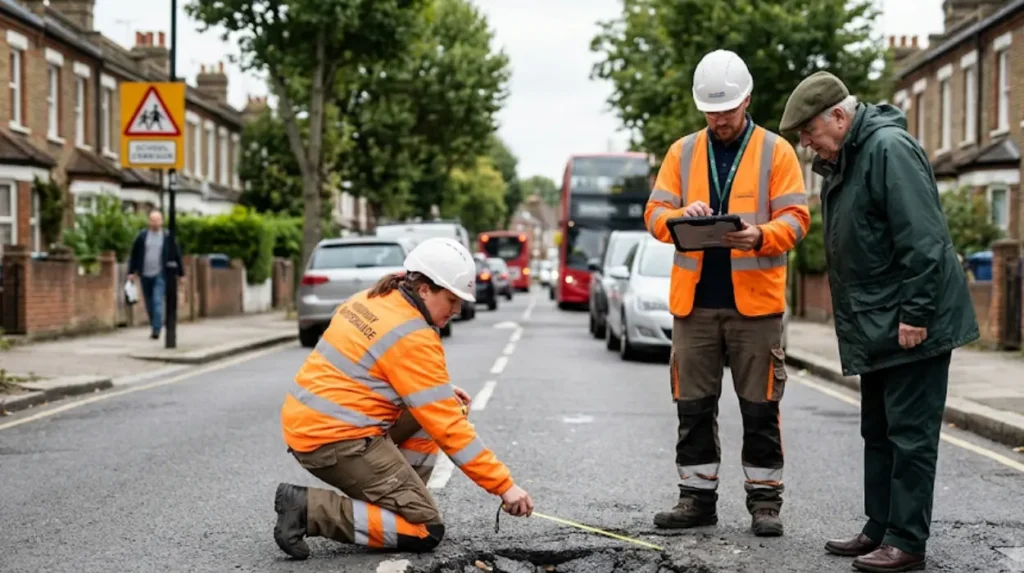
Enfield residents should report the pothole to the correct authority, give exact location details, and include a photo where possible. Local council roads go through Enfield Council, while motorways and certain major A roads go through National Highways. A precise, well-documented report gives the best chance of a faster repair response.
The practical rule is simple. If the road belongs to Enfield’s local network, use the council route or FixMyStreet. If the road is part of the National Highways network, use its reporting service. If the situation is an emergency, call 999 first.
Enfield reporting checklist
A complete report needs the road name, exact spot, description of the hazard, and supporting evidence. Use a photo, note whether the pothole is deep or wide, and explain why it is dangerous. Include nearby landmarks so the highway team can find it quickly.
Keep the wording direct and factual. For example: “Deep pothole in the left lane outside 42 Church Road, near the bus stop, damaging tyres and forcing cyclists into traffic.” That style gives the authority the location, severity, and risk in one sentence.
Why this process stays relevant
Pothole reporting stays relevant because road surfaces change continually and local authorities rely on public detection as an early warning system. Enfield’s own public messaging shows that resident reports remain part of its local maintenance workflow. National guidance also keeps the process simple by routing users to the correct road owner based on postcode and road type.
For search engines and readers, the core answer remains stable over time. Report the pothole, report it to the right authority, and include enough detail to make the defect easy to locate and assess. That approach works for Enfield, for the wider North London area, and for road defects across England.
What is considered a dangerous pothole in Enfield?
A dangerous pothole is a road defect that poses a risk to motorists, cyclists, motorcyclists, or pedestrians. Large, deep, or sharp-edged potholes that could cause vehicle damage, loss of control, or trips and falls should be reported as soon as possible.