Barnet has a substantial religious heritage shaped by medieval parishes, rural settlements, expanding suburbs, Victorian church building and twentieth-century community development. Its historic churches preserve architectural evidence from several centuries and provide important connections to local people, landscapes, transport routes and major historical events.
- What makes Barnet’s historic churches important?
- Which medieval church is the most significant historic visit in Monken Hadley?
- What can visitors see at St John the Baptist Church in Chipping Barnet?
- Why should visitors include St Mary-at-Finchley on a Barnet heritage itinerary?
- Are there other historic religious buildings and churches worth seeing in Barnet?
- How does Barnet’s religious architecture reflect different historical periods?
- How can tourists plan a historic church itinerary in Barnet?
- Why are Barnet’s historic churches still relevant to visitors today?
The London Borough of Barnet contains settlements including Chipping Barnet, Monken Hadley, Finchley, Hendon, Mill Hill and Hampstead Garden Suburb. Each developed at different periods, producing a varied religious landscape. Historic England identifies churches and religious buildings among the borough’s significant heritage assets, while Barnet Council maintains conservation areas and a local heritage list covering buildings of local architectural and historic importance.
For visitors interested in architectural and cultural heritage, the strongest starting points are St Mary the Virgin in Monken Hadley, St John the Baptist in Chipping Barnet and St Mary-at-Finchley. These buildings provide especially strong evidence of medieval and later church architecture.
Religious heritage in Barnet is not limited to one denomination or architectural period. The borough’s historic environment also includes churches associated with planned communities, nineteenth-century expansion and changing patterns of worship. Some buildings remain active places of worship, while others are best understood through their architecture, listed status, churchyards and surrounding conservation areas.
What makes Barnet’s historic churches important?
Barnet’s historic churches are important because they preserve medieval fabric, Victorian restoration, historic monuments, churchyards and evidence of changing communities. St Mary the Virgin, St John the Baptist and St Mary-at-Finchley demonstrate how religious buildings developed alongside Barnet’s settlements.
Historic churches are buildings with architectural, archaeological and cultural evidence connected to religious worship and local communities. In Barnet, their significance extends beyond religious use. Their masonry, roofs, towers, windows, memorials, fonts, monuments and churchyards record different stages of development.
Historic England’s National Heritage List for England provides statutory information about listed buildings. Listing recognises buildings with special architectural or historic interest. Grade II* buildings are particularly important buildings of more than special interest, while Grade II buildings are nationally important and of special interest.
St Mary the Virgin at Monken Hadley is Grade II*. Historic England records a west tower dated to about 1494, later nineteenth-century additions and a major restoration by George Edmund Street between 1848 and 1850. The church also contains historic monuments and has an important churchyard.
St John the Baptist in Chipping Barnet is also Grade II*. Historic England records a mid-fifteenth-century structure incorporated into the present church and extensive alterations undertaken around 1873–75 by architect William Butterfield.
St Mary-at-Finchley is another Grade II* building. Historic England records fifteenth-century elements, a heavily restored nineteenth-century structure, a battlemented west tower, a fifteenth-century open timber roof and a thirteenth-century Purbeck marble font.
These buildings therefore provide visitors with physical evidence from different periods rather than representing a single architectural style.
Which medieval church is the most significant historic visit in Monken Hadley?
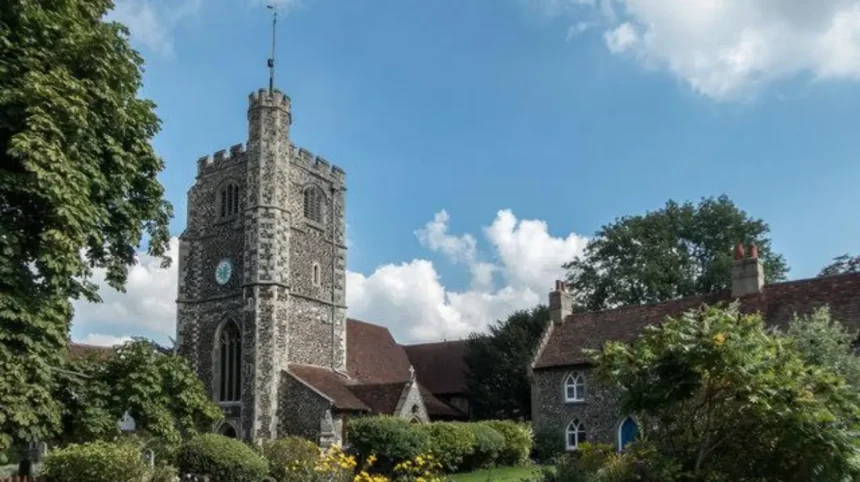
St Mary the Virgin in Monken Hadley is one of Barnet’s most significant medieval churches. Its fifteenth-century fabric, approximately 1494 west tower, nineteenth-century restoration, historic monuments and churchyard connect the building directly with Barnet’s medieval landscape.
St Mary the Virgin stands on Hadley Green Road and forms the architectural focus of Monken Hadley. Barnet Council identifies the church as a focal point within the Monken Hadley Conservation Area. The surrounding landscape contains historic buildings, winding roads, common land and mature trees.
Historic England dates the west tower to approximately 1494. The building uses flint and ironstone, materials strongly associated with historic churches in parts of southern England. Its four-bay nave has a hammerbeam roof, while later additions contribute substantially to the present appearance.
The restoration undertaken by George Edmund Street around 1848–50 forms an important part of the building’s architectural history. Street was a major nineteenth-century Gothic Revival architect. His intervention demonstrates how medieval churches were frequently restored and adapted during the Victorian period.
The church also retains a rare eighteenth-century copper beacon on its tower. Historic England records stained glass by Warrington dating from 1846 and a monument to Sir Roger Wilbraham created by sculptor Nicholas Stone in 1616.
The churchyard adds another layer of historical interest. Historic England records tombs associated with figures including William Makepeace Thackeray, Hester Chapone and John Monro. These memorials connect the building with literary, medical and social history.
Monken Hadley’s wider historical setting also matters. Barnet Council records the parish’s association with the manor of Barnet and notes that the name Hadley appears in a boundary description dating from 1005. The Monken name reflects a medieval monastic association.
The area is also closely associated with the Battle of Barnet in 1471, an important conflict in the Wars of the Roses. Barnet Council states that the battle took place within sight of the church.
As you explore the modern site, you are crossing land with a deep heritage. Read about the full to understand its origins.
What can visitors see at St John the Baptist Church in Chipping Barnet?
St John the Baptist Church in Chipping Barnet combines a medieval core with major Victorian alterations. Visitors can examine its imposing west tower, fifteenth-century fabric, Butterfield interiors, historic roof structures and stone furnishings within one of Barnet’s principal heritage landmarks.
St John the Baptist stands on Wood Street in Chipping Barnet. The building is Grade II* listed, confirming its national architectural and historic importance. Historic England records its present character as a combination of medieval fabric and substantial nineteenth-century work.
The church incorporates a mid-fifteenth-century building as its double north aisle. This surviving medieval component is particularly important because it demonstrates how later churches frequently incorporated earlier structures rather than replacing them completely.
William Butterfield carried out extensive alterations around 1873–75. Butterfield was one of the leading architects of the Victorian Gothic Revival and is associated with numerous ecclesiastical buildings across Britain.
The church’s west tower provides one of its strongest external architectural features. Flint and stone dressings create a distinctive material appearance. Historic England also records a timber fleche associated with Traylen. A fleche is a slender spire or turret rising above a roof.
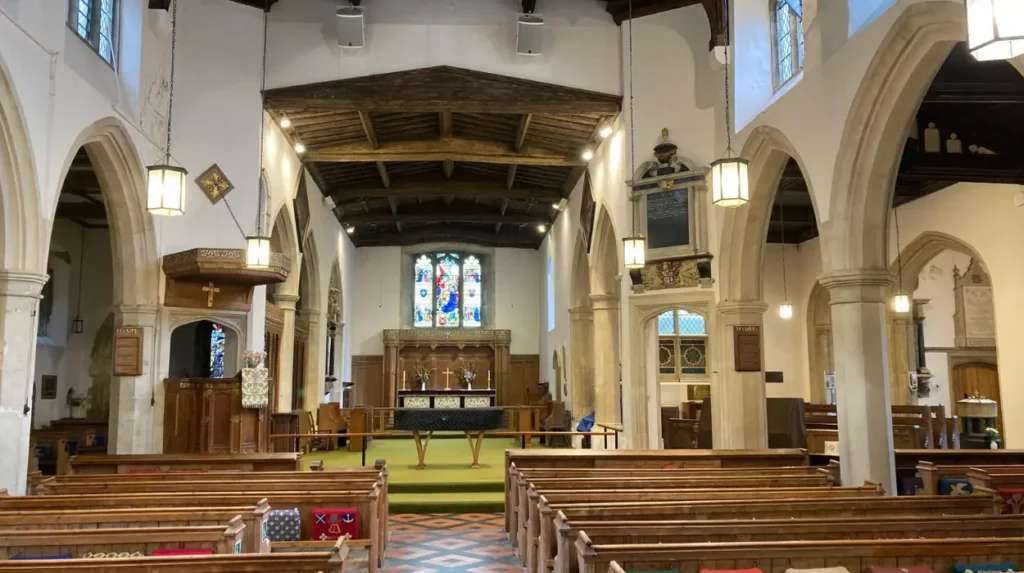
Inside, the roof structure provides further evidence of different construction periods. The main nave roof has a double-framed collar-braced structure with closely spaced scissor-braced rafters. The roof of the fifteenth-century building has a flat panelled ceiling.
The Victorian interior also contains furnishings designed by Butterfield. Historic England records a font cover, altar and reredos made from stone and Purbeck marble between 1880 and 1882. A reredos is an ornamental structure positioned behind an altar.
The church remains an active place of worship. Its official parish website identifies it as St John the Baptist, Chipping Barnet, and describes its community as part of the Church of England.
For heritage visitors, the building offers an unusually clear comparison between medieval construction and Victorian restoration. Its architectural value comes from this combination rather than from one period alone.
Visitors should distinguish between general public access and access during worship or special events. Churches remain working religious buildings, so visiting arrangements, photography rules and access to particular areas should be checked before travelling.
Why should visitors include St Mary-at-Finchley on a Barnet heritage itinerary?
St Mary-at-Finchley is an essential heritage stop because its site has Norman-era evidence, a fourteenth-century chapel, a fifteenth-century nave, a thirteenth-century font, historic memorials and an eighteenth-century bell, creating an unusually dense architectural record.
St Mary-at-Finchley stands at 26 Hendon Lane in Finchley. The church describes itself as Finchley’s ancient parish church, while Historic England lists the building at Grade II*.
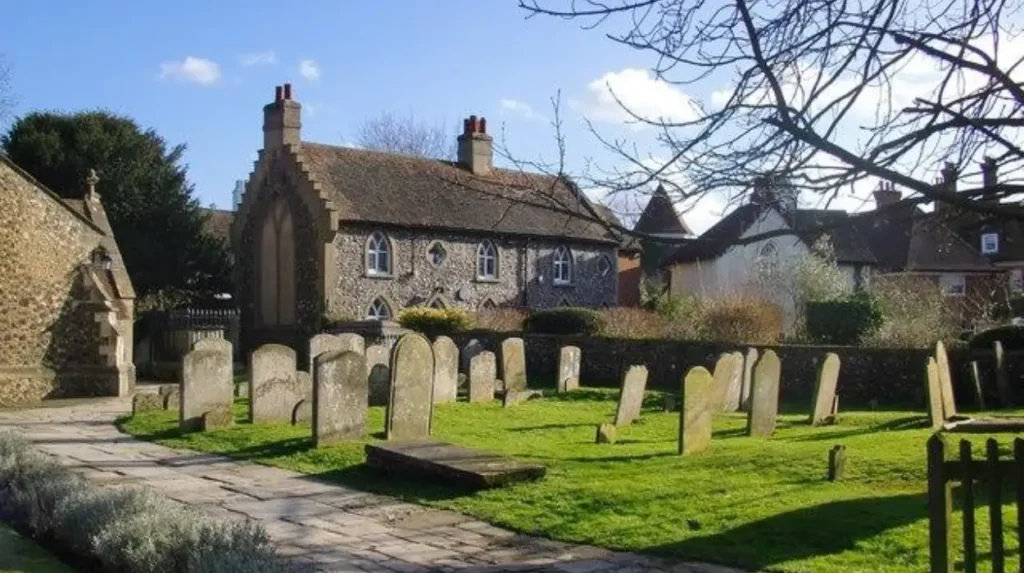
The site’s history extends further back than the surviving main structure. The church’s own historical account records fragments of twelfth-century Norman stonework, including a lancet window, piscina, sedilia, aumbry and a fresco associated with St George and the Dragon.
The oldest surviving parts include the north wall, chapel and tower base. The chapel dates from 1334 and was established as a chantry chapel. A chantry was a foundation established for priests to celebrate masses for the souls of particular people, usually the founder and family members.
The nave and roof are predominantly fifteenth-century. The church was enlarged during the nineteenth and twentieth centuries, including the addition of a south aisle in 1872 and another south aisle in 1932.
The church also demonstrates how historic buildings respond to modern events. The chancel was destroyed by bombing during the Second World War and later restored. The surviving building therefore contains medieval, Victorian, twentieth-century and post-war layers.
One of the most significant internal objects is the octagonal font. The church dates it to the twelfth century and records that it was discovered in the rectory garden. It was restored in 1891 and moved to its current location in 1953.
Music is another important part of the building’s heritage. St Mary-at-Finchley has eight bells, with the oldest dating from 1770. Its organ was built by Henry Willis in 1878, damaged during wartime bombing and rebuilt in 1948 before further restoration in 2011.
The churchyard contains significant memorials, including the monument to Major John Cartwright. Cartwright was an eighteenth-century political reformer associated with campaigns for political reform. His memorial forms part of the site’s wider social history.
St Mary-at-Finchley also demonstrates that heritage buildings remain part of contemporary community life. The church currently hosts worship, private prayer and heritage-related activities. Its website lists regular opening for private prayer from Monday to Saturday, alongside services and heritage events. Visitors should verify current arrangements before travelling.
Are there other historic religious buildings and churches worth seeing in Barnet?
Barnet contains additional religious heritage beyond its best-known medieval churches, including locally listed buildings, churches within conservation areas and historic places associated with expanding settlements. Examples include religious buildings around Hendon, Mill Hill and Hampstead Garden Suburb.
Barnet’s religious heritage should be viewed as a network rather than a short list of isolated churches. The borough expanded through several distinct phases, from medieval villages and rural parishes to nineteenth-century suburbs and planned twentieth-century communities.
Barnet Council’s local heritage system recognises buildings with local architectural and historic merit. Local listing differs from statutory listing. A locally listed building does not receive the same statutory protection as a nationally listed building, but the designation identifies its contribution to local character and planning considerations.
Hampstead Garden Suburb provides an important example of planned twentieth-century development. Historic England’s Barnet heritage material identifies St Jude’s Church and the surrounding suburb as significant historic material within its archive. Historic England also records historic images of St Jude’s Church and the suburb from the early twentieth century.
The significance of these buildings differs from that of medieval parish churches. Their importance relates to planned urban design, community planning, architectural design and the social ideals behind the development of the suburb.
Religious buildings in Hendon and surrounding areas also form part of Barnet’s wider historic environment. Historic England’s National Heritage List contains multiple church entries within the borough, demonstrating the geographical spread and architectural diversity of religious heritage.
Visitors interested in religious architecture should therefore examine both nationally listed buildings and locally recognised heritage assets. The two categories provide different evidence about Barnet’s past.
How does Barnet’s religious architecture reflect different historical periods?
Barnet’s religious architecture reflects medieval parish organisation, Reformation-era change, Georgian memorial culture, Victorian Gothic Revival, wartime damage and twentieth-century suburban development. St Mary-at-Finchley and St John the Baptist demonstrate particularly clear layers from these different historical periods.
Medieval parish churches were closely connected with settlement patterns. Their locations often reflected established roads, villages and manorial structures. Monken Hadley illustrates this relationship because St Mary the Virgin occupies a central position within the historic settlement and near routes that developed over centuries.
The Reformation changed religious practice across England during the sixteenth century. Physical evidence from earlier Catholic worship remained within many parish churches, while later interiors reflected Protestant forms of worship and changing liturgical requirements.
Georgian and early modern periods introduced additional memorials, monuments and architectural alterations. At St Mary the Virgin, the monument to Sir Roger Wilbraham dates from 1616, while the church also retains an eighteenth-century copper beacon.
The Victorian period produced particularly extensive changes. Gothic Revival architects such as George Edmund Street and William Butterfield restored or altered medieval churches throughout Britain. Their work often sought to recover medieval architectural character while introducing new structures, furnishings and arrangements.
St Mary the Virgin demonstrates Street’s nineteenth-century restoration approach. St John the Baptist demonstrates Butterfield’s extensive Victorian intervention. St Mary-at-Finchley combines earlier medieval fabric with nineteenth- and twentieth-century additions.
The twentieth century added another historical layer through wartime destruction and suburban expansion. St Mary-at-Finchley’s chancel suffered bombing during the Second World War and was subsequently restored. The church therefore provides physical evidence of both medieval construction and modern conflict.
This chronological layering is important for visitors. A historic church is rarely the product of one construction campaign. Its present appearance usually represents centuries of repairs, alterations, restoration and adaptation.
Explore More Area Guide
What Wildlife Can You See in Barnet North London 2026
Where to Experience Barnet Arts and Creative Scene North London 2026
How can tourists plan a historic church itinerary in Barnet?
A Barnet church heritage itinerary works best when visitors group sites geographically and combine architecture with conservation areas, historic streets and open spaces. Monken Hadley, Chipping Barnet and Finchley provide three practical heritage areas for focused visits.
Monken Hadley provides the strongest setting for combining church architecture with historic landscape. St Mary the Virgin sits within the Monken Hadley Conservation Area, where historic buildings, common land, mature trees and old routes contribute to the character of the settlement.
A visit to St Mary the Virgin can therefore be combined with an examination of Hadley Green and the surrounding historic streetscape. Hadley Highstone also provides historical context. Historic England records the monument as a Grade II listed obelisk erected around 1740 to commemorate the Battle of Barnet of 1471.
Chipping Barnet provides a second heritage focus. St John the Baptist stands on Wood Street and forms part of the historic town environment. Visitors can examine the relationship between the church, the historic street pattern and the wider centre.
Finchley provides a third focus through St Mary-at-Finchley. The church’s location on Hendon Lane makes it suitable for visitors exploring the area’s historic development. The building’s churchyard, memorials, medieval fabric and surviving architectural details provide several distinct areas for observation.
Timing matters because historic churches remain active places of worship. Access to interiors, photography and specific heritage features depends on services, private functions, maintenance and local arrangements.
Visitors should use official church websites and relevant heritage records before setting out. St Mary-at-Finchley’s current information, for example, distinguishes public worship from private prayer and publishes current events and opening information.
The best approach is to allow time for architectural observation rather than treating each church as a short photographic stop. Look at building materials, roof forms, tower construction, window design, memorials, fonts, monuments and evidence of restoration.
Why are Barnet’s historic churches still relevant to visitors today?
Barnet’s historic churches remain relevant because they connect architecture with local history, religious practice, social memory and conservation. Their continued use preserves buildings as functioning community spaces while their listed status supports long-term recognition of their heritage significance.
Historic churches provide unusually concentrated evidence about the development of local communities. A single building can contain medieval masonry, Victorian restoration, memorials to local residents, wartime repairs and modern community facilities.
Their relevance also extends to heritage conservation. Barnet Council’s local heritage framework identifies buildings that contribute positively to local environments and explains that local listing helps recognise and manage their special character.
National listing provides another layer of protection and recognition. The Planning (Listed Buildings and Conservation Areas) Act 1990 provides the statutory framework for listed buildings and conservation areas in England. Historic England’s individual records identify the architectural and historic reasons for designation.
For visitors, listing information provides a reliable starting point for understanding why a building matters. It also encourages closer observation. A Grade II* church is not simply old; its designation reflects assessed architectural or historic significance.
Barnet’s churches also demonstrate the continuing relationship between heritage and community use. St Mary the Virgin in Monken Hadley remains an active church with worship, music, bell ringing and community activities. St John the Baptist continues as a Church of England parish church. St Mary-at-Finchley remains open for worship and private prayer.
This combination of preservation and active use gives Barnet’s religious heritage continuing relevance. Visitors can study buildings as historic artefacts while recognising that they remain living places rather than static museum exhibits.
For anyone exploring North London architecture, the churches of Barnet provide a compact way to study more than five centuries of building history. Medieval parish organisation, Tudor and post-Reformation change, seventeenth-century memorial culture, Victorian Gothic Revival, wartime reconstruction and twentieth-century suburban development are all represented within the borough.
The most important starting points are St Mary the Virgin at Monken Hadley, St John the Baptist at Chipping Barnet and St Mary-at-Finchley. Together, they provide a strong architectural and historical foundation for understanding Barnet’s religious heritage. Their surrounding streets, churchyards, conservation areas and monuments add essential context to the buildings themselves.
Visitors should check official church information before travelling because opening arrangements change according to worship, events and maintenance. Historic England and Barnet Council records provide authoritative background information for researching listed status, conservation areas and heritage significance.
What are the most historic churches to visit in Barnet?
The key historic churches are St Mary the Virgin in Monken Hadley, St John the Baptist in Chipping Barnet, and St Mary-at-Finchley. They contain medieval fabric, Victorian restoration, historic monuments and important architectural features.