
With a population of over 120 million, Ethiopia is a strategically located demographic and economic powerhouse in the Horn of Africa region. it is currently engulfed in a multifaced civil war affecting almost all corners of the country. The ongoing conflict represents a continuation of the war that erupted in 2020 in Tigray, Ethiopia’s northmost region, which reportedly resulted in the tragic deaths of more than 600 thousand people over two years period. The Tigray conflict was formally brought to an end when the Ethiopia federal government and the Tigray people’s Liberation Front (TPLF) concluded Pretoria Peace Agreement on November 02, 2022. However, the agreement failed to address the underlying structural and political drivers of the conflict, leaving Ethiopia susceptible to renewed confrontation and broader political and military instability.
The circumstances surrounding the Pretoria Peace Agreement help explain its subsequent difficulties. The agreement was reached under significant diplomatic pressure from the US rather than through a comprehensive negotiation adequately addressing the root causes of the conflict. The parties used the agreement as a tactical exit from an increasingly costly war and an opportunity to gain some breathing space. In a nutshell, it was not reached in good faith and hence the parties never showed any interest in its full implementation. Indeed, following the conclusion of the agreement, the parties retracted from the commitments made in Pretoria and became increasingly embroiled in a persistent struggle for political and strategic advantage. Thus, it was only a matter of time before the outbreak of a new and more lethal conflict in the region.
By and large, the approach adopted by PM Abiy Ahmed—who garnered a Nobel Peace Prize under contentious and arguably premature circumstances played significant role in undermining the peace process. Instead of prioritizing political accommodation of the signatories, Abiy’s government focused on dividing and weakening the TPLF. It outlawed the TPLF as a political party and terminated the flow of budgetary funding to the Tigray region, effectively depriving the region of important economic and political benefits associated with its full participation in Ethiopia’s federal system. These measures further deepened political grievances and erroded mutual trust and credibility, the very foundations upon which the peace agreement depended. Equally important, the Pretoria process sidelined other key stakeholders, notably the Amhara Fano militia, which is currently aligned with the TPLF and other six regional armed movements collectively known as the Alliance for Survival of Ethiopia. A coalition of armed militias driven by growing opposition to Abiy’s rule, which is marked by a series of incessant wars aimed at ousting him from power. Paradoxically, over the past eight years, PM Abiy Ahmed initiated several wars, yet he has failed to resolve any of them.
In the recent weeks, the federal government force gained control of major cities and towns in the Tigray region, while the war continues in Amhara, Afar, and Oromia regions. However, these advances in Tigray have not been translated into greater national stability. It is also reported that the TPLF fighters are withdrawing from major towns to the push intact, an early sign of a deadly guerrilla warfare to follow. Moreover, as federal forces extend their operations into remote areas, the security situation in central Ethiopia, including areas surrounding the capital city, has become increasingly vulnerable to rebel attacks. It is therefore plausible to argue that the government may be securing territory in Tigray, while simultaneously exposing other more strategic regions to intensified insurgent activity. Even, the country’s capital city has been reportedly targeted by drones and missile for the first time in its recent history, further demonstrating that the war will eventually destabilize the core of the state. Thus, Ethiopia is facing the risk of entering into another protracted civil war in which its key regions, including Tigray, Amhara, Afar, and Oromia, become increasingly difficult to govern because of persistent insurgency, fragmented political authority, and deteriorating security conditions.
Furthermore, the danger of domestic instability in Ethiopia is compounded by escalating tensions between Ethiopia and its neighbors – Eritrea and Sudan. Particularly, the government in Addis Ababa appears determined to expand its military campaign into neighboring Eritrea, citing allegations that Eritrean forces have been deployed inside Ethiopian territory. Thus, the tension between the two countries has been escalating for some time, particularly since PM Abiy Ahmed declared his intention to acquire sovereign sea access through any means. Such remarks suggest a willingness to resort to military action and reflect a troubling disregard for international norms. The two countries have already severed their diplomatic relations and cut off all communication channel between them. Tension along the border has reached unprecedented levels and troops at the border are fully loaded and charged to engage in another lethal combat. Both countries have simultaneously lodged protest letters in the UNSC, exchanging accusations of potentially aggressive intentions. However, the UNSC has not yet responded and the international community remains largely silent about this critical development.
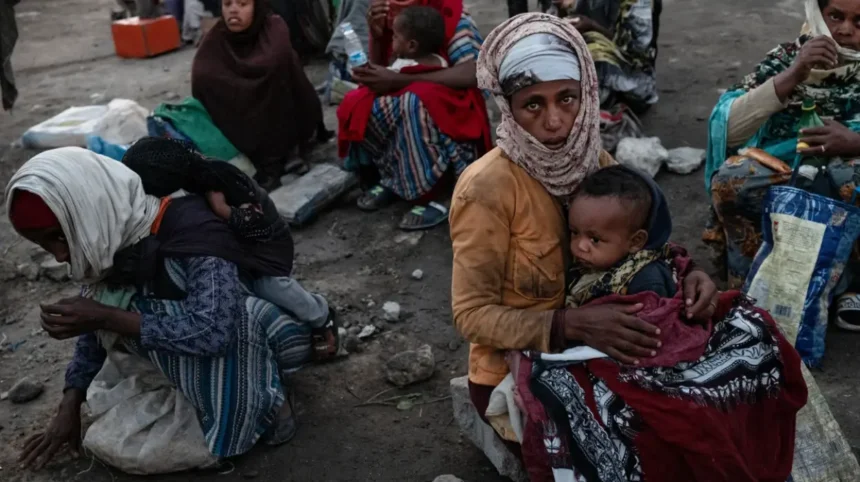
Today, growing political polarization and the proliferation of armed opposition groups is rapidly unravelling the integrity of the Ethiopian state, testing its continuity as a unified polity. Given, the country’s sheer demographic size, any large-scale refugee exodus, which is likely to be triggered by the ongoing conflict, would not only overwhelm neighboring nations but also exacerbate the already dire situation elsewhere. In this context, the prospect of the movement of millions of refugees towards the European shores and the Arabian Gulf states is real and deserves serious international attention.
An alarming report broadcasted by the BBC this week described the death of more than 130 Ethiopian refugees after a boat capsized off the coast of Djibouti while they were attempting to cross to war-torn Yemen. The consequences of Ethiopia’s instability are already extending beyond its borders, even before any potential mass exodus reaches its full scale. Therefore, the international community should treat Ethiopia’s conflict not solely as an internal political and security crisis but also as a potential source of wider regional and international instability. Countries already grappling with refugee pressures, including the United Kingdom, have a direct humanitarian and strategic interest in preventing further escalation. The Labour government in the UK in particular, should take an active diplomatic role in encouraging negotiations and supporting efforts to restore political stability in Ethiopia. Such engagement would be preferable to waiting until the conflict produces a larger humanitarian emergency, further regional confrontation, and more extensive displacement.
A sustainable path to peace must begin with renewed commitment to existing agreements, particularly the Pretoria Peace Agreement and the 2018 peace agreements between Ethiopia and Eritrea. These agreements provide an important diplomatic framework that should be upheld and implemented rather than undermined by renewed military confrontation. Indeed, the Ethiopian government must acknowledge that without a more inclusive peace process, military advances on the ground alone are unlikely to produce a durable settlement and the country may remain trapped in a cycle of insurgency, retaliation, and political fragmentation. Moreover, PM Abiy Ahmed should be pressed to abandon the pursuit of sovereign sea access through coercion or military threats. Ethiopia’s interest in obtaining reliable commercial sea access is a legitimate economic and strategic concern, but it should be pursued through good-faith negotiations rather than through threats to annex territory belonging to another sovereign state. PM Abiy’s continued saber-rattling risks intensifying tensions with Eritrea and other Red Sea littoral state, and is counterproductive to the domestic and regional security and stability.