
Islington’s theatre culture developed through more than three centuries of changing entertainment, artistic experimentation and community performance. Located in North London, the borough became an important centre for London’s theatrical history through historic playhouses, Victorian music halls, independent theatres, puppet performances and internationally recognised dance productions.
- What Are the Historical Origins of Islington’s Theatre Culture?
- How Did Seventeenth-Century Playhouses Influence Islington’s Theatrical Development?
- Why Did Sadler’s Wells Become Central to Islington’s Theatre History?
- How Did Victorian Music Halls Transform Entertainment in Islington?
- Collins’s Music Hall and Islington Green
- The Grecian Theatre and City Road
- Why were music halls important to local audiences?
- How Did Islington’s Independent Theatre Movement Develop?
- King’s Head Theatre: London’s first pub theatre
- Old Red Lion Theatre: Supporting emerging playwrights
- How did pub theatres change the relationship between audiences and performers?
- How Did the Almeida Theatre Strengthen Islington’s Contemporary Theatre Scene?
- What Role Has Puppet Theatre Played in Islington’s Cultural Identity?
- How Did Islington’s Theatre Buildings Adapt to Changing Cultural Demands?
- How Did Theatre Archives Preserve Islington’s Performance Heritage?
- How Has Islington’s Theatre Culture Influenced Modern Performing Arts?
- Contemporary dance and international performance
- Independent drama and emerging talent
- Family entertainment and creative education
- Why Is Islington an Important Destination for Theatre Visitors Today?
- Exploring Angel’s theatre venues
- Discovering Islington’s historic entertainment locations
- Planning a theatre visit
- What Is the Future of Islington’s Theatre Industry?
- How Did Islington’s Theatre Culture Develop?
The development of Islington’s theatre industry reflects changes in London’s population, transport, leisure habits and cultural institutions. Its theatrical heritage stretches from the early entertainment traditions at Sadler’s Wells in the seventeenth century to the contemporary productions staged at the Almeida Theatre, King’s Head Theatre and Old Red Lion Theatre.
The borough also developed a distinctive relationship between traditional entertainment and independent performance. Large entertainment venues attracted audiences from across London, while smaller theatres provided opportunities for emerging writers, actors and directors.
Today, Islington remains an important destination for theatre audiences, performers and cultural visitors. Its theatres preserve historic performance traditions while supporting new productions, experimental drama, contemporary dance and accessible arts programmes.
What Are the Historical Origins of Islington’s Theatre Culture?
Islington’s theatre culture developed from early London entertainment traditions, particularly at Sadler’s Wells, which opened as an entertainment venue in 1683. Its evolution connected public amusement, theatrical performance, music, opera and dance with the borough’s expanding urban population.
The earliest important chapter in Islington’s theatrical development began at Sadler’s Wells, near Angel. The venue originated when Richard Sadler discovered a mineral spring in the garden of his music house in 1683.
The discovery attracted visitors interested in the spring’s supposed medicinal properties. Entertainment gradually became part of the attraction. Performances included music, dancing, acrobatics and other public amusements.
This combination of leisure and performance established an early foundation for Islington’s entertainment industry.
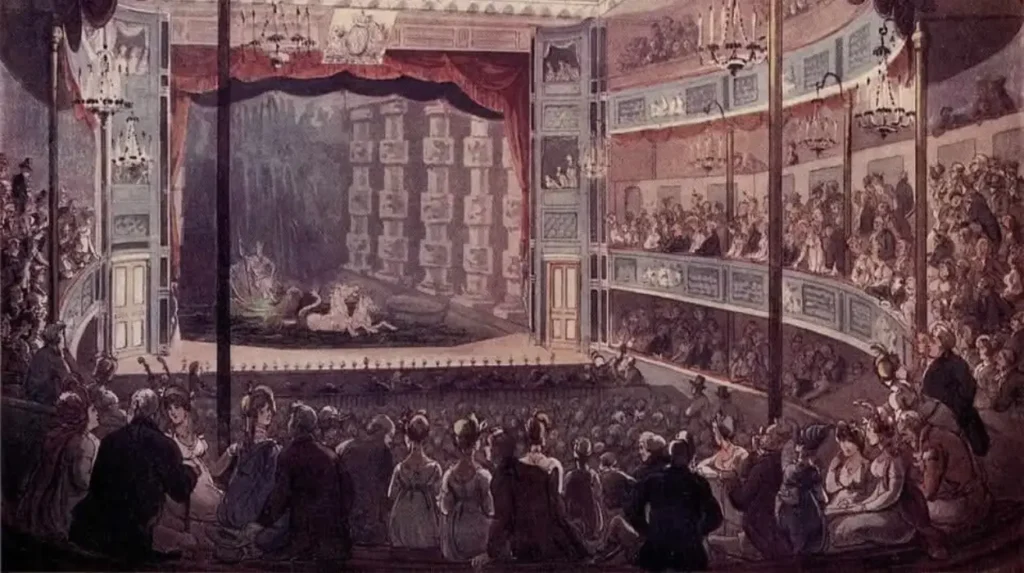
During the eighteenth century, Sadler’s Wells expanded its theatrical programme. Visitors encountered jugglers, tumblers, rope dancers, singers, wrestlers and unusual animal performances. These attractions reflected the popularity of mixed entertainment before modern theatre developed its more specialised formats.
The venue also developed a reputation for dramatic productions and opera. In 1765, manager Thomas Rosoman supervised the construction of a new theatre, strengthening its position as a recognised performance venue.
Sadler’s Wells became particularly important because it served audiences beyond London’s established West End theatre district.
Its history also demonstrates how Islington’s theatrical identity repeatedly adapted to changing entertainment preferences. The venue experienced periods of popularity, financial difficulty and closure before becoming an internationally recognised centre for dance.
According to the London Museum’s historical account, six successive theatres have occupied the Sadler’s Wells site since its origins in 1683.
How Did Seventeenth-Century Playhouses Influence Islington’s Theatrical Development?
Seventeenth-century playhouses established an early theatrical tradition around Islington and neighbouring Clerkenwell. The Red Bull Theatre, associated with Queen Anna’s acting company, demonstrated the area’s importance within London’s developing commercial theatre industry.
The Red Bull Theatre was an important early modern playhouse situated on St John Street in Clerkenwell, close to Islington’s historic theatrical geography.
It developed during the early seventeenth century and became associated with the Queen’s Servants, a professional acting company supported by Queen Anna of Denmark.
The company performed at the Red Bull during the period around 1605–1619. Its productions contributed to London’s expanding theatrical culture during the reigns of James I and Charles I.
The Red Bull differed from more exclusive indoor playhouses. It operated as a large amphitheatre-style entertainment venue and attracted audiences interested in popular drama.
Its theatrical programme included performances shaped by the commercial tastes of contemporary audiences.
The Red Bull’s history also demonstrates the relationship between theatre companies, royal patronage and neighbourhood audiences. Professional performers depended on established venues, while theatre owners relied on regular audiences to sustain their businesses.
The playhouse became one of the recognised popular theatres of early modern London. Its history is documented in Eva Griffith’s academic study, A Jacobean Company and Its Playhouse: The Queen’s Servants at the Red Bull Theatre (c.1605–1619).
Although the Red Bull no longer operates, its historical significance provides an important connection between early London theatre and the later performance venues established throughout Islington.
The development of these early playhouses also formed part of a wider transformation in English theatre. The Theatres Act of 1843 later changed the regulatory distinction between legitimate drama and other forms of entertainment, including music hall performances. OUP Academic
Why Did Sadler’s Wells Become Central to Islington’s Theatre History?
Sadler’s Wells became central to Islington’s theatre history because it survived repeated changes in entertainment, management and architecture. Established in 1683, it developed from a pleasure garden attraction into a major venue for opera, ballet and contemporary dance.
Sadler’s Wells is one of the most historically significant performance institutions in North London.
Its development involved several distinct phases.
The early entertainment period
During the late seventeenth and early eighteenth centuries, the venue combined its mineral spring attraction with public entertainment. Visitors attended performances featuring music, physical acts and popular amusements.
The development of theatrical productions
In the eighteenth century, Sadler’s Wells strengthened its theatrical identity. Thomas Rosoman’s management from 1746 to 1771 introduced more ambitious opera productions.
The rebuilt theatre opened in 1765, providing a more substantial performance environment.
During the early nineteenth century, the venue presented Shakespearean drama and spectacular productions. Its aqua-dramas, which incorporated water into theatrical performances, became another distinctive feature.
Between 1804 and 1824, the theatre staged 36 aqua-dramas, demonstrating its interest in elaborate stage effects and large-scale entertainment.
Decline and changing uses
Sadler’s Wells experienced significant difficulties during the late nineteenth and early twentieth centuries.
Its building underwent several changes of use. It operated at different times as a music hall, cinema and roller-skating venue. The theatre eventually closed in 1915.
This period demonstrated the financial challenges facing traditional entertainment institutions as public tastes and commercial conditions changed.
Lilian Baylis and the 1931 reopening
A major turning point came through the work of Lilian Baylis.
Baylis was a theatre manager and cultural campaigner who believed that high-quality performing arts should reach wider audiences.
In 1925, she began campaigning for Sadler’s Wells to reopen. Her efforts resulted in a new theatre opening in 1931.
The venue subsequently became associated with ballet and opera, establishing a stronger institutional foundation for classical performance in North London.
The contemporary dance institution
The modern Sadler’s Wells identity developed further during the late twentieth century.
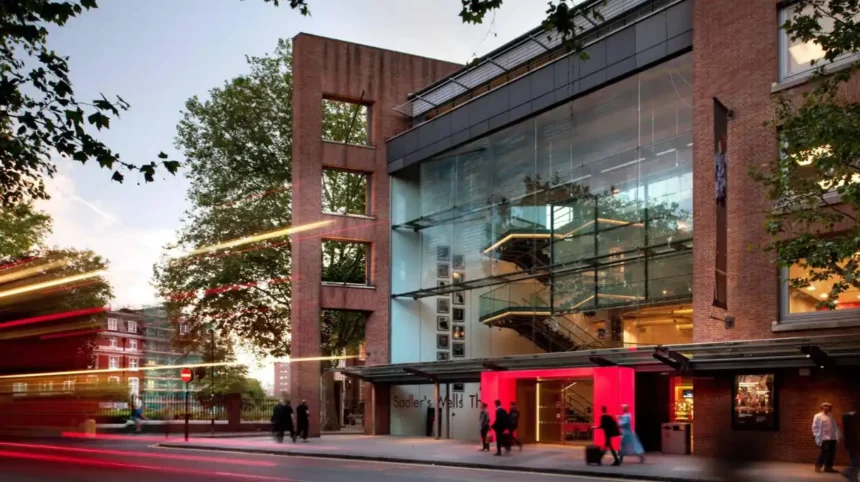
The present theatre opened in 1998 following extensive redevelopment. Its facilities included a larger performance environment, improved technical infrastructure, rehearsal spaces and a studio theatre.
In 2005, director Alistair Spalding established a stronger strategic focus on contemporary dance.
This direction positioned Sadler’s Wells as a major international platform for dance artists, choreographers and touring companies.
Sadler’s Wells continues to connect Islington’s historic performance traditions with international contemporary arts.
How Did Victorian Music Halls Transform Entertainment in Islington?
Victorian music halls transformed Islington’s entertainment industry by introducing large-scale popular performances, variety shows, comedy, singing and pantomime. Venues around Islington Green and City Road attracted working-class audiences and helped establish commercial entertainment as part of local culture.
The nineteenth century represented a major period of expansion for Islington’s theatrical culture.
Population growth, urban development and improvements in public transport increased demand for entertainment. Music halls became important venues for audiences seeking affordable performances outside traditional theatre institutions.
Music halls combined several entertainment formats under one roof. Their programmes included comic songs, dancing, short dramatic acts, acrobatics and variety performances.
Two important examples were Collins’s Music Hall and the Grecian Theatre.
Collins’s Music Hall and Islington Green
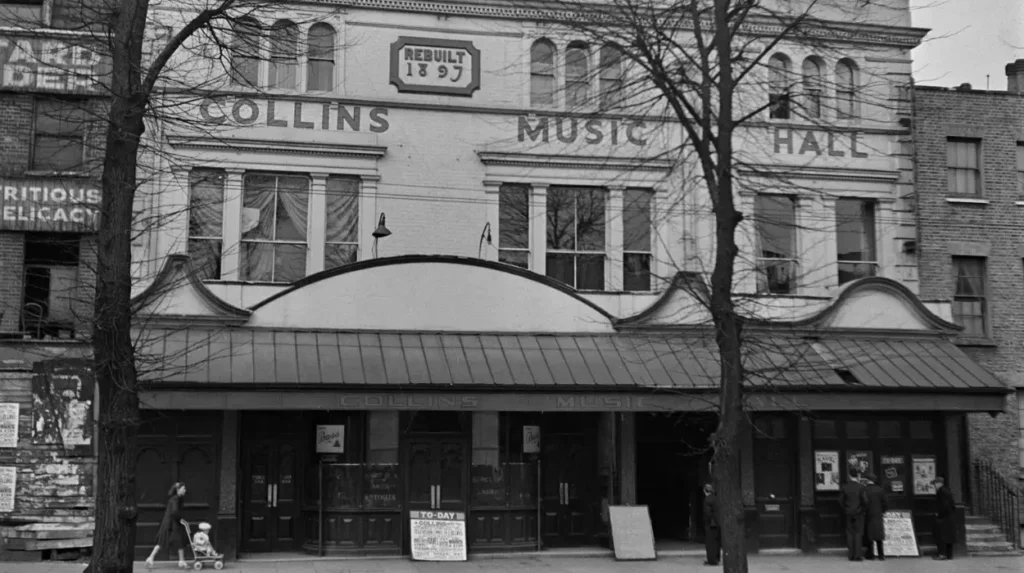
Collins’s Music Hall was established in 1862 by Samuel Thomas Collins Vagg near Islington Green.
It developed from an entertainment room associated with the Lansdowne Tavern. The venue initially provided singing and entertainment for customers before expanding into a major music hall.
The building underwent substantial reconstruction in 1897 and became known as Collins’s Theatre.
By this period, it had developed into a large entertainment venue with a capacity of approximately 1,800 people and ten bars. Its programmes included numerous performers and variety acts.
The venue became associated with popular entertainment figures, including Marie Lloyd, George Robey, Harry Lauder and Vesta Tilley.
Marie Lloyd was particularly significant in British music hall history. Her comic songs and performances helped define the popular entertainment culture of the period.
Collins’s Music Hall suffered a serious fire in September 1958 and never reopened as a functioning theatre.
Its historic façade survives as part of the Waterstones building at Islington Green, preserving a visible connection with the area’s Victorian entertainment heritage.
The Grecian Theatre and City Road
The Grecian Theatre was another significant entertainment venue associated with Islington’s nineteenth-century cultural development.
Its origins were connected with the Grecian Saloon at the Eagle Tavern on City Road.
The Grecian Theatre opened in 1858 following the redevelopment of the earlier entertainment building.
Its capacity reached approximately 2,500 people, making it a substantial venue for popular entertainment.
The theatre presented melodramas, pantomimes, music hall acts and other theatrical attractions.
Pantomime became particularly important to its commercial success. These productions combined comedy, music, spectacle and audience participation.
The Grecian also provided opportunities for performers entering the entertainment industry. Marie Lloyd made an early stage appearance there at the age of 15.
The venue operated until the late nineteenth century before the theatre and associated tavern were demolished.
Historical accounts of the Grecian demonstrate how Islington’s entertainment industry developed through a mixture of popular drama, music, comedy and large-scale public performances.
Why were music halls important to local audiences?
Music halls widened access to live entertainment.
Traditional theatres often maintained more formal performance conventions. Music halls offered mixed programmes that appealed to different social groups and income levels.
They also created opportunities for entertainers to develop professional careers.
Islington’s Victorian venues therefore contributed to the wider development of British popular culture.
Their influence remains visible in the borough’s surviving theatre buildings, archival collections and continued interest in independent performance.
How Did Islington’s Independent Theatre Movement Develop?
Islington’s independent theatre movement developed through smaller performance spaces that prioritised artistic experimentation, emerging performers and original productions. The King’s Head Theatre and Old Red Lion Theatre became important examples of this alternative theatrical tradition.
During the twentieth century, Islington developed a strong independent theatre identity.
Independent theatre refers to performance organisations operating outside the traditional large commercial theatre system. These venues often focus on smaller productions, emerging talent and experimental approaches to storytelling.
Islington’s independent theatre movement became particularly important during the 1970s.
King’s Head Theatre: London’s first pub theatre
The King’s Head Theatre was established in 1970 by Dan Crawford.
It became recognised as London’s first pub theatre of the modern era.
The original performance space operated behind the King’s Head pub on Upper Street. This arrangement created a close relationship between the audience, performers and surrounding community.
The theatre challenged conventional ideas about performance venues. Instead of relying on a large auditorium, it used an intimate environment to present plays, musical productions and experimental performances.
Its programme helped introduce audiences to emerging performers and writers.
Notable performers associated with the venue include:
- Hugh Grant.
- Alan Rickman.
- Dawn French.
- Jennifer Saunders.
- Maureen Lipman.
- Richard E. Grant.
Writers associated with its history include Tom Stoppard, Steven Berkoff and Victoria Wood.
The theatre also developed a reputation for productions that explored subjects outside conventional commercial theatre programming.
Its history became particularly important to London’s fringe theatre movement.
The original pub theatre closed in 2023 following challenges involving the building’s future. A new purpose-built King’s Head Theatre opened behind the pub in 2024.
The new building continued the organisation’s commitment to independent performance and emerging theatrical talent.
Old Red Lion Theatre: Supporting emerging playwrights
The Old Red Lion Theatre opened in 1979 above the Old Red Lion public house.
The pub has a much older history, with the site traditionally associated with a public house dating back to 1415. The present pub building was reconstructed in 1899.
The theatre began when its upstairs space was converted into a small performance venue.
Its intimate auditorium created opportunities for playwrights, actors and directors to develop productions without the costs associated with larger theatres.
The Old Red Lion became an important part of London’s Off-West End theatre network.
Off-West End describes professional theatre venues outside the traditional West End commercial theatre district. Such venues include independent playhouses and smaller producing organisations.
The theatre has presented new writing, revivals and experimental productions.
Artists associated with its development include:
- Abi Morgan.
- Joe Penhall.
- Kathy Burke.
- Stephen Daldry.
- Nina Raine.
Several established performers and writers developed their careers through opportunities at smaller independent venues.
The Old Red Lion continues to focus on ambitious productions and emerging theatrical talent.
How did pub theatres change the relationship between audiences and performers?
Pub theatres created smaller and more informal performance environments.
Their scale encouraged direct engagement between performers and audiences. Productions often relied on limited scenery, compact casts and creative stage arrangements.
This approach reduced some of the financial barriers associated with traditional theatre production.
It also helped independent companies test new material before presenting larger productions elsewhere.
The King’s Head and Old Red Lion demonstrate how Islington’s theatre culture developed beyond large historic venues.
How Did the Almeida Theatre Strengthen Islington’s Contemporary Theatre Scene?
The Almeida Theatre strengthened Islington’s contemporary theatre scene by establishing an important producing venue for ambitious drama, new writing and international productions. Its development transformed a historic nineteenth-century building into a recognised cultural institution.
The Almeida Theatre occupies a historic building on Almeida Street near Upper Street.
The building originally served as the headquarters of the Islington Literary and Scientific Institution.
Established in the nineteenth century, the institution provided facilities for education, lectures, reading and public discussion.
Its original building included a lecture theatre capable of seating approximately 500 people.
The premises later experienced several changes of use, including occupation by the Wellington Club and the Salvation Army.
During the twentieth century, the building became a focus for cultural redevelopment.
A campaign to establish a theatre at the site began in 1978. The initiative developed into the Almeida Theatre project, which became established in the early 1980s.
The venue helped broaden Islington’s theatrical identity beyond traditional entertainment and pub theatre productions.
What makes the Almeida Theatre significant?
The Almeida operates as a producing theatre.
A producing theatre develops and stages its own productions rather than functioning solely as a venue for visiting companies.
Its programme has included contemporary plays, adaptations, classic drama and international work.
The theatre has also supported established and emerging directors, actors and playwrights.
Its position near Angel and Upper Street makes it an important part of Islington’s cultural landscape.
The building itself demonstrates how historic architecture can accommodate contemporary performance.
The Almeida’s development also reflects the wider regeneration of Islington’s cultural institutions during the late twentieth century.
Rather than replacing its historic surroundings, the theatre introduced a new cultural purpose to an existing heritage building.
What Role Has Puppet Theatre Played in Islington’s Cultural Identity?
Puppet theatre expanded Islington’s performance traditions by introducing specialist productions for children, families and wider audiences. Little Angel Theatre became a significant institution through its commitment to puppetry, educational activities, creative workshops and original productions.
The Little Angel Theatre is one of the borough’s distinctive cultural institutions.
It specialises in puppetry, a performance form in which puppets are manipulated by performers to communicate characters, movement and dramatic action.
The theatre was established in 1961 by puppeteer John Wright.
Its home occupies a former Victorian building in Dagmar Passage. The historic building was adapted to accommodate performances, workshops and creative activities.
Little Angel Theatre helped establish puppetry as an important part of Islington’s performing arts identity.
How does puppetry contribute to theatrical development?
Puppetry combines visual art, storytelling, movement and performance.
Unlike conventional drama, it uses objects and constructed figures as central performance elements.
Different techniques include hand puppetry, marionettes and shadow puppetry.
Little Angel Theatre has developed productions for young audiences while also presenting work that appeals to adults.
Its educational activities introduce children to storytelling, character creation and performance techniques.
The theatre’s workshop activities also connect artistic production with practical creative skills.
Puppetry therefore provides an additional dimension to Islington’s theatre culture.
It demonstrates that the borough’s theatrical identity extends beyond traditional stage drama and large commercial productions.
Islington’s heritage records also identify Little Angel Theatre as an important part of the borough’s theatre collection.
How Did Islington’s Theatre Buildings Adapt to Changing Cultural Demands?
Islington’s theatre buildings adapted to changing cultural demands through reconstruction, restoration and changes of use. Historic entertainment buildings became modern performance spaces, while former social and educational buildings gained new cultural purposes.
The physical development of Islington’s theatres reflects the changing economics of London’s entertainment industry.
Some historic venues survived through repeated rebuilding. Others disappeared as commercial entertainment patterns changed.
Sadler’s Wells provides a clear example of architectural adaptation. Six successive theatres occupied its site, reflecting different approaches to public entertainment and stage design.
The current building incorporates elements of the 1931 theatre while providing modern facilities for contemporary dance.
The Almeida represents another form of adaptation. Its historic institutional building became a professional theatre through cultural redevelopment.
Collins’s Music Hall demonstrates a different outcome. Its auditorium disappeared, but its historic frontage survived as part of a modern commercial building.
These examples reveal three important approaches to theatre conservation:
- Restoration: Maintaining historic buildings and architectural features, as demonstrated by the heritage fabric associated with Sadler’s Wells.
- Adaptive reuse: Giving an existing building a new cultural function, as demonstrated by the Almeida.
- Architectural preservation: Retaining significant historic elements even when the original performance space disappears, as demonstrated by Collins’s Music Hall.
Historic England recognises Sadler’s Wells Theatre as a Grade II listed building. Its listing records the 1930 construction and the retention of historic fabric from earlier theatres.
The preservation of these buildings also supports local tourism and heritage education.
Visitors can understand Islington’s theatrical development through surviving architecture, historic streets and the locations of former entertainment venues.
For a wider understanding of the neighbourhood’s development, explore the [historical evolution of Islington and its architectural heritage](Insert Anchor Text for History Article Here). This background explains how changing land use, urban expansion and local communities created the conditions for the borough’s entertainment industry.
How Did Theatre Archives Preserve Islington’s Performance Heritage?
Theatre archives preserve Islington’s performance heritage through historical programmes, photographs, posters, administrative documents and newspaper records. These collections provide evidence of theatrical productions, venue management, performers and changes in local entertainment.
Islington’s theatrical history is documented through important local archival collections.
The Islington Local History Centre holds material relating to theatres, cinemas and music halls throughout the borough.
Its Sadler’s Wells collection is particularly significant because it documents the venue’s development from its early history to its modern identity.
The collection includes:
- Historical programmes and playbills.
- Theatre posters and promotional material.
- Photographs and illustrations.
- Newspaper cuttings and reviews.
- Management and administrative records.
- Documents relating to theatrical buildings.
The archive also contains material relating to the Almeida Theatre, King’s Head Theatre, Old Red Lion Theatre, Little Angel Theatre and former entertainment venues.
This evidence helps researchers understand how performance traditions changed over time.
Why are historical playbills important?
Playbills were printed advertisements used to announce theatrical performances.
They commonly included production titles, performers, performance dates and venue information.
These documents provide valuable evidence about the commercial and artistic activities of historic theatres.
For example, the Islington Local History Centre holds incomplete playbill collections relating to the Grecian Theatre from 1839 to 1882.
It also holds historical programmes associated with the former Grand Theatre on Islington High Street.
The Sadler’s Wells collection contains material representing all six theatres that occupied its site.
These documents allow historians to reconstruct theatrical programmes and investigate the development of individual performance institutions.
How can visitors explore Islington’s theatrical heritage?
Visitors interested in theatre history can explore the borough through its surviving buildings and historic locations.
The Islington Local History Centre provides an important starting point for historical research.
Its collections connect visitors with the people, buildings and organisations that shaped local cultural life.
Researchers can also consult the published history of Sadler’s Wells and academic studies of the Red Bull Theatre.
This combination of surviving architecture and archival evidence makes Islington an important destination for people interested in London’s performance history.
How Has Islington’s Theatre Culture Influenced Modern Performing Arts?
Islington’s theatre culture influenced modern performing arts through independent production, contemporary dance, experimental drama and specialist performance. Its institutions support emerging artists while maintaining connections with established British and international theatrical traditions.
The borough’s contemporary theatre industry reflects the development of several different performance traditions.
Sadler’s Wells has established an international identity through dance.
The Almeida has developed a reputation for ambitious dramatic productions.
The King’s Head and Old Red Lion continue to support independent performance and emerging creative talent.
Little Angel Theatre provides specialist opportunities for puppetry and children’s theatre.
These institutions perform different functions within the wider performing arts industry.
Contemporary dance and international performance
Sadler’s Wells has become particularly important to contemporary dance.
Its programming includes performances, festivals, artist development and educational activities.
The organisation also works with artists and companies to develop original productions.
Its wider institutional activity extends beyond the Islington building through touring productions and other performance spaces.
Sadler’s Wells reports that more than half a million people visit its London theatres annually, demonstrating the scale of its contemporary performing arts activity.
Independent drama and emerging talent
Islington’s independent theatres continue to provide opportunities for new theatrical work.
The King’s Head Theatre maintains its historical commitment to fringe performance and artistic development.
The Old Red Lion supports new writing, experimental productions and early-career creatives.
These organisations contribute to London’s wider Off-West End theatre sector.
Smaller venues also provide important development opportunities for creative professionals.
Actors gain stage experience, writers test original scripts and directors develop new approaches to production.
This activity supports the wider theatrical economy by creating opportunities beyond large commercial theatres.
Family entertainment and creative education
Little Angel Theatre contributes to the borough’s performing arts through puppetry and educational programming.
Its activities introduce children to theatre from an early age.
Workshops connect performance with practical creative disciplines, including puppet construction, movement and storytelling.
This educational role helps maintain public engagement with live performance.
It also ensures that Islington’s theatre culture includes audiences who do not regularly attend conventional dramatic productions.
Explore More Area Guide
What Is the History of Islington’s Former Workhouses?
How Victorian Industry Transformed Clerkenwell, North London
Why Is Islington an Important Destination for Theatre Visitors Today?
Islington attracts theatre visitors because it combines historic performance institutions, independent playhouses and contemporary cultural venues. Its concentration of theatres around Angel and Upper Street makes it an important destination for audiences exploring North London’s performing arts.
Islington offers visitors access to several different theatrical experiences within a relatively compact area.
Angel and Upper Street provide a useful starting point for exploring the borough’s contemporary theatre scene.
Exploring Angel’s theatre venues
Angel is one of the most convenient areas for visitors interested in Islington’s theatre culture.
Sadler’s Wells stands on Rosebery Avenue, while the King’s Head Theatre is located on Upper Street.
The Old Red Lion Theatre is situated on St John Street.
These venues represent different stages in the development of Islington’s theatrical identity.
Visitors can combine performances with restaurants, cafés and other cultural attractions in the surrounding neighbourhood.
Discovering Islington’s historic entertainment locations
Visitors interested in the borough’s earlier theatrical traditions can explore Islington Green.
The surviving façade of Collins’s Music Hall provides a visible reminder of Victorian music hall entertainment.
The former Grecian Theatre site on City Road also represents an important chapter in nineteenth-century popular performance.
These locations demonstrate how the borough’s entertainment industry developed alongside its commercial streets and expanding population.
Planning a theatre visit
Visitors should check individual theatre programmes before travelling.
Performance schedules, ticket prices, age restrictions and accessibility arrangements vary between venues.
Advance booking is particularly useful for popular productions and limited-run performances.
Sadler’s Wells, the Almeida and the independent theatres also provide different audience experiences, so checking the production details helps visitors choose suitable performances.
For tourists, Islington offers an opportunity to explore London’s theatrical heritage without limiting a cultural visit to the West End.
For residents and domestic business travellers, evening performances provide an accessible cultural activity after work or during a short stay in London.
What Is the Future of Islington’s Theatre Industry?
Islington’s theatre industry continues to develop through investment in performance spaces, artist development, cultural education and innovative productions. Its future depends on maintaining historic venues while supporting independent organisations and making live performance accessible to wider audiences.
The future of Islington’s theatre culture depends on balancing heritage preservation with contemporary artistic development.
Several priorities influence this development.
1. Protecting historic performance venues
Historic theatres provide cultural continuity and architectural value. Maintaining buildings such as Sadler’s Wells helps preserve the borough’s connection with earlier entertainment traditions.
2. Supporting independent theatre organisations
Smaller theatres need sustainable operating models, affordable production facilities and opportunities to attract audiences.
The King’s Head Theatre’s move into its new building in 2024 demonstrates how investment and redevelopment can support the future of an independent cultural organisation.
3. Developing new theatrical talent
Artist development remains important to Islington’s theatrical identity.
Independent venues provide opportunities for emerging playwrights, performers, directors and producers.
4. Expanding educational opportunities
Theatre workshops and educational programmes introduce new audiences to performance.
Institutions such as Little Angel Theatre demonstrate how specialist artistic education contributes to the long-term development of the performing arts.
5. Increasing international cultural connections
Sadler’s Wells demonstrates the importance of international collaboration through contemporary dance and touring productions.
Its activities connect London audiences with performers and choreographers from different cultural backgrounds.
These priorities ensure that Islington’s theatrical development remains connected to its historical foundations while responding to changing audience expectations.
How Did Islington’s Theatre Culture Develop?
Islington’s theatre culture developed through a continuous process of entertainment innovation, architectural change and artistic experimentation.
Its origins at Sadler’s Wells in 1683 established an early foundation for public performance in North London. The Red Bull Theatre represented the area’s earlier connection with professional playhouses, while Victorian music halls such as Collins’s Music Hall and the Grecian Theatre expanded access to popular entertainment.
The twentieth century introduced another important phase through independent theatres, including the King’s Head and Old Red Lion. The Almeida strengthened the borough’s contemporary dramatic identity, while Little Angel Theatre established a distinctive tradition of puppetry and family performance.
Today, Islington combines historic theatre heritage with contemporary dance, independent drama, educational programmes and international productions.
Its theatrical identity remains an important part of North London’s cultural landscape, attracting visitors, supporting creative professionals and preserving London’s wider performance history.
When did Islington’s theatre culture begin?
Islington’s theatre culture dates back to 1683, when Sadler’s Wells first opened as an entertainment venue. It initially offered music, dancing and public amusements before developing into a major theatre and dance institution.